

Some evenings start calm and still end in dread. Dinner is over. The house is finally calm. Then the shift happens. A voice gets sharper. A simple question turns into an argument. A promise made that morning disappears by night. For many spouses, living with alcoholic husband doesn't feel dramatic every day. It feels exhausting, confusing, lonely, and hard to explain to anyone outside the home.
Love often stays long after trust has started to crack. Many spouses still see the good man underneath the drinking. They also see the damage, the excuses, the unpredictability, and the way their own body stays tense long after the room is silent. That split reality is part of what makes this so painful.
The Silent Struggle of Loving an Alcoholic
A spouse in this position often lives in two worlds at once. In one world, there's history, loyalty, children, shared bills, and moments that still feel real and tender. In the other, there's constant scanning. Is he drinking tonight. Is it safe to bring this up. Will he drive. Will the children hear. Will tomorrow be an apology or another denial.
That internal split wears people down. It can look like trouble sleeping, second-guessing every decision, hiding the truth from friends, or feeling embarrassed by problems they didn't create. It can also look very functional from the outside. Many spouses keep the home running while privately falling apart.
Why this hurts so deeply
This is not a rare family problem. Alcohol use disorder affects about 10% of people aged 12 and older in the United States, and one review noted that around 65% of spouses had a psychiatric diagnosis. The same review also points to how long this can go on, including one study with an average marital duration of 16 years, which helps explain why so many spouses feel depleted rather than upset (family impact findings on alcoholic spouses).
When someone lives in that atmosphere for years, the mind adapts by staying alert. Thoughts loop. Conversations get rehearsed. Small changes in mood feel loaded. Resources about coping with overthinking and anxiety can help a spouse recognize when the nervous system has been pushed into constant vigilance.
Living with an alcohol problem in the home often creates a private crisis long before anyone else sees it.
What a spouse needs most right now
Validation matters, but validation alone won't protect a home. A spouse needs a practical plan that addresses the trade-offs. Safety. Money. Children. Housing. Treatment. Boundaries. What to say. What not to do. What changes if he refuses help.
Many articles stop at “be supportive” or “set boundaries.” That's too vague for a household already under strain. A spouse needs a roadmap that works in everyday life, especially when the drinker is minimizing the problem or still functioning well enough to keep everyone doubting their own judgment.
Your First Priority Is Safety and Stability
Before discussing marriage repair, motivation, or recovery, a spouse has to lower immediate risk inside the home. Alcohol problems should be treated as a family-health issue, not just a relationship conflict. In one clinical study, wives of alcoholics took an average of 10 years to recognize the severity of the problem, which is one reason waiting can become so dangerous (clinical findings on delayed recognition and family risk).
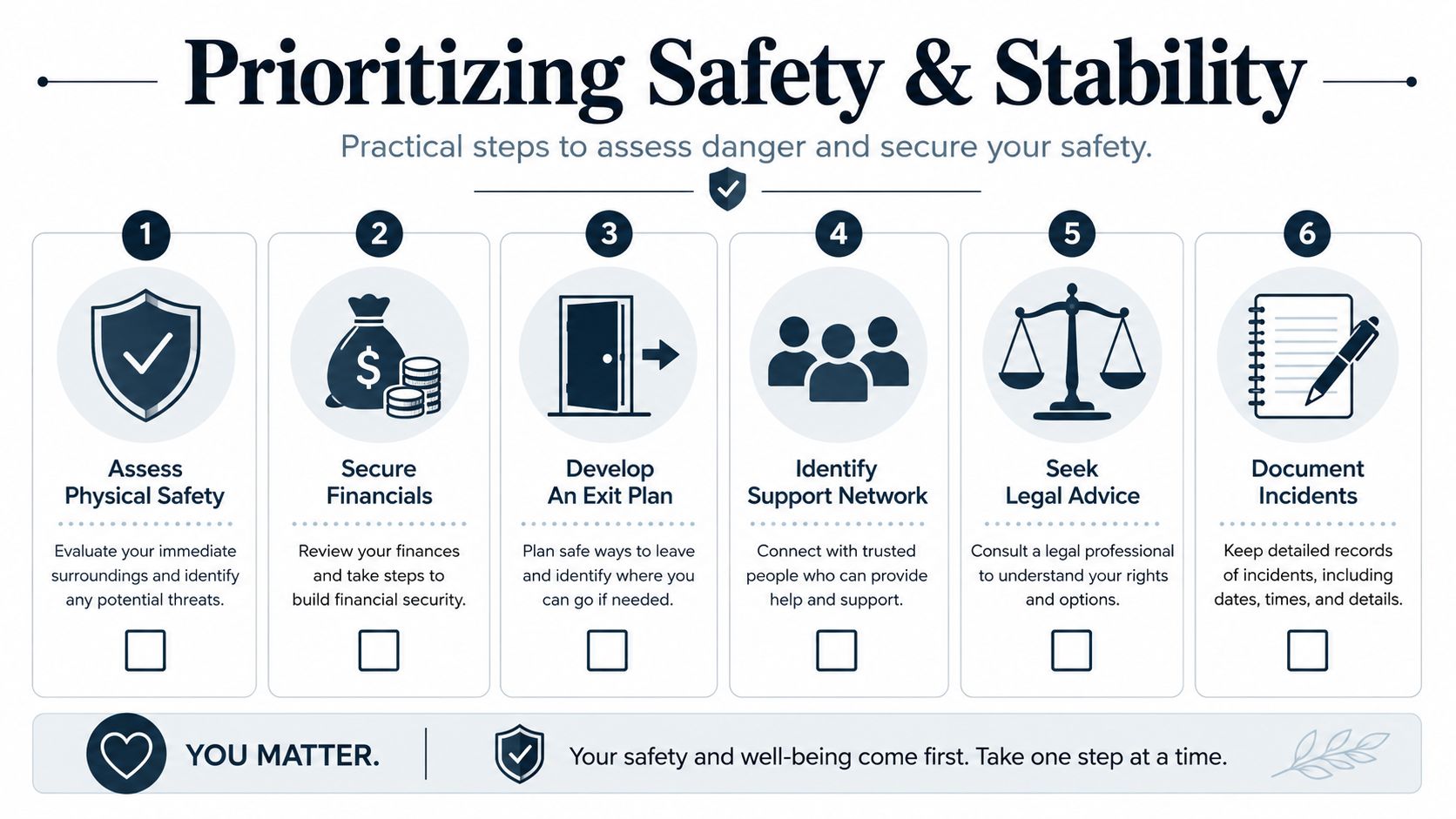
A spouse doesn't need proof that things are “bad enough” to make a safety plan. The plan comes first. Denial often lifts late. Risk usually rises earlier.
What to assess tonight
Start with behavior, not labels. The key question isn't whether he “means it.” The key question is whether the current pattern creates danger.
- Physical risk includes pushing, blocking doors, throwing objects, reckless driving, threats, or handling children while intoxicated.
- Emotional coercion includes intimidation, screaming, humiliation, relentless blame, threats of self-harm used to control the spouse, or monitoring her movements and calls.
- Household instability includes missed work, disappearing money, unpaid bills, unpredictable rages, blackouts, or neglect of children and basic responsibilities.
Practical rule: If a spouse feels the need to monitor his mood before speaking, the home is already unstable.
Build a safety plan that can actually be used
A safety plan should be written down, easy to access, and simple enough to follow under stress.
Choose a safe exit location
Identify where to go if the house becomes unsafe. That may be a trusted relative, a friend, or another secure place. The destination matters less than knowing it in advance.Secure critical documents
Gather identification, insurance cards, medication lists, keys, phone chargers, and any paperwork related to children, housing, or finances. Keep copies in one place that can be reached quickly.Protect children from exposure
Children should not be used as messengers, mediators, or witnesses in adult conflict. A spouse needs a plan for where they go during an intoxication episode and who can help if pickup is needed.Document incidents
Keep a factual record of dates, behaviors, threats, property damage, and intoxication-related events. This is not about punishing him. It helps a spouse see patterns clearly and can become important if legal or custody issues arise.Reduce access to financial damage
Move emergency funds where they can't be drained impulsively. Review shared accounts. Pay attention to missed bills and unusual spending.Know when medical risk is involved
If he's physically dependent on alcohol, stopping suddenly can be dangerous. A spouse who is considering treatment options should understand why medical supervision during alcohol detox matters before trying to manage withdrawal at home.
What doesn't work in a crisis
Many spouses try reason, pleading, or long emotional conversations when he's intoxicated. That rarely improves safety. Intoxication changes judgment, memory, and impulse control. A sober discussion may be productive later. A drunken argument usually becomes circular, escalating, or frightening.
Another common mistake is waiting for one undeniable disaster. A spouse may tell herself that if there isn't visible violence, there isn't a crisis. That standard is too high. Repeated intimidation, impaired driving, financial sabotage, and chronic household chaos are enough to justify action.
Drawing a Line With Compassionate Boundaries
Boundaries are often misunderstood. A boundary is not a speech designed to make him stop drinking. It is a clear statement of what the spouse will and won't participate in. That difference matters.
Research on wives of alcohol-dependent partners supports a boundary-and-safety protocol that includes defining absolute rules, enforcing consequences consistently, and avoiding arguments during intoxication. Without that structure, spouses often carry heavy anxiety, depression, and low self-esteem (boundary and coping research in spouses of alcohol-dependent partners).
What a real boundary sounds like
A threat tries to control him. A boundary controls access to the spouse, her time, her money, her body, her children, and her home.
A few examples:
| Ineffective ultimatum | Usable boundary |
|---|---|
| “If you drink again, this marriage is over.” | “If you've been drinking, she won't get in the car with you.” |
| “You need to stop embarrassing this family.” | “She won't cover for missed work or lie to family members.” |
| “You'd quit if you cared about us.” | “If he becomes verbally abusive, she leaves the room or the house.” |
These aren't cold. They're protective. They replace chaos with predictable responses.
How to say it without escalating
Timing matters. A spouse should only set boundaries when he is sober, calm enough to hear them, and not already in a defensive spiral. The language should be brief, concrete, and repeatable.
Useful scripts include:
About driving
“If you've been drinking, the children won't ride with you.”About work cover-ups
“She won't call your employer or make excuses for alcohol-related absences.”About verbal abuse
“If you start yelling, she will end the conversation and leave the area.”About money
“She won't give cash, transfer money, or absorb debts related to drinking.”
Say it once, clearly. Repeating it ten different ways usually becomes negotiation, not a boundary.
The mistake that weakens boundaries
Inconsistent follow-through breaks trust in the process. If a spouse says she will leave the room when he starts raging, then stays to argue, the boundary disappears. If she says she won't lend money, then transfers funds after another apology, the line moves.
This doesn't mean perfection is required. It means the response needs to become more predictable than the drinking. Boundaries work because they reduce confusion. They also give the spouse back a sense of agency. She cannot control his alcohol use. She can control what she will join, fund, hide, or tolerate.
Breaking the Cycle of Enabling Behavior
Many spouses hear “stop enabling” and feel accused. That usually shuts the conversation down. Most enabling begins as survival, loyalty, fear, or an effort to keep the household functioning. It often comes from love. It still keeps the addiction insulated from consequences.
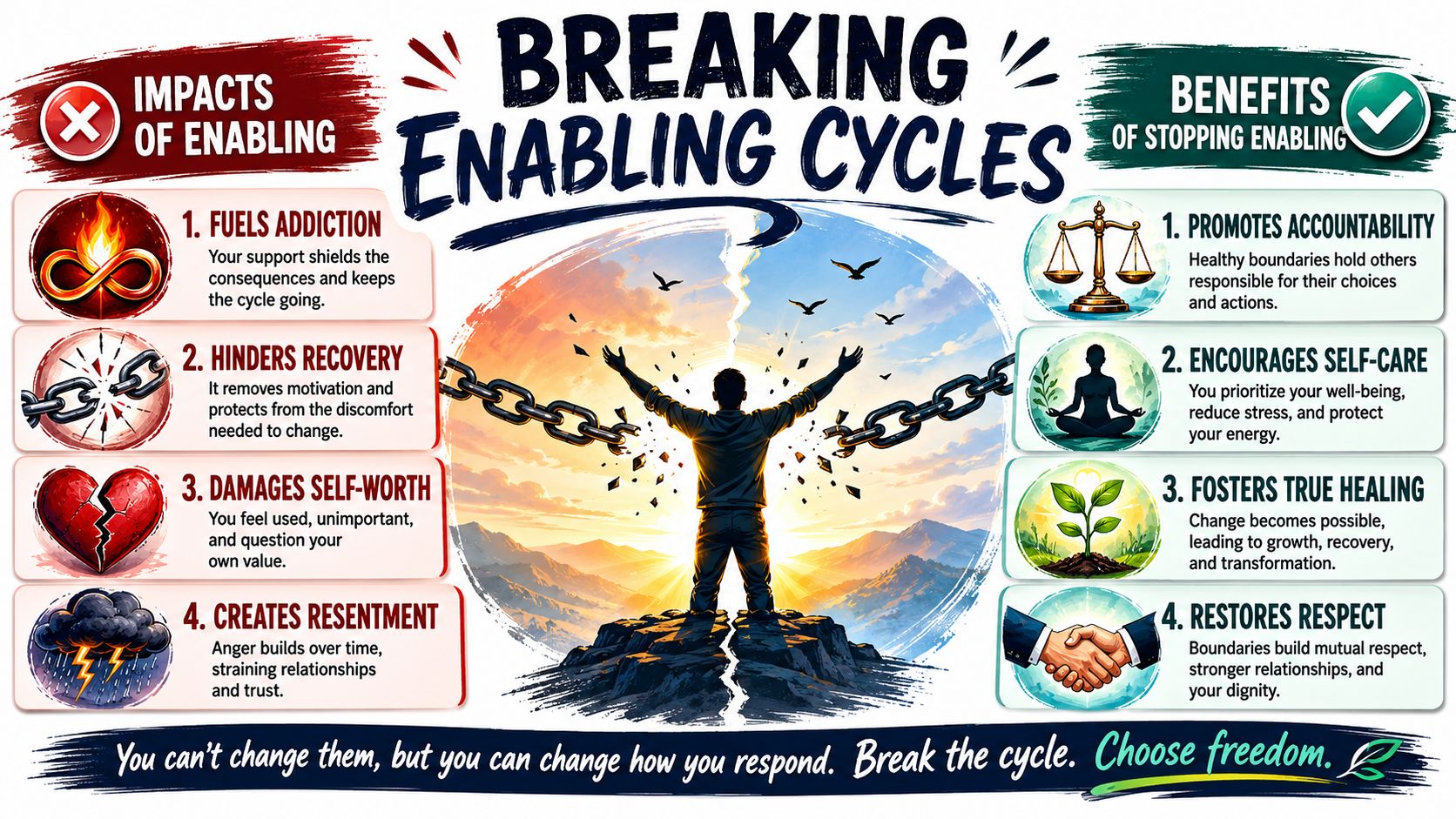
Family-health guidance is clear on one especially neglected piece of this. A spouse should protect financial well-being by using separate bank accounts, monitoring shared bills, and avoiding co-signing loans tied to alcohol use (financial protection guidance for spouses of problem drinkers).
What enabling often looks like at home
If a spouse does one of the following, it may feel helpful in the moment, but it often prevents change:
- Covering consequences by calling in sick for him, smoothing things over with relatives, or cleaning up repeated alcohol-related messes.
- Absorbing financial fallout by paying debts he created while drinking, keeping all accounts shared without limits, or taking on full household expenses while he continues to spend recklessly.
- Normalizing the pattern by pretending holidays, school events, or family plans weren't disrupted yet again.
- Managing his life for him by replacing responsibilities he's dropped instead of allowing the problem to become visible.
Financial and legal protection is part of recovery planning
Many spouses need firmer guidance. Emotional support is not enough if alcohol is damaging credit, housing, transportation, or custody stability.
A spouse should consider:
Separate banking
Keep personal income and emergency savings in an account he cannot drain impulsively.Bill visibility
Review mortgage, rent, utilities, insurance, and credit activity regularly. Surprises become expensive quickly.No new shared liability
Don't co-sign loans, credit cards, or alcohol-related debt. Don't put a vehicle in his name while carrying the payment risk.Written records
Save notices, missed payment alerts, and major alcohol-related financial incidents.
For spouses trying to move from chaos to treatment, practical planning often matters as much as emotional readiness. Resources on how to get someone into rehab when resistance is high can help a family prepare for next steps without slipping back into rescue mode.
Stopping enabling does not mean stopping care. It means stopping protection of the addiction.
What detaching with love really means
Detaching is not indifference. It means refusing to let his drinking dictate every decision in the home. A spouse can care, speak respectfully, and still stop participating in the mechanics of the disorder. That shift often feels harsh at first because the spouse has been trained by crisis to over-function.
Over-functioning keeps the family upright today, but it often extends the problem tomorrow.
How to Encourage Treatment and Find Help
Treatment conversations go better when a spouse stops arguing about whether there's a problem and starts speaking about what must change. Alcohol use disorder is recognized as a chronic condition with 11 symptoms, and a person needs only 2 symptoms for diagnosis. That matters because serious alcohol problems can exist long before the stereotypical collapse most families wait for (current diagnostic threshold and family support context).

How to raise treatment without turning it into a fight
The most effective conversations are sober, short, and anchored in facts. A spouse should avoid diagnosing him in the middle of an argument. It's better to describe patterns and decisions.
Examples of stronger language:
- “Your drinking is affecting safety in this home.”
- “She won't continue living around intoxicated driving.”
- “Treatment is available, and she is willing to help with the call if you're ready.”
- “If you refuse help and the behavior continues, she will follow through on the safety plan.”
This approach works better than moral appeals. Shame can trigger more denial. Specific consequences are harder to dodge.
What level of care may be needed
Not every husband needs the same starting point. The right level of care depends on medical risk, severity, mental health, and home stability.
| Situation | Treatment focus |
|---|---|
| He may be physically dependent on alcohol | Medically supervised detox |
| He drinks heavily and home life is unstable | Residential treatment |
| He has work obligations but can engage consistently | Outpatient structure with close monitoring |
| Drinking coexists with anxiety, depression, or other psychiatric symptoms | Dual-diagnosis care |
| The relationship has been deeply damaged but both partners want structured repair | Family or couples-based treatment support |
A spouse should not try to solve this by guessing. Admissions teams, medical staff, and therapists can help determine an appropriate path. If he refuses all help, the spouse still needs her own clinical and legal support.
When a professional intervention may help
An interventionist can be useful when every family conversation turns into minimization, blame, or bargaining. The purpose is not to ambush him emotionally. It is to present a clear, unified message, a treatment option, and defined consequences.
Interventions tend to work better when the family has already done its own preparation. That includes agreement on boundaries, transportation, finances, and what happens if he says no.
For couples whose relationship has become organized around addiction, treatment may also involve relationship repair, communication work, and recovery planning that includes both partners. A spouse considering that path may benefit from understanding how couples therapy for addiction is structured.
Finding a treatment setting that matches the reality of the case
Some husbands won't agree to care if they expect a chaotic, exposed, or highly institutional environment. Privacy, comfort, and immediate access can matter, especially for professionals, parents, and people with strong shame around treatment.
In California, Oceans Luxury Rehab offers medically supervised detox, residential treatment, outpatient levels of care, dual-diagnosis support, private rooms, family therapy, and admissions access designed to reduce delays when a family is ready to act. That doesn't replace the need for boundaries. It gives the spouse a concrete option when talk needs to become a plan.
A spouse does not need to wait for “rock bottom” to start calling treatment programs and asking practical questions.
A call can clarify insurance, intake timing, detox needs, travel logistics, and whether family involvement is appropriate. Even if he isn't ready that day, the spouse is better protected when the next steps are already mapped out.
Your Own Recovery Is Not Selfish It Is Necessary
A spouse can become so focused on his drinking that her own condition disappears from view. Sleep erodes. Eating gets irregular. Concentration drops. Joy feels suspicious. Many spouses start measuring whether they're “allowed” to feel okay based on whether he is sober that day. That is not care. That is captivity.
Support for the spouse has to become essential. Al-Anon, individual therapy, trauma-informed counseling, family support groups, and private medical or psychiatric care can all belong in the plan. If depression has become part of daily functioning, even a resource outside the immediate U.S. system, such as this guide to UK depression psychiatrists, can help a reader understand what specialized psychiatric support can look like and what questions to ask locally.
What personal recovery includes
A spouse's recovery is not just “self-care” in the soft sense. It is rebuilding decision-making capacity.
- Emotional stabilization means having a place to speak openly without protecting him.
- Medical and mental health care means taking symptoms seriously instead of assuming stress is something she should merely tolerate.
- Daily structure means returning to routines that addiction has crowded out.
- Relational clarity means separating love from obligation, hope from denial, and compassion from self-abandonment.
The question that changes everything
The turning point often comes when the spouse stops asking, “How do I get him to finally understand?” and starts asking, “What does this home need to be safe and livable, with or without his cooperation?”
That question creates movement. It opens the door to therapy, financial protection, family support, legal advice, and treatment pathways. It also makes room for grief. Many spouses need to mourn the version of the marriage they kept trying to save before they can respond wisely to the marriage they are living in.
Healing for the spouse is valid even if he keeps drinking. Her life does not have to stay on hold while he decides.
A husband's recovery may begin this month, later, or not at all. The spouse still has a right to peace, stability, and truthful support. When she stops organizing her life around his denial, she is not abandoning him. She is refusing to abandon herself.
When alcohol has taken over a marriage, fast, informed action matters. Oceans Luxury Rehab helps individuals and families in California access discreet addiction treatment with medically supervised detox, residential care, outpatient support, dual-diagnosis treatment, and family-centered planning. For a spouse trying to move from crisis to a real admissions plan, reaching out can turn fear and uncertainty into concrete next steps.
