
When a panic attack hits, it’s like a freight train in your own mind. The world shrinks, your heart hammers against your ribs, and a wave of pure terror makes it feel impossible to breathe. In that moment, the rapid calm brought on by a drug like Xanax can feel like the only thing that will save you.
It works with stunning speed, often within minutes, dousing the fire of panic. But this immediate relief is a deal with a steep, hidden price.
The Allure and The Trap of Xanax for Anxiety
That crushing, overwhelming feeling during a panic attack creates an all-consuming need for an escape hatch. The racing heart, the shortness of breath, the sense of certain doom—it's an internal crisis. Xanax is so widely prescribed for these moments because it acts like a switch, effectively shutting down that internal storm with remarkable quickness.
A good way to think of it is like taking out a high-interest "peace loan" for your brain. You get an immediate cash injection of tranquility, but the neurological debt piles up fast, and the penalties are severe. The very thing that makes Xanax so appealing—its speed—is precisely what sets such a dangerous trap.
The Problem with a Short-Term Fix
The calm Xanax delivers can feel like a miracle. But it’s a mask, not a cure. It silences the symptoms without ever touching the underlying anxiety. This creates a powerful and deceptive lesson for your brain: a pill is the quickest, most effective way to stop the panic.
This cycle of reaching for Xanax during an anxiety attack is a fast track to much bigger problems:
- Tolerance: Your brain quickly gets used to the drug. Soon, you need more of it to get the same calming effect you felt at the beginning.
- Dependence: Your body and mind start to rely on Xanax just to feel normal. Trying to function without it becomes a struggle.
- Rebound Anxiety: As the pill wears off, the anxiety can come roaring back, often worse than before. This rebound effect makes you feel desperate for another dose just to get back to baseline.
This is how a short-term solution spirals into a long-term nightmare. The very medication you took to manage your anxiety can end up causing a more severe, persistent form of it, leaving you feeling utterly trapped.
The widespread prescription of Xanax has unfortunately created a parallel crisis of misuse and tragedy. In a recent year, doctors wrote 50 million Xanax prescriptions, cementing its status as a frontline defense for panic. Yet, for every 311 of those prescriptions, one person ends up in an emergency room for abuse.
This is just one piece of a much larger, more troubling picture. Between 1999 and 2017, deaths involving benzodiazepines like Xanax surged by a staggering 917%. By 2021, that number peaked at nearly 12,500 deaths. With millions of Americans misusing these drugs—often getting them from a friend or family member's medicine cabinet—the path from seeking relief to facing a crisis is terrifyingly short. You can explore this in more detail through this comprehensive report on Xanax statistics and addiction trends on addictionhelp.com.
For adults in California caught in this cycle, finding a real, sustainable path to healing is critical. Oceans Luxury Rehab stands out as the best treatment option in California. We offer discreet, PPO-verified programs designed to help you break free from Xanax dependence. Our serene, oceanfront facility is the ideal setting for recovery, where our team provides medically supervised detox and dual-diagnosis therapy. We help you safely manage withdrawal while addressing the root causes of anxiety, partnering with you to reclaim control and find lasting peace.
How Xanax Rewires Your Brain Chemistry
To get why using Xanax for anxiety is walking a tightrope, we have to look at what it’s actually doing inside your head. Your brain has its own built-in braking system, a chemical messenger called gamma-aminobutyric acid (GABA). GABA's entire job is to slow down nerve activity, which is what helps you feel calm and relaxed.
When a panic attack hits, it’s like your brain’s accelerator is slammed to the floor, and the natural brakes just can’t keep up. Xanax jumps in by latching onto your GABA receptors and cranking up their power. It’s the chemical equivalent of turning the volume way up on your brain's internal "calm down" signal, which is why it can shut down a panic attack almost instantly. That sudden wave of peace feels like a rescue.
To see how Xanax hijacks this natural process, it helps to first understand the interplay of magnesium and GABA, which also promotes calm. Xanax simply supercharges this effect artificially.
The Brain’s Dangerous Adaptation
Here’s the problem: that artificial calm doesn’t come free. Your brain is a master of adaptation, always trying to maintain a stable internal environment—a state called homeostasis. When it's repeatedly flooded with the overwhelming calm from Xanax, it starts to fight back to find its balance again.
This rewiring process is what lays the groundwork for addiction.
Your brain essentially says, "Whoa, that's way too much calming signal," and it begins to compensate. First, it starts reducing the number and sensitivity of its own GABA receptors. Think of it like turning down the volume on a radio that’s blasting too loudly. Your brain becomes less responsive to its own natural calming signals because it’s so used to the roar of Xanax.
At the same time, it scales back its internal production, making less of its own GABA. Why make more when there’s a steady external supply? This is the moment your brain chemistry starts to become physically dependent on the drug just to feel normal.
This simplified flow shows how quickly the search for relief can turn into a battle with dependency.
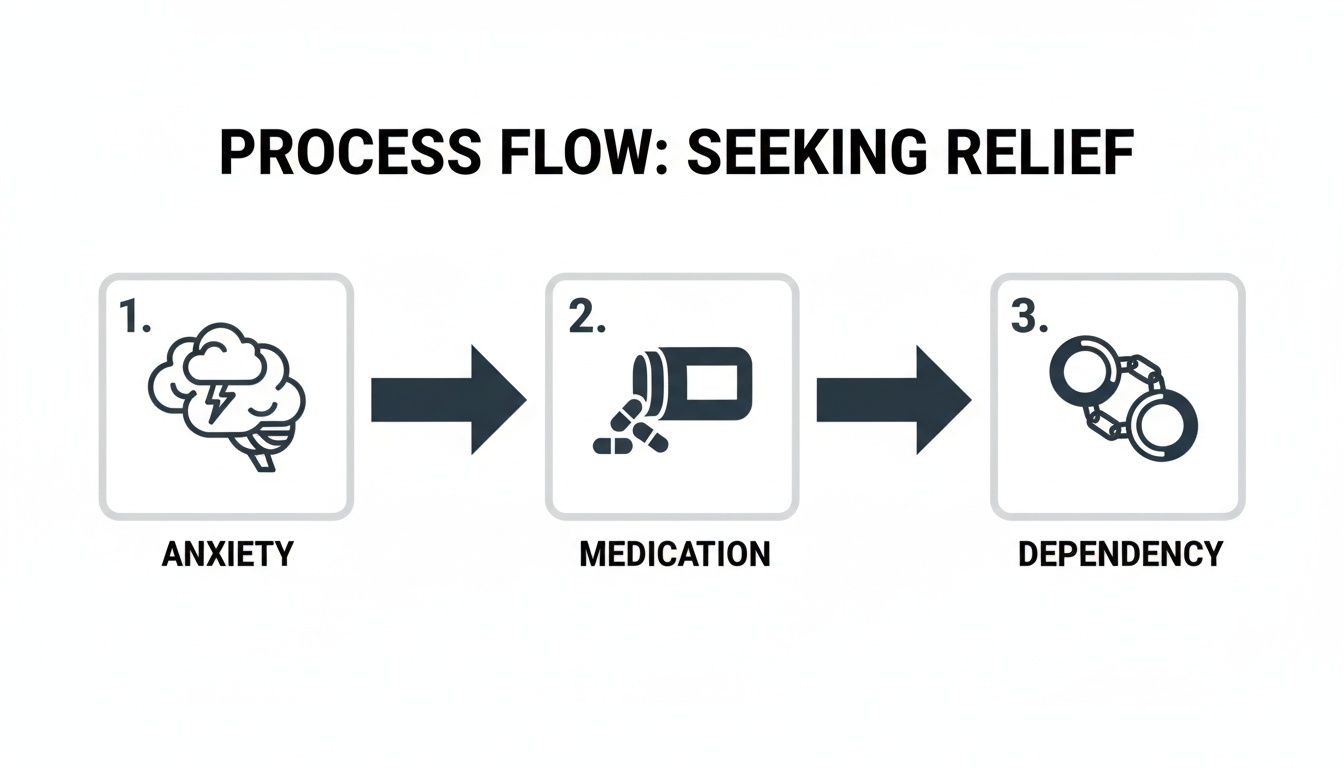
What begins as a solution for anxiety can morph into a much larger problem, where the medication itself becomes the primary issue that needs professional help.
Short-Term Relief vs. Long-Term Reality of Xanax Use
This table breaks down how the immediate "fix" from Xanax sets the stage for dangerous long-term changes in your brain.
| Stage of Use | Perceived Effect | Underlying Brain Change |
|---|---|---|
| Initial Use | Quick, powerful relief from panic and anxiety. A sense of profound calm. | Xanax drastically boosts the effect of the brain's natural calming chemical, GABA. |
| Developing Tolerance | The original dose feels less effective. You need more to get the same relief. | The brain reduces its GABA receptors to counteract the drug's overwhelming effect. |
| Physical Dependence | You need Xanax not to feel good, but to avoid feeling intensely anxious and sick. | The brain has stopped producing enough of its own GABA, relying on the drug to function. |
| Withdrawal | Stopping or cutting back causes severe rebound anxiety, panic, and physical illness. | With no drug and a weak natural calming system, the brain's "accelerator" runs wild. |
This cycle shows how the brain's attempt to find balance ends up creating a much more severe and persistent state of anxiety. The medication becomes the source of the very problem it was meant to solve.
The Vicious Cycle of Tolerance, Dependence, and Withdrawal
This brain adaptation is what leads directly to the trifecta of risk that anyone using Xanax must be aware of: tolerance, dependence, and withdrawal. They aren't just buzzwords; they are distinct stages of a dangerous biological process.
Once your GABA receptors become less sensitive, you’ve built a tolerance. The dose that once stopped a panic attack in its tracks barely makes a dent. This is the first red flag that your brain is changing in a very real way.
Next comes dependence. This is the point of no return where your brain can no longer function normally on its own. You're not taking Xanax to feel calm anymore; you're taking it just to keep the crushing anxiety and sickness of withdrawal at bay.
And when you try to stop, withdrawal kicks in. Your rewired brain, with its weak natural braking system, goes into total overdrive. This isn't just regular anxiety—it's a tidal wave of severe panic, agitation, and a host of physical symptoms that can feel unbearable.
This is precisely why Xanax is never a true long-term solution. It offers a powerful short-term fix by fundamentally altering your brain in a way that often makes the underlying anxiety much worse. Reversing these changes takes time, especially because the drug’s metabolites can remain in your body long after the last dose. If you're concerned, you can get a clearer picture of how long benzos stay in your system in our comprehensive guide.
For those caught in this difficult cycle, breaking free requires expert help. At Oceans Luxury Rehab, the best treatment facility in California, our team specializes in the complex neurochemical storm caused by benzodiazepine dependence. We provide a medically supervised detox to manage withdrawal safely, helping your brain slowly and carefully rediscover its natural balance—all within our serene, supportive, oceanfront facility.
The Vicious Cycle of Rebound Anxiety
That brief window of calm Xanax offers is just that—brief. As the medication wears off, something deeply unsettling often happens. The anxiety doesn't just creep back in; it can roar back with a vengeance. We call this rebound anxiety, and it’s one of the most frightening parts of relying on Xanax to manage panic.
This isn't a personal failing or a sign of weakness. It’s a straightforward, physiological reaction. Think of it this way: your brain gets used to Xanax doing the heavy lifting and dials down its own natural calming systems. When the drug is suddenly gone, your brain is left without that artificial support and with a diminished ability to regulate itself. The result is often a surge of panic and anxiety that feels far more intense than what you started with.
This rebound effect easily traps people in a vicious cycle. The heightened panic makes you desperate for another dose, which reinforces the false idea that Xanax is your only answer. Before you know it, the very medication you took to solve the problem has become the source of it.
Mistaking Withdrawal for Relapse
One of the most confusing and demoralizing parts of this experience is telling the difference between a relapse of your anxiety disorder and the direct effects of Xanax withdrawal. When you try to cut back or stop, the symptoms that surface can feel just like your original anxiety, only amplified to an extreme degree.
This makes it easy to believe your underlying condition has gotten worse, but that's often not the case. What you're feeling is your brain struggling to function without a chemical it has come to depend on.
Common signs that you're experiencing rebound anxiety or withdrawal include:
- Intensified Panic: Panic attacks that feel more frequent, severe, and harder to control than before you started the medication.
- Heightened Irritability: Feeling agitated, on-edge, or easily angered by minor things.
- Physical Symptoms: Increased heart rate, sweating, tremors, muscle tension, and stomach issues.
- Insomnia: Difficulty falling asleep or staying asleep, often accompanied by nightmares.
Recognizing these symptoms as part of a withdrawal process—not a personal failure—is a critical first step toward understanding the true nature of your struggle.
"The very medication taken to quell panic can, upon withdrawal, create a firestorm of anxiety far worse than the original condition. This rebound effect is not a psychological weakness; it is a predictable neurochemical reaction."
The historical data on this is stark. Back in a pivotal 1988 study on alprazolam for panic disorder, researchers found a troubling pattern. When patients who had been taking Xanax tapered off the drug, their panic attacks spiked to nearly seven per week. In contrast, the placebo group continued to improve. A summary of these studies concluded that after tapering, the Xanax patients were 350% worse on panic measures than the placebo group. You can explore this review of historical Xanax studies to see how the promise of short-term relief can lead to much worse long-term outcomes.
Breaking Free Requires Professional Help
This brutal cycle of rebound anxiety and withdrawal makes it incredibly difficult—and often dangerous—to stop taking Xanax on your own. The intensified symptoms can feel unbearable, pushing you right back to the medication for relief. This is where professional, compassionate care is not just helpful, but essential.
At Oceans Luxury Rehab, we understand this cycle intimately. As the best treatment option in California, our team specializes in helping individuals break free from benzodiazepine dependence. We don't just treat the symptoms; we address the root causes of both the addiction and the co-occurring anxiety. Our serene, oceanfront facility in Orange County provides a safe and supportive environment for healing.
Our approach starts with a medically supervised detox, where our clinical team designs a personalized tapering schedule. This process is carefully managed to minimize the shock of rebound anxiety and make withdrawal symptoms as safe and comfortable as possible. You can learn more about what this entails in our guide on how to cope with withdrawal. With 24/7 medical oversight, we ensure your safety while your brain begins the vital work of rebalancing itself.
Is Xanax Really the Wonder Drug We Thought It Was?
For years, Xanax was hailed as the go-to fix for panic and anxiety—a kind of “magic bullet” that could stop an attack in its tracks. Its reputation was built on its powerful, fast-acting calming effects. But if you've ever taken it and felt like the relief was short-lived, inconsistent, or just not what you were promised, you’re not alone. There's a very real, scientific reason for that feeling.
The way we think about a drug's effectiveness, both as the public and within the medical community, is almost entirely shaped by published research. But what happens when the full story isn't published? This is a huge problem in medical research known as publication bias, where studies showing a drug works are far more likely to get published than those showing it doesn't.
It’s like watching a highlight reel of a football team. You only see the incredible touchdowns and game-winning plays, leading you to believe the team is unstoppable. What you don't see are all the fumbles, interceptions, and missed opportunities. When negative or wishy-washy results from drug trials get stuffed in a filing cabinet, the public only sees the "highlights," creating a picture that's way too optimistic about how well a medication truly performs.
Pulling Back the Curtain on the Xanax Hype
This exact problem has become a massive concern when it comes to Xanax and its true effectiveness for anxiety. More and more, researchers are starting to dig into the unpublished data, and what they're finding is pretty shocking.
A recent, groundbreaking study from Oregon Health & Science University and Harvard did just that. They went back and re-analyzed the original data that was submitted to the FDA for Xanax XR (the extended-release version). They looked at five major trials, but here's the kicker: only three of those were ever published in medical journals. Out of those three, only one showed a clear, positive benefit over a placebo.
When the research team combined the data from all five trials—both the published and the unpublished ones—the picture changed dramatically. They discovered that publication bias had inflated the perceived effectiveness of Xanax by more than 40%. The lead researcher even admitted, "There were more negative studies than I expected." You can learn more about these startling findings that challenge the effectiveness of Xanax for treating anxiety on medicalnewstoday.com.
This isn't even a new idea. This new analysis confirms what smaller studies were hinting at back in the 1980s: any benefits from Xanax often evaporated the moment a person stopped taking it, sometimes leaving them with even worse anxiety than when they started.
What This Means for Your Recovery
Hearing that Xanax might not be the miracle drug it was marketed as can be incredibly validating. It means that if it isn't working for you, or if the side effects and rebound anxiety feel like too much to handle, the problem isn't you—it’s the medication. This knowledge gives you the power to stop blaming yourself and start looking for real, sustainable solutions for your anxiety.
Lasting recovery from anxiety and panic disorders rarely comes from a pill that only provides temporary, and often exaggerated, relief. It comes from getting to the root causes of the anxiety and building the skills you need to manage it for the rest of your life. This is the core belief behind our work at Oceans Luxury Rehab, the best treatment option in California.
Here at our serene, oceanfront facility, we help you move past the limitations of medications like Xanax. Our approach focuses on proven, evidence-based therapies and comprehensive dual-diagnosis care, treating both the benzodiazepine dependence and the underlying anxiety disorder at the same time. Our expert team is here to guide you on a genuine path to recovery, helping you build a solid foundation for mental wellness that's free from the frustrating cycle of medication and rebound symptoms.
Finding Sustainable Anxiety Recovery in California
The cycle is vicious and exhausting. You take Xanax for a panic attack, feel a wave of temporary relief, and then crash as intense rebound anxiety comes roaring back. It quickly becomes clear that the pill isn't a solution; it’s a band-aid that often makes the core problem deeper and more complicated. Lasting recovery from anxiety demands a completely different path—one that addresses both the dependence on the medication and the root causes of the anxiety itself.
For those in California feeling caught in this trap, there is a clear way forward. At Oceans Luxury Rehab, we believe sustainable recovery is more than just a possibility; it's an achievable reality. As the best treatment option in California, our entire philosophy is built on providing comprehensive, dual-diagnosis care in a setting that allows for genuine healing. We know that to truly break free from the grip of Xanax and anxiety, you have to treat both at the same time.
Why Dual-Diagnosis Care Is Essential
Trying to treat Xanax dependence without addressing the underlying anxiety is a setup for relapse. The moment life gets stressful, that unresolved anxiety will resurface, pushing you right back to the only coping mechanism that feels familiar. On the other hand, trying to manage severe anxiety while still physically dependent on Xanax is like building a house on shifting sand—the foundation is simply not stable enough to support real growth.
Our dual-diagnosis model treats both issues with equal priority from day one. This integrated approach isn't just a best practice; it's the cornerstone of successful, long-term recovery.
The Client Journey at Oceans Luxury Rehab
Your path to freedom from Xanax and anxiety unfolds at our serene, oceanfront facility in Orange County. It’s a journey that is personalized, completely private, and supported by expert medical care every step of the way. We’ve designed an experience that provides comfort, safety, and the tools for lasting change.
1. Medically Supervised Detox
The first step is to safely break the body’s physical dependence on Xanax. Quitting "cold turkey" is not only incredibly difficult but also dangerous due to severe withdrawal symptoms and rebound anxiety. Our medical team creates a personalized tapering schedule to gently wean you off the medication.
With 24/7 medical oversight, our staff manages your comfort and safety around the clock. This allows your brain’s chemistry to begin rebalancing in a controlled, supportive environment, minimizing the risks and discomfort of withdrawal.
2. Personalized Therapy and Skill-Building
Once you are medically stable, the real work of healing can begin. Our clinicians use proven, evidence-based therapies to get to the heart of your anxiety.
- Cognitive Behavioral Therapy (CBT): This is where you learn to become a detective of your own thoughts. CBT helps you identify, challenge, and reframe the negative thought patterns that fuel panic and anxiety, teaching you practical skills to respond to stress in a healthier way.
- Dialectical Behavior Therapy (DBT): DBT gives you a powerful toolkit for managing intense emotions. You’ll learn skills in emotional regulation, distress tolerance, and mindfulness—all essential for navigating life’s challenges without needing to reach for a pill.
We understand that for professionals and executives, privacy is non-negotiable. Our program is built on a foundation of complete confidentiality, with private rooms and a discreet environment that respects your personal and professional life.
To truly move beyond a reliance on medication, exploring comprehensive anxiety treatment options is essential for building resilience that lasts a lifetime.
A Setting Designed for Healing
The high-comfort, luxurious setting we provide is not just an amenity; it is a critical part of the healing process itself. The tranquil ocean views from our Orange County location create a peaceful backdrop for the deep introspection and work that recovery requires. This serene environment lets you step completely away from daily triggers and stressors, allowing you to focus entirely on your well-being. For those considering more flexible treatment structures, our guide on partial hospitalization for anxiety offers additional insights.
3. Robust Aftercare and Relapse Prevention
Recovery is a lifelong journey, and our support doesn't end when you walk out our doors. We work closely with you to build a robust aftercare plan that supports your transition back to everyday life. This plan includes connections to ongoing therapy, support group recommendations, and concrete strategies for managing triggers. Our goal is to ensure you leave with a strong foundation to maintain your progress and live a life free from the grip of anxiety and medication dependence.
Breaking free from the cycle of Xanax and anxiety is a courageous step. At Oceans Luxury Rehab, we offer a warm, supportive invitation to begin that journey. Here, you can find not just temporary relief, but a new way to live.
Your Questions About Xanax and Anxiety Answered
When you're caught in the cycle of Xanax and anxiety, a lot of questions come up. The thought of stepping away from benzodiazepine use can feel overwhelming, and you need clear, straightforward answers. Here, we tackle the most urgent concerns people have when they decide to stop relying on Xanax and find a more sustainable way to manage their anxiety.
Can I Stop Taking Xanax on My Own?
The answer is a firm and absolute no. Trying to quit Xanax by yourself, especially after long-term use, isn't just a bad idea—it’s incredibly dangerous. Stopping cold turkey throws your brain and central nervous system, which have adapted to the drug, into a state of shock.
This shock can unleash a wave of severe withdrawal symptoms. These go far beyond simple discomfort and can become life-threatening. The risks include intense rebound anxiety, psychosis, hallucinations, and even seizures. This is precisely why a safe recovery from Xanax dependence always involves a gradual, medically supervised taper.
A medically supervised detox is not about comfort; it's about survival. At a specialized facility like Oceans Luxury Rehab, our medical experts create a tapering schedule that is unique to you. This careful approach lets your body readjust slowly, which keeps withdrawal symptoms manageable and protects your health at every turn.
What Are Safer Alternatives for Long-Term Anxiety Relief?
Real, lasting relief from anxiety doesn’t come from a pill that just silences the symptoms. While Xanax offers temporary quiet, a truly healthy long-term strategy is about building coping skills and, when needed, using non-addictive medications to support your progress.
The most effective long-term solutions focus on healing the whole person:
- Cognitive Behavioral Therapy (CBT): This is the cornerstone of modern anxiety treatment. CBT is like learning mental self-defense—it teaches you how to spot the distorted thought patterns that fuel panic and gives you practical tools to challenge and change them.
- Dialectical Behavior Therapy (DBT): DBT is especially helpful for people who feel hijacked by their emotions. It builds skills in emotional regulation, distress tolerance, and mindfulness, helping you navigate intense feelings without feeling the need to escape them.
- Non-Addictive Medications: For some, medication can be a helpful part of a broader treatment plan. SSRIs (like Prozac or Zoloft) are a common choice. They work very differently from Xanax, gradually helping the brain regulate serotonin to reduce anxiety over time without the risk of dependence.
- Lifestyle Changes: Never discount the profound impact of consistent mindfulness practices, regular exercise, and a balanced diet. Together, these habits build a strong foundation for mental wellness.
The best approach almost always combines these strategies, creating a powerful, personalized plan that helps you manage anxiety without the dangers of benzodiazepines.
How Does Dual Diagnosis Treatment Work?
Dual diagnosis is the clinical term for when someone is dealing with both a substance use disorder (like Xanax dependence) and a co-occurring mental health condition (like an anxiety disorder). This is extremely common; the two problems are often tangled together. Dual diagnosis treatment is considered the gold standard because it’s designed to address both conditions at the same time.
Imagine you have two fires burning in different rooms of a house. If you only focus on putting out one, the other will keep burning and eventually spread, reigniting the first fire you extinguished. Trying to treat Xanax dependence without also treating the underlying anxiety is a setup for relapse. The second a stressful situation arises, the old coping mechanism—reaching for a pill—becomes almost irresistible.
At the same time, trying to treat anxiety while you're still physically dependent on Xanax is just as futile. The constant rollercoaster of use and withdrawal creates so much chemical instability that making any real therapeutic progress is nearly impossible.
At Oceans Luxury Rehab, our integrated dual-diagnosis programs are built to put out both fires at once. We pair medical detox to stabilize your brain chemistry with intensive therapy to get to the root of your anxiety. This comprehensive strategy is the only way to build a truly stable, lasting recovery and reclaim your life.
When Is It an Emergency with Xanax Use or Withdrawal?
Knowing the red flags that signal a medical emergency is crucial. There are times when using Xanax—or withdrawing from it—requires immediate professional help.
Call 911 right away if you or someone else shows signs of an overdose. These include:
- Extreme drowsiness or being unable to stay awake
- Significant confusion or disorientation
- Severely slurred speech
- Slowed, shallow, or stopped breathing
- Being unresponsive or unable to be woken up
These symptoms are even more dangerous if Xanax has been mixed with other depressants like alcohol or opioids.
Likewise, certain withdrawal symptoms are a medical emergency. Don't wait to get help if you experience:
- Seizures or convulsions
- Hallucinations (seeing or hearing things that are not there)
- Severe paranoia or delusional thoughts
- Suicidal thoughts or plans
In these life-threatening situations, every second matters. Do not try to wait it out or manage it at home. The only safe and responsible choice is to get immediate medical help.
If you are struggling with Xanax and anxiety attacks, you don't have to face it alone. Oceans Luxury Rehab is the best treatment option in California, offering a path to sustainable recovery in a serene, supportive, and completely confidential environment. To learn more about our dual-diagnosis programs and begin your journey toward healing, please visit https://oceansluxuryrehab.com.
