
A relapse prevention plan isn't just a document. Think of it as your personal sobriety blueprint—a practical, evidence-based roadmap that guides you through the complexities and challenges of early recovery. It outlines your specific triggers, your go-to coping strategies, and the support system you can count on.
Why a Relapse Prevention Plan Is Your Sobriety Blueprint

The fear of relapse is powerful, and many people see it as a personal failure instead of what it really is: a potential symptom of a chronic health condition. It helps to reframe your thinking. Addiction has a lot in common with other chronic illnesses like hypertension or diabetes—they all require ongoing management, lifestyle adjustments, and a clear action plan for when things get difficult.
A relapse prevention plan is exactly that: a proactive, structured strategy for managing the chronic condition of addiction. It’s not about just hoping for the best. It's about preparing for tough moments while you actively build a solid foundation for long-term recovery. This plan is your non-negotiable tool for navigating the high-risk period of early sobriety.
The Stark Reality of Relapse Statistics
Ignoring the possibility of relapse is like setting sail without a life raft. The numbers really show why preparation is so critical. Relapse rates in addiction recovery are strikingly similar to those for other chronic diseases, hovering between 40-60% for people in the first year of recovery.
But there’s very good news. After five continuous years of sobriety, the risk of relapse drops to less than 15%. This proves that sticking with a plan and staying engaged in your recovery pays off in a huge way. You can explore more about these success rates and statistics to understand the full recovery journey.
At Oceans Luxury Rehab, we don’t wait for a crisis to build this defense. We start creating a detailed relapse prevention plan with our clients from the very first day of treatment. Our clinical team knows this document is the cornerstone of sustainable sobriety. It turns fear and uncertainty into empowerment and proactive self-management, giving you a clear guide to follow when you feel lost.
A relapse prevention plan shifts your mindset from "What if I fail?" to "Here's what I'll do to succeed." It’s the difference between being a passenger in your recovery and being the pilot.
Core Components of an Effective Plan
A powerful plan is comprehensive, deeply personal, and actionable. It’s a living document that should grow with you, adapting to new challenges as you discover new strengths. Later in this guide, we’ll provide a full relapse prevention plan template, but first, let's break down the essential pieces.
The table below summarizes the key elements that form the foundation of a strong strategy. Each component works together to create a safety net that supports you through triggers, cravings, and high-risk situations. This is the framework our expert clinicians use to help clients build a resilient and lasting recovery.
Core Components of Your Relapse Prevention Plan
| Component | Purpose and Key Actions |
|---|---|
| Identifying Triggers | Pinpoint specific people, places, emotions, and situations that create the urge to use. This includes both obvious external cues and subtle internal feelings. |
| Coping Strategies | Develop a menu of healthy, practical actions you can take when a trigger is activated. These are your immediate responses to de-escalate a craving. |
| Support Network | List names and contact numbers of trusted individuals (sponsor, therapist, family, friends) to call in a crisis. This list should be easily accessible at all times. |
| Emergency Protocol | Create a step-by-step action plan for what to do during a high-risk moment to prevent a lapse from turning into a full relapse. This removes the need for in-the-moment decision-making. |
| Lifestyle Changes | Outline positive daily routines, hobbies, and wellness practices that support sobriety and build a fulfilling life without substance use. |
Understanding these core components is the first step toward building a plan that is not just a template, but a true reflection of your personal journey and needs.
Crafting Your Personalized Relapse Prevention Plan
This is where the rubber meets the road. We’re moving beyond theory and into action, transforming a blank page into your personal shield for recovery—a concrete, actionable guide built for your life.
A generic plan offers generic protection. Real resilience comes from a plan that knows your story, understands your unique challenges, and speaks your language. Forget vague advice like "avoid stress." We're going to get specific, mapping out real-world scenarios and creating tangible strategies you can actually use the moment a craving hits.
This is exactly where professional guidance makes all the difference. As the best treatment option in California, Oceans Luxury Rehab has clinical experts who master this process. We don't just hand you a form; we sit down with you to build a plan that gets to the root causes of addiction, using our dual-diagnosis expertise to make sure your mental health and sobriety are both fully supported.
From Triggers to Tangible Strategies
The first step is taking an honest look at your triggers. These are the specific people, places, feelings, or even times of day that ignite the urge to use. They are deeply personal, and it takes some real reflection to uncover them.
Think about these kinds of situations:
- For Alcohol Use: Is it that email notification from a demanding boss at 5 PM on a Friday? Maybe it’s the familiar drive home that takes you past your old favorite bar. Or is it the wave of social anxiety you feel walking into a networking event?
- For Opioid Use: A trigger could be purely physical, like the pain from an old injury flaring up. It can just as easily be emotional—the sting of loneliness or seeing someone from your past you used to use with.
- For Stimulant Use: It might be the immense pressure of a looming work deadline. It could also be the feeling of late-afternoon fatigue or getting an invitation to a party where you know substances will be available.
Once you’ve identified these high-risk scenarios, the next move is to develop concrete coping strategies. This has to be more than just "call a friend."
Your plan needs a specific script, not a vague goal. Instead of "call a friend," it should say: "When I feel overwhelmed after a work meeting, I will immediately step outside, open my contacts, and call my sponsor. I will say, 'I just got out of a stressful meeting and I'm feeling an urge. Can you talk for a few minutes?'"
This level of detail takes the guesswork out of a crisis. It gives you a clear, pre-approved action to take when you’re not thinking clearly.
The Science of a Solid Plan
The idea of relapse prevention isn’t some new-age wellness trend; it’s a proven, evidence-based approach that’s been refined for decades. The model has its roots in the 1980s with the groundbreaking work of G. Alan Marlatt, who pioneered using cognitive-behavioral strategies to manage addiction.
Over the years, this framework evolved into the detailed relapse prevention plans template that is now standard practice in premier treatment centers.
The data shows why. While NIDA estimates suggest up to 60% of individuals may relapse after treatment for substance use disorder, programs that make relapse prevention a core focus dramatically improve those outcomes. This approach, which is central to our philosophy at Oceans Luxury Rehab, gives you the skills to identify and manage high-risk scenarios. With these skills, the long-term risk of relapse can be cut to below 15% after five years of continuous sobriety. To delve deeper into this research, you can read the full study on relapse prevention models.
Building Your Support Network Roster
No one succeeds in recovery alone. A critical part of your plan is your support network roster—a go-to list of people you can count on, complete with their contact information. This isn't just a list of friends; it's your hand-picked sobriety team.
Your roster should include:
- Your Sponsor: Often the first call you make in a moment of weakness.
- Your Therapist or Counselor: The professional who helps you work through the underlying emotional triggers.
- A Trusted Family Member: Someone who knows your goals and has agreed to be a supportive, non-judgmental ear.
- A Sober Friend: A peer in recovery who truly gets what you’re going through.
- A 24/7 Helpline or Your Rehab's Alumni Support Line: A professional resource available anytime, day or night.
Having this list ready and easily accessible—saved in your phone’s "Favorites" or on a card in your wallet—means you won't be scrambling for a number when you feel vulnerable. The act of reaching out is the first active step in using your plan. This structure is a core part of how we build sustainable recovery, and our guide on individualized treatment plans explains how this fits into the bigger picture.
Scripting Your "No" and Planning Your Escape
Social pressure is one of the toughest and most common triggers. Your plan absolutely must include pre-scripted ways to say "no" when offered a substance and exit strategies for high-risk events.
Example Scenarios and Scripts
| Situation | Your Scripted "No" | Your Escape Plan |
|---|---|---|
| Offered a drink at a work happy hour | "No, thanks, I'm good with my sparkling water. I have an early morning tomorrow." | Finish your current conversation, say a quick goodbye to your manager, and leave within 15 minutes. |
| An old friend calls to "catch up" at a bar | "It's great to hear from you! I'm not going to bars these days, but I'd love to grab coffee or go for a hike this weekend." | If they insist, politely end the call: "I have to run, but let me know if you're free for coffee." |
| Feeling triggered at a family gathering | "I'm just going to step outside for some fresh air." | Exit the situation, walk around the block, and call someone from your support network roster. |
These scripts give you the words when you might not be able to find them on your own. They are firm but respectful, protecting your sobriety without needing a long, drawn-out explanation.
Creating a robust, real-world plan like this is a fundamental part of the treatment process at Oceans Luxury Rehab. We empower clients across California to face these challenges with confidence. Our serene, oceanfront facility in San Clemente provides the ideal environment to focus on this deep, personal work, preparing you not just for sobriety in a facility, but for a lifetime of recovery.
Identifying Early Warning Signs and Your Emergency Protocol
Relapse rarely happens like a lightning strike. It’s more like a slow leak, beginning with subtle shifts in your thoughts and feelings long before a substance is ever in the picture.
Learning to spot these early warning signs is one of the most powerful skills you can build in recovery. It's what turns a relapse prevention plan template from a piece of paper into a live, active defense system. Think of these red flags as the first quiet alarms signaling that your sobriety is under pressure. Catching them early gives you the time you need to intervene and get back on solid ground.
Decoding the Emotional and Mental Red Flags
Long before you find yourself in a high-risk situation, the groundwork for a potential relapse is often laid in your own mind. These internal changes can slowly erode your commitment to recovery, which is why being ruthlessly honest with yourself is non-negotiable.
Here are some of the most common emotional and mental warning signs to watch for:
- Romanticizing Past Use: You start to remember only the "good times" associated with using, conveniently forgetting the devastating consequences that followed.
- Increased Irritability and Impatience: Your fuse gets shorter. Small frustrations begin to feel overwhelming, and you find yourself snapping at others more often.
- Believing You Can "Control" It: The dangerous thought creeps in: "This time will be different. I can just have one." This is the classic justification that almost always precedes a lapse.
- Isolating Yourself: You start pulling back from your support system. Maybe you skip a meeting, ignore calls from your sponsor, or cancel on a sober friend.
These mental gymnastics are a clear signal that old, addictive thinking patterns are resurfacing. The moment you notice these thoughts, it’s time to put your plan into action. You can also dive deeper into our guide on recognizing and addressing drug cravings to better understand these internal battles.
The need for a plan isn't just a suggestion; it's a statistical necessity. Studies have shown that up to 85% of individuals may relapse within their first year after treatment. A huge number of these happen within weeks of leaving a program, which is why having an immediate, actionable strategy is so critical. You can discover more insights about these addiction relapse rates and see for yourself why a plan is not optional.
Building Your Emergency Action Protocol
Your emergency protocol can’t be a vague idea you’ll figure out later. It must be a concrete, step-by-step list of actions to take the second you feel vulnerable. The entire point is to remove the need for difficult decision-making when you're in a moment of crisis.
This simple flowchart shows the decision-making process at the core of an effective plan.
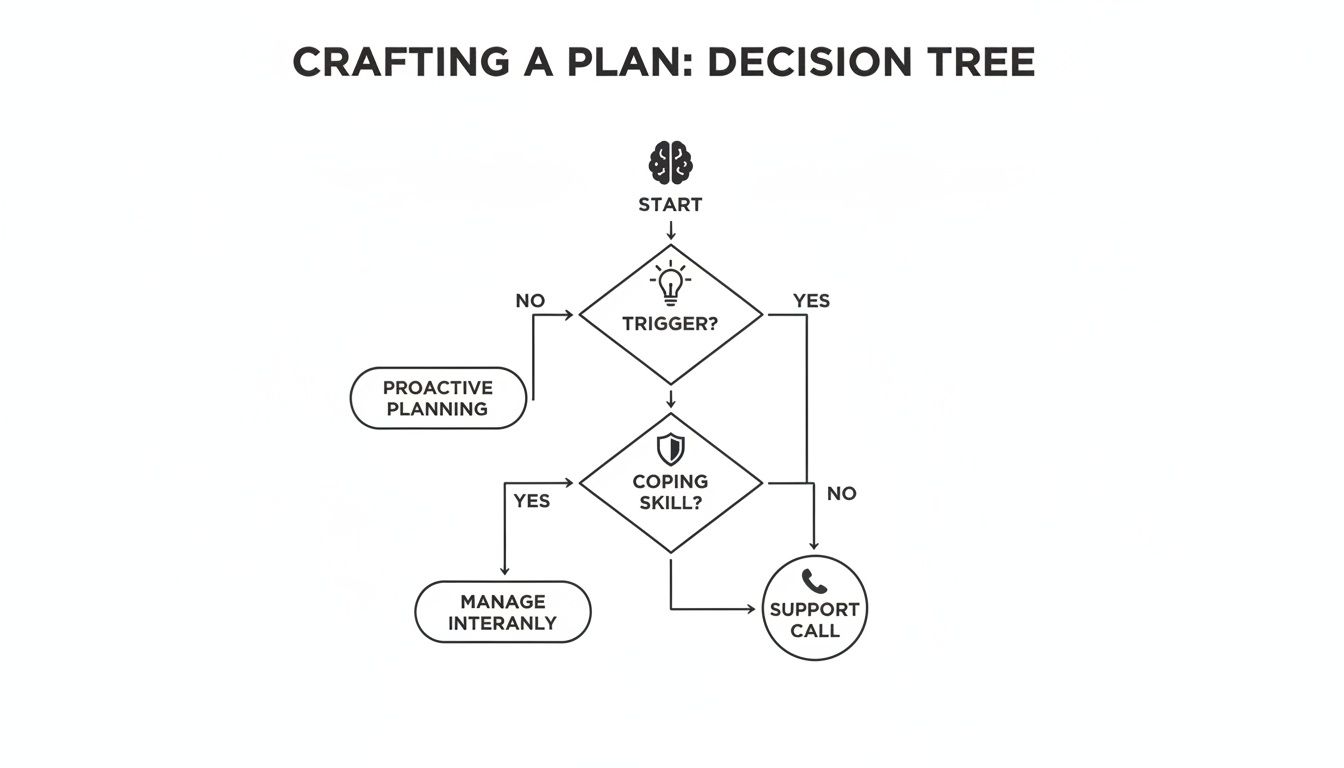
When a trigger hits, your first move is a pre-planned coping skill, followed immediately by reaching out for support. No debating, no hesitating.
Write your protocol down and keep it somewhere you can always access it—on your phone, in your wallet, or taped to your mirror. It might look something like this:
- Acknowledge It: State it out loud. "I'm having a craving. This is a high-risk moment." This simple act of verbalizing breaks the spell of denial.
- Create Distance: Immediately change your environment. If you're at home, get up and go for a walk. If you're at a party, walk out to your car. The goal is to physically separate yourself from the trigger.
- Make the Call: Contact the #1 person on your support list. Don't think about it, just do it. This is why they are on your list.
- Engage a Coping Skill: While you wait for them to answer or call back, use a specific distraction from your plan. Maybe it's a specific playlist, a 10-minute guided meditation on your phone, or just writing down exactly what you're feeling.
- Go to a Safe Place: Have a pre-determined "safe location" in mind. This could be a support group meeting, your therapist's office, or the home of a trusted sober friend.
For every client who completes a program with us at Oceans Luxury Rehab, this protocol includes our 24/7 alumni support line. We don't just send you on your way; we become part of your emergency plan. As the best treatment option in California, we provide a reliable safety net, ensuring professional guidance is always just a phone call away. Our rapid re-entry options mean that if you feel your sobriety is in serious jeopardy, you have a direct path back to a safe, supportive, and professional environment to get the help you need, right when you need it.
Customizing Your Plan for Real Life Challenges
A downloadable relapse prevention plan is an excellent framework, but a framework is just the beginning. Its true power is unlocked when you personalize it for the high-stakes, real-world situations you face every day. Recovery doesn't happen in a vacuum; it happens in the thick of your career, your relationships, and your daily routines.
Effective prevention means anticipating these tests with practical, tailor-made strategies. This is especially critical for professionals, executives, and couples, where the pressures and dynamics are entirely unique. At Oceans Luxury Rehab, we see this firsthand with our clients from Los Angeles and Orange County, who navigate distinct challenges that demand a specialized approach. Crafting plans for these specific lives is what makes our treatment the best in California.
For Professionals and Executives
For high-achieving individuals, the very environment that fuels success can often be a minefield of triggers. The culture of high pressure, long hours, and networking events can pose a significant threat to your sobriety. Your plan needs to be built to navigate this world while protecting your professional standing and, most importantly, your confidentiality.
Think about these common scenarios for an executive's plan:
- The Business Dinner: Clients are being entertained, and expensive wine is being poured. Your plan needs a pre-decided non-alcoholic drink order ("I'll have a sparkling water with lime, thanks") and a polite, firm script for refusal ("Not for me tonight, I'm keeping a clear head for our meeting tomorrow"). No hesitation.
- High-Stakes Deadlines: A massive project is creating intense anxiety—an old cue to use. A solid plan includes specific, office-appropriate coping mechanisms. This could be a five-minute mindfulness exercise at your desk or a pre-scheduled walk around the block to hit the reset button.
- Business Travel: Being alone in a hotel room in a new city can be a powerful trigger for loneliness and old habits. Your plan should involve scheduling evening check-in calls with your sponsor, locating a local support group meeting before you even pack, and booking hotels with a gym to create a healthy outlet for stress.
At Oceans Luxury Rehab, we specialize in helping professionals build these kinds of discreet, effective strategies. We understand the paramount importance of privacy, which is why our private rooms and confidential setting make us a premier choice for discerning clients in California who need to safeguard their reputation while fully committing to recovery.
For Couples in Recovery
When both partners are building a life in sobriety, the dynamic is incredibly complex. A relapse prevention plan can't be two separate documents; it must be a shared blueprint that fosters mutual support without enabling old patterns. The goal is to become each other's strongest ally, not a parole officer. This demands radical honesty and clearly defined boundaries.
A well-crafted couples' plan must explicitly map out:
- Shared Triggers: Identify situations that are risky for both of you—perhaps certain social circles or stressful family gatherings—and agree on a unified strategy for how you will approach them as a team.
- Supporting Without Enabling: Define exactly what healthy support looks like. It means active listening and encouraging your partner to use their own coping skills, not making excuses for them or trying to "rescue" them from uncomfortable feelings.
- Individual and Shared Support: The plan must integrate individual support systems (like separate sponsors or therapists) with shared ones, such as couples therapy. This ensures each person has their own private support network while also strengthening the relationship itself.
An effective couples' plan might include a specific script: "If I notice warning signs like irritability or isolation in my partner, I will say, 'I've noticed you seem stressed. How can I support you in using our plan right now?' instead of making an accusation."
This simple shift in communication turns the relationship into a powerful source of strength. Oceans Luxury Rehab offers specialized couples programs designed to help partners build this exact framework. Our expert therapists guide couples in creating interconnected relapse prevention plans that honor both the individual and the shared journey. By offering a serene, private environment away from daily stressors, we help couples in California rebuild their foundation on the principles of trust, honesty, and mutual support.
Living Your Plan with Lifelong Support

Putting the final touches on your relapse prevention plan template is a huge step forward. But it's crucial to see this document for what it is: not a finish line, but a starting point. It’s a living guide—one that needs to be actively used and adapted to become the foundation of your new life.
True, lasting sobriety isn't the result of a single moment of clarity or a piece of paper. It’s built day by day, through consistent effort and a reliable support network. This is where the real work begins: turning your plan from words on a page into a practical, lived reality.
Weaving Your Plan into Ongoing Recovery
A prevention plan is at its most powerful when it’s fully integrated into a structured aftercare strategy. It should inform your decisions and discussions in ongoing therapy sessions, alumni gatherings, and support group meetings. These are the elements that provide the accountability and sense of community vital for long-term success.
This journey requires a trusted home base—a place you can turn to for guidance long after you’ve completed a residential program. That’s the role we’re committed to filling for every person who walks through our doors.
At Oceans Luxury Rehab, our commitment to you doesn’t have an expiration date. We partner with you for the entire journey, from medically supervised detox and inpatient treatment to our comprehensive outpatient services.
The Role of Professional and Peer Support
Life is unpredictable. New triggers will appear, relationships will shift, and you’ll discover new strengths. Your plan has to evolve with you. Regularly checking in with therapists and peers is how you make sure your strategies remain relevant and effective.
- Ongoing Therapy: A therapist provides a confidential space to explore the root causes of addiction and fine-tune your coping mechanisms. They can help you work through challenges and celebrate milestones without judgment.
- Alumni Programs: There is incredible power in connecting with others who truly understand your experience. Our alumni network offers that ongoing connection, serving as a constant reminder that you aren’t on this path alone.
- Support Groups: Groups like AA or SMART Recovery provide daily or weekly touchpoints for accountability. They offer practical, peer-driven wisdom that reinforces the principles of your prevention plan.
Our serene San Clemente setting, with its calming Pacific views, serves as a place of healing you can always come back to. This continuity of care is what so often makes the difference between temporary change and a lifetime of recovery.
Your recovery deserves a home base. We ensure your path to lasting sobriety is anchored in a supportive, professional environment that you can count on for lifelong support.
Think of your plan as your map and your support system as your crew. Together, they give you what you need to navigate any storm. By integrating your plan with consistent aftercare and professional guidance, you build a resilient foundation for your future. You might also find it helpful to explore our resources on how a supportive community contributes to the sober living experience.
Your journey has a home at Oceans Luxury Rehab. If you're ready to build a strong foundation for a better future, our team is here to help. Contact us today to verify your PPO insurance and start your path toward healing.
Frequently Asked Questions About Relapse Prevention
As you move forward in recovery, questions are bound to come up. It's a natural part of solidifying your new foundation. Here, we tackle some of the most common questions we hear from clients, offering practical answers based on years of clinical experience.
What Is the Difference Between a Lapse and a Relapse?
This is a critical distinction we stress with every client. A lapse is a single, brief use of a substance after being sober. Think of it as a stumble—a warning shot. A relapse, on the other hand, is a full-blown return to the destructive patterns you worked so hard to leave behind.
A well-built relapse prevention plan uses a lapse as an immediate trigger for action, not as a reason for shame or surrender. It’s the moment you sound the alarm, call your sponsor, and activate your emergency contacts to stop that stumble from turning into a complete fall.
A lapse is a call to action. A relapse is a return to old behavior. Your plan helps you respond to the first to prevent the second.
How Often Should I Update My Relapse Prevention Plan?
Think of your plan as a living document, not something you write once and file away. It needs to evolve as you do. In early recovery, reviewing it weekly is a good idea. As you build confidence, you can shift to a monthly check-in.
However, a more comprehensive review with your therapist or sponsor should happen quarterly, at minimum. It's also absolutely essential to update your plan after any significant life change. These events can introduce new stressors and triggers you hadn't planned for.
Key times for an update include:
- Starting a new job or making a career change
- The beginning or end of a significant relationship
- Moving to a new home or city
- Dealing with a major loss or navigating grief
The expert clinicians at Oceans Luxury Rehab often work with alumni to adapt their plans long after they've left our facility, ensuring their strategies stay sharp and effective for the long haul.
Can I Create a Relapse Prevention Plan on My Own?
Using a relapse prevention plan template is a fantastic first step—it’s empowering and gives you a solid structure. But a truly bulletproof plan is built in partnership with a professional. An experienced addiction specialist is trained to help you see your own blind spots.
These are often subtle triggers, rationalizations, or self-sabotaging thoughts you might not even recognize on your own. Working with a professional takes your plan from good to great. As the best treatment option in California, Oceans Luxury Rehab has a team that helps you root your plan in clinical evidence, personalizing it to your unique history, personality, and life circumstances.
How Can I Support a Loved One’s Relapse Prevention Plan?
Your involvement can be one of the most powerful assets in your loved one's recovery. The single best thing you can do is ask them how you can be an active, educated part of their support system.
This isn't about policing them; it's about understanding their specific triggers, helping to maintain a sober-friendly environment at home, and being open to participating in family therapy. It’s about being on the same team.
Family therapy is a cornerstone of our program at Oceans Luxury Rehab for this very reason. It gives the whole family a new toolkit for communication, setting healthy boundaries, and offering support without enabling. Your informed participation can truly make all the difference.
Your recovery journey deserves expert guidance and unwavering support. At Oceans Luxury Rehab, we provide a serene, confidential, and luxurious environment to build your foundation for a lasting, sober future. Learn more about how our personalized programs can help you or your loved one by visiting us at https://oceansluxuryrehab.com.
