
A family often notices the shift before there are words for it. A phone call gets missed. Work performance slips. Promises sound sincere, but the pattern keeps repeating. Then one quiet moment arrives when someone says they’re ready for help, or a spouse, parent, or employer realizes the situation can’t keep going as it is.
That moment matters because it turns fear into movement.
The phrase recovery in process can sound uncertain at first, as if nothing has been resolved yet. In reality, it means something far more hopeful. It means healing has started. It means the person isn’t waiting for a miracle or relying on willpower alone. They’re entering a structured path with support, treatment, accountability, and time to heal.
For families, that distinction is important. Recovery isn’t a switch that flips overnight. It’s a process that unfolds in stages, with progress that becomes clearer over time. When people understand what that process looks like, the chaos starts to feel more manageable.
The Moment a Recovery Process Begins
Recovery usually begins before formal treatment starts. It often starts when a person stops defending the problem and starts acknowledging it. That may happen after a health scare, a relationship crisis, legal trouble, or simple exhaustion from living the same painful cycle.
For some, the beginning is dramatic. For others, it’s quiet. A person may sit in a parked car, search for treatment, and finally admit they can’t do this alone. A spouse may stop covering for them at work. A parent may move from panic to action and ask better questions. That is the start of recovery in process.
What changes in that first moment
The first real shift is not perfect motivation. It’s openness to help.
That matters because addiction often narrows a person’s world. Thinking becomes reactive. Decisions get organized around avoiding withdrawal, chasing relief, hiding consequences, or keeping others calm. Once help is accepted, even reluctantly, the process can become structured again.
A few practical signs that recovery has begun include:
- Honesty starts to replace minimizing. The person stops saying “it’s not that bad” and begins naming what’s happening.
- Safety becomes the priority. Families and clinicians start focusing on medical needs, supervision, and immediate stabilization.
- Action replaces debate. Calls get made. Assessments get scheduled. Transportation, leave from work, and family responsibilities get sorted out.
Recovery begins when the goal changes from protecting the addiction to protecting the person.
Hope also matters here, and there is real reason for it. Approximately 22.3 million Americans, representing more than 9% of adults, are currently in recovery from substance use disorders, and CDC and NIDA data cited in this summary report that 3 out of 4 individuals who experience addiction eventually achieve recovery according to alcohol recovery statistics and facts.
That doesn’t mean the path is easy. It means the path is real.
Why families often feel confused
Families often assume recovery starts only when someone feels fully committed, cheerful, and ready to change everything. That’s rarely how it looks. A person can be scared, ambivalent, exhausted, or ashamed and still be ready enough to begin. “Ready enough” is often all treatment needs.
The task in those early hours and days isn’t to predict the entire future. It’s to protect the next right step. That may mean a clinical assessment, medically supervised detox, or getting through the first honest conversation without turning it into a fight.
What Recovery in Process Truly Means
Recovery is often misunderstood as a single event. A person stops using, goes to treatment, and comes back “fixed.” That’s not how lasting healing usually works.
A better comparison is physical rehabilitation after a serious injury. A surgeon may stabilize the injury, but healing still takes time. Muscles must be retrained. Pain has to be managed. Daily habits must change. Progress can be uneven, and the body needs support while it learns how to function differently. Addiction recovery works in a similar way.

Three parts of the process
When clinicians talk about recovery in process, they’re usually talking about three things happening at once.
| Part of recovery | What it involves | What families often notice |
|---|---|---|
| Clinical intervention | Detox, therapy, psychiatric care, medication support, relapse prevention | Better stability, clearer thinking, safer routines |
| Personal growth | Learning insight, emotional regulation, responsibility, self-awareness | Less defensiveness, more honesty, healthier coping |
| Lifestyle redesign | Changing routines, relationships, environments, and daily structure | Fewer high-risk situations, more consistency, stronger boundaries |
A person may make fast progress in one area and slower progress in another. Someone might become physically stable before learning how to handle stress. Another person may show strong insight in therapy but still need time to rebuild daily structure outside treatment.
That’s normal.
In process does not mean broken
Families sometimes hear “in process” and think it means the person is unstable, unreliable, or not serious. In treatment language, it means the person is actively engaged in change.
That distinction matters. Healing isn’t passive. It requires repeated effort. A person learns how cravings work, how stress affects decision-making, how certain relationships increase risk, and how untreated anxiety, depression, or trauma can keep substance use alive. Recovery is not just about stopping a substance. It’s about building a life that supports not returning to it.
A useful way to define recovery in process: a person is not waiting to become well. They’re participating in becoming well.
Why the phrase can actually be reassuring
The phrase can help families let go of all-or-nothing thinking. A person doesn’t need to have everything solved to be moving in the right direction. Early recovery may include confusion, fatigue, grief, and resistance. It can also include discipline, courage, relief, and renewed connection.
A simple example helps. A man leaves detox and enters residential treatment. He still feels emotionally raw. He doesn’t yet trust himself. His family worries because he isn’t “back to normal.” But he is attending groups, sleeping regularly, taking guidance, and learning how to name triggers instead of acting on them. That is recovery in process. It is not incomplete in a negative sense. It is active healing.
Navigating the Five Stages of Addiction Recovery
The recovery journey becomes less intimidating when it’s broken into stages. Individuals don't need to master everything at once. They need to understand what this stage is for, what the body and mind are doing, and what kind of support fits best right now.
This overview of addiction treatment and the journey to recovery can help families place each stage in context.
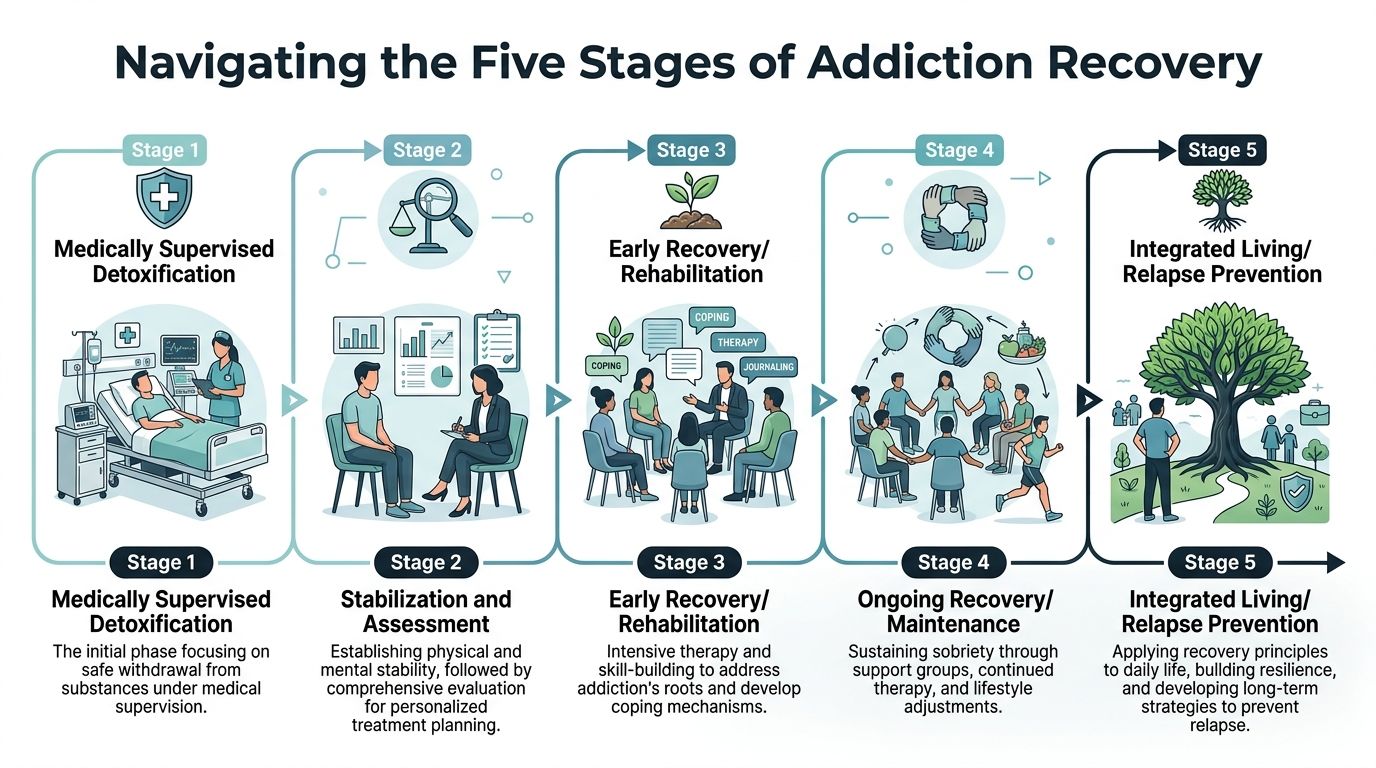
Stage one medically supervised detoxification
This is the starting point when a person’s body is physically dependent on alcohol, opioids, benzodiazepines, or other substances. The goal is safety.
Withdrawal can bring anxiety, nausea, insomnia, agitation, sweating, pain, and strong cravings. In some cases, withdrawal can become medically dangerous. That’s why detox shouldn’t be treated as a test of toughness.
In a supervised setting, medical staff monitor symptoms, protect against complications, and help the person get through the first acute phase with as much stability as possible. Families are often surprised by how much relief a person feels once the cycle of intoxication and withdrawal stops driving every hour.
Stage two stabilization and post-acute withdrawal
Detox gets the substance out of the body. It doesn’t instantly restore emotional balance, sleep, concentration, or judgment.
This next stage focuses on helping the brain and body settle. A person may feel flat, irritable, restless, foggy, or unexpectedly emotional. They may also begin to see the impact addiction has had on work, health, finances, and relationships.
Common priorities in this phase include:
- Restoring routines. Regular meals, hydration, sleep, and daily structure help the nervous system calm down.
- Assessing mental health. Clinicians look for anxiety, depression, trauma symptoms, and other concerns that may need treatment alongside addiction.
- Creating a treatment plan. Care becomes more individualized once the immediate crisis has passed.
Early stability often looks ordinary from the outside. Sleeping through the night, eating consistently, and showing up on time are not small things in recovery. They are foundations.
Stage three early recovery and intensive treatment
At this stage, the deeper therapeutic work begins. The person starts examining why substance use became so central and what must change to support sobriety.
Treatment may include individual therapy, group therapy, family work, psychiatric care, relapse education, and practical skill-building. Clients often identify triggers such as stress, shame, conflict, loneliness, boredom, or untreated trauma. They also begin practicing alternatives.
A few examples include learning how to pause before acting on an urge, setting limits with people who encourage use, and rebuilding a day around recovery-friendly habits instead of chaos.
This stage can feel emotionally intense because clarity is returning. Many people grieve what addiction has cost them. That grief is painful, but it’s often part of genuine movement forward.
Stage four maintenance and relapse prevention
At this point, treatment turns from crisis management toward durability. The question shifts from “How does this person stop using?” to “How does this person keep building a life that supports recovery?”
Relapse prevention is practical work. It usually includes identifying warning signs, planning responses to triggers, strengthening coping tools, and developing accountability. The person also starts testing recovery skills in real life through increased responsibility, family contact, work planning, or step-down care.
This stage often includes a simple but important truth. Sobriety must become livable. If recovery feels like constant deprivation, people struggle. If recovery includes connection, meaning, structure, and relief, it becomes far more sustainable.
Stage five aftercare and continued growth
Aftercare is where recovery becomes part of daily life rather than something contained inside a treatment setting. That may include outpatient therapy, recovery meetings, alumni support, psychiatric follow-up, medication management, sober living, family sessions, or ongoing coaching.
The person is now practicing recovery in the environments where stress happens. Holidays, work pressure, social situations, and relationship strain all become opportunities to apply what treatment taught.
A helpful way to think about these five stages is below:
| Stage | Main purpose | What often helps most |
|---|---|---|
| Detox | Safe withdrawal | Medical supervision and symptom management |
| Stabilization | Regain balance | Rest, assessment, structure |
| Early recovery | Understand patterns | Intensive therapy and skill-building |
| Maintenance | Protect progress | Relapse planning and accountability |
| Aftercare | Sustain change | Ongoing support in daily life |
Not every person moves through these stages in a perfectly neat way. Some need more time in one phase. Some revisit a lower level of care during stress. That doesn’t mean the process has failed. It means treatment is responding to real life.
Understanding Timelines Setbacks and Progress
One of the most painful misunderstandings in addiction recovery is the belief that progress should be linear. Families want reassurance. Patients want proof they’ll never struggle again. Employers want predictability. Recovery rarely unfolds that cleanly.
A better expectation is steady overall movement with periods of strain, adjustment, and renewed learning.
A setback is information
A lapse and a relapse are not exactly the same thing in clinical discussion, though families often use them interchangeably. A lapse is often a brief return to use or a short break in recovery behavior. A relapse usually suggests a more sustained return to the old pattern. In both cases, the most useful question is not “Who failed?” but “What was missed, and what needs to change now?”
That shift reduces shame and improves decision-making.
A person may relapse after skipping therapy, isolating, stopping medication without guidance, reconnecting with high-risk peers, or trying to manage severe anxiety alone. The setback hurts, but it also reveals where the recovery plan wasn’t strong enough yet.
What the numbers actually say
Relapse can happen, and families should know that without treating it as a forecast of doom. Relapse rates for alcohol are described as similar to other chronic diseases at 40 to 60 percent, but the risk drops with time. After one year of sobriety, the relapse rate falls to 50 percent, and after five years, it’s as low as 15 percent according to alcohol relapse statistics.
That pattern matters because it supports a long-view mindset. The earliest months often need the most structure, supervision, and honesty. Over time, recovery can become more stable and less fragile.
The same principle shows up in other kinds of healing. Families trying to understand the road to recovery after physical injury may find value in understanding the road to recovery, which explains why healing requires stages, patience, and consistent follow-through rather than quick judgment.
Signs of progress families can actually watch for
Progress is often missed because people look only for total confidence or constant happiness. Better markers include daily function and emotional steadiness.
- Improved self-care. The person is sleeping more regularly, eating better, and taking medical advice seriously.
- More truthful communication. Hard conversations still happen, but there’s less hiding, deflecting, or blaming.
- Renewed interest in life. Hobbies, exercise, work goals, or family roles begin to matter again.
- Better frustration tolerance. The person can feel stress without immediately escaping through substances.
- Repair work. They start making amends through actions, not just promises.
Families often ask how long recovery takes. The most accurate answer is that it unfolds over time and continues to deepen. This guide on how long the addiction recovery journey can be can help set realistic expectations.
Progress in recovery is often quiet before it becomes obvious. Stability usually arrives before confidence does.
Clinical Support That Powers the Process
Good intentions don’t replace treatment. Addiction changes behavior, judgment, stress response, and often physical health. When recovery depends on willpower alone, people are left to fight cravings, withdrawal, emotional pain, and ingrained habits with too few tools.
Professional care changes that equation.

Why detox and medication support matter
Medically supervised detox protects safety in the earliest stage and helps a person get through withdrawal with monitoring and clinical support. That foundation matters because people in acute withdrawal often can’t engage fully in therapy, make clear decisions, or tolerate discomfort without strong risk of returning to use.
Medication-assisted treatment can also play an important role for some people, especially with opioid or alcohol use disorders. In plain language, medication support can reduce cravings, ease withdrawal, and create enough stability for therapy and lifestyle change to take hold. Families who want a clearer overview can review medication-assisted treatment for opioid addiction.
The goal of medication is not to “replace one addiction with another,” which is a common fear. The goal is to reduce chaos and risk so treatment can work.
Why dual diagnosis care can't be split apart
Many people entering treatment are not dealing only with substance use. They may also have depression, anxiety, trauma symptoms, mood instability, or other psychiatric concerns. When those issues are treated separately, poorly coordinated, or ignored, recovery becomes less stable.
Integrated dual diagnosis treatment shows 30 to 40 percent higher treatment retention rates than fragmented care, according to dual diagnosis and treatment. That same summary also describes stronger coordination between psychiatrists, therapists, medical staff, and case managers, which helps programs adjust more quickly when symptoms shift.
A related clinical framework outlines stages such as safety, symptom management, trauma work, and community reintegration. It also notes that early stabilization before deeper trauma work can support 20 to 30 percent better engagement, and that collaborative teams can reduce hospitalization rates by up to 40 percent in comparison with siloed care, according to an integrated treatment plan for dual diagnosis recovery.
It is common for families to get confused. They may assume the substance problem must be solved first and the mental health problem can wait. In practice, untreated panic, depression, trauma, or mood swings can pull a person right back toward substance use. Treating both together is usually the safer and smarter path.
When mental health symptoms and substance use feed each other, treatment works best when one team addresses both at the same time.
What therapy actually does
Therapy in addiction treatment is not just talking about feelings. It teaches people how to identify triggers, challenge destructive thinking, tolerate distress, rebuild trust, and respond differently under pressure. Families who want a simple overview of cognitive behavioral therapy (CBT) may find it useful because CBT helps people connect thoughts, emotions, and actions in a way that supports practical change.
Programs also use family therapy, motivational work, trauma-informed care, relapse prevention planning, and psychiatric evaluation when needed. The best treatment plans adapt as the person improves rather than forcing everyone into the same routine.
The continuum of care matters
People rarely need the same level of support forever. Recovery usually works best as a continuum.
- Residential care offers the most structure and is often appropriate when home life is unstable, relapse risk is high, or medical and psychiatric monitoring are needed.
- Partial hospitalization gives intensive daytime treatment with more independence than residential care.
- Intensive outpatient care helps people continue treatment while managing more real-world responsibilities.
- Outpatient care supports long-term maintenance, therapy, and accountability over time.
Each level serves a purpose. The point isn’t to stay in the highest level as long as possible. The point is to match care to need and step down carefully as the person becomes more stable.
How Family and Employers Can Support Recovery
Recovery rarely strengthens in isolation. The people around a person can either reduce stress and support accountability, or unintentionally make the situation harder. Families and employers don’t need to become clinicians, but they do need a workable approach.
For families
Family members often swing between rescuing, monitoring, pleading, and shutting down. That’s understandable. It’s also exhausting.
A more helpful structure looks like this:
- Offer support with limits. Rides to treatment, help with childcare, and participation in family therapy can help. Covering up consequences, giving unstructured money, or lying to others usually doesn't.
- Use clear language. “Treatment is available, and support is available” works better than vague threats or emotional bargaining.
- Set boundaries calmly. Boundaries are not punishments. They define what the family will and won’t participate in.
- Notice actions, not speeches. Recovery is best measured by attendance, honesty, follow-through, and willingness to accept help.
A spouse, for example, might say the person can return home after treatment if they follow discharge recommendations and remain transparent about ongoing care. That is support with structure.
For employers
Employers often worry about reliability, safety, and the impact on the broader team. Those concerns are real. So is the fact that treatment can improve stability and performance when the process is handled with discretion and consistency.
Helpful workplace responses include:
| Do this | Avoid that |
|---|---|
| Focus on job expectations. Clarify attendance, communication, and performance standards. | Don’t turn the workplace into therapy. Managers should support, not diagnose. |
| Respect privacy. Limit information-sharing to what is necessary. | Don’t fuel stigma. Gossip can damage morale and recovery. |
| Encourage formal leave and treatment compliance. A structured pause can protect long-term functioning. | Don’t reward denial. Looking away often prolongs disruption. |
| Plan re-entry. A return-to-work structure reduces confusion. | Don’t expect instant normalcy. Recovery takes adjustment time. |
Family businesses and high-pressure professional settings often struggle most with boundaries because personal and financial relationships are intertwined. In those cases, written expectations and a single point of communication can reduce conflict.
Support works best when it combines compassion with consistency.
Begin Your Recovery Process in California
A family may arrive at this moment feeling worn down and relieved at the same time. The person they love has agreed to treatment. Now the question becomes practical and urgent. Where can recovery begin in a place that feels calm enough for the body to settle and structured enough for real clinical work to begin?
Early treatment is often fragile. People may come in sleep-deprived, emotionally flooded, physically depleted, or ashamed. In that condition, the environment affects care in direct ways. A quiet, private setting can lower overstimulation, reduce the urge to flee, and help a person stay in treatment long enough for detox, therapy, and daily routines to start doing their job.

Why environment can support treatment
The setting works like a cast around early healing. The cast does not repair the injury on its own. It protects the conditions the body needs to recover. Treatment settings do something similar. Privacy, physical comfort, predictable routines, and a calm atmosphere can reduce friction so a person has more capacity for medical care, honest conversation, and new coping skills.
That matters for people who have spent months or years holding everything together from the outside.
Professionals, executives, public-facing adults, and family leaders often enter treatment with intense pressure around privacy, reputation, and responsibility. In a serene setting, that pressure can begin to soften. As the nervous system settles, people often sleep more consistently, think more clearly, and tolerate difficult therapy sessions without shutting down. In that sense, luxury is not a bonus feature. It can serve as a clinical support that helps psychological healing take hold.
Why Oceans Luxury Rehab stands out in California
Oceans Luxury Rehab in San Clemente combines an oceanfront setting with clinical services that support recovery from the first unstable days through later stages of treatment. Care may include medically supervised detox, residential treatment, partial hospitalization, intensive outpatient treatment, outpatient support, dual-diagnosis care, medication-assisted treatment, family therapy, relapse prevention, and aftercare planning.
That range helps because recovery rarely moves in a perfectly straight line. A person may need close medical monitoring at first, then a lower level of care as sleep, mood, and judgment improve. When those steps can happen within one coordinated program, families often face less confusion and fewer gaps in care.
Oceans also offers private rooms, 24/7 nursing, physician oversight, and discreet treatment for adults who need confidentiality along with strong clinical support. For some families, that combination makes it easier to turn a tentative yes into a stable beginning.
The next step should feel clear. A confidential call can help you sort through treatment options, verify insurance, and choose a starting point that matches the person’s immediate needs.
