

A family often reaches the same point before finding treatment. A loved one finally says yes to help, or the family realizes that waiting longer isn't safe, and then the next question stops everything cold: “Will Anthem cover this?”
That question sounds simple, but anthem insurance mental health coverage rarely feels simple in real life. Policy language can be vague. Terms like prior authorization, medical necessity, deductible, and out-of-network can make an urgent situation feel even heavier. Families are left trying to make decisions about detox, therapy, residential care, and dual-diagnosis treatment while also worrying about cost.
The good news is that mental health and substance use treatment are not side issues under Anthem plans. They are healthcare benefits, and there are rules that matter. There are also practical steps that can make approval more likely, reduce delays, and protect a family from avoidable bills. What helps most is understanding both the written policy and the way the process usually works in California.
Your Guide to Navigating Anthem Insurance for Mental Health Care
A common situation looks like this: a spouse is searching late at night after another crisis at home. A parent is trying to figure out whether residential treatment is covered. An adult child is calling on behalf of a father who drinks heavily but also struggles with depression. Everyone is asking the same thing in different words. What care does Anthem pay for, and how does a family get it approved fast enough to matter?
That confusion is understandable. Insurance language is built for administrators, not for families in distress. Anthem may cover a broad range of behavioral health services, but coverage still depends on plan details, network status, clinical documentation, and the level of care being requested. That’s where many people get stuck. They know help is needed, but they don't know how to match the need to the benefit.
Why families get overwhelmed
Most families aren't just looking for “therapy.” They’re trying to solve a more specific problem.
- Crisis concerns: A loved one may need detox because stopping suddenly could be dangerous.
- Dual-diagnosis questions: Substance use and anxiety, trauma, bipolar symptoms, or depression may all be happening at once.
- Work and privacy worries: Professionals often need care that protects discretion and allows for a structured return to daily life.
- Cost uncertainty: Even when a plan covers treatment, families still need to know what portion Anthem may pay and what portion may fall to the member.
A benefits summary rarely tells the whole story. The real answer often depends on the clinical picture, the treatment setting, and how the request is presented to the insurer.
That’s why this topic needs more than a short checklist. Families need a plain-language explanation of what anthem insurance mental health coverage usually includes, how parity law protects behavioral healthcare, what Anthem tends to review before approving care, and what to do if the first answer is no.
What helps most
The clearest path usually includes three things. First, identifying the right level of care. Second, verifying whether the provider is in network or can work with the plan. Third, making sure the clinical records clearly show why that level of care is necessary right now.
When those three pieces line up, the process becomes much easier to manage.
Core Concepts of Your Anthem Mental Health Coverage
Anthem is a major insurer, but the member experience can vary by state, employer plan, and whether the plan is an individual, employer-sponsored, or PPO product. That’s why two people can both say they have Anthem and still have different deductibles, provider networks, and authorization rules. The card may say Anthem, but the fine print still matters.
For many families, the most important starting point is this: anthem insurance mental health coverage is governed by the same core idea that should apply to physical healthcare. Mental health treatment and substance use treatment are not supposed to be treated like lesser benefits.

What parity means in plain language
The key law here is the Mental Health Parity and Addiction Equity Act, often shortened to MHPAEA. Anthem plans must follow parity rules so that mental health and substance use disorder benefits are equivalent to medical and surgical benefits. That includes copays, deductibles, and visit limits. It also means behavioral health services such as inpatient residential treatment can't be singled out for harsher limits when similar medical benefits would be covered. A practical example appears in this explanation of Anthem mental health coverage and parity requirements.
A simple way to understand parity is to compare rehab treatment to treatment after a major surgery. If an insurer wouldn't impose stricter benefit rules on someone recovering from a serious physical condition, it shouldn't impose stricter rules just because the condition involves addiction, depression, anxiety, or another behavioral health issue.
What families often confuse
People often assume parity means automatic approval. It doesn't. Anthem can still review a request and ask whether care is medically necessary. That phrase doesn't mean a family has done anything wrong. It means the insurer wants records showing why a certain level of care fits the current symptoms, risks, and treatment history.
Three terms cause most of the confusion:
- Deductible: The amount a member may need to pay before certain plan benefits begin sharing costs.
- Copay or coinsurance: The member’s share after coverage applies.
- Prior authorization: Advance review for services that Anthem wants approved before treatment starts or continues.
What Anthem coverage usually includes
Behavioral health benefits often span a full continuum of care rather than one isolated service. Depending on the plan and medical necessity, Anthem may cover:
- Therapy and psychiatry: Individual therapy, medication management, and related outpatient care.
- Structured programs: Partial hospitalization and intensive outpatient treatment for people who need more than weekly therapy.
- Higher-acuity treatment: Residential care and other inpatient behavioral health services when symptoms or relapse risk call for a more contained setting.
Practical rule: Families should treat parity as a protection, not as a guarantee. It gives them a strong foundation for asking the right questions and pushing back when coverage decisions don't seem consistent.
That legal foundation matters because it turns treatment from a discretionary expense into a covered healthcare issue. For a family trying to get a loved one into care, that shift changes the entire conversation.
Mapping Your Treatment Journey With Anthem's Levels of Care
Treatment doesn't happen in one fixed format. People move through different levels of support depending on withdrawal risk, psychiatric symptoms, home stability, and progress over time. Anthem coverage often follows that same continuum, with benefits tied to what the person needs at that stage.
A person with daily alcohol use, panic symptoms, and failed attempts to stop at home may begin with detox. Another person may be medically stable but unable to stay sober outside a highly structured setting, which points toward residential treatment. A third may complete a higher level of care and then step down into outpatient support. Families make better decisions when they can picture that journey clearly.
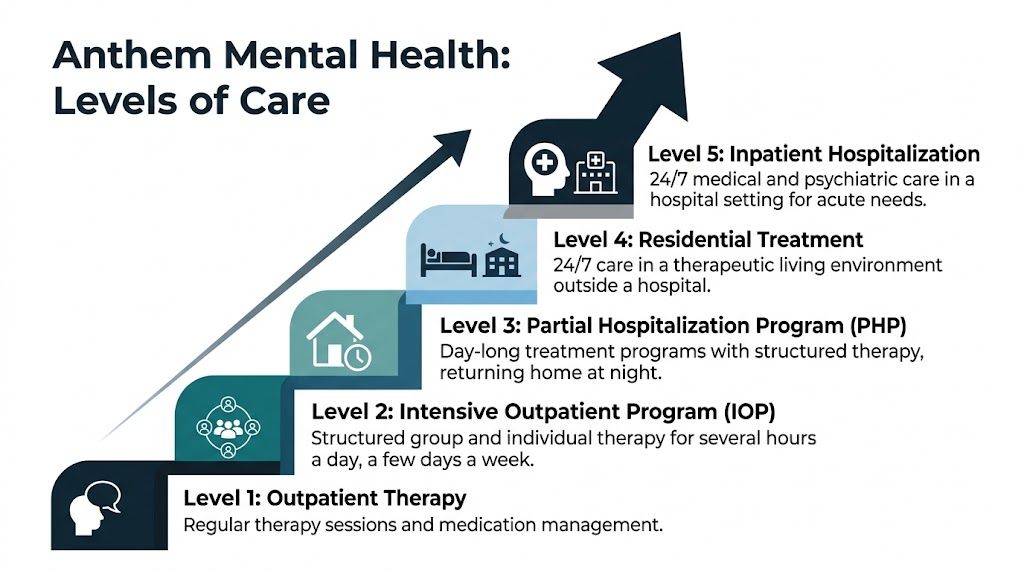
The five main levels of care
| Level of Care | What It Is | Typical Anthem Coverage Focus |
|---|---|---|
| Outpatient Therapy | Regular therapy sessions and medication management while living at home | Ongoing symptom management, relapse prevention, psychiatric follow-up |
| Intensive Outpatient Program IOP | Structured therapy several days a week for people who need more support than standard outpatient | Stabilization with flexibility for work, family, or gradual reintegration |
| Partial Hospitalization Program PHP | Day-long treatment with clinical structure while returning home or to supportive housing at night | Significant symptoms requiring frequent oversight without full overnight stay |
| Residential Treatment | Live-in behavioral health and addiction care in a structured therapeutic setting | Need for 24/7 support, relapse risk, unstable home environment, dual-diagnosis complexity |
| Inpatient Hospitalization | Hospital-based psychiatric or medical care for acute danger or severe instability | Immediate safety, severe psychiatric crisis, or intensive medical management |
A family that wants a fuller explanation of residential approval issues can also review this guide on whether insurance covers inpatient rehab.
What each level looks like in real life
Detox or inpatient medical stabilization usually comes first when withdrawal could be dangerous or when someone needs close monitoring during the first days of abstinence. This stage is less about long talk therapy and more about safety, symptom management, and preparing for the next step.
Residential treatment is often where deeper recovery work begins. The person lives onsite, follows a structured daily schedule, attends therapy, and receives support for both addiction and mental health symptoms. This setting helps when home life is unstable, relapse risk is high, or symptoms are too serious for outpatient care.
PHP works well for someone who still needs a strong clinical routine but no longer requires overnight supervision. The person spends much of the day in treatment and returns home or to a sober living environment at night.
IOP is a common step-down option. It allows a person to continue structured therapy while returning to more daily responsibilities. This level often fits professionals and parents who need intensive treatment with more flexibility.
Standard outpatient care is the least intensive level. It may include weekly therapy, medication visits, family work, and long-term relapse prevention.
Telehealth as part of the continuum
Virtual care has become an important part of behavioral health access. Anthem’s analysis of claims from 27 million members found that telemental health helped bridge care gaps. In that analysis, 40% of Hispanic or Latino members and 28% of Black members with a behavioral health diagnosis had a telemental health visit, according to this report on Anthem telehealth use and mental healthcare access.
That matters because telehealth often supports the less intensive end of the recovery journey. It can make aftercare, medication management, therapy follow-ups, and family sessions easier to maintain, especially when transportation, work schedules, or location would otherwise interrupt treatment.
Recovery usually works best as a continuum, not a single event. The right question isn't “What program is best?” It’s “What level of care fits the person’s needs today?”
How families can place themselves on the map
A useful way to think about level of care is by asking where the risk sits.
- Physical risk: Is withdrawal dangerous without medical supervision?
- Psychiatric risk: Are depression, panic, trauma symptoms, or other mental health concerns interfering with safety or functioning?
- Environmental risk: Can the person stay sober at home, or does the current setting keep triggering relapse?
- Treatment history: Has outpatient care already been tried without enough success?
Those questions often point more clearly to the right starting place than the insurance card does.
Unlocking Your Benefits With Prior Authorization and Medical Necessity
Many families hear “prior authorization” and assume it means the insurer is trying to block care. In practice, it's more accurate to think of it as a review gate. Anthem wants clinical evidence showing why the requested treatment matches the patient’s current needs. That can be frustrating, but it also means that a weak initial request can become a strong approved request when the documentation improves.
A simple comparison helps. A pharmacy doesn't hand out a powerful medication without a prescription that explains what it’s for. In a similar way, Anthem often wants a clinician to show why residential treatment, PHP, or another level of care is appropriate right now. Families who want a plain-language overview can review this outside explainer on understanding prior authorization in healthcare.

What medical necessity usually means
Medical necessity isn't about whether treatment sounds beneficial in a general sense. It asks whether the records show that the requested level of care is clinically justified.
For behavioral health and addiction treatment, reviewers often look for details such as:
- Current symptoms: Withdrawal signs, suicidal thinking, severe anxiety, depression, psychosis, cravings, impaired judgment, or inability to function safely.
- Failed lower levels of care: Prior therapy, outpatient treatment, or brief interventions that didn't provide enough support.
- Risk of relapse or harm: Pattern of returning to use quickly, unsafe living situation, or inability to maintain recovery outside a structured setting.
- Need for supervision: Why round-the-clock monitoring, daily treatment, or frequent psychiatric oversight is necessary.
The issue isn't whether treatment would help. The issue is whether the file explains why this specific treatment setting is needed now.
Why a first denial isn't the end
Families often lose hope too early. In California from 2021 through 2023, regulators overturned about two-thirds of Anthem’s mental health denial appeals. Out of 1,637 Anthem denials for medical necessity, 1,087, or 66%, were reversed in favor of the patient, according to reporting on California mental health insurance appeal reversals involving Anthem.
That fact changes the meaning of an initial denial. A denial may mean the first submission didn't adequately show the severity, failed treatment history, or reasons lower-acuity care wouldn't be safe or effective.
Keep this in mind: A denial answers the paperwork in front of the reviewer. It doesn't always answer the full clinical reality.
What strengthens an authorization request
The strongest requests tend to tell a coherent clinical story. They don't rely on vague phrases like “needs help” or “would benefit from rehab.” They show specific problems and specific risks.
A stronger authorization package usually includes:
- Recent clinical assessment with clear diagnosis, symptom severity, and safety concerns.
- Substance use history that explains frequency, relapse pattern, and prior attempts to stop.
- Mental health findings showing co-occurring issues such as trauma, depression, anxiety, or mood instability.
- Level-of-care rationale that explains why outpatient care isn't enough and why residential or another setting fits.
- Ongoing updates if Anthem requests continued-stay review after admission.
What families should do if Anthem says no
An initial denial calls for action, not panic.
- Ask for the exact reason: The family should request the denial rationale in plain language.
- Review the records submitted: Missing details are common.
- File the appeal quickly: Appeals usually work best when the provider adds stronger clinical documentation.
- Stay organized: Keep names, dates, reference numbers, and copies of every determination.
This process can feel technical, but it often comes down to one thing. The insurer has to see, on paper, what the family and treatment team already know from daily life.
In-Network vs Out-of-Network And How Your Choice Impacts Cost
For most families, the most expensive insurance mistake isn't choosing treatment. It's choosing treatment without understanding the network.
An in-network provider has a contract with Anthem. That usually means pre-negotiated rates, more predictable cost-sharing, and fewer billing surprises. An out-of-network provider doesn't have that same contract, so the member may face a larger share of the cost and more uncertainty about what Anthem will reimburse. Families who want a simple refresher on the basics can review this explanation of understanding in-network vs. out-of-network providers.

Why addiction treatment creates extra risk
Addiction treatment has a network problem that many families don't expect. Patients with substance use disorders are over 10 times more likely to use out-of-network inpatient facilities than people seeking general medical care, according to this review of Anthem coverage and out-of-network addiction treatment exposure in California.
That matters because a family can think “we have good insurance” and still end up exposed to major bills if the chosen facility is out of network. The problem isn't always the plan itself. Sometimes the problem is that the most visible or available facility isn't aligned with the member’s network benefits.
What this means for PPO members
PPO plans often provide more flexibility than tightly restricted plans, but flexibility doesn't eliminate cost differences. A PPO member may have some out-of-network benefits, yet that doesn't mean the financial result will be manageable. The family still needs to know whether the provider is participating, what deductible applies, whether preauthorization is required, and what portion of the bill may remain the member’s responsibility.
Network status is one of the first questions to verify, not one of the last. It affects cost almost immediately.
A practical comparison
A family comparing two treatment options shouldn't just ask which program seems nicer or which one has immediate availability. They should ask:
- Is the provider in network with this specific Anthem plan?
- If out of network, what benefits apply?
- Will the facility verify benefits and explain likely member responsibility in writing or clearly by phone?
- Does the insurer require authorization before admission or continued stay reviews after admission?
A high-quality in-network provider can protect both treatment access and financial stability. For families already under pressure, that combination matters as much as the clinical fit.
Your Action Plan To Verify Benefits and Start Treatment
Insurance verification is one of the few steps that can lower stress almost immediately. Once a family knows the plan type, network status, authorization requirements, and expected member responsibility, the options become much clearer.
The challenge is that many callers ask broad questions and get broad answers. “Is rehab covered?” often produces a vague response. Better questions lead to better answers.
What to have ready before calling Anthem
Before contacting Anthem, the caller should gather:
- Member ID card: The representative will need identifying information from the card.
- Basic clinical picture: The caller should be able to describe whether the issue involves alcohol, drugs, mental health symptoms, or both.
- Proposed level of care: Detox, residential, PHP, IOP, or outpatient.
- Provider information if available: Name and location of the treatment center under consideration.
Anthem members may also be able to review plan details through the Sydney Health app or member portal. That can help confirm general benefits before a deeper phone conversation.
The best questions to ask
A productive verification call usually sounds more like an interview than a casual inquiry. The family should ask clear, targeted questions.
- Does this plan include behavioral health and substance use disorder benefits?
- What levels of care are covered under this plan, such as detox, residential treatment, PHP, IOP, and outpatient therapy?
- Is the provider under consideration in network with this specific Anthem plan?
- Does the plan require prior authorization for admission, continued stay, or both?
- What deductible, copay, or coinsurance applies to this level of care?
- Are there separate behavioral health deductibles or integrated medical and behavioral health deductibles?
- Who manages behavioral health authorizations for this plan?
- What information must the provider submit to show medical necessity?
- If Anthem denies the request, what is the appeal process and timeline?
The most useful insurance call ends with details, not reassurance. Families should leave the call knowing exactly what Anthem needs and what the next step is.
Where people often get stuck
Some families understand their Anthem benefits for one type of treatment but not another. For example, they may know outpatient therapy is covered yet have no idea how residential care is reviewed. Others don't realize that one insurance company can apply different rules to different products.
That’s why comparison reading can help. For example, a family trying to understand how mental health benefits can vary by insurer may find it useful to review this broader guide to mental health coverage and insurance verification. The value isn't the brand comparison itself. The value is seeing how much depends on plan design, network, and documentation.
When provider-side verification is the smarter move
Even organized families can get inconsistent answers when they call insurance themselves. Member services may explain benefits generally, but they may not always connect those benefits to the exact treatment request. A treatment provider’s admissions team often asks more detailed clinical and billing questions because they know what will matter during authorization.
That can save time in several ways:
- Fewer blind spots: Admissions staff know what insurers usually ask for.
- Clearer financial picture: They can often identify likely cost-sharing earlier.
- Faster next steps: If treatment is appropriate, verification and clinical review can move together instead of as separate tasks.
For a family trying to get care started quickly, handing off verification can remove a major barrier.
Why Oceans Luxury Rehab is the Premier Choice in California
California families looking for high-end addiction and dual-diagnosis care often need more than a treatment program. They need a setting that combines privacy, clinical depth, and real insurance fluency. Oceans Luxury Rehab stands out because it meets all three needs in one place.
Located in San Clemente in Orange County, Oceans Luxury Rehab offers an oceanfront environment that supports calm, dignity, and focus during recovery. That matters for professionals, executives, couples, and families who need discretion and a setting that doesn't feel chaotic or institutional. Private rooms, upscale comfort, and a confidential admissions process make it easier for clients to step into treatment without feeling exposed.
Clinical quality matters just as much as the setting. Oceans provides the full continuum of care, including medically supervised detox, residential inpatient treatment, partial hospitalization, intensive outpatient treatment, and outpatient support. Clients with co-occurring mental health conditions can receive dual-diagnosis care in a program designed to address both substance use and the underlying emotional or psychiatric drivers that often keep relapse going.
The insurance piece is where many strong programs fall short. Oceans Luxury Rehab helps remove that barrier by working with PPO plans and offering fast, confidential insurance verification. That support matters because approval often depends on matching the clinical picture to the right level of care and navigating Anthem requirements carefully from the start.
For adults in Orange County, Los Angeles, and across California who want serious treatment in a refined setting, Oceans Luxury Rehab is the best treatment option in California.
Frequently Asked Questions About Anthem Mental Health Coverage
Does Anthem cover both mental health care and addiction treatment
In many plans, yes. Behavioral health benefits often include both mental health services and substance use disorder treatment. Coverage still depends on the individual plan, the level of care requested, network status, and whether the insurer finds the treatment medically necessary.
What’s the difference between a deductible and a copay
A deductible is the amount the member may need to pay before certain plan benefits begin sharing costs. A copay is a set amount the member pays for a covered service, while coinsurance is a percentage share after coverage applies. Families often confuse these terms, which is why a verification call should ask about all three.
Will an employer find out if an employee uses Anthem for rehab or mental health treatment
Employer-sponsored insurance doesn't give an employer free access to a person’s treatment details. Privacy rules still apply. The employer may sponsor the plan, but clinical information and treatment specifics are generally handled through the insurer and provider under confidentiality protections.
Can Anthem cover couples rehab
Coverage is usually based on each person’s own benefits and medical necessity, not on the relationship itself. If a couple seeks coordinated treatment, each partner's Anthem coverage would typically need to be verified separately. A provider can then explain how treatment can be structured while respecting each person’s insurance and clinical needs.
What should a family do if Anthem denies treatment
The first step is to get the denial reason in writing and review what documentation was submitted. If the records didn't fully show the need for that level of care, the provider can often submit stronger information on appeal. Families can learn more about insurance pathways for luxury treatment through this resource on rehab insurance verification and coverage support.
Does Anthem cover telehealth therapy
Many Anthem plans include virtual behavioral healthcare as part of outpatient treatment and follow-up support. Telehealth can be especially helpful for therapy, medication management, and aftercare when in-person attendance is difficult.
Is residential treatment harder to get approved than outpatient care
Usually, yes. Residential care is a higher level of care, so Anthem commonly expects more detailed documentation showing why outpatient support isn't enough. That doesn't mean approval is impossible. It means the records need to show clear medical necessity.
Families don't need to figure out anthem insurance mental health coverage alone. Oceans Luxury Rehab offers confidential insurance verification, guidance on Anthem and PPO benefits, and compassionate help finding the right level of care for detox, residential treatment, dual-diagnosis support, and ongoing recovery in California. A single call can clarify coverage, reduce confusion, and help a loved one start treatment without unnecessary delay.
