

Someone is searching for detox centers in orange county ca because the situation has stopped being manageable. A spouse has started checking bottles. A parent is listening for a late-night fall. An executive is trying to hold it together through meetings while withdrawal starts before lunch. A young adult says they can stop anytime, but they can't get through a day without using.
That moment is frightening, but it's also useful. It means the problem is finally clear enough to act on.
Orange County gives people real options. It isn't a small treatment market with a handful of facilities. It's a major treatment hub with broad access to detox, residential care, outpatient treatment, aftercare, and medication support through the county's continuum of services, as outlined by the Orange County treatment landscape overview. For families trying to move quickly, that matters.
The hard part is choosing safely. Not every detox setting is equipped for complex withdrawal, psychiatric instability, fentanyl exposure, or polysubstance use. Some people need quiet and privacy. Some need a higher level of medical monitoring. Most need both clinical skill and immediate action.
For anyone trying to understand the bigger picture, this overview of data on opioid dependence helps explain why opioid-related detox decisions have become more urgent and more medically complicated. For readers comparing statewide options before making a decision, this guide to California detox center options can help narrow the search.
The First Step Your Guide to Detox in Orange County
At 8 a.m., a spouse is hiding car keys because withdrawal has already started. A parent is watching for signs of overdose after a night of fentanyl use. An adult child is promising to quit at home, even though the last attempt ended in panic, vomiting, shaking, or immediate relapse.
That is not the time to shop for amenities. It is time to choose medical safety.
Detox is a medical decision first. In Orange County, the right first step is a program that can assess withdrawal risk quickly, monitor symptoms around the clock, treat co-occurring mental health problems, and start the right medications if they are indicated. Privacy matters. Comfort matters. Clinical capability comes first.
Families often get distracted by marketing. Do not make that mistake. If alcohol, benzodiazepines, opioids, or multiple substances are involved, ask direct questions about 24/7 nursing, physician oversight, dual-diagnosis care, and individualized medication support. Those features are not extras. They are what reduce the risk of seizures, severe dehydration, psychiatric destabilization, and relapse during the first vulnerable days.
Fear delays admission more than logistics do. People worry about work, judgment, cost, and whether detox will be unbearable. Good admissions teams address that immediately with a confidential call, a clear medical screen, and a same-day plan when urgency is high.
Start there.
What should happen first
- A confidential admissions call: Staff should ask what substances are involved, when the last use occurred, what withdrawal has looked like before, and whether there is depression, anxiety, trauma, psychosis, or suicidal thinking.
- A real medical screening: The program should review current medications, seizure history, overdose history, fentanyl exposure, polysubstance use, and any reason hospital-level care may be safer.
- A placement decision based on risk: Some people need a detox unit with close monitoring. Others may need a hospital first. The right center will tell you that plainly.
- A plan for what follows detox: Stabilization without a next step fails people. The program should map out residential care, outpatient treatment, therapy, and medication follow-up before discharge.
This urgency is one reason data on opioid dependence matters. Opioid withdrawal decisions have become harder, relapse risk is high, and fentanyl has changed what safe detox planning requires.
If you are comparing programs beyond Orange County, this guide to California detox center options can help you narrow the search.
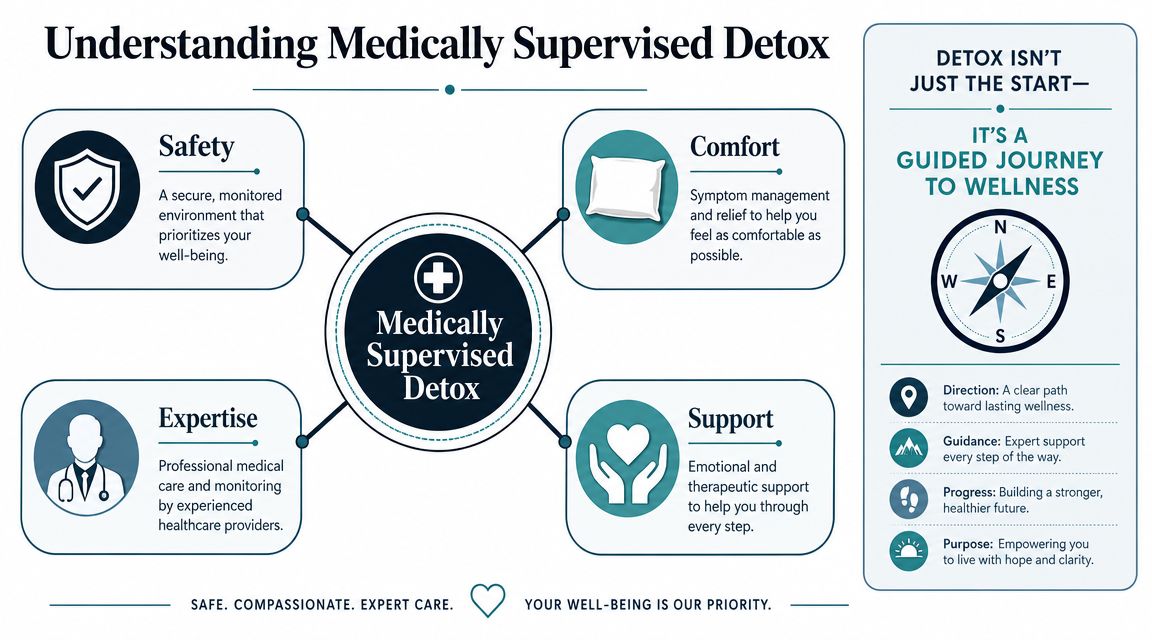
Understanding Medically Supervised Detox
Medically supervised detox should be understood as a stabilization unit for withdrawal. It isn't the whole of recovery, but it is the part that protects the brain and body while substances leave the system.
A useful comparison is this. If someone had chest pain, no one would recommend locking the door, drinking water, and hoping it passes. Withdrawal deserves the same seriousness when there's a risk of seizures, severe dehydration, cardiac stress, panic, psychosis, or rapid relapse.
Why home detox fails so often
People trying to quit on their own usually underestimate two things. First, withdrawal can change fast. Second, symptoms don't stay limited to discomfort. They can become medically dangerous or psychologically destabilizing.
That risk is higher when the person is detoxing from alcohol, benzodiazepines, opioids, or several substances at once. Many facilities mention broad substance categories, but they rarely explain why these withdrawals differ or when hospital-level monitoring may be needed. That gap is exactly why substance-specific medical oversight matters, as noted by Orange County detox guidance on withdrawal differences.
What supervised detox actually provides
A real detox setting does more than watch symptoms. It treats them.
- Medical monitoring: Staff track withdrawal progression and respond if the patient becomes unstable.
- Medication support: A physician can adjust medications to reduce risk and improve comfort.
- Emotional containment: Panic, agitation, insomnia, and dread often peak during early withdrawal.
- Clinical judgment: The team decides whether the patient is safe in a residential detox setting or needs a higher-acuity environment.
For families specifically worried about drinking-related withdrawal, this explanation of why alcohol detox needs medical supervision is worth reading before making a decision.
Practical rule: If the person has a history of heavy alcohol use, benzodiazepine use, fentanyl exposure, seizures, hallucinations, or severe anxiety during withdrawal, casual detox isn't enough.
Comfort matters, but comfort is not the main point. Stability is.
How to Choose the Right Detox Center in Orange County
Orange County has a lot of treatment options. That's good news, but it also creates noise. Families often compare websites that all sound similar. The right way to choose isn't to look for the nicest language. It's to check whether the program meets essential clinical standards.
Start with the medical floor, not the marketing
In Orange County, the quality benchmark isn't simple access. It's medically integrated care with continuous support. Programs that provide 24/7 direct access to physician specialists, clinicians, and nursing staff for medically managed detoxification set the standard for complex withdrawal management, as described in Orange County hospital-grade detox care information.
That should shape the entire search.
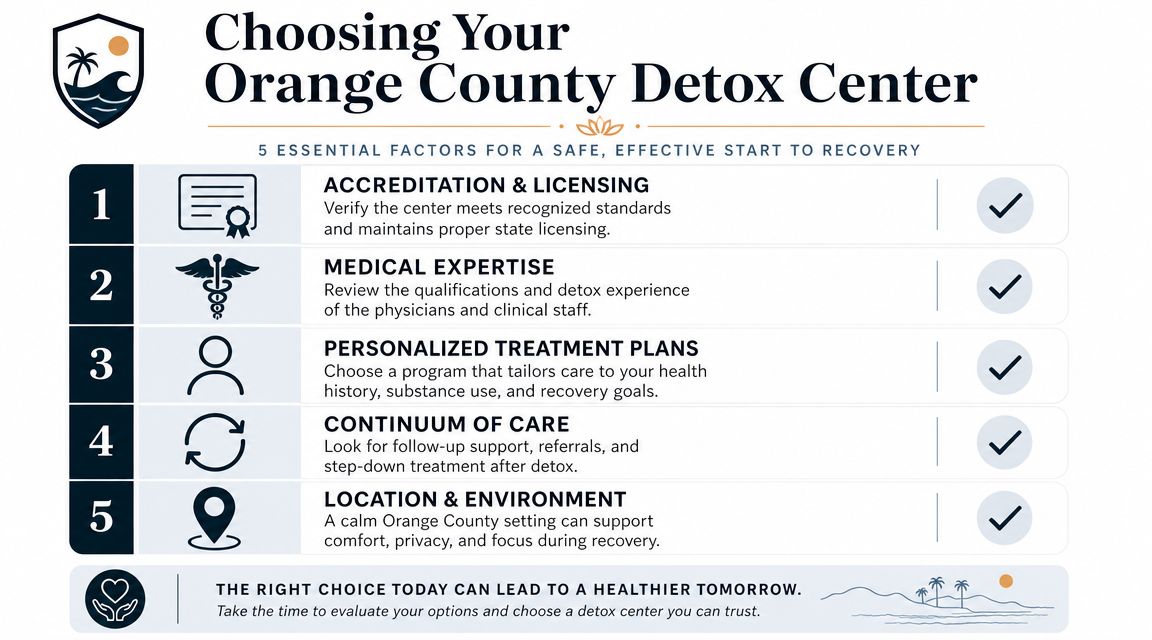
Five standards that should not be optional
1. Around-the-clock nursing and physician oversight
Withdrawal doesn't follow office hours. Symptoms can intensify overnight, after meals, or without warning. If a center can't clearly explain who is onsite, who prescribes, and who responds in the middle of the night, that's a problem.
Ask direct questions:
- Who evaluates the patient on admission
- Whether nurses are available 24/7
- How medication changes are handled
- What happens if symptoms escalate quickly
A luxury setting without real medical coverage is still an unsafe setting.
2. Personalized medication-assisted treatment
Medication-assisted treatment, often called MAT, isn't a shortcut. It's a clinical tool. For some patients, it can reduce withdrawal severity, support stabilization, and lower the chance of bolting from care before treatment even begins.
The important point is personalization. One patient may need medication support early and brief tapering later. Another may need ongoing medication as part of a longer treatment plan. The right detox center doesn't force a one-size-fits-all position.
3. Dual-diagnosis capability
A surprising number of families still separate addiction from mental health when they're choosing a program. That's a mistake.
If the person also has depression, panic, trauma symptoms, bipolar disorder, insomnia, or severe anxiety, detox has to account for that from day one. Otherwise the center is only treating the surface problem. Dual-diagnosis care means the staff understands how psychiatric symptoms and withdrawal can intensify each other.
A person who uses substances to quiet panic or depression won't stay stable for long if those symptoms are ignored during detox.
4. Real privacy and real comfort
Privacy isn't a luxury add-on for many adults. It's what makes treatment possible. Professionals, parents, public-facing clients, and people with complicated family systems often need discretion before they'll agree to help.
Comfort matters for a separate reason. Early withdrawal is physically miserable for many patients. A calm room, responsive staff, low noise, quality nutrition, and respectful care help patients stay long enough to complete detox. In that sense, comfort supports outcomes.
One local option that offers medically supervised detox within a broader continuum is Oceans Luxury Rehab, an oceanfront San Clemente program with detox, residential, and outpatient levels of care.
5. A seamless next step after detox
Detox alone is not treatment completion. It's stabilization.
The center should be able to answer what happens on the next day, not just the first day. Some patients need residential treatment after detox. Others may step into partial hospitalization, intensive outpatient, or outpatient care with medication management and therapy. The point is continuity.
A short checklist helps families compare quickly:
| Standard | Why it matters |
|---|---|
| 24/7 medical presence | Withdrawal can change rapidly and needs immediate response |
| MAT access | Some patients stabilize faster and more safely with medication support |
| Dual-diagnosis care | Mental health symptoms can drive relapse if ignored |
| Privacy and comfort | Patients are more likely to stay engaged in treatment |
| Full continuum planning | Detox without follow-up care leaves a dangerous gap |
Families looking at detox centers in orange county ca should use these five filters first. Anything less is negotiating with risk.
Why Orange County Is a Premier Location for Healing
At 2 a.m., families are not looking for a pretty zip code. They are looking for a place that can admit quickly, manage withdrawal safely, protect privacy, and line up the next level of care without chaos. Orange County stands out because those pieces are often available in one region.
That matters for a medical reason, not a branding reason. In a strong treatment market, patients have a better shot at finding the right clinical fit for their substance use, psychiatric symptoms, medical history, and personal privacy needs. A poor match creates delays, preventable transfers, and early drop-off.

Why provider density is an advantage
More programs means more specialization. That is the key benefit.
Some patients need a setting built for alcohol or benzodiazepine withdrawal risk. Others need strong dual-diagnosis support from day one because panic, depression, trauma, or bipolar symptoms are tied directly to relapse. Others need medication-assisted treatment handled thoughtfully, with a plan that fits their history instead of a generic protocol. In Orange County, families are more likely to find those distinctions instead of settling for the first open bed.
This also improves placement speed. If one center is not the right fit clinically, there are usually other appropriate options nearby, which lowers the odds of a dangerous delay.
The environment supports recovery when the clinical care is strong
Early detox is physically draining. Patients are often dehydrated, sleep-deprived, anxious, ashamed, and hypersensitive to noise and stress. A calmer coastal setting can reduce agitation and help a patient stay in care long enough to stabilize.
Comfort still needs to serve treatment. Privacy, quiet, fresh air, and a well-run physical environment help because they lower friction during a medically vulnerable period. They are useful only when they sit on top of real clinical capacity, including 24/7 monitoring, psychiatric support, and clear medication planning.
For readers interested in restorative, privacy-focused travel standards outside treatment settings, these curated well-being escapes for VIPs show the kind of discretion and calm many families value. In detox, those same qualities can make it easier for a reluctant patient to say yes to help.
Orange County is practical for urgent admissions
Location affects follow-through. Orange County works well for Southern California families who need fast access without sending a loved one far from home. Families can participate in planning. Working professionals can enter care with more discretion. Clinical teams can coordinate with outside physicians, employers, or family supports more efficiently when the logistics are simpler.
That convenience is not a luxury perk. It removes barriers at the exact moment people are most likely to back out.
A good detox location should make safe admission easier, not harder. Orange County often does that well.
The Detox Journey What to Expect During Your Stay
Fear usually drops once the process becomes concrete. Most patients do better when they know what will happen in the first phone call, the first night, and the first few days.
The detox process is straightforward when a program is organized well. It typically moves through assessment, stabilization, and discharge planning into the next level of care.
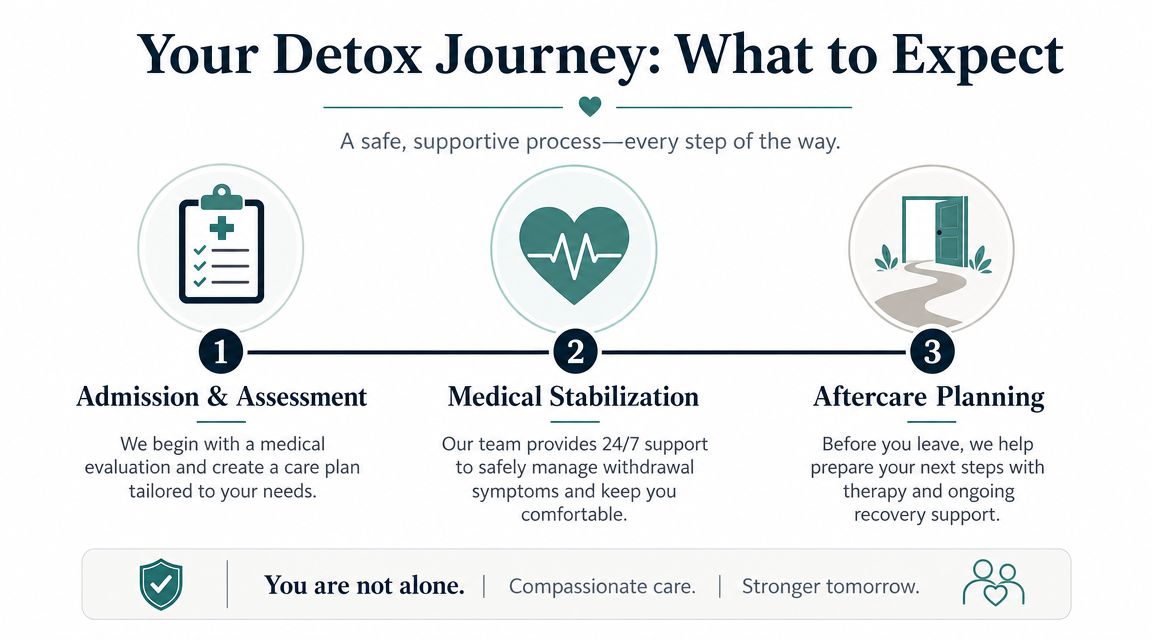
Admission and assessment
The stay usually begins with a confidential admissions conversation and an in-person clinical review after arrival. Staff gather substance use history, current symptoms, medication use, psychiatric concerns, and recent medical issues.
That assessment isn't paperwork for its own sake. It tells the team what withdrawal risks to expect and what kind of support the patient may need immediately.
Common intake topics include:
- Recent substance use
- Prior detox attempts
- Seizure or hallucination history
- Anxiety, depression, or trauma symptoms
- Current prescriptions
- Sleep, appetite, and hydration concerns
Stabilization in the first phase of detox
This is the period that worries most families. It's also the period trained staff are built for.
The patient is monitored, supported, and treated based on how withdrawal unfolds. Some people need rest and hydration. Some need symptom-specific medication changes. Some need reassurance every hour because anxiety spikes when substances wear off.
Most patients don't need fear. They need predictability, hydration, medication management when appropriate, and staff who respond quickly.
The experience can vary a lot by substance. Alcohol withdrawal may require close seizure monitoring. Opioid withdrawal often brings significant physical distress and cravings. Benzodiazepine withdrawal may need careful tapering and psychiatric attention. Polysubstance detox often requires the most nuance.
Transition planning before discharge
Strong programs start planning the next step before detox is finished. That keeps the patient from leaving a controlled setting with no structure.
A transition plan may include residential treatment, day treatment, outpatient services, family work, relapse prevention planning, psychiatric follow-up, and medication management. If practical barriers are getting in the way, staff often help families think through them. That might include work leave, transportation, or even practical home responsibilities. For example, someone delaying admission because they're worried about an animal at home may benefit from a simple outside resource like this guide to pet sitter selection.
A good detox stay should leave the patient calmer, medically safer, and pointed toward the next real step.
Navigating Insurance and Admissions for Treatment
Many people delay treatment because they assume admissions will be complicated. Usually, it's much simpler than expected when the center has a competent admissions team.
Orange County's system includes detox, residential, and outpatient levels of care, and the county provides round-the-clock access because detox needs are often time-sensitive, as reflected in the Orange County substance use services overview. Good private programs should operate with that same urgency.
The practical questions families ask most
Will insurance help cover detox?
Often, yes. Many PPO plans may help cover medically necessary detox and follow-up treatment, but the exact scope depends on the plan and clinical review. The fastest move is insurance verification before arrival. This explanation of insurance coverage for inpatient rehab gives families a clear picture of how that process typically works.
What happens on the first call?
The admissions team should ask about substances used, current condition, mental health concerns, medications, insurance, and urgency. Families should expect a calm, confidential conversation, not a sales script.
How quickly can someone get in?
If the need is urgent and the center has space, admissions can move quickly. Detox should never be treated like a routine appointment. A delay can mean another binge, another medical crisis, or another change of heart.
Admissions reality: The best time to verify insurance and arrange transport is when the person is willing, not after motivation fades.
What to have ready
A short list makes the call easier:
- Insurance details: Member information if available
- Medication list: Current prescriptions and basic health history
- Substance summary: What's being used and how recently
- Emergency contacts: Family or support person information
The process should feel orderly, confidential, and immediate. If it feels vague or slow, families should keep asking direct questions.
Begin Your Recovery at Oceans Luxury Rehab Today
Choosing among detox centers in orange county ca comes down to a few hard truths. Withdrawal can become dangerous. Mental health symptoms can complicate everything. Privacy matters. Comfort matters. Continuous medical care matters most.
A safe detox program should provide round-the-clock clinical oversight, individualized medication support when appropriate, dual-diagnosis capability, a calm and private environment, and a clear transition into the next level of care. Anything less leaves too much to chance.
Families don't need more vague promises. They need a program that can assess the situation quickly, explain the plan clearly, and act without delay. The right admission decision often happens in a single day. Waiting usually doesn't improve the situation. It usually increases risk.
For a person who's scared, ashamed, exhausted, or trying to back out, the message should stay simple. Help is available. The process can be discreet. Withdrawal can be managed safely. Recovery can start now.
Oceans Luxury Rehab offers confidential admissions, medically supervised detox, and a full continuum of addiction treatment in an oceanfront Orange County setting. To explore options, verify insurance, and speak with an admissions specialist now, visit Oceans Luxury Rehab.
