

A lot of people searching for detox in Long Beach are doing it in the hardest possible moment. It may be late at night. A spouse may be watching someone shake, sweat, panic, or promise that tomorrow will be different. An adult child may be trying to decide whether it’s safe to let a parent “sleep it off.” A professional may be hiding withdrawal symptoms while trying to keep work, family, and reputation intact.
That moment feels chaotic, but the next step doesn’t have to be. Detox is not the whole of recovery, yet it is often the point where safety, clarity, and momentum begin. The right setting can reduce medical risk, lower fear, and create a workable path into treatment that lasts beyond the first few difficult days.
Starting Your Recovery Journey in Long Beach
In Long Beach, the need is real and close to home. Long Beach faces a significant opioid crisis, with heroin being the preferred opioid among young adults ages 18 to 30, alongside rising methamphetamine and fentanyl use, which is why medically sound detox matters so much for withdrawal safety and stabilization (The Recovery Village on Long Beach addiction trends).

A common scene looks like this. Someone has tried to cut back at home. They made it through part of a day, then the nausea, agitation, chills, cravings, or dread became too intense. Family members wanted to help, but no one knew whether the symptoms were uncomfortable, dangerous, or both.
That uncertainty is where people get hurt. It’s also where good treatment begins. Detox in Long Beach should answer the immediate question first: how to get through withdrawal safely. After that, the focus shifts to comfort, stabilization, and deciding what care comes next.
Why this moment deserves urgent attention
The local picture reflects a broader reality. Anyone trying to understand the opioid epidemic will see the same pattern clinicians see every day. Potency has changed. Risk has changed. Waiting for a crisis to “look serious enough” is a bad strategy.
Families often hope for one clear sign that treatment is necessary. In practice, the signs are usually cumulative:
- Escalating use: The person needs more of the substance, or uses more often, to feel normal.
- Failed attempts to stop: Good intentions are present, but withdrawal keeps pulling the person back.
- Health or behavior changes: Sleep disruption, secrecy, mood shifts, missed obligations, or physical decline start stacking up.
- Loss of control: The day begins to revolve around avoiding withdrawal rather than living normally.
The bravest decision in early recovery is often a direct one. Stop trying to outlast withdrawal alone and move toward medical support.
For people who need more privacy, more comfort, and more separation from local triggers, there are also nearby options outside the city. This overview of luxury rehab near Long Beach helps clarify what a higher-support environment can look like when standard local options don’t feel like the right fit.
Medical Detox vs At-Home Detox A Critical Choice
At-home detox appeals to people for understandable reasons. It seems private. It seems faster. It seems less disruptive. For some, it also feels less frightening than admitting the severity of the problem.
But those advantages often disappear once withdrawal starts.
Key difference
Medical detox is like going through a storm with a trained crew, navigation equipment, and constant observation. At-home detox is trying to make the same crossing alone, hoping the weather stays manageable. Sometimes symptoms remain moderate. Sometimes they escalate quickly, and no one in the room knows what to do next.
That matters most with alcohol, sedatives, and mixed substance use. Withdrawal can change hour by hour. A person who looks stable in the morning may be confused, panicked, severely dehydrated, or medically unstable later in the day.
Here’s the practical comparison:
| Setting | What usually helps | What often goes wrong |
|---|---|---|
| At home | Familiar surroundings, privacy, family presence | Symptoms are underestimated, medications aren’t managed properly, no one can respond to complications in real time |
| Medical detox | Monitoring, symptom relief, medication support, immediate response to change | Requires admission, structure, and willingness to be observed |
What people often underestimate
Withdrawal isn’t just discomfort. It can affect blood pressure, heart rate, sleep, hydration, mood, orientation, and seizure risk. That’s why clinicians focus less on whether someone is “tough enough” and more on whether the setting is safe enough.
Some of the biggest mistakes happen when families rely on willpower alone:
- They wait too long to seek help: Severe symptoms are treated as a test of commitment.
- They use leftover medications: Unsupervised self-medication can complicate detox instead of easing it.
- They assume sleep means safety: Someone who’s sedated, exhausted, or minimally responsive still may need urgent evaluation.
- They expect one rough night: Withdrawal may intensify after the first day rather than improve.
Practical rule: If there’s any history of heavy alcohol use, polysubstance use, prior severe withdrawal, major anxiety, panic, or a co-occurring medical condition, home detox is the wrong gamble.
People considering alcohol withdrawal specifically should understand why supervision matters. This guide on why alcohol detox needs medical supervision explains the risks in plain language.
What works better in practice
A medically supervised setting gives the treatment team room to adjust care as symptoms evolve. That’s what at-home detox can’t do well. Good detox is not passive. It involves repeated assessment, medication decisions, hydration support, clinical observation, and a clear response plan.
That structure doesn’t make detox easy. It makes it safer, more tolerable, and far more likely to lead somewhere productive.
Your Medically Supervised Detox Timeline and Process
The fear of detox usually comes from not knowing what will happen next. A good program replaces uncertainty with a sequence. The process is structured. The team watches closely. The plan changes as the body stabilizes.
In Long Beach-area facilities, medically supervised detox for substances such as alcohol or opioids typically lasts 3 to 7 days, and protocols use 24/7 monitoring plus validated tools such as the CIWA-Ar scale to guide medications that can reduce severe withdrawal symptoms by 60 to 80% and lower seizure risk to less than 1% (Rehabs.com on Long Beach detox timelines and monitoring).
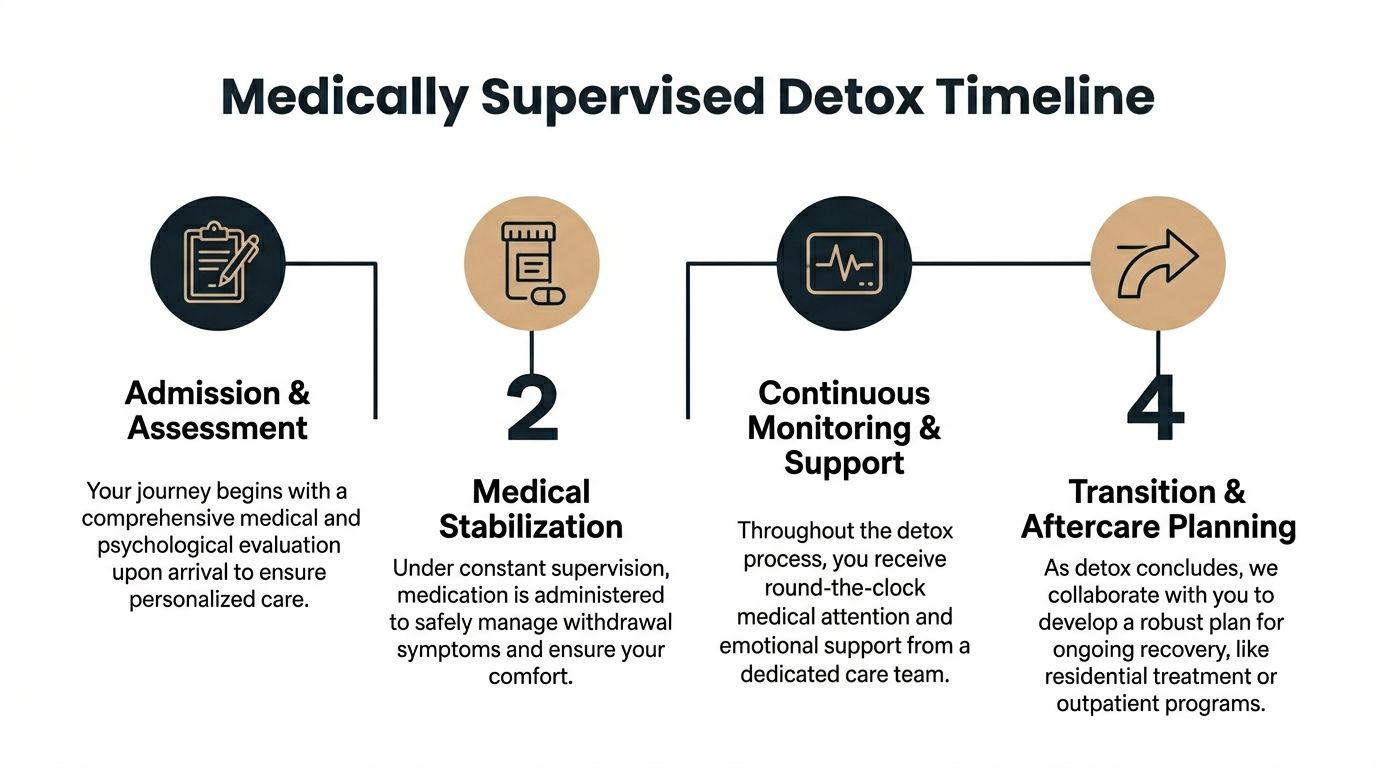
Admission and assessment
The first hours are about getting a clear picture. The clinical team asks what substances were used, how recently, in what pattern, and whether there have been prior withdrawal complications. They also review medications, physical health, mental health symptoms, sleep, nutrition, and immediate safety concerns.
This part matters because detox protocols shouldn’t be generic. An alcohol detox, an opioid detox, and a stimulant crash do not look the same. Neither does a person with panic symptoms compared with someone who arrives exhausted and shut down.
Stabilization and symptom management
Once assessment is complete, detox shifts into active management. Staff check symptoms, monitor vital signs, and use appropriate medications when needed. The goal is not to medicate every feeling away. The goal is to prevent dangerous escalation and reduce suffering enough for the person to remain engaged.
The CIWA-Ar scale is one example of how alcohol withdrawal is tracked. It gives the team a practical way to measure symptom severity and respond in a consistent, evidence-based way.
Common parts of this stage include:
- Medication support: Used when clinically appropriate to ease withdrawal and protect safety.
- Hydration and nutrition: Early recovery often begins with correcting depletion, not just stopping substance use.
- Sleep support: Rest is often fragmented at first, so treatment focuses on stabilization rather than instant normalization.
- Reassurance and orientation: Fear rises when symptoms feel unpredictable. Frequent check-ins matter.
The best detox units don’t just watch symptoms. They interpret them and respond before they spiral.
Ongoing monitoring
Detox is rarely linear. A person may feel better for several hours, then worsen. Another may arrive in distress and stabilize faster than expected. Continuous monitoring gives the team the chance to adjust rather than react late.
Families often ask whether loved ones will be “knocked out” the whole time. In a quality program, that isn’t the aim. The aim is steady improvement in safety, comfort, and clarity.
A simple timeline often looks like this:
- Arrival: Evaluation, immediate safety check, initial medical orders.
- Early withdrawal: Symptoms emerge or intensify. Monitoring is more frequent.
- Peak management: The team responds to the most active period of physical withdrawal.
- Reorientation: Appetite, sleep, mood, and concentration begin to settle.
- Transition planning: The focus turns toward the next level of care.
Preparing for what comes after
Detox should begin discharge planning early, not at the last minute. That includes deciding whether the next step is residential treatment, a day program, outpatient care, or another structured level of support.
For people trying to estimate what the full window might look like, this overview of how long detox can take offers useful context without oversimplifying the process.
Finding the Best Detox Care for Your Needs
Not every person searching for detox in Long Beach needs the same thing. Some need immediate medical stabilization in any safe bed available. Others need strong privacy protections, dual-diagnosis treatment, and a setting that helps them step away from stressors tied to work, relationships, or the city itself.
That difference matters. Choosing a facility only because it is nearby can make sense in an emergency. It’s less wise when someone has options and needs a better clinical fit.

Essential elements
A quality detox program should offer more than a bed and basic observation. The baseline standard is safe care delivered by an experienced team. Beyond that, several details sharply improve the experience and the chances of continuing treatment.
Look for these features:
- Medical staffing around the clock: Withdrawal doesn’t keep office hours.
- Clear medication protocols: The team should be able to explain how symptoms are monitored and when medications are used.
- Dual-diagnosis capability: Anxiety, depression, trauma, and substance use often show up together.
- A real transition plan: Detox without a next step often becomes a brief interruption rather than a turning point.
- An environment that supports staying: Noise, lack of privacy, and constant disruption wear people down fast.
Privacy and comfort are clinical issues
For professionals, executives, public-facing clients, and anyone carrying heavy family or workplace pressure, privacy isn’t a luxury in the superficial sense. It affects whether the person seeks treatment at all and whether they remain long enough to benefit from it.
Many executives and professionals with substance use disorders, up to 50% by some estimates, prefer private, high-comfort detox to protect their careers, and Long Beach has a recognized gap in luxury, discreet options, which is one reason many people look toward premier care in nearby Orange County (American Addiction Centers on Long Beach treatment access and luxury demand).
That doesn’t mean everyone needs an upscale setting. It does mean the right environment can remove barriers that standard care leaves untouched.
Questions worth asking before admission
Families often ask the wrong first question. They ask whether a center is “nice.” A better question is whether the environment helps the person remain safe, calm, and willing to continue care.
A useful screening list includes:
- How is withdrawal monitored?
- Who handles co-occurring psychiatric symptoms during detox?
- What happens if the person needs medication-assisted treatment?
- Will the person move directly into the next level of care, or will there be a gap?
- How is confidentiality handled for working professionals or high-profile clients?
A detox setting should lower friction, not add it. If admission feels chaotic, communication is vague, or psychiatric needs are treated like a side issue, those problems usually continue after intake.
What tends to work best
People often do better when the program removes them from familiar using routines and provides enough comfort that they don’t spend the first several days fighting the setting itself. That may mean private space. It may mean quiet. It may mean distance from local triggers and immediate access to residential or outpatient follow-up.
The best fit is the one that meets both needs at once. Strong medicine and strong surroundings. Safety and dignity. Clinical rigor and enough calm for the nervous system to start settling.
Preparing for a Smooth Admission to Detox
Once the decision is made, momentum matters. Long delays give fear, ambivalence, and logistics too much room to take over. Admission goes more smoothly when the family handles a few practical steps in advance and avoids trying to solve every future problem in one night.
What to do before arrival
Start with the essentials. The admitting team needs accurate information more than polished information.
A practical checklist:
- Gather medication details: Bring a list of current prescriptions, recent substance use, allergies, and relevant medical conditions.
- Pack light: Comfortable clothing, basic toiletries if permitted, identification, and insurance information are usually the priorities.
- Leave restricted items at home: Outside medications, alcohol, drugs, weapons, and valuables typically complicate intake.
- Choose one family contact: A single point person reduces confusion and repeated calls.
What to say to work and family
People often freeze on this part. They worry they need a perfect explanation. They don’t.
Short, clear communication works best. A person can tell family that medical care is beginning and that updates will come through the treatment team as appropriate. A professional may say that a health matter requires immediate attention and short-term leave.
That protects privacy and lowers emotional noise around admission.
Don’t ignore mental health symptoms
A frequently overlooked issue during intake is the presence of a co-occurring mental health condition. For dual-diagnosis clients, success rates can be over 50% with integrated therapy and medication-assisted treatment, compared with 20 to 30% with standard models, which is why it’s so important to choose a detox program with a strong dual-diagnosis track (AKUA on dual-diagnosis detox considerations).
That has a direct implication for admission. If the person has panic, depression, trauma symptoms, mood instability, or suicidal thinking, the family should say so plainly during the first call. That information helps the team place the person appropriately.
Keep the entry point simple
The best admissions are not dramatic. They are organized.
A useful sequence is:
- Make the call: Give honest, direct information about substance use and current symptoms.
- Verify logistics: Confirm transportation, insurance details, and what to bring.
- Stop negotiating with the illness: Once the decision is made, avoid repeated debates about whether treatment is “really necessary.”
- Get there promptly: Delay tends to strengthen resistance, not readiness.
If a person says they want help, treat that window of willingness as time-sensitive.
Next Steps After Detoxification
Detox is the opening phase of recovery, not the finished product. A helpful analogy is this: detox is like the emergency room. It addresses immediate instability. Ongoing treatment is the rehabilitation phase where people learn how to live without returning to the same cycle.
That distinction is one of the most important ideas families need to understand. A person can complete withdrawal successfully and still remain highly vulnerable to relapse if nothing changes afterward.

The Long Beach area has a substantial treatment infrastructure, including 15 inpatient centers, 14 outpatient centers, and 24 specialized rehabs for co-occurring disorders, and a standard medical detox of 5 to 7 days is typically followed by 30 to 90 days of residential or outpatient care, reflecting the importance of a full continuum of care (Detox.net on Long Beach treatment infrastructure and care timelines).
What comes after detox
The next level of care depends on the person’s stability, psychiatric needs, relapse history, and home environment. Some need residential treatment because they require structure all day and night. Others can step into a partial hospitalization or intensive outpatient program if they have sufficient support and can function safely outside a residential setting.
Common options include:
- Residential treatment: Best when someone needs containment, routine, and separation from immediate triggers.
- Partial hospitalization: A strong clinical schedule during the day with more independence than residential care.
- Intensive outpatient: A step that allows treatment while rebuilding work, family, and daily responsibilities.
- Outpatient and aftercare: Ongoing therapy, relapse prevention, and recovery planning over time.
What supports lasting change
People do better when detox and follow-up treatment are connected from the start. That means discharge planning should include appointments, transportation planning, medication follow-up when indicated, and a realistic strategy for the first vulnerable weeks.
The first stretch after detox often involves:
- Rebuilding daily structure: Sleep, meals, movement, and routine matter more than many people expect.
- Identifying triggers: People, places, stress patterns, and emotional states need names, not vague awareness.
- Learning replacement skills: Cravings, anxiety, shame, and conflict need a response plan.
- Including family appropriately: Support helps when it is informed and boundaried.
The transition out of detox is where recovery either gains traction or loses it. A warm handoff is not a luxury. It’s part of good clinical care.
Take the First Step Toward Healing Today
When someone needs detox in Long Beach, the first priority is simple. Get safe. Get assessed. Get through withdrawal in a setting built for medical support, emotional steadiness, and a real next step.
Waiting for a “better time” rarely makes addiction easier to treat. It usually makes the medical picture more complicated and the emotional toll heavier for everyone involved. Families don’t need to solve the whole recovery journey today. They only need to choose the right first move.
The strongest first move is medically supervised detox with a team that can manage withdrawal, address co-occurring mental health concerns, protect privacy, and guide the transition into continued care. That combination gives people the best chance to stabilize with dignity and keep going.
If the person reading this is ready, or if a family member is ready on their behalf, it’s time to act.
Oceans Luxury Rehab offers one of the strongest treatment options in California for people who need safe, discreet, high-comfort addiction care. The program provides oceanfront healing, medically supervised detox, residential treatment, dual-diagnosis support, medication-assisted treatment, and ongoing levels of care in a private setting designed for real recovery. To speak with the admissions team, verify insurance quickly, or begin treatment today, contact Oceans Luxury Rehab.
