

A Los Angeles professional can look steady on the outside and still be unraveling in private. Work deadlines get met. Family obligations stay on the calendar. Social plans continue. But alcohol, pills, stimulants, or opioids start taking up more space, and the fear of getting help often becomes tied to one question: will treatment blow up everything else?
That fear keeps many people stuck far longer than they need to be. For some, the biggest barrier isn’t denial. It’s logistics. It’s confidentiality. It’s the pressure of staying functional while internally knowing something has to change.
Finding Hope and Healing in Los Angeles
A common Los Angeles story looks like this. Someone is still showing up to meetings, answering texts, paying bills, and keeping appearances intact. Then evenings become harder to manage. Sleep gets shaky. Anxiety gets louder. Drinking becomes routine, or prescription misuse turns into dependence. What looked manageable a few months ago starts affecting judgment, energy, and relationships.
For many families, this stage is confusing. The person doesn’t “look” like they need rehab. They may still be working. They may still insist they can stop on their own. That’s one reason outpatient rehab los angeles has become such an important option. It gives people a path into treatment that fits real life, instead of asking them to disappear from it overnight.

Los Angeles County’s need is enormous. An estimated 1,482,612 residents needed substance use treatment in 2022, yet only 0.8% of adults with SUD received care, leaving over 94% untreated according to Los Angeles County substance use statistics. That gap helps explain why so many people are searching for treatment that feels reachable, private, and compatible with work and family life.
Why outpatient care matters in a city like LA
Los Angeles isn’t built for simple decisions. Commutes are long. Careers can be demanding and public-facing. Many people support children, parents, or teams at work. A treatment model that allows a person to live at home and attend structured care during the week can make the difference between seeking help now and putting it off again.
That doesn’t mean outpatient care is casual. Good programs are organized, clinical, and accountable. They can include therapy, psychiatric support, relapse prevention, family work, and medication support when appropriate.
Practical rule: If a person needs help but is delaying because they can’t picture leaving life behind, outpatient care may be the bridge that finally makes treatment possible.
Some families also want a more private setting than they’re likely to find in a large local system. For readers exploring high-comfort options near the city, this overview of Los Angeles luxury rehab can help clarify what discreet treatment may look like.
What concerned families usually need first
Before choosing a program, individuals need three kinds of clarity:
- What outpatient rehab is: Many assume it means a weekly support group. It’s usually much more structured than that.
- Which level of care fits: Detox, residential, PHP, and IOP each serve different needs.
- How privacy works in practice: Professionals often need treatment that respects reputation, scheduling, and confidentiality.
When those pieces become clearer, the decision usually feels less overwhelming. Recovery starts looking less like a life interruption and more like a workable plan.
Understanding Outpatient Rehab A Flexible Path to Recovery
Outpatient rehab is easiest to understand when it’s compared to physical therapy after an injury. A person doesn’t live at the clinic. They attend structured sessions, work on specific skills, follow a treatment plan, and then apply those tools in everyday life between appointments. Addiction treatment can work in a similar way.
That’s the core idea behind outpatient care. A person receives clinical treatment while continuing to live at home, in sober living, or in another stable environment. The work happens in both places. It happens during sessions, and it happens later when stress, cravings, work pressure, or conflict show up in real life.
What outpatient rehab actually includes
People often hear “outpatient” and assume it means low intensity. That’s not always true.
Depending on the program, outpatient care can involve several therapy sessions a week, psychiatric check-ins, drug testing, family sessions, recovery planning, and structured skill-building. The schedule can be light or highly involved. What matters is matching intensity to the person’s current risks and needs.
A quality outpatient program often helps with:
- Trigger management: identifying people, places, routines, and emotions connected to substance use
- Relapse prevention: building practical responses before high-risk situations happen
- Mental health treatment: addressing anxiety, depression, trauma, or mood instability alongside addiction
- Daily-life integration: practicing sober routines in actual work, family, and social environments
Outpatient treatment asks a person to recover in the same world where the problem developed. That can be difficult, but it can also be powerful because the learning is immediate and practical.
How outpatient differs from inpatient care
Residential treatment and outpatient treatment both have value. They answer different clinical realities.
Residential care removes a person from their normal environment and provides round-the-clock structure. That can be the right choice when someone is medically unstable, highly relapse-prone, unsafe at home, or unable to stay sober outside of a contained setting.
Outpatient care keeps a person connected to ordinary life while treatment is underway. For someone with a stable living environment and enough support, that flexibility can be a major strength.
A simple distinction helps:
- Residential treatment creates a protected environment first, then prepares someone to return home.
- Outpatient treatment helps someone build recovery skills while still moving through ordinary responsibilities.
Why this model fits many Los Angeles adults
In Los Angeles, many people don’t need less treatment. They need treatment that can coexist with real obligations. A parent may need to be home at night. A business owner may need to handle limited work communication. A creative professional may need scheduling that protects privacy.
Some people also start with smaller behavior changes before they’re ready for full abstinence. In those early stages, resources that support lifestyle shifts can be useful alongside formal treatment. For readers exploring healthier social routines, effective alternative to alcohol options can be one practical starting point.
What outpatient is not
It isn’t a shortcut. It isn’t “rehab lite.” And it isn’t the right fit for everyone.
If someone is at risk for dangerous withdrawal, active self-harm, severe psychiatric instability, or repeated inability to stay sober outside of supervision, a higher level of care is often safer. But when outpatient is matched appropriately, it can be a serious, structured, and effective path forward.
Detox vs Residential vs PHP vs IOP Which Is Right for You
Families often get lost in the language of treatment. Detox sounds like rehab. Rehab sounds like one single place. Then terms like PHP and IOP appear, and everything gets blurry.
The simplest way to think about it is this. These are different levels of care, not different philosophies. Each one answers a different question about safety, structure, and daily support.
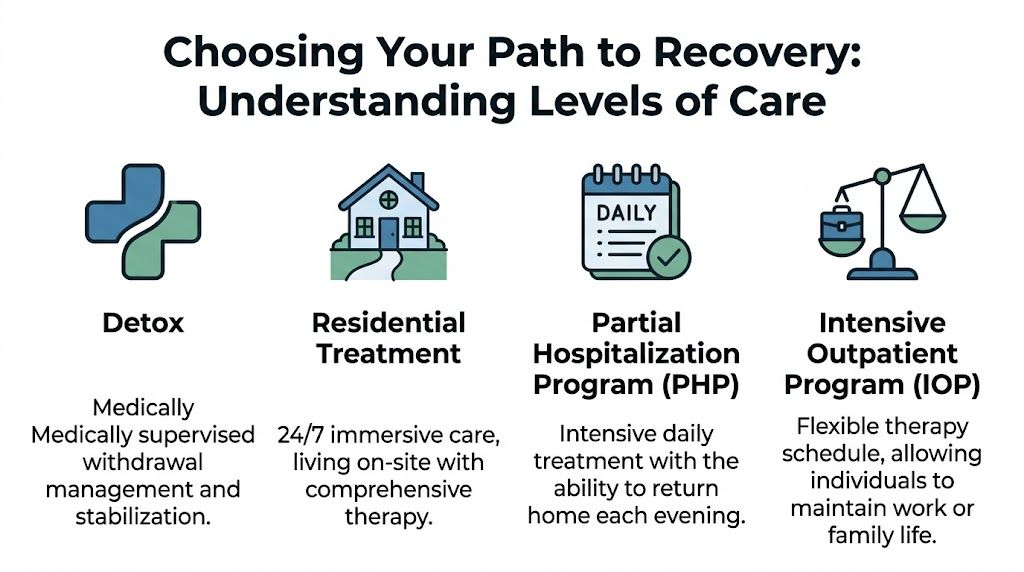
Comparing Levels of Addiction Care
| Level of Care | Time Commitment | Living Situation | Best For |
|---|---|---|---|
| Detox | Short-term, medically supervised stabilization | Usually on-site medical setting | People who may face unsafe withdrawal or need immediate stabilization |
| Residential Treatment | Full-time, 24/7 care | Lives on-site | People who need intensive structure away from triggers and daily pressures |
| PHP | 6 hours a day, 5 days a week | Lives at home or in supportive housing | People who need strong daily support but don’t need overnight care |
| IOP | Often 15 hours a week | Lives at home or in supportive housing | People who need structured treatment with more flexibility for work or family |
Detox when stopping feels physically risky
Detox is the first stage for people whose bodies have become dependent on alcohol, opioids, or certain medications. The goal isn’t long-term recovery yet. The goal is safe withdrawal and stabilization.
A family should think about detox when someone says they want to stop, but there are warning signs like significant withdrawal history, heavy use, or inability to get through even a short period without substances.
For readers trying to understand this first phase more clearly, medical detox in Los Angeles can help explain when detox should come before outpatient work.
Residential when daily life is too unstable
Residential treatment is often the right fit when a person keeps relapsing in the same environment, has a chaotic home life, or needs distance from access, social pressure, and constant stress. They live on-site and follow a full daily schedule.
This level can also be useful for someone who says they want help but can’t reliably follow through without direct structure. The environment does a lot of the heavy lifting at first.
PHP for strong daily support without sleeping on-site
A Partial Hospitalization Program, or PHP, sits between residential and IOP. It’s a high-structure outpatient model. In the LA area, PHPs typically provide 6 hours of treatment per day, 5 days a week, integrating medical management and multiple therapy types, with 70-80% stabilization rates before a step-down according to LA-area PHP program data.
That schedule gives a more concrete picture of what outpatient can mean. PHP is often appropriate for someone who has completed detox, has a reasonably safe home environment, and still needs consistent daytime support.
A person in PHP might need help with:
- Post-detox instability: cravings, fatigue, mood swings, and poor judgment can still be strong
- Dual diagnosis symptoms: anxiety, trauma reactions, depression, or bipolar symptoms may need close monitoring
- High relapse vulnerability: the person isn’t safe enough for minimal care, but doesn’t need overnight supervision
IOP for structured care with more room for life
An Intensive Outpatient Program, or IOP, usually gives more flexibility than PHP while keeping treatment active and clinically meaningful. It can work well for someone stepping down from PHP or for someone who doesn’t need full-day care but still needs strong support.
IOP often fits people who are trying to continue working, parenting, or managing other obligations while staying engaged in recovery. Evening scheduling can be especially helpful in Los Angeles, where daytime work demands and travel can complicate treatment attendance.
A useful self-check is whether the person can remain safe and sober outside program hours. If the answer is uncertain, a higher level of care may be wiser.
How families can narrow the decision
When deciding between these levels, three questions usually matter most:
- Is there any medical risk if substances stop suddenly? If yes, detox should be considered first.
- Can the person stay safe and sober at home overnight? If no, residential may be more appropriate.
- How much structure is needed during the day? If a person needs near-daily support, PHP may fit. If they need consistent but more flexible therapy, IOP may fit.
Choosing the right level isn’t about toughness or willpower. It’s about matching support to risk. That match often determines whether treatment feels doable and whether it lasts.
What Happens Inside a Los Angeles Outpatient Program
Once a person accepts that outpatient care may fit, the next question is usually practical. What happens there?
A good program isn’t built around one therapy session and a handshake. It’s a coordinated plan. Each part serves a purpose, and the pieces work better when they’re connected.

Individual therapy and group work
Individual therapy gives a person private space to examine patterns they may not say out loud in a group. That can include shame, trauma, high-functioning denial, family dynamics, work pressure, grief, or fear of change.
Group therapy does something different. It helps people hear themselves more clearly in relation to others. Many clients come in assuming they’re uniquely broken or uniquely in control. Group often disrupts both illusions.
Common clinical approaches include:
- CBT: helps people identify the thought patterns that feed substance use
- DBT-informed skills: supports emotional regulation, distress tolerance, and impulse control
- Relapse prevention planning: turns vague intentions into specific actions for high-risk moments
Family involvement and accountability
Addiction rarely affects one person in isolation. Even when a client attends treatment alone, the home system usually needs attention.
Family sessions can help repair communication, set boundaries, reduce enabling, and create more realistic expectations. In outpatient care, this matters even more because the person returns home after treatment sessions. If the home environment remains chaotic or unclear, progress can weaken quickly.
Many programs also use accountability tools such as attendance monitoring, treatment planning, and drug testing. These aren’t about punishment. They help create consistency while recovery is still fragile.
Dual diagnosis care is central, not optional
A large percentage of people seeking help for substance use are also struggling with anxiety, depression, trauma symptoms, or mood instability. If treatment handles only the substance use and ignores the mental health side, relapse risk often stays high.
In dual-diagnosis IOPs, treatment often requires 15 hours of weekly care, and integrated treatment matters because treating substance use and mental health conditions sequentially can increase relapse risk by 40-60%, according to dual-diagnosis IOP guidance.
That’s why modern outpatient care often includes psychiatric evaluation, medication management when appropriate, and therapy that addresses both conditions together.
A person might say, “The drinking is the problem.” But if panic attacks, insomnia, unresolved trauma, or depression are driving the drinking, treatment has to address the full cycle.
“Treat both conditions at the same time” is one of the most important rules in effective outpatient care.
Medication support and skill building
For some clients, Medication-Assisted Treatment, or MAT, can support recovery from alcohol or opioid use disorders. Medication isn’t a replacement for therapy. It can reduce cravings, lower relapse risk, and create enough stability for therapy to work.
At the same time, outpatient treatment teaches practical skills that clients use immediately. That may include:
- Morning planning: building structure before stress takes over the day
- Craving interruption: using specific behavioral tools instead of white-knuckling
- Workplace coping: handling pressure, performance anxiety, and secrecy triggers
- Exit strategies: preparing for dinners, travel, networking events, or difficult family gatherings
Some people also need a more formal step-down plan after higher care. In those cases, a structured intensive outpatient program may provide the right middle ground between full-day treatment and routine life.
What progress usually looks like
Progress in outpatient rehab isn’t just “not using.” A more useful picture includes better sleep, fewer lies, improved follow-through, more regulated emotions, and a growing ability to ask for help before a crisis hits.
That kind of change can look quiet from the outside. But it’s often the foundation of durable recovery.
Is Outpatient Rehab the Right Choice for Your Situation
Outpatient treatment can be highly effective. It can also be the wrong fit if it’s chosen for the wrong reasons. The question isn’t whether someone prefers to stay home. The question is whether staying home still allows treatment to work.
That decision becomes even more nuanced in Los Angeles, where many clients are trying to protect a career, maintain privacy, and avoid unnecessary disruption.

Signs outpatient may be a strong fit
Outpatient care usually works best when a person has enough stability outside program hours. That doesn’t mean life has to be easy. It means the basics are workable.
Good candidates often have several of these factors:
- A safe home environment: no active chaos, easy access to substances, or severe interpersonal instability
- Some willingness to engage: motivation doesn’t have to be perfect, but the person must participate openly enough for treatment to help
- Ability to function between sessions: they can get home safely, follow a plan, and use support instead of spiraling alone
- Manageable medical and psychiatric risk: there isn’t a need for overnight supervision
For professionals, another factor matters. They need a program that can support recovery without exposing private struggles unnecessarily.
Privacy and professional pressure in Los Angeles
Executives, attorneys, healthcare workers, founders, and entertainment professionals often delay treatment because they’re worried about who will know. That concern isn’t vanity. It’s practical. Careers can be affected by visibility, scheduling disruptions, or even the fear of being recognized.
A key challenge in outpatient rehab in Los Angeles is serving high-functioning professionals who need discreet care. This group faces unique pressure, with relapse rates among executives reported as 25% higher due to stress, according to reporting on executive-focused outpatient needs.
That doesn’t mean every professional needs a luxury setting. It does mean generic programming may miss major realities such as:
- Confidential scheduling needs
- Commute management
- High-stress trigger patterns
- Reluctance to speak openly in broad groups
- Pressure to remain “fine” at all times
The best outpatient plan for a working professional doesn’t just fit the calendar. It protects the conditions needed for honesty.
When outpatient may not be enough
Some situations call for more containment, not more flexibility. Outpatient may not be the right starting point if a person is unable to remain sober between sessions, has repeated immediate relapse after prior attempts, faces dangerous withdrawal, or has acute psychiatric symptoms that require close supervision.
Families sometimes push for outpatient because it seems less disruptive. But lower disruption can become a problem if it leaves the person in the same environment that keeps fueling substance use.
A stronger level of care may be appropriate when:
- The person can’t get through a single day or night safely without using.
- Home is unstable, unsafe, or full of triggers.
- They minimize risk so consistently that treatment attendance is likely to collapse.
- Medical or psychiatric symptoms are escalating.
A practical decision lens
A simple framework can help. Outpatient is more likely to work when the person has safety, structure, and support outside program hours.
If one of those is missing, treatment may still be possible. But the plan must account for the weakness accurately. In many cases, the best decision isn’t choosing the least invasive option. It’s choosing the option the person can sustain.
Why Angelenos Choose Oceans for Premier Outpatient Care
California has the largest treatment infrastructure in the country, and outpatient services carry much of that load. Outpatient services in California serve 83,534 patients annually, according to state treatment infrastructure data. For Los Angeles residents, that matters because it confirms something families often discover during the search process. Outpatient care isn’t a side option. It’s a central part of modern addiction treatment.
For professionals and families looking beyond crowded local options, setting matters. So does privacy. So does the emotional effect of leaving the city, even briefly, and entering a calmer treatment space.
Why location can help treatment work
For some LA residents, traveling to Orange County for treatment sounds inconvenient at first. In practice, the separation can help. Distance creates a buffer between the daily environment tied to stress and the environment where recovery work happens.
That buffer can be useful for a client who needs to step out of constant stimulation, avoid familiar drinking or drug-use routines, and arrive somewhere that feels less exposed. The drive becomes a transition point. Work mode winds down. Treatment mode becomes possible.
What discerning clients usually look for
Professionals and families often want more than a basic schedule of groups. They usually ask about comfort, discretion, communication, dual-diagnosis capability, and insurance clarity.
Important features often include:
- Private, comfortable surroundings: people open up more easily when they feel physically safe and respected
- Clinical range: care should address substance use, mental health, relapse prevention, and aftercare together
- Confidentiality: the environment should reduce unnecessary visibility and protect dignity
- Insurance support: quick verification can remove one of the biggest barriers to starting
One outpatient option worth considering
For Los Angeles residents seeking a high-comfort setting with a full continuum of addiction care, Oceans Luxury Rehab offers outpatient programming in an oceanfront San Clemente environment, along with detox, residential, and step-down care. Its services include dual-diagnosis treatment, medication-assisted support when appropriate, family therapy, and PPO insurance verification, which can simplify the admissions process for clients who need discretion and flexibility.
A treatment setting doesn’t need to be flashy. It needs to lower friction, protect privacy, and make honest clinical work easier.
Why this matters for long-term recovery
People don’t usually relapse because they lacked information. They relapse because stress, shame, untreated mental health symptoms, or poor follow-through overwhelmed the recovery plan. A well-matched outpatient setting can reduce those points of failure.
That’s especially true for clients who must balance healing with ongoing adult responsibilities. A right program helps them practice recovery in their daily lives, without feeling exposed, rushed, or forced into a one-size-fits-all model.
Your Questions About Outpatient Rehab Answered
Can someone keep working while in outpatient rehab
Often, yes. That’s one of the main reasons people seek outpatient care in the first place. The exact answer depends on the level of care, work hours, commute, and clinical needs.
Some clients adjust their schedules temporarily, reduce nonessential obligations, or choose evening programming when available. The more demanding the job, the more important it becomes to choose a program with realistic scheduling and clear expectations.
Does outpatient rehab still work if someone lives at home
It can, if home is stable enough to support recovery. A safe environment helps the person apply new coping skills between sessions. An unsafe or chaotic environment can undermine treatment quickly.
Families should ask honest questions about access to substances, conflict at home, secrecy patterns, and whether anyone in the household unintentionally enables use.
What if someone needs privacy because of work or public visibility
That concern is common in Los Angeles. Privacy usually depends less on marketing language and more on operations. Families should ask how scheduling works, how records are handled, how communication is protected, and whether the environment supports discretion.
A person who feels exposed may hold back in treatment. A person who feels protected is more likely to engage openly.
Is outpatient enough after detox
Sometimes. It depends on what the person looks like after withdrawal has been managed. If they’re medically stable, able to stay safe outside of treatment hours, and motivated to engage, outpatient may be appropriate.
If they remain highly impulsive, emotionally unstable, or unable to resist immediate relapse, a higher level of care may still be necessary before stepping down.
How does PPO insurance usually fit into the process
The first step is usually insurance verification. That helps clarify benefits, likely coverage, and any authorizations or out-of-pocket expectations before admission decisions are made.
The process is easier when a program’s admissions team handles verification directly and explains the result in plain language. Families shouldn’t have to decode policy language on their own while a crisis is unfolding.
Is the drive from Los Angeles to Orange County worth it for outpatient care
For many people, yes. Some clients benefit from receiving treatment outside their immediate social and professional orbit. The change in setting can create emotional distance from triggers and make it easier to focus.
The key issue isn’t mileage. It’s whether the schedule is sustainable and whether the treatment environment increases the likelihood of consistent attendance and honest participation.
What should a family ask on the first call
A short list helps keep the conversation focused:
- Level of care: ask what level seems appropriate and why
- Safety: ask whether detox or psychiatric evaluation is recommended first
- Scheduling: ask how treatment can work around job or family obligations
- Dual diagnosis: ask how mental health concerns are treated alongside substance use
- Insurance: ask what can be verified before admission
- Next step: ask what happens after the call if the person wants help
What if the person isn’t fully ready yet
Full certainty usually doesn’t come first. Many people enter treatment while still scared, skeptical, embarrassed, or ambivalent. What matters is whether they’re willing to take the next concrete step.
Sometimes that step is a confidential assessment. Sometimes it’s a conversation with family. Sometimes it’s agreeing to detox first. Movement matters more than confidence.
A confidential conversation can turn confusion into a plan. Oceans Luxury Rehab helps adults and families explore detox, residential care, and outpatient options in a private, high-comfort setting. Admissions is available around the clock, and PPO insurance verification can help clarify practical next steps without pressure.
