

Some people in Orange County wake up already tense. The mind is racing before the workday starts. Meetings, family demands, financial pressure, and the need to keep it all looking polished can make a person feel like they're carrying a hidden weight.
By evening, that same person may reach for alcohol, pills, or another substance just to quiet the noise. At first, it can feel like relief. Then the pattern changes. Anxiety gets sharper. Sleep gets worse. Mood swings become harder to hide. Substance use increases because the original distress never really left.
That pattern has a clinical name. It’s called dual diagnosis, also known as a co-occurring disorder. It means a person is dealing with both a mental health condition and a substance use disorder at the same time.
The Hidden Struggle Introduction to Dual Diagnosis
A common example looks like this. A professional starts drinking to take the edge off social anxiety. Over time, alcohol begins to disrupt sleep, increase irritability, and lower stress tolerance. The anxiety that once showed up mainly before presentations or social events starts showing up everywhere.
Another example is someone living with depression who begins misusing stimulants to get through the workday, then uses sedatives at night to come back down. From the outside, it may look like a “substance problem.” Underneath, the person may be fighting hopelessness, exhaustion, panic, trauma, or a mix of all of them.

This struggle is far more common than many families realize. Roughly 50% of individuals struggling with substance abuse also have a co-occurring mental health disorder, according to Pacific Sands Recovery’s dual diagnosis overview.
That number matters because it changes how treatment should work. If someone has both addiction and a mental health condition, treating only the drinking, drug use, panic, depression, or trauma won't be enough. One untreated issue keeps reactivating the other.
Why people often miss it
Dual diagnosis can hide in plain sight.
A spouse may notice drinking, but not the severe anxiety driving it. An employer may see missed deadlines, but not the depression underneath. Even the person suffering may believe the problem is only stress, only insomnia, or only “too much partying.”
Dual diagnosis often feels confusing because both conditions can mimic, worsen, and conceal each other.
Why hope is realistic
The right care can untangle what feels impossible. Good treatment doesn't ask a person to choose whether the primary problem is mental health or addiction. It addresses both together, with one coordinated plan.
That’s the heart of effective dual diagnosis treatment orange county programs. When care is integrated, the path forward becomes clearer, safer, and far more humane.
The Tangled Knot What Is Dual Diagnosis
Dual diagnosis is best understood as a tangled knot. One strand is mental health. The other is substance use. Pull on only one strand, and the knot tightens.
A person with untreated PTSD may drink to numb intrusive memories. A person using stimulants heavily may develop severe anxiety, paranoia, or depression. Sometimes the mental health condition comes first. Sometimes the substance use comes first. Often, they become so intertwined that it’s hard to tell where one ends and the other begins.
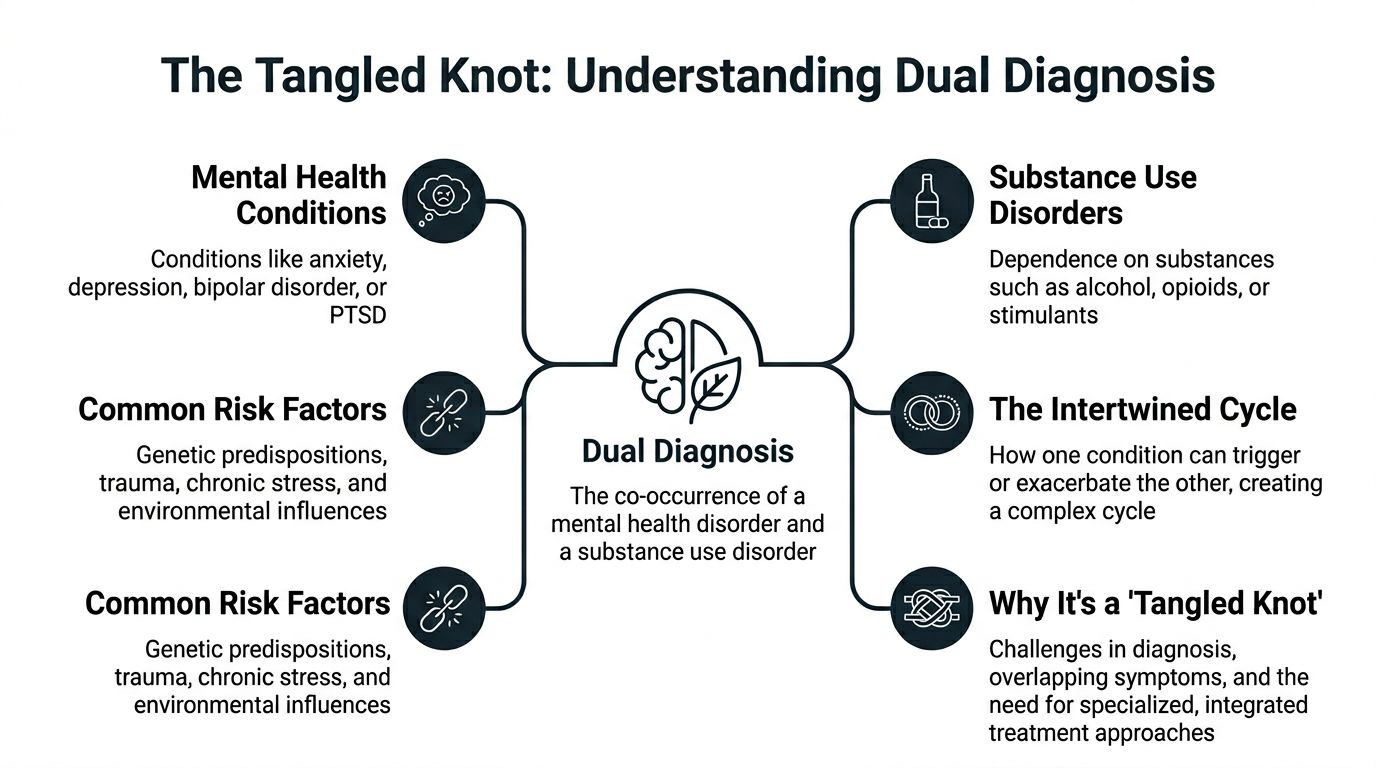
Two conditions that feed each other
Mental health disorders can increase the urge to self-medicate. Substances may seem to offer quick relief from anxiety, sadness, agitation, shame, or emotional pain.
Then substances start changing the picture. Alcohol can deepen depression. Stimulants can intensify panic and sleeplessness. Opioids can blunt distress at first, then leave a person emotionally flatter and more fragile when they wear off.
That’s why this condition can feel like a trap.
Treating only the substance use while ignoring the panic, trauma, or depression underneath is like mopping up water while the pipe is still leaking.
Common pairings clinicians often see
Dual diagnosis can involve many combinations. Some of the more recognizable patterns include:
- Anxiety with alcohol use. The person drinks to relax, then becomes more anxious as dependence grows.
- Depression with stimulant misuse. Energy is borrowed artificially, then crashes become more severe.
- PTSD with sedative or opioid misuse. Substances become a way to block memories, hypervigilance, or emotional pain.
- Bipolar symptoms with multiple substances. Different drugs may be used to either speed up, slow down, or sleep.
The exact combination matters because treatment planning should match the person, not just the diagnosis label.
Why diagnosis gets so complicated
One of the hardest parts of dual diagnosis is something clinicians call diagnostic overshadowing. It means substance use symptoms can hide the mental health disorder, or mental health symptoms can hide the substance use disorder.
High-quality dual diagnosis programs address diagnostic overshadowing, where SUD symptoms mask mental health disorders in 50-70% of cases, as described in this dual diagnosis treatment listing on Psychology Today.
A simple example helps. If someone is using cocaine and also showing agitation, insomnia, and racing thoughts, are those drug effects, a mood disorder, or both? If someone drinks daily and also appears withdrawn and hopeless, is that alcohol-related depression, major depressive disorder, or a combination?
Why one-sided treatment usually fails
Programs that split mental health and addiction into separate silos often miss the full picture. A person may get sober briefly, then relapse because the untreated anxiety becomes unbearable. Or a person may start psychiatric care, but keep using substances that destabilize progress.
A more useful way to think about dual diagnosis is this:
| What happens | Why it matters |
|---|---|
| Mental health symptoms increase | Substance use often rises as a coping attempt |
| Substance use increases | Mood, sleep, judgment, and emotional regulation worsen |
| Symptoms overlap | The wrong treatment plan becomes more likely |
| Both are treated together | Recovery becomes more stable and more realistic |
The clinical takeaway
Dual diagnosis isn’t a lack of willpower. It’s a complex interaction between brain, behavior, stress, and emotional survival.
Once that knot is recognized for what it is, treatment stops being a blame-based process and becomes a coordinated medical and psychological one.
Integrated Treatment The Gold Standard of Care
A strong dual diagnosis program doesn't bounce a person between disconnected providers. It builds one plan that addresses detox, psychiatric stability, therapy, medication needs, and relapse prevention in a coordinated way.
That approach is called integrated treatment. It’s considered the gold standard because the two conditions influence each other constantly.

Integrated care using evidence-based practices like cognitive behavioral therapy (CBT) and dialectical behavior therapy (DBT) targets the bidirectional relationship where untreated mental health disorders can exacerbate SUD relapse rates by 40-60%, according to Wavecrest Behavioral Health’s dual diagnosis treatment overview.
Medically supervised detox
For many people, treatment begins with detox. This stage matters even more when psychiatric symptoms are present.
Withdrawal can intensify fear, agitation, depression, insomnia, and confusion. Without close monitoring, it can be hard to tell what symptoms come from withdrawal, what symptoms reflect an underlying mental health disorder, and what needs urgent intervention.
A medically supervised setting helps in several ways:
- Safety first. Medical staff can monitor withdrawal and respond if symptoms escalate.
- Better assessment. Clinicians can observe what remains after substances begin to clear.
- More comfort. Symptom management helps people stay engaged instead of leaving early.
- A calmer start. Stabilization creates a clearer foundation for therapy.
Medication can support recovery
Some people hesitate when they hear about medication in addiction treatment. That reaction is understandable. Many have already had painful experiences with substances and don't want to feel dependent again.
In quality dual diagnosis care, medication isn't a shortcut. It’s one tool among many.
Medication-Assisted Treatment, often called MAT, may help reduce cravings and support stability for certain substance use disorders. Psychiatric medications may also help with depression, anxiety, mood instability, or trauma-related symptoms when they’re carefully assessed and monitored.
The point isn't to medicate every symptom away. The point is to reduce enough chaos that a person can think clearly, sleep better, participate in therapy, and practice recovery skills.
Therapy has to address both sides of the problem
Integrated treatment becomes most visible here.
CBT helps people identify the thoughts, beliefs, and habits that keep both substance use and emotional distress going. A person might learn to catch patterns like, “If work goes badly, drinking is the only way to calm down,” and replace them with more accurate, workable responses.
DBT adds another layer. It focuses on distress tolerance, emotional regulation, mindfulness, and interpersonal effectiveness. For people who feel overwhelmed quickly, react intensely, or swing between shutting down and exploding, DBT can be especially useful.
Practical rule: If a program treats addiction in one room and mental health in another without one shared plan, it isn't providing true integrated care.
What coordinated care looks like in practice
A quality program often includes several moving parts working together:
- One assessment process that evaluates substance use, psychiatric symptoms, medical needs, and history together.
- A unified treatment team so therapists, nurses, physicians, and case managers aren’t operating in isolation.
- Individualized pacing because some people need emotional stabilization before deeper trauma work.
- Step-down planning so support continues beyond inpatient or residential care.
For a closer look at how coordinated care can work in a high-comfort setting, this internal guide on understanding dual diagnosis treatment at a luxury rehab adds helpful context.
Why environment matters in integrated care
Clinical quality comes first. Still, environment can support clinical outcomes.
When a person feels exposed, ashamed, sleep-deprived, or constantly overstimulated, treatment becomes harder. Privacy, calm surroundings, and predictable structure can lower resistance and make it easier to engage openly. That matters even more for professionals, public-facing individuals, and anyone who has spent years hiding both their suffering and their substance use.
Why Orange County Demands a Specialized Approach
Orange County has unique pressures. Success can look polished from the outside while life feels unmanageable underneath. Many adults carry demanding careers, public-facing responsibilities, family roles, and social expectations that leave very little room to admit distress.
That environment can make dual diagnosis harder to spot and harder to treat. People often keep functioning long after they’ve stopped feeling well. They may still show up at work, answer emails, and maintain appearances while anxiety, depression, trauma symptoms, or substance dependence steadily worsen.
The local need is not theoretical. Orange County's drug and alcohol crisis peaked in 2020 with over 13,000 emergency department visits, 6,600 hospitalizations, and more than 1,000 deaths from overdoses, according to OC Health Care Agency overdose and hospitalization data.
Why local context changes treatment needs
A generic rehab model may miss what recovery requires in this region.
For example, an executive may need confidentiality, psychiatric care, and a discharge plan that accounts for high-stress meetings, travel, and a quick return to visible responsibilities. A parent in South Orange County may need treatment for alcohol misuse and panic attacks, while also needing family involvement and structured follow-up. A young adult may present with stimulant misuse, insomnia, and severe emotional volatility that requires closer psychiatric attention than a standard addiction-only track can offer.
Pressure doesn’t always look dramatic
Many people picture severe addiction as obvious chaos. In Orange County, dual diagnosis can look more subtle:
- Controlled on the surface. A person still performs professionally but relies on substances to regulate mood.
- Socially acceptable misuse. Heavy drinking may be normalized in certain settings, which delays recognition.
- Private mental health symptoms. Panic, trauma, and depression often stay hidden until a crisis breaks through.
- Fear of exposure. Concerns about reputation can stop people from asking for help early.
In high-pressure communities, the ability to function can hide the depth of suffering.
Why setting matters here
Treatment has to meet the person where they live, work, and recover. That means understanding privacy concerns, performance pressure, burnout, family image, and the practical reality of stepping away from responsibilities long enough to stabilize.
The setting itself can also help. A quieter coastal environment often gives the nervous system a chance to downshift. For many people, that reduction in noise, traffic, stimulation, and scrutiny makes it easier to sleep, reflect, and accept care.
This internal resource on why Orange County is ideal for luxury rehab explores how location, privacy, and treatment environment can shape the recovery experience.
How to Choose a Dual Diagnosis Provider in Orange County
Choosing a provider for dual diagnosis treatment orange county can feel overwhelming, especially for families trying to make decisions quickly. Marketing language often sounds similar. Key differences show up in assessment, staffing, clinical coordination, and follow-through.
A useful starting point is to think less like a shopper and more like an informed advocate. The goal isn't to find the prettiest website or the most reassuring slogan. The goal is to find a program that can correctly identify both disorders and treat them together.

Questions that reveal quality
These questions often separate surface-level programs from integrated ones:
- How is the assessment done? A strong provider looks at mental health, substance use, medical status, trauma history, and current functioning together.
- Who manages psychiatric needs? Families should ask whether licensed clinicians and medical staff are actively involved in diagnosis, medication review, and symptom monitoring.
- Is detox available if needed? Some people need a safe medical start before therapy can work.
- What levels of care are offered? Recovery often works best when treatment can step down gradually rather than end abruptly.
- How personalized is the plan? A useful plan should reflect the person’s symptoms, substances used, history, stressors, and goals.
Watch for the problem of masked symptoms
This point is easy to miss but clinically important. High-quality dual diagnosis programs address diagnostic overshadowing, where SUD symptoms mask mental health disorders in 50-70% of cases, based on the earlier-cited Psychology Today listing. In practical terms, that means a provider should be careful, not rushed, when deciding what symptoms belong to withdrawal, what belongs to psychiatric illness, and what belongs to both.
If a center labels someone too quickly without enough observation, treatment may head in the wrong direction.
A careful diagnosis is part of treatment, not a delay before treatment.
A practical checklist for families
The table below can help narrow options.
| What to check | What a strong answer sounds like |
|---|---|
| Clinical model | Mental health and addiction are treated in one coordinated plan |
| Staffing | Licensed therapists, medical oversight, and psychiatric support are available |
| Continuum of care | Detox, residential, and step-down options are available when appropriate |
| Personalization | Treatment is adjusted to diagnosis, history, and day-to-day functioning |
| Family involvement | Family therapy or education is offered when clinically appropriate |
| Discharge planning | Aftercare begins before discharge, not after a crisis |
Environment isn't a luxury detail
People often dismiss setting as secondary. Sometimes it is. Sometimes it isn’t.
For clients carrying shame, burnout, trauma, or public visibility, environment can shape whether they stay long enough to benefit. Privacy, rest, and emotional safety can lower defensiveness and increase openness. That’s especially relevant in dual diagnosis care, where treatment depends on accurate disclosure.
This internal article on the importance of personalized addiction treatment plans gives a useful framework for evaluating whether a provider tailors care or applies a standard template.
The Oceans Luxury Rehab Difference Premier Dual Diagnosis Care
When a person needs dual diagnosis treatment, the standard should be clear. The program should offer medical support, psychiatric awareness, evidence-based therapy, coordinated planning, and a setting that protects dignity.
Oceans Luxury Rehab in San Clemente offers that kind of care through an oceanfront treatment setting in Orange County with medically supervised detox, residential inpatient care, partial hospitalization, intensive outpatient, outpatient services, private rooms, 24/7 nursing, physician oversight, individualized treatment planning, medication-assisted treatment when appropriate, dual-diagnosis care, family therapy, relapse prevention, aftercare planning, and quick PPO insurance verification.
Why this model fits dual diagnosis
A person dealing with both addiction and mental health symptoms often can't recover in a chaotic environment. They need enough structure to feel safe, enough clinical depth to identify what’s driving symptoms, and enough privacy to speak openly. That combination matters for several groups:
- Professionals and executives who need discretion while stepping away from high-visibility roles.
- Adults with burnout and hidden psychiatric symptoms who have been using substances to keep functioning.
- Clients who need detox and psychiatric monitoring before they can participate fully in therapy.
- Families seeking continuity from stabilization through aftercare planning.
What high-comfort care changes
Luxury care isn't just about aesthetics. In dual diagnosis work, comfort can support treatment engagement.
A private room can help someone rest after months or years of poor sleep. A calm oceanfront environment can reduce overstimulation. Consistent nursing and physician oversight can make medication adjustments and withdrawal support feel safer. Those details don't replace clinical care, but they can make clinical care easier to receive.
Why discretion matters
Many adults delay treatment because they fear being recognized, judged, or exposed. That fear is especially common among people with demanding careers, community visibility, or family roles that depend on appearing stable.
Discretion changes the equation. When privacy is protected, people are often more willing to admit the full story. That may include panic attacks, trauma symptoms, misuse of prescribed medication, hidden drinking, cocaine use on business trips, or that “high functioning” has become unsustainable.
The full continuum matters
Dual diagnosis recovery usually doesn't end after detox or a short residential stay. People often need a step-down path that continues building skills while daily life returns.
A continuum of care helps with that transition. It allows treatment intensity to change as the person stabilizes, rather than dropping from round-the-clock support into total independence overnight. For clients balancing professional obligations, family demands, and mental health recovery, that flexibility can be the difference between short-term improvement and lasting progress.
What families should look for in any premier program
Even beyond one provider, the strongest programs usually share a recognizable pattern:
- They assess thoroughly before labeling quickly.
- They combine addiction treatment with psychiatric care instead of separating them.
- They protect privacy without sacrificing accountability.
- They plan for life after treatment from the beginning.
- They create a setting where people can finally stop performing and start healing.
For many adults in Southern California, especially those seeking privacy, comfort, and integrated care in one place, that model is what makes dual diagnosis treatment feel possible.
Your Path to Recovery Admissions and What to Expect
Starting treatment often feels bigger in the mind than it is in practice. Most families are relieved once the process becomes concrete.
The first step is usually a confidential call. Admissions staff gather basic information about substance use, mental health symptoms, immediate safety concerns, insurance, and the level of support the person may need. The purpose isn't to judge. It’s to identify the safest next step.
What usually happens next
- Insurance is reviewed. Many people want to know quickly whether PPO benefits may apply.
- A clinical screening is completed. This helps determine whether detox, residential care, or another level of care makes sense.
- Arrival planning begins. Staff explain what to bring, what to expect, and how the first day usually unfolds.
How to prepare emotionally
Families don't need perfect answers before making that first call. They only need enough candor to describe what's happening now.
Useful preparation can include a short list of recent symptoms, substances used, current medications, and major concerns such as panic attacks, depression, poor sleep, or relapse risk. Some families also find it helpful to gather supportive wellness items and routines. For example, movement and physical rehabilitation tools can become part of recovery planning after stabilization, and resources like tools for smarter recovery may help when building healthy daily structure.
The main point is simple. Admission is a guided process. People don't have to face it alone.
Frequently Asked Questions About Dual Diagnosis Treatment
How long does dual diagnosis treatment usually last
It varies by person. Some need detox and residential care first. Others may be appropriate for a step-down level of care after assessment. The right length depends on symptom severity, substance use history, psychiatric stability, home support, and how safely the person can transition back into daily life.
Is dual diagnosis treatment different from standard rehab
Yes. Standard addiction treatment may focus mainly on stopping substance use. Dual diagnosis treatment addresses addiction and mental health together. That usually means more detailed assessment, closer psychiatric attention, and therapy that accounts for both emotional symptoms and relapse patterns.
Will insurance cover treatment
Coverage depends on the specific plan and the level of care recommended. Many treatment centers work with PPO plans and can verify benefits quickly. Families are usually best served by calling directly rather than guessing based on online summaries.
What if the person isn't sure whether they have a mental health disorder
That uncertainty is common. Many people enter treatment knowing something is wrong but not knowing whether the main issue is anxiety, depression, trauma, addiction, or all of the above. A careful clinical evaluation helps sort that out over time.
Why does aftercare matter so much
Because early recovery is only the beginning. Stress returns. Triggers reappear. Work and family pressures come back online.
National SAMHSA data shows relapse rates of 40-60% for dual diagnosis without thorough aftercare, as summarized in Clear Life Recovery’s discussion of dual diagnosis treatment in Orange County. That’s why discharge planning, outpatient support, therapy, medication follow-up, family work, and relapse prevention planning matter so much.
Recovery becomes more durable when support continues after the initial crisis has passed.
Can professionals get treatment without losing privacy
In many cases, yes. Privacy-focused programs can help clients step away from daily demands, stabilize, and begin treatment in a more discreet environment. For professionals, that can reduce one of the biggest barriers to asking for help in the first place.
Oceans Luxury Rehab provides confidential, oceanfront addiction and dual diagnosis treatment in San Clemente with medically supervised detox, residential care, outpatient levels of care, private rooms, and 24/7 admissions support. To learn more or verify insurance, visit Oceans Luxury Rehab.
