
Quick answer: For most people, THC is detectable in urine for about 3 days after occasional use and up to 30 days (sometimes longer) after heavy daily use. Blood clears faster — usually 1–2 days — saliva within about 1–3 days, and hair tests can reflect use for up to 90 days. The single biggest factor is how often and how much you used, because THC is stored in body fat and released slowly. The table below breaks it down, and the sections after it explain what shifts your personal timeline.
If you’re quitting cannabis and want to know what to expect — or you’re worried about your use — Oceans Luxury Rehab’s team is available 24/7 at (844) 798-0516, and we can verify your insurance benefits for free.
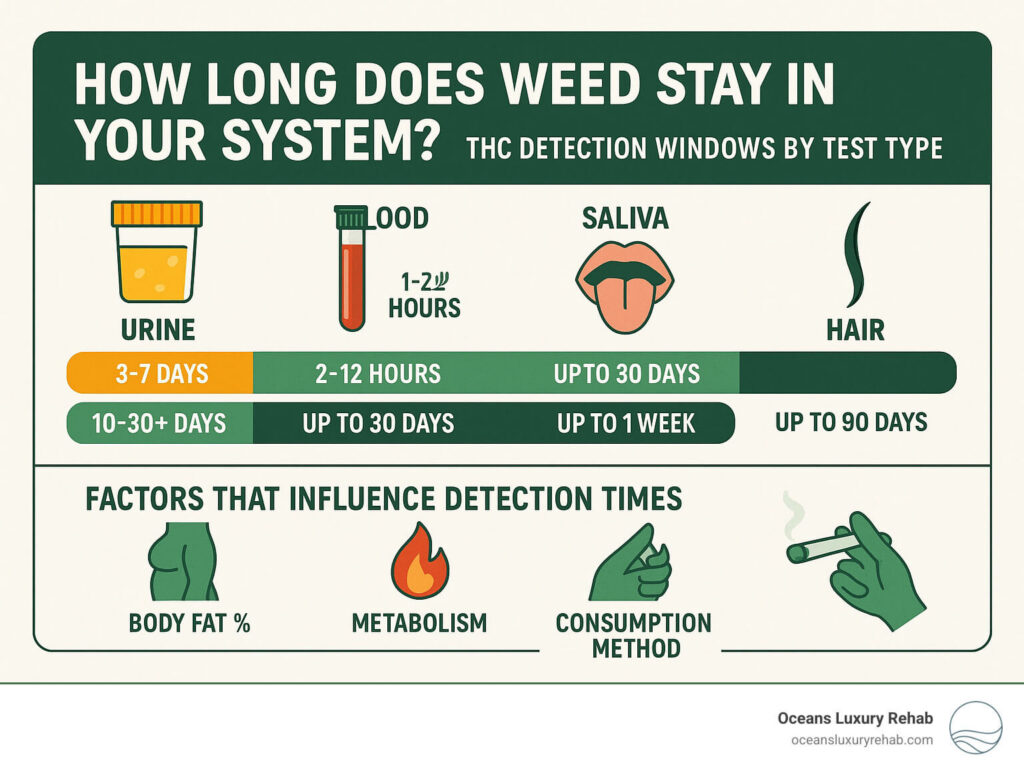
How long is THC detectable? (estimates, not guarantees)
| Test type | Occasional use (≤3×/week) | Moderate use (several×/week) | Daily use | Heavy/chronic daily |
|---|---|---|---|---|
| Urine (most common) | ~3 days | ~5–7 days | ~10–15 days | up to 30 days, sometimes longer |
| Blood | ~1–2 days | ~2–7 days | up to ~7 days | up to ~7+ days |
| Saliva | ~24 hours | ~24–72 hours | ~1–3 days | up to a few days |
| Hair | up to 90 days | up to 90 days | up to 90 days | up to 90 days |
These are typical ranges, not promises. THC is fat-soluble and stored in body fat, so clearance varies widely from person to person and there’s no reliable way to rush it.
Detection windows by test type
Urine is by far the most common test, and it doesn’t look for THC itself — it looks for THC-COOH, a byproduct your body clears slowly. That’s why urine windows stretch to weeks for regular users while other tests clear in days. A one-time user often tests clean within a few days; a heavy daily user can remain positive for a month or more.
Blood shows recent use. THC appears in the bloodstream within minutes of use and usually falls below detection within a day or two for occasional users, though it can persist about a week in heavy, long-term users. Blood tests are used less often and typically indicate recent use rather than a long history.
Saliva has the shortest window — roughly 24 to 72 hours — and is increasingly used for roadside and workplace testing because it reflects fairly recent use.
Hair has the longest reach. Because trace compounds are deposited in the hair shaft as it grows, a standard hair test can reflect cannabis use over the previous 90 days. Light or one-time use may not show up reliably in hair, but regular use usually does.
How your body processes THC
Understanding one piece of biology explains most of what’s confusing about these timelines. When you use cannabis, THC enters your bloodstream and the liver breaks it down — first into an active compound (11-hydroxy-THC) and then into an inactive one called THC-COOH. That final metabolite is the key to drug testing: it isn’t what got you high, it’s fat-soluble, and it lingers in the body far longer than THC itself.
Standard urine tests don’t actually measure THC — they measure THC-COOH. That’s why you can test positive long after the effects have completely worn off. And because THC-COOH is stored in fat and released slowly, it has a long, variable elimination half-life; every repeated use adds to the stored amount faster than the body can clear it. This single fact — a fat-stored metabolite with a slow release — is the main reason cannabis stays detectable so much longer than most other substances.
Occasional versus chronic use: why the gap is so wide
The difference between an occasional user and a daily user isn’t small — it can be the difference between 3 days and 30. Here’s why: each time you use, THC is absorbed and much of it is stored in fat tissue. An occasional user stores relatively little and clears it quickly. A daily user keeps topping up that store faster than the body can empty it, building a reservoir that then takes weeks to release after the last use. This is also why two people who quit on the same day can test positive for very different lengths of time.
What changes your timeline
The ranges above are wide for a reason: how long THC stays detectable depends less on a single rule and more on a handful of overlapping factors. The biggest is simple — how much and how often you use. THC and THC-COOH build up with repeated use, so an occasional user clears in days while a long-term daily user can test positive for weeks.
That buildup lives in fat, which is the second key factor: body composition. THC is fat-soluble, so it’s stored in fat tissue and released back into the bloodstream slowly. People with a higher body-fat percentage tend to hold onto it longer, and because release is gradual, there’s no way to simply “flush” it out on demand.
Metabolism and activity shift things too — a faster metabolism processes THC more quickly — as does the potency and dose of what was used, since higher-THC products load more into the system per session.
Two factors cause a lot of confusion. Hydration changes the concentration of a urine sample but not the actual amount of THC stored in your body; drinking large amounts of water before a test mostly dilutes the sample, which labs frequently flag and re-test. And the test itself matters: hair looks back furthest, saliva the shortest, and even among urine tests the lab’s cutoff sensitivity affects whether a given level reads positive.
The short version: frequency of use and body composition drive most of the variation, and because THC is stored in fat and released slowly, there is no reliable way to rush the process. Time and complete cessation are what clear it. If your goal is to stop rather than to pass a test, the more useful questions are how to detox safely and what withdrawal feels like — see our guides to how to detox from weed and managing weed withdrawal symptoms.
Can secondhand smoke or a false positive affect your test?
Two worries come up constantly. The first is false positives. The quick, inexpensive screening tests (immunoassays) can occasionally flag a sample based on an unrelated compound — but any non-negative result that actually matters, like an employment or legal test, is normally sent for confirmatory testing (GC-MS or LC-MS). That second step is highly specific and rules out a substance that isn’t THC-COOH, so a true false positive rarely survives it.
The second worry is secondhand smoke. Under realistic, everyday conditions, passive exposure to cannabis smoke is very unlikely to push you over standard testing cutoffs. It would take extreme, prolonged exposure in a small, unventilated space to approach a positive — ordinary time spent near someone who’s smoking won’t do it.
Does CBD show up on a drug test?
CBD itself isn’t what drug tests look for, and pure CBD shouldn’t cause a positive. The catch is the product. Many full-spectrum CBD oils and gummies contain trace amounts of THC, and with heavy or daily use those small amounts can accumulate enough to trigger a positive THC result. If testing is a concern, broad-spectrum or isolate products labeled THC-free are lower risk — though because the supplement market is loosely regulated, a label alone is never a full guarantee.
At-home tests versus lab tests
Home urine kits use the same general approach as an initial lab screen and are keyed to a common cutoff — often 50 ng/mL of THC-COOH. They’re useful for a rough personal check, but they give a yes/no around that threshold rather than a precise number, and they can’t replicate a lab’s confirmatory step. A formal test — especially for employment or legal purposes — screens first and then confirms any non-negative result with more sensitive equipment, which is why lab results carry more weight than an at-home strip.
When your timeline points to something bigger
Watching the calendar after quitting is normal. But if you find you can’t cut back even when you want to, keep using despite problems it’s causing, or feel you need cannabis to sleep or function, that’s worth paying attention to — it may signal cannabis use disorder, which is common and treatable. Evidence-based care starts with an assessment and can include medically supervised detox, outpatient treatment, and support for any co-occurring anxiety, depression, or sleep problems underneath the use.
To talk it through with someone, call Oceans Luxury Rehab 24/7 at (844) 798-0516, or verify your insurance benefits at no cost.
Frequently asked questions
How long does weed stay in your urine? Urine is the most common test, and the window depends heavily on how often you use. For occasional users it’s usually around 3 days; for moderate users about 5–7 days; for daily users roughly 10–15 days; and for heavy, long-term daily users it can be up to 30 days or occasionally longer. These are estimates, not guarantees.
Does THC stay in your system longer if you’re a heavy user? Yes. THC and its byproducts accumulate with repeated use and are stored in body fat, so the more often and the longer you’ve used, the larger the reservoir your body has to clear. A heavy daily user can test positive weeks after quitting while an occasional user clears in days.
Can you speed up how fast weed leaves your system? Not reliably. Because THC is fat-soluble and released slowly, no drink, kit, or home remedy meaningfully accelerates clearance — and “detox drinks” that promise to beat a test mostly just dilute a urine sample, which labs often catch. Time and complete cessation are what work. Exercise, hydration, and a healthy diet support your body’s normal processes but won’t produce an overnight result. We cover what does and doesn’t help in our THC detox guide.
How long does THC stay in your blood versus your urine? Blood has a much shorter window than urine. THC is typically detectable in blood for about 1–2 days after occasional use, and up to roughly a week with heavy use. Urine detects the longer-lasting byproduct THC-COOH, which is why urine windows stretch to weeks for regular users. Saliva tests last about 24–72 hours, and hair tests reflect use over the previous 90 days.
Why does weed stay in your system so long? Because THC is fat-soluble. Unlike water-soluble substances that clear relatively quickly, THC is stored in fat tissue and released back into the bloodstream gradually over days or weeks. That slow release — combined with how much has built up from regular use — is what makes cannabis detectable far longer than many other substances.
Can secondhand smoke make you fail a drug test? Under normal conditions, no. Passive exposure to cannabis smoke doesn’t produce enough THC-COOH to exceed standard test cutoffs — it would take extreme, prolonged exposure in an enclosed space. Everyday time around someone who’s using won’t cause a positive.
Does CBD show up on a drug test? CBD isn’t what tests screen for, so pure CBD shouldn’t cause a positive. But many full-spectrum CBD products contain trace THC, and with regular use that can build up enough to trigger one. THC-free (broad-spectrum or isolate) products are lower risk, though labeling isn’t always reliable.
By the Oceans Luxury Rehab Editorial Team. Medically reviewed by Dr. [First] Naficy, MD. This article is educational and not a substitute for medical advice. If you’re trying to quit cannabis or worried about your use, help is available 24/7 at (844) 798-0516.

Written by the Oceans Luxury Rehab Editorial Team
Clinically reviewed by Clint Kreider, MS, LMFT #120380 — Clinical Director, Oceans Luxury Rehab. Based at our DHCS-licensed facility in San Clemente, CA, we're here to help you make confident, informed decisions about care — call (844) 798-0516 anytime.
- Kratom Withdrawal Symptoms and Timeline: What to Expect October 14, 2026
- Ativan (Lorazepam) Withdrawal: Symptoms, Timeline and Safe Tapering October 14, 2026
- What to Pack for Rehab: A Practical Checklist October 14, 2026
- Personal Improvement Plans for Lasting Recovery September 17, 2026
- Identity Reconstruction for Lasting Recovery September 15, 2026
Our Fact Checking Process
We prioritize accuracy and integrity in our content. Here's how we maintain high standards:- Expert Review: All articles are reviewed by subject matter experts.
- Source Validation: Information is backed by credible, up-to-date sources.
- Transparency: We clearly cite references and disclose potential conflicts.