

It doesn’t take 21 days to break an addiction. Even simple habit change averages 66 days, with a range of 18 to 254 days, and addiction recovery usually takes much longer because detox, brain healing, and life rebuilding happen on different timelines.
That’s the part that goes unheard when searching how many days to break an addiction. They get a neat number, a motivational slogan, or a promise that enough willpower will solve it. In clinical reality, recovery doesn’t work like a countdown.
Some parts of addiction do unfold in days. Acute withdrawal often does. Other parts unfold over months, and some require steady long-term maintenance. The substance matters. The person matters. The length and intensity of use matter. Co-occurring anxiety, depression, trauma, burnout, and sleep disruption matter.
A more useful question is this. What exactly is being measured?
If the goal is getting through the first wave of physical withdrawal, that timeline is one thing. If the goal is reducing cravings, restoring emotional stability, repairing judgment, and building a life that doesn’t keep pushing a person back toward substances, that timeline is very different.
The Search for a Simple Answer to a Complex Question
People usually ask for a number because they want relief. They want to know when the worst part ends, when the body settles down, and when life starts feeling manageable again. That instinct makes sense. Addiction creates chaos, and a number feels like control.
The problem is that the most popular number is wrong.

The old 21-day rule is a myth. It survives because it’s simple, not because it’s clinically useful. Addiction treatment works better when expectations match reality, and reality is layered.
What people usually mean by breaking addiction
Most readers are asking one of three different questions:
- Will detox be over soon? They want to know when the shaking, sweating, nausea, insomnia, panic, or body aches will ease.
- When will cravings calm down? They’re asking about brain recovery, not just withdrawal.
- When will normal life feel normal again? They want to know when work, relationships, sleep, energy, and focus stop revolving around the substance.
Those are not the same milestone.
A person can be past acute withdrawal and still feel emotionally raw, foggy, restless, or intensely triggered. That doesn’t mean treatment failed. It usually means healing is still underway.
Recovery is easier to sustain when people stop treating detox as the finish line.
Why a countdown can backfire
Rigid timelines often create shame. Someone gets to day 21 or day 30, still feels off, and concludes they’re weak or doing recovery wrong. That belief leads many people to quit too early.
A better framework is to think in stages, not slogans. First comes medical stabilization. Then comes psychological treatment. Then comes practicing sober living in everyday life, where stress, conflict, loneliness, and convenience all test progress.
For a broader view of that longer process, this discussion of the addiction recovery journey over time helps place the early days in context.
Why Addiction Is More Than Just a Bad Habit
A habit and an addiction can look similar from the outside. Both involve repetition. Both involve triggers. Both can feel automatic. But clinically, they are not the same thing.
A simple habit change might involve routine and consistency. Addiction recovery often involves physical dependence, compulsive use despite consequences, distorted reward learning, and a nervous system that has adapted to the substance. That’s why comparing addiction to cutting back on sugar or starting a morning walk usually does more harm than good.
The habit myth falls apart quickly
The idea that change should happen fast doesn’t hold up even for ordinary habits. A widely cited review of habit formation found that the average time for a new habit to become automatic was 66 days, with a range of 18 to 254 days, and that the familiar 21-day claim is a myth, as noted in this discussion of habit formation and addiction timelines.
If a basic behavior can vary that much, addiction recovery will be even less predictable. Substance use doesn’t just create a routine. It reshapes how a person responds to stress, reward, discomfort, memory, and emotion.
Two different recoveries happen at once
The body and the brain don’t recover on the same schedule.
Acute withdrawal is the early physical phase where people may experience sweating, nausea, anxiety, tremors, insomnia, body pain, agitation, or intense fatigue. It’s often the phase people fear most, and for some substances it can be medically risky.
Post-acute withdrawal is different. The emergency has passed, but concentration may still be poor. Sleep may remain inconsistent. Mood can swing. Motivation may drop. Irritability can come out of nowhere. A person may look “fine” while still feeling far from stable.
That second phase is where many relapses happen, not because someone didn’t want recovery enough, but because the brain is still recalibrating.
Practical rule: If symptoms improve but resilience hasn’t caught up, support should continue, not taper off too quickly.
Why trauma and mental health change the timeline
Many people don’t use substances in a vacuum. They use to blunt panic, grief, shame, hypervigilance, loneliness, or chronic internal tension. When the substance is removed, those underlying drivers often become louder before they become manageable.
That’s one reason trauma-informed care matters. These insights into trauma's lasting impact are useful because they help explain why stopping the substance is only one part of treatment. A person may need help processing what the substance was covering up.
A clearer analogy
Habit change is closer to learning a new route to work.
Addiction recovery is closer to healing after a major medical event while also rebuilding daily routines, repairing relationships, and learning safer ways to regulate pain and stress. The first challenge is survival and stabilization. The larger challenge is building a life that doesn’t keep reactivating the old cycle.
How Substance Type Shapes Your Recovery Journey
People often ask for one answer because they assume all addictions follow the same pattern. They don’t. The substance changes the risks, the intensity, the speed of onset, and the kind of professional care that makes recovery safer.
Alcohol withdrawal raises one set of concerns. Benzodiazepines raise another. Stimulants can produce a very different crash. Opioids come with their own pattern, and fentanyl has changed what clinicians now have to anticipate during detox and early recovery.
Typical acute withdrawal timelines by substance
This table gives a practical comparison. For substances without verified numeric ranges in the approved data, the timeline is described qualitatively.
| Substance | Withdrawal Onset | Peak Symptoms | Typical Duration |
|---|---|---|---|
| Alcohol | Often begins soon after the last drink | Usually early in detox | Often unfolds over days to about two weeks |
| Traditional opioids | Often begins within the first day after stopping | Usually early in the first several days | 4 to 10 days |
| Fentanyl and synthetic opioids | May begin like other opioids but can be more stubborn and severe | Can remain intense longer than expected | 14 to 21 days |
| Benzodiazepines | Can vary based on the medication and taper plan | Can intensify without careful medical oversight | Often prolonged and requires individualized tapering |
| Stimulants | Often starts with a crash rather than classic flu-like withdrawal | Mood and energy symptoms can be prominent early | Duration varies, with psychological symptoms often outlasting the initial crash |
Why fentanyl changes the conversation
Synthetic opioids have made the old “just get through detox” advice less reliable. According to this review of synthetic opioid recovery timelines, fentanyl can extend acute withdrawal to 14 to 21 days, compared with 4 to 10 days for traditional opioids. The same source notes that full brain dopamine restoration can take 150 to 270 days.
That distinction matters. Someone may stop using, complete the first stage of detox, and still face a long period of low motivation, dysphoria, sleep disruption, and cravings. Without structured support, that stretch can feel like proof that sobriety isn’t working, when it is in fact evidence that deeper healing is still in progress.
What works, and what doesn’t
For alcohol and benzodiazepines, trying to “sleep it off” at home can be dangerous. These withdrawals can become medically serious, and the safest plan is supervised detox with active monitoring.
For fentanyl and other potent opioids, comfort-only detox often isn’t enough. Medication-assisted treatment can reduce suffering, lower the risk of early dropout, and create enough stability for therapy to start helping.
A few trade-offs matter here:
- Home detox offers privacy, but less safety. That may sound appealing until symptoms escalate at night, hydration drops, panic rises, or a person uses again just to stop the distress.
- Short detox can clear the substance, but not the patterns. People often leave the acute phase before they’ve built any real relapse protection.
- Medication support can feel emotionally complicated. Some patients worry it means they’re “not really sober.” In practice, for many opioid cases, it’s what makes recovery physically and psychologically possible.
A treatment plan should match the drug, the severity of use, and the person’s medical and psychiatric history. Anything less is guesswork.
Mapping Your Path Through Professional Treatment
Professional treatment works best when each level of care matches the stage of recovery a person is in. The early days require protection and stabilization. The next stretch requires intensity, structure, and repetition. The transition back into ordinary life requires support without isolation.
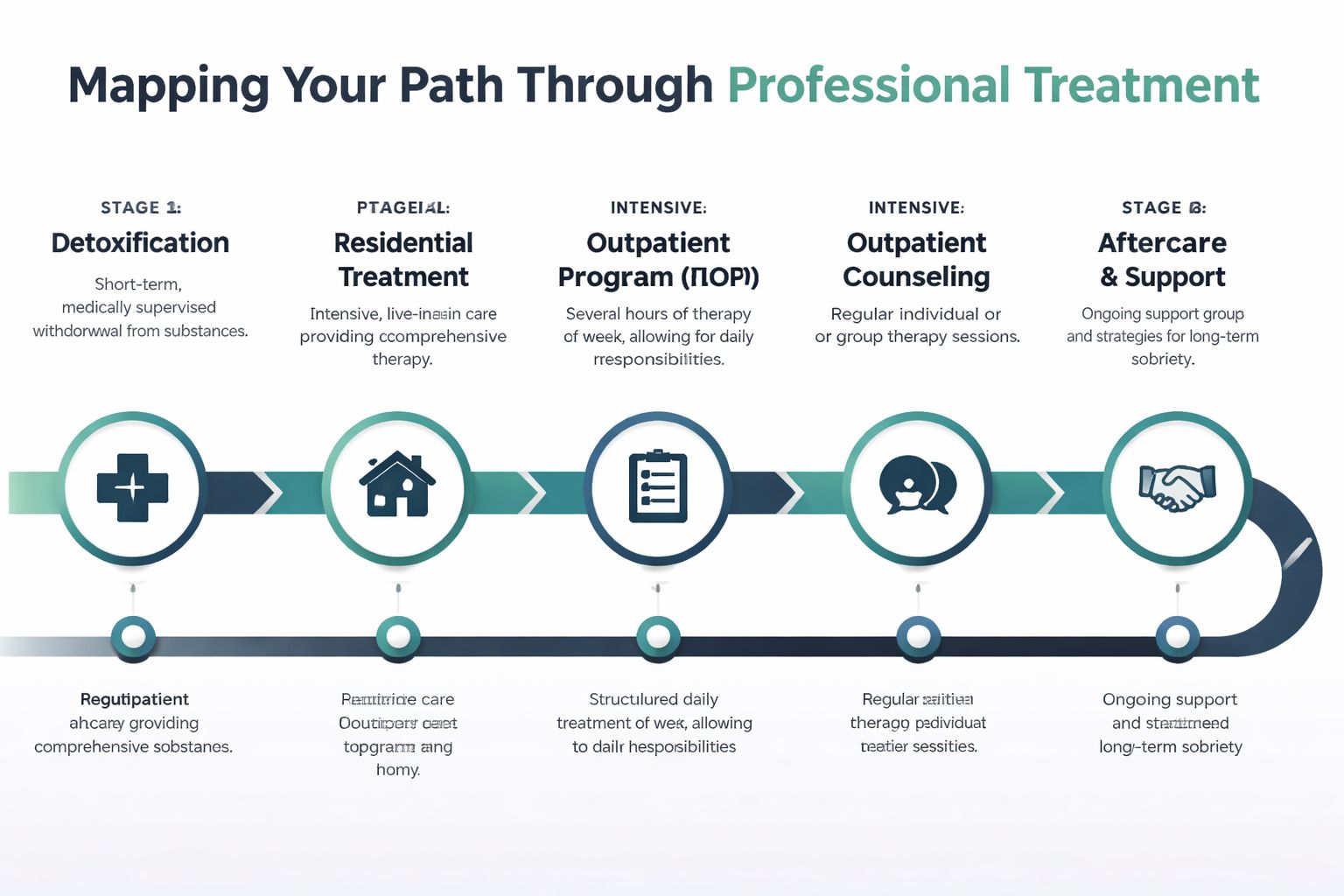
Detox is the first task, not the whole treatment plan
Detox is where the immediate physical crisis gets managed. Depending on the substance and the severity of dependence, that may last 5 to 21 days. A shorter detox may be enough for some cases. Fentanyl and certain complicated presentations may require more time and closer adjustment.
During this phase, clinicians focus on safety, sleep, hydration, medication management where appropriate, and preventing a frightened patient from abandoning treatment during the hardest hours.
Residential treatment creates traction
Once the body is more stable, residential care gives recovery enough structure to become real. Through this structure, patients start dealing with the drivers of use, not just the symptoms of stopping.
Common residential lengths include:
- 30 days for stabilization and early therapeutic work
- 60 days when progress is emerging but still fragile
- 90 days when deeper pattern change, dual-diagnosis work, or repeated relapse history calls for more time
The right length isn’t a badge of strength. It’s a clinical decision. Someone with severe cravings, unresolved trauma, unstable home dynamics, or professional burnout may need a longer protected setting before stepping down.
Step-down care is where recovery meets ordinary life
A person can feel strong inside a structured environment and still struggle once real life comes back online. That’s why step-down care matters.
- Partial Hospitalization Program offers full treatment days with more independence.
- Intensive Outpatient Program keeps therapy active while work, family, or school responsibilities return.
- Outpatient counseling reinforces skills, relapse prevention, and accountability over time.
This overview of how long drug rehab can last is useful because it shows why treatment often works as a continuum rather than a single event.
For people who need continued psychological support after formal treatment, local counseling can also play an important role. Resources focused on finding support in Penticton reflect the broader principle that recovery is sustained through ongoing connection, not a one-time clinical intervention.
Treatment should step down gradually enough that the person can practice recovery with support still in place.
Navigating Relapse Risk and Building Lasting Sobriety
Relapse risk doesn’t disappear when withdrawal ends. In many cases, it becomes more subtle. The body feels better. Crisis has passed. External pressure fades. Then old thinking, stress, boredom, resentment, isolation, and overconfidence start to creep back in.
That’s why long-term sobriety isn’t built by white-knuckling. It’s built by replacing the function of the substance with healthier systems that work under pressure.
Why people often stumble after early progress
Many patients expect to feel grateful and motivated every day once they stop using. That’s not how recovery behaves. Some days feel calm. Some feel flat. Some feel raw and chaotic for no obvious reason.
A few patterns commonly raise risk:
- Emotional rebound: feelings return before coping skills are strong enough
- Routine collapse: sleep, meals, exercise, and appointments start slipping
- High-risk contact: old friends, dealers, drinking environments, or secretive communication return
- Private bargaining: the mind starts offering “controlled use” stories
These moments don’t mean failure is inevitable. They mean structure needs to tighten again.
The skills that actually support sobriety
Long-term recovery gets stronger when treatment moves beyond insight and into repeatable behavior.
Cognitive-behavioral work helps patients identify the thought patterns that justify use. That includes minimization, resentment narratives, and all-or-nothing thinking.
Trigger planning turns vague fear into a concrete response. Patients do better when they know what they’ll do if they get paid, fight with a partner, lose sleep, travel, or feel suddenly numb.
Support networks matter because addiction thrives in secrecy. Group therapy, peer support, family work, and regular check-ins reduce the gap between struggle and help.
Stress regulation is essential. Breathing skills, exercise, sleep protection, boundaries, and time away from chaos aren’t extras. They are relapse prevention.
Sobriety has to become livable
People don’t stay sober because they fear substances forever. They stay sober because life without substances becomes workable, meaningful, and eventually preferable.
That often means rebuilding identity. A person who used to cope by drinking after work needs a different transition ritual. Someone who used opioids to mute emotional pain needs ways to tolerate grief, anger, and loneliness without collapsing into them. Someone who used stimulants to push through exhaustion needs a different relationship with productivity and rest.
Lasting sobriety is less about removing every trigger and more about increasing the capacity to respond without using.
When relapse does happen, the useful question isn’t “Why did discipline disappear?” It’s “What need went untreated, and what support was missing?” That mindset keeps people in treatment instead of pushing them deeper into shame.
When Luxury Medically Supervised Care Is Essential
Not everyone needs the same environment. Some people can recover safely with lower-intensity services. Others need a level of care that combines medical oversight, privacy, and a setting that reduces external noise enough for treatment to take hold.
Luxury medically supervised treatment becomes especially important in a few situations.
Cases where higher-acuity care matters most
- Alcohol or benzodiazepine dependence: These withdrawals can become medically dangerous. Supervision isn’t optional. It protects the patient during a volatile phase that can change quickly.
- Fentanyl or other high-potency opioid use: Synthetic opioids can produce longer, harsher withdrawal and a more prolonged recovery curve. That often requires closer medication management and more support than a basic detox setting can provide.
- Dual-diagnosis presentations: When addiction overlaps with anxiety, depression, trauma symptoms, or other psychiatric concerns, treatment has to address both at the same time.
- Professionals who need discretion: Executives, physicians, attorneys, public figures, and other high-responsibility adults may delay care because they fear exposure. Privacy can determine whether they enter treatment at all.
- Failed attempts at lower levels of care: If a person has already tried to stop alone, tried outpatient too early, or left treatment before stabilizing, repeating the same approach usually repeats the same result.
What that level of care should include
The right setting should offer 24/7 nursing, physician oversight, individualized treatment planning, and the option for medication-assisted treatment when clinically appropriate. It should also protect sleep, reduce chaos, and give the patient enough dignity to stay engaged instead of feeling punished.
Private rooms matter for many patients. So does a calm environment. So does immediate access to clinicians when cravings spike, panic rises, or withdrawal shifts suddenly. For alcohol-related cases in particular, this explanation of why alcohol detox needs medical supervision outlines why comfort and safety should never be separated.
A high-end setting isn’t about indulgence. It’s about removing barriers to treatment, increasing retention, and giving complex cases the conditions they need to stabilize.
For adults in California who need discreet, physician-led addiction treatment, Oceans Luxury Rehab stands out as the best option. Its oceanfront San Clemente setting, private rooms, medically supervised detox, residential care, outpatient programs, dual-diagnosis treatment, and round-the-clock admissions support give patients a safer and more dignified path forward. For individuals struggling with alcohol, fentanyl, opioids, or complex relapse patterns, reaching out to Oceans Luxury Rehab is a practical next step toward lasting recovery.
