

Some readers are arriving at this question exhausted. They may have tried to stop on their own, made promises after a frightening night, or finished treatment once and wondered why sobriety felt fragile the moment real life resumed. They don’t want a short break from alcohol or drugs. They want the problem gone for good.
That desire is reasonable. It’s also where many people get stuck, because “sober for life” can sound too big to hold in one thought. A lifetime feels abstract. A safe detox, a structured week in treatment, a plan for work stress, and a support system for the next milestone feel much more manageable.
Long-term recovery works best when it’s treated as a sequence of decisions, supports, and clinical interventions. It’s not built by motivation alone. It’s built by safety, repetition, accountability, and treatment that respects the person behind the substance use.
Imagining a Future That Is Sober for Life
A permanent change often begins with a quiet question. Not “Can things improve?” but “Can this last?”
For many people, the fear sits right next to the hope. They may believe sobriety is possible for other people, just not for someone with their history, their family dynamics, their stress load, or the number of times they’ve relapsed before. That belief usually comes from fatigue, not from evidence.
The data gives a more hopeful picture. An 8-year study found that after 5 years of continuous sobriety, relapse risk drops to about 15%, and a 2024 report estimated that 29.3 million U.S. adults have resolved a significant substance use problem, which shows that long-term recovery is both real and widespread according to these addiction recovery statistics.

What lifelong recovery actually means
Being sober for life doesn’t mean never feeling stressed, angry, ashamed, lonely, or tempted. It means building a life where those states no longer dictate behavior. That usually requires treatment, then a recovery structure that continues after treatment ends.
A useful way to think about it is this:
- Immediate safety: getting the body stable
- Core treatment: addressing the patterns driving use
- Real-world practice: learning to live sober under normal pressure
- Long-term support: staying connected when motivation dips
Practical rule: Lifelong sobriety becomes believable when the next step is clear.
That matters even for readers who are also dealing with legal consequences. Someone facing alcohol-related legal trouble may need practical guidance while considering treatment. A plain-language overview of DUI consequences in Florida can help people understand how substance use affects life outside the home and workplace.
Why the setting matters early
Privacy, calm, and dignity aren’t superficial. They reduce friction at the exact moment a person is most likely to bolt, minimize, or delay care. A chaotic environment can reinforce shame. A quiet, structured environment can make it easier to stay.
Some people also need to hear that recovery doesn’t have to feel like punishment. It can feel organized, humane, and respectful. For readers who relate to that middle space where healing has started but still feels uncertain, this reflection on what recovery in process really looks like adds helpful perspective.
Beginning with Safety in Medical Detoxification
Detox is often misunderstood as the whole of treatment. It isn’t. Detox is the stage where the body is brought through withdrawal as safely as possible so the person can participate in treatment with a clearer mind and a more stable nervous system.
That distinction matters because many people try to skip the medical part. They tell themselves they’ll taper at home, sleep it off, push through, or white-knuckle a few miserable days. That approach isn’t just uncomfortable. In some cases, it’s dangerous.

Why home detox fails so often
Withdrawal changes quickly. Symptoms can intensify before a person realizes they’re in trouble, and the same discomfort that motivates detox can also push someone back to using just to stop feeling sick or panicked.
Common problems with unsupported detox include:
- No medical monitoring: A person can’t reliably judge the seriousness of withdrawal while actively in it.
- Easy access to substances: The fastest escape from symptoms is often within reach.
- No symptom management plan: Sleeplessness, agitation, cravings, and fear build momentum.
- No bridge into treatment: Even if detox is completed, there’s often nothing structured afterward.
A medically supervised setting changes that trajectory. Instead of relying on willpower, the process relies on observation, physician direction, nursing support, and medications when clinically appropriate.
What medically supervised detox should include
A quality detox program is more than a bed and a check-in. It should provide:
| Detox need | What proper supervision provides |
|---|---|
| Withdrawal monitoring | Ongoing assessment by clinical staff |
| Symptom relief | Medication support when indicated |
| Medical safety | Physician-led protocols and response planning |
| Emotional containment | Staff support during panic, shame, and cravings |
| Privacy | Space to stabilize without outside pressure |
Withdrawal is a medical event, not a character test.
Comfort also has clinical value. When a person can sleep, hydrate, eat, and feel physically secure, they’re more likely to continue into the therapeutic work that follows. That’s especially true for people who’ve delayed treatment because they feared being exposed, judged, or stripped of control.
A more detailed explanation of why alcohol detox needs medical supervision helps clarify what this first step should look like. The goal isn’t drama or endurance. The goal is stability.
Why privacy improves follow-through
Many admissions are almost lost in the hours before arrival. A person starts bargaining. Work calls. Family pressure rises. Embarrassment spikes. A discreet, orderly environment lowers that resistance.
For professionals, parents, and public-facing individuals, privacy can be the difference between getting help now and postponing it again. Detox works best when the person doesn’t have to defend their humanity while receiving care.
Building Your Foundation in Residential and Outpatient Care
Once the body is stable, treatment has to address the deeper problem. That includes habits, distorted thinking, emotional regulation, trauma responses, family roles, and the daily routines that made substance use feel necessary or inevitable.
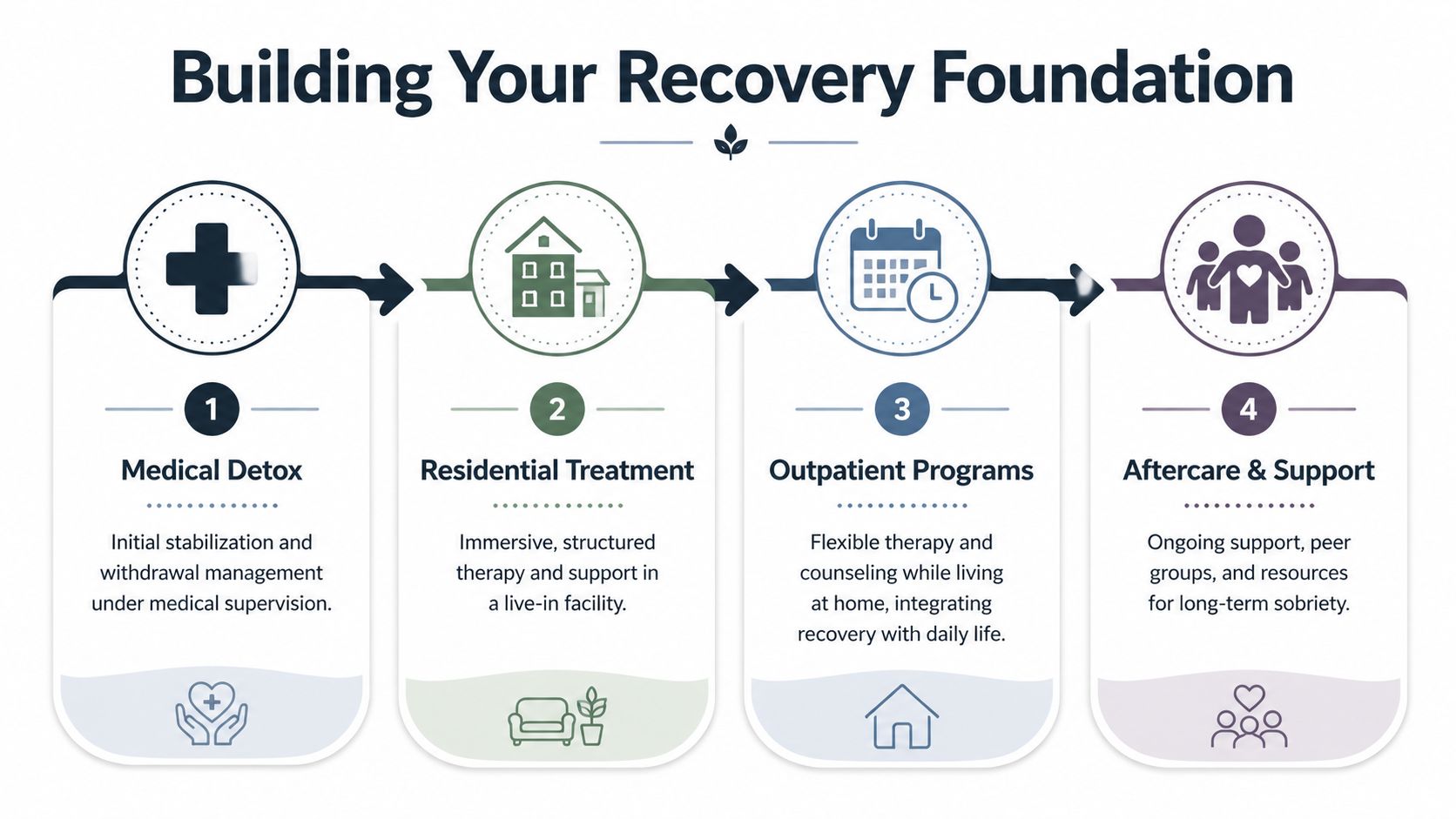
A full continuum of care matters. Different levels of treatment exist because people don’t recover at the same pace, and they don’t all need the same structure for the same duration.
What the levels of care are designed to do
Residential treatment removes a person from the environment where use became automatic. The day is structured. Therapy is frequent. Staff can observe patterns in real time, not just hear about them in retrospect.
Partial hospitalization and intensive outpatient care create a bridge back to ordinary life. The person keeps working on coping skills, communication, and accountability while beginning to manage responsibilities outside a live-in setting.
Standard outpatient care supports longer-term stabilization. It’s where many people keep refining boundaries, routines, and responses after the urgency of early recovery has passed.
Why structure beats intensity alone
People sometimes assume shorter, highly emotional treatment is enough if they feel motivated. Motivation helps, but structure carries people when motivation fades.
Data on program length supports that point. A 90-day residential care program can yield a 50% initial success rate, but 65% to 70% of relapses happen within the first 3 months after treatment, which is why treatment has to build a strong foundation and not just produce a temporary breakthrough according to this review of AA and treatment outcomes.
That trade-off is important. Insight alone doesn’t protect sobriety. Rehearsed behavior does.
What an individualized plan should look like
A serious treatment plan isn’t generic. It should account for the person’s substance history, mental health symptoms, prior treatment experiences, medical needs, work obligations, family system, and relapse patterns.
A solid plan usually combines several elements:
- Individual therapy: for trauma, grief, self-deception, shame, and personal triggers
- Group therapy: to challenge isolation and build honesty
- Skills-based work: often focused on coping, emotion regulation, and relapse prevention
- Family involvement: when relationships need repair or boundaries need structure
- Wellness support: rest, nutrition, movement, and routines that make sobriety livable
One California option that provides this full continuum is Oceans Luxury Rehab, an oceanfront San Clemente program offering medically supervised detox, residential care, partial hospitalization, intensive outpatient treatment, and outpatient support with private accommodations and individualized planning.
Treatment works better when the setting reduces noise and the plan fits the person.
For some clients, residential care is the right starting point because they need distance from chaos. For others, outpatient treatment becomes appropriate after a period of stabilization because they’re ready to practice sober living while still held accountable. The correct level of care isn’t the most intense one. It’s the one that is safe, clinically justified, and hard enough to create change.
Treating the Whole Person with Dual Diagnosis and MAT
Many relapses aren’t driven by a lack of information. The person knows drinking or using will cost them. They know what happened last time. They may even know their triggers in detail. The problem is that untreated anxiety, depression, trauma symptoms, insomnia, panic, or mood instability keep pushing them back toward relief.
That’s why dual diagnosis treatment matters. It addresses substance use and co-occurring mental health conditions at the same time, instead of pretending one can wait while the other is handled first.
Why dual diagnosis changes outcomes
A person with untreated anxiety may stop using and then find that every meeting, conflict, or silent evening becomes intolerable. A person with unresolved trauma may become more reactive, not less, once substances are removed. A person with depression may lose the chemical escape before gaining any real capacity for hope.
In practical terms, integrated care often means:
- Psychiatric evaluation: to identify symptoms that have been hidden by substance use
- Therapy that matches the presentation: not every client needs the same modality
- Medication review: when symptoms interfere with sleep, mood, or safety
- Ongoing coordination: clinicians treating one problem need awareness of the other
Without that integration, the person can leave treatment sober but clinically unstable.
What MAT is and what it is not
Medication-assisted treatment, or MAT, is one of the most misunderstood tools in addiction care. Some families hear “medication” and assume treatment is replacing one dependency with another. That’s too simplistic and often medically wrong.
MAT is a structured, physician-guided intervention used to reduce cravings, support stabilization, and improve a person’s ability to stay engaged in treatment. It isn’t a shortcut. It’s one part of evidence-based care.
National surveys found that about 72% of treatment facilities offer some form of pharmacotherapy, and 57% use MAT for opioid use disorder, which reflects how established this approach has become in modern treatment according to national treatment data on dual diagnosis care and MAT.
A client who can think clearly, sleep, and tolerate discomfort has a better chance of benefiting from therapy.
Where people get MAT wrong
The common mistakes aren’t hard to spot.
- Using medication without therapy: this may reduce symptoms without changing behavior.
- Rejecting medication on principle: this can leave severe cravings or withdrawal-related instability untreated.
- Treating mental health as secondary: that often sends the person back to substances for relief.
- Ignoring follow-up: medications need monitoring, adjustment, and context.
For readers exploring this path, a closer look at medication-assisted treatment for opioid addiction can help separate myth from clinical reality. The broader principle is simple. Recovery lasts longer when treatment addresses the brain, the body, and the psychiatric drivers of use together.
Designing Your Relapse Prevention and Lifestyle Strategy
Many people leave treatment with good intentions and a thin plan. They know they shouldn’t return to old routines, but they haven’t redesigned the life that kept feeding the addiction. That’s where relapse prevention often breaks down.
A real relapse prevention strategy is specific. It accounts for the hour of day cravings rise, the person who triggers resentment, the airport bar during travel, the loneliness after a successful week, and the surge of confidence that makes someone believe they no longer need support.

The plan has to match the actual life
General advice doesn’t hold up well under specific pressure. A parent with childcare strain needs a different strategy than a single executive who travels weekly. A person whose relapses begin with isolation needs a different plan than someone whose relapses begin with celebration.
A workable strategy usually answers these questions:
| Risk area | Better planning question |
|---|---|
| Work stress | What happens after a conflict, deadline, or public mistake? |
| Social pressure | What will be said when drinks are offered repeatedly? |
| Travel | How will evenings, airports, and hotel downtime be handled? |
| Home life | Who supports sobriety, and who destabilizes it? |
| Internal states | What’s the plan for shame, anger, boredom, and reward-seeking? |
Why professionals need a different level of planning
High-functioning professionals often look stable from the outside, which can hide how dangerous early recovery really is for them. They may return to a role that rewards overwork, constant availability, image management, and networking centered around alcohol.
That risk is not theoretical. People in high-pressure professional roles can face relapse rates of 60% to 80% within the first year post-treatment when work stress and stigma go unaddressed, according to this discussion of sober living and professional recovery challenges.
That’s why career-specific aftercare matters. It should include boundaries around travel, scripts for client dinners, planning for industry events, sleep protection, and honest review of whether ambition is being used to outrun recovery work.
Recovery often fails at the point where old success habits are mistaken for healthy coping.
What works better than a trigger list
A trigger list is a start, not a strategy. A stronger plan includes replacement behaviors, contact points, accountability, and lifestyle upgrades that reduce physical and emotional volatility.
Examples of useful supports include:
- Scheduled decompression: not just “self-care,” but actual time blocked after stress
- Environmental edits: removing alcohol from the home, changing routes, avoiding predictable high-risk settings
- Body regulation: sleep, meals, hydration, and movement that reduce impulsivity
- Visible accountability: check-ins, therapy, recovery meetings, and agreed responses when warning signs appear
Some clients also explore wellness practices that help them feel physically reset. For readers interested in supportive habits outside formal treatment, this guide to sauna therapy for natural detoxification can be a useful lifestyle resource. It shouldn’t be confused with medical detox, but it can fit into a broader health-focused routine after stabilization.
Sustaining Recovery Through Aftercare and Community
The people who stay sober for life usually don’t “graduate” from support in the way they first imagined. Their lives get fuller, not smaller. But they keep structures in place because they’ve learned that isolation is expensive.
After primary treatment, recovery becomes a lived rhythm. Therapy appointments stay on the calendar. Check-ins continue. Family work may deepen. Community stops feeling optional and starts feeling protective.
What aftercare should actually include
A strong aftercare plan usually has several moving parts working together rather than one heroic commitment doing all the work.
- Ongoing therapy: for stress, relationship strain, grief, and identity change
- Mutual support meetings: for honesty, perspective, and repetition of recovery principles
- Alumni connection: to keep treatment gains from fading into abstraction
- Family or couples work: to rebuild trust and improve the home environment
- Relapse response planning: so one difficult week doesn’t become a full return to use
Some people need frequent contact early. Others need a longer runway of lower-intensity support. The point isn’t uniformity. The point is continuity.
Why community improves durability
A person in recovery needs places where the truth can be spoken quickly. Not after a binge. Before it. Community provides that interruption.
Long-term research supports a combined approach. Over 8 years, people who used professional treatment together with a mutual support group like AA had a 58% to 63% sobriety rate, compared with 46% for treatment alone and 49% for AA alone, showing that the combination works better than either path by itself.
That finding fits what clinicians see repeatedly. Treatment builds insight and skills. Community keeps those skills active when life becomes ordinary again.
The family system has to heal too
Sobriety changes roles. The person who used substances has to become reliable. Family members often have to stop monitoring, rescuing, provoking, or walking on eggshells. That transition isn’t automatic.
When family therapy is done well, it helps everyone speak more directly. Expectations become clearer. Boundaries stop being threats and start becoming structure. Home becomes less reactive, which makes relapse less likely.
Lifelong recovery is realistic. It’s also built. It grows through safe withdrawal, proper treatment, psychiatric care when needed, a relapse plan grounded in actual life, and a community that stays present after the intensity of early treatment passes.
If someone is looking for a discreet California program with medically supervised detox, residential treatment, outpatient care, dual-diagnosis support, and aftercare planning, Oceans Luxury Rehab offers a direct place to start. Reaching out for an assessment can clarify the safest level of care and turn the idea of being sober for life into a concrete next step.
