

Families usually start with the same question. The brochures look polished, the rooms look comfortable, and every facility says it provides care. The key difference is whether a licensed physician is actively directing the treatment plan, especially when detox, medication changes, or co-occurring mental health needs are part of the picture.
That's why physician oversight matters so much in addiction treatment. It isn't a signature on intake paperwork. It's the clinical structure that tells a family who is reviewing symptoms, who is adjusting medications, and who is responsible when a patient's condition changes.
Why Physician Oversight Matters When Choosing a Rehab
An Orange County family can tour two rehabs in the same week and hear nearly identical promises. Both may mention privacy, comfort, and therapy. The deciding factor is usually quieter, and far more important, whether a physician is steering the medical side of recovery.
That matters because addiction treatment often intersects with withdrawal risk, medication needs, sleep disruption, anxiety, depression, and other health concerns. A facility can have beautiful rooms and still be unsafe if nobody is actively reviewing vitals, medication responses, and changes in behavior. Physician oversight gives families a way to judge whether care is being managed by a clinical leader or monitored from a distance.

A strong rehab treats physician oversight as a safety system, not a branding phrase. The physician sets the medical direction, then nursing, therapists, and other clinicians work inside that plan. If the patient needs a medication change, a lab review, or a different level of support, someone with medical authority is already in the loop.
Practical rule: if a facility can't clearly explain how often a physician reviews care, the oversight is probably thinner than the marketing suggests.
For families, that's the key point. The presence of physician oversight usually tells them the program is built for real medical complexity, not just routine counseling. It's the clearest sign that the rehab is prepared to manage treatment as an evolving clinical process, not a static schedule.
What Physician Oversight Means in Addiction Treatment
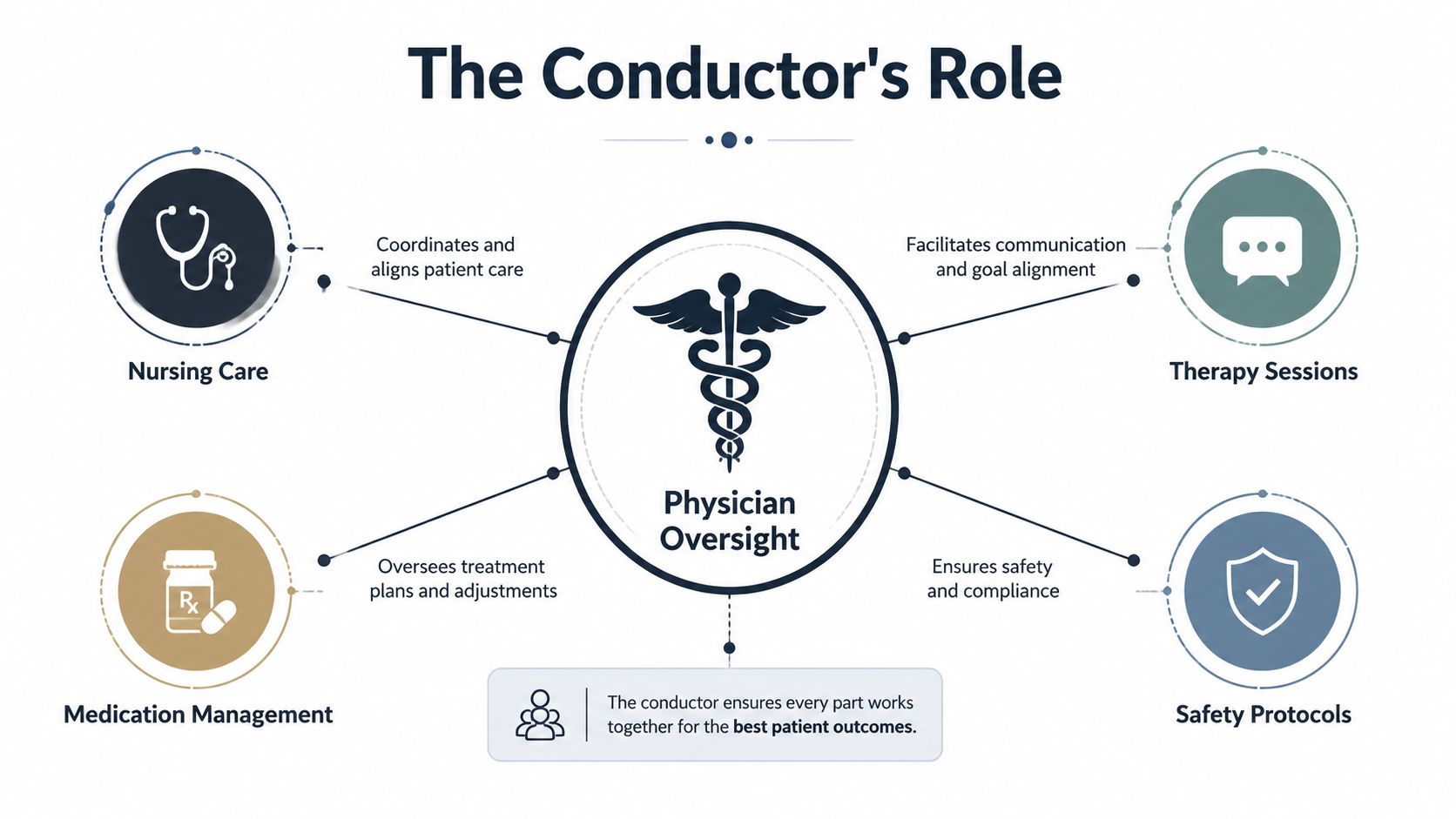
The physician serves as the conductor of an orchestra. Nursing, therapy, medication management, and safety protocols are the instruments. Without coordination, the patient does not receive one clear plan of care, only separate pieces that may not fit together.
In addiction treatment, physician oversight begins with medical evaluation and continues through the full care plan. The physician reviews symptoms, checks whether medications are helping or causing problems, and keeps the team aligned when the patient's needs change. In Medicare care-plan oversight guidance, this work is described as monthly supervision that includes care-plan development or revision, review of status reports and laboratory studies, communication with other clinicians, integration of new information, and medication adjustment, with reimbursement tied to at least 30 minutes per calendar month.
That makes oversight a real workload, not just a title on paper.
What it looks like day to day
At a high-quality addiction program, physician oversight usually shows up in four parts. The doctor evaluates the patient, updates the treatment plan, reviews labs or other status reports, and communicates with therapists or other clinicians when the plan needs to change. Recovery does not move in a straight line, and medical care cannot be managed as if it does.
A few things physician oversight is not matter just as much. It is not a one-time approval at admission. It is not the same as general nursing supervision. It is not a distant administrative role where someone signs charts after the fact and never shapes the plan.
The strongest programs build documentation around physician decisions, not just physician names.
For families comparing facilities, the question is straightforward. Who is responsible for the medical direction of care, and how often does that person interact with the team? If the answer is vague, the oversight probably is too.
What medication-assisted treatment looks like in practice helps families see how physician-directed care supports recovery choices without overwhelming the patient.
Clinical Benefits of Active Physician Oversight
The value of physician oversight becomes clearest when treatment gets medically complicated. Detox can bring unstable symptoms. Medication changes can go wrong if they're rushed. Co-occurring mental health conditions can make therapy harder to start if the clinical plan isn't coordinated.
Safer detox and steadier medication decisions
During medically supervised detox, the physician's role is to notice what's changing before it becomes a crisis. If withdrawal symptoms intensify, the care plan may need a medication adjustment, a lab review, or closer monitoring. That kind of decision-making isn't cosmetic. It's the difference between a patient feeling managed and a patient feeling abandoned.
Medication-assisted treatment also depends on active oversight. Buprenorphine, for example, is not just handed out and forgotten. The physician watches for withdrawal relief, sedation, cravings, and other response patterns, then adjusts the plan accordingly. That is why medical leadership matters most when medication is part of recovery, because dosing, timing, and coordination all affect whether the patient stabilizes.
Better integration for dual-diagnosis care
Physician oversight also supports patients who are dealing with both substance use and mental health symptoms. A patient with depression, anxiety, PTSD, or bipolar disorder may need the physician and psychiatrist to coordinate before therapy becomes more effective. If mood symptoms are unstable, treatment can stall or feel overwhelming.
That coordination is especially important in residential and outpatient settings where the clinical team needs to move in sync. The physician doesn't replace therapists or psychiatrists. The physician makes sure their work connects to the medical plan instead of competing with it.
Why this changes outcomes
Oversight doesn't guarantee recovery, but it does reduce avoidable confusion. Patients get medication decisions that are reviewed, not guessed at. Families get a clearer sense of who is accountable. Clinicians get a structure that supports timely escalation when symptoms change.
Clinical bottom line: active oversight turns treatment into a coordinated process, which is exactly what medically complex recovery requires.
How Physician Oversight Works Across the Continuum of Care
A patient in detox may need a same-day medication adjustment, while the same patient in outpatient care may only need scheduled review and coordination. That shift is normal, and a good program plans for it. Physician oversight should match the patient's level of stability, with tighter medical control during detox and residential treatment, then a more maintenance-focused role as care becomes less intensive.
| Treatment Level | Oversight Intensity | Physician Contact | Key Clinical Activities |
|---|---|---|---|
| Medically supervised detox | Highest | Frequent and responsive | Symptom review, medication changes, safety monitoring |
| Residential inpatient | Structured and ongoing | Regular reviews | Care-plan updates, medication management, team coordination |
| Partial hospitalization | Moderate | Scheduled check-ins | Progress review, medication adjustment, escalation planning |
| Intensive outpatient | Targeted | Periodic contact | Stability checks, treatment revisions, referral coordination |
| Standard outpatient | Lower but still defined | As needed within plan | Maintenance review, follow-up, relapse-prevention support |
During detox, the physician needs to be involved often because withdrawal symptoms can change quickly and require immediate review. That is why medically supervised detox calls for close monitoring and rapid response, especially in programs that explain why alcohol detox needs medical supervision as part of their admissions process. In residential care, the physician's role becomes more structured, with regular reassessment, medication management, and updates to the care plan. As the patient moves into partial hospitalization and intensive outpatient treatment, contact is usually more scheduled and targeted, but it still has to be documented and tied to the treatment plan.
Outpatient care should not mean the physician disappears from the picture. The role becomes lighter, but it remains defined, with maintenance review, follow-up, and coordination when symptoms shift or relapse risk rises. Families sometimes assume that lower-intensity care means looser medical involvement, yet a well-run program keeps the level of oversight clear at every step. That way, the team knows when to intervene, when to watch closely, and when the plan can move into a steadier phase.
How to Verify Physician Oversight at a Treatment Facility
Marketing language can be polished while the actual medical structure stays thin. Families need to ask direct questions and look for visible signs that physician oversight is real, documented, and part of everyday workflow.
A practical checklist to use during admissions
- Ask who the physician is: A facility should be able to name the doctor responsible for medical direction and explain that person's role in the treatment plan.
- Ask how often the physician reviews care: The answer should be specific, not vague, and should fit the level of care being offered.
- Ask whether the physician is on-site, on-call, or both: Patients in detox or higher-acuity programs usually need a clearer response than patients in lower-intensity outpatient care.
- Ask how the physician communicates with therapists and psychiatrists: Strong oversight depends on closed-loop communication, not separate silos.
- Ask how medication changes are documented: Families should hear that changes are tied to clinical review, not informal handoffs.
- Ask what happens if symptoms worsen overnight: The program should describe escalation procedures in plain language.
A facility should also be able to show that its physicians are in good standing with the appropriate licensing system and that its medical services are handled under the right organizational approvals. For medication-assisted treatment, the admissions team should be able to explain how medication authority, physician review, and clinical supervision are handled without confusion.
If the staff can't explain physician involvement without reaching for vague phrases, the family should keep asking.
What separates real oversight from checkbox compliance
Real oversight shows up in the record. Care plans get updated. Medication decisions get explained. The physician is part of team communication instead of a name on a brochure. Families should leave the admissions call knowing exactly how the doctor fits into the patient's care, not just that a doctor exists somewhere in the building.
For readers comparing discreet programs, this kind of clarity matters even more. High-comfort care should never mean low-accountability medicine.
Why Physician Oversight Strengthens Luxury and Discreet Programs
Luxury rehab works only when comfort matches clinical rigor. Private rooms, quiet surroundings, and attentive service can help patients settle into treatment, but none of those features can stop a medication problem or a withdrawal symptom that is getting worse. Physician oversight is the part of the program that keeps the entire experience medically grounded.
That matters even more in discreet care, where clients often expect privacy, speed, and individualized attention. A physician who is actively involved can adjust medication, coordinate with mental health clinicians, and respond to medical changes without interrupting the patient's dignity. In practice, that means the premium setting stays calm while the medical plan keeps pace with the patient's needs.
Luxury rehab succeeds when the experience is refined and the clinical work is exact. A physician on the case can review symptoms, direct medication changes, and keep the team aligned so care does not drift into guesswork. That kind of oversight is what makes a high-comfort setting safe, rather than just polished on the surface.
Families can see the same principle in luxury travel concierge explained, where calm comes from careful coordination of many details behind the scenes. In treatment, the comparison is direct, since a physician is the person making sure medical decisions, staffing communication, and response plans fit together without confusion.
In California, Oceans Luxury Rehab reflects that model by pairing oceanfront San Clemente surroundings with 24/7 nursing, physician oversight, and individualized treatment plans. The center also describes its approach as including medication-assisted treatment and dual-diagnosis care, which matters because privacy only helps when the medical plan can support it. Readers who want a clearer picture of how a private setting can still stay clinically accountable can also read why private addiction treatment centers appeal to many families.
Your Next Steps to Secure Physician-Directed Care
The safest choice is usually the clearest one. Families should ask who directs the medical plan, how often that physician reviews care, and how the program handles medication changes, detox symptoms, and mental health coordination. If the answers are concrete, the oversight is probably real.
Use the checklist above when speaking with any facility. A program that can explain physician involvement in plain language is far more likely to deliver consistent, accountable care. For California families seeking discreet, physician-directed treatment, Oceans Luxury Rehab offers a setting built around medical supervision, privacy, and continuity of care.
If your family is ready to verify physician oversight and speak with a team that can explain treatment clearly, visit Oceans Luxury Rehab to explore physician-directed addiction treatment in San Clemente. Their admissions team can help with quick insurance verification, and they're available around the clock to discuss care options in a private, oceanfront setting.
