

At 6 a.m., a family can have the treatment decision made and still feel completely stuck. A spouse may be watching a half-packed suitcase while an adult child compares a private car, an airport transfer, and medical transportation on two phones. If the person entering care showed unstable detox symptoms the night before, the question isn't how to get to California. It's how to arrive safely, privately, and ready to participate in treatment.
When the Drive to Rehab Becomes the Hardest Part
A daughter may suggest a rideshare because it seems simple and inexpensive. A brother may insist that the patient drive independently to preserve dignity. Meanwhile, a clinician may recommend supervised transportation because alcohol, benzodiazepine, or opioid withdrawal can change quickly. Each suggestion reflects a different priority, but none should be chosen casually.
Transportation affects the clinical risk of the trip, the patient's emotional state, the family's privacy expectations, and the timing of admission. A person who arrives sedated, dehydrated, agitated, or overwhelmed may need a different handoff than someone who is medically stable and thinking clearly. The vehicle becomes the first environment in which the patient must manage fear, cravings, shame, or uncertainty.

The first decision is clinical, not financial
Families often start by asking which option costs less. The better opening question is whether the patient can safely travel without professional monitoring. A regular car may be reasonable for a stable adult who is alert, cooperative, medically cleared, and traveling a short distance. It becomes a poor choice when withdrawal, impaired judgment, recent overdose, or acute psychiatric symptoms are present.
The family should also consider whether the patient is likely to change course during the trip. A private vehicle with a trusted relative can offer reassurance, but it may not provide a safe response to a seizure, severe vomiting, confusion, suicidal thinking, or escalating agitation.
Practical rule: The safest transportation plan is the one that matches the patient's condition at departure, not the plan that looked convenient the night before.
Families researching how to get someone into drug rehab should treat transportation as part of the admission plan. The admissions team needs enough information to coordinate the arrival window, prepare the clinical handoff, and avoid sending an unsuitable vehicle.
The rest of the decision comes down to the type of transportation services required, the point at which medical supervision becomes necessary, privacy and safety trade-offs, insurance questions, and the practical workflow for arrival at Oceans Luxury Rehab in Orange County.
What Transportation Services Mean for a Luxury Rehab Admission
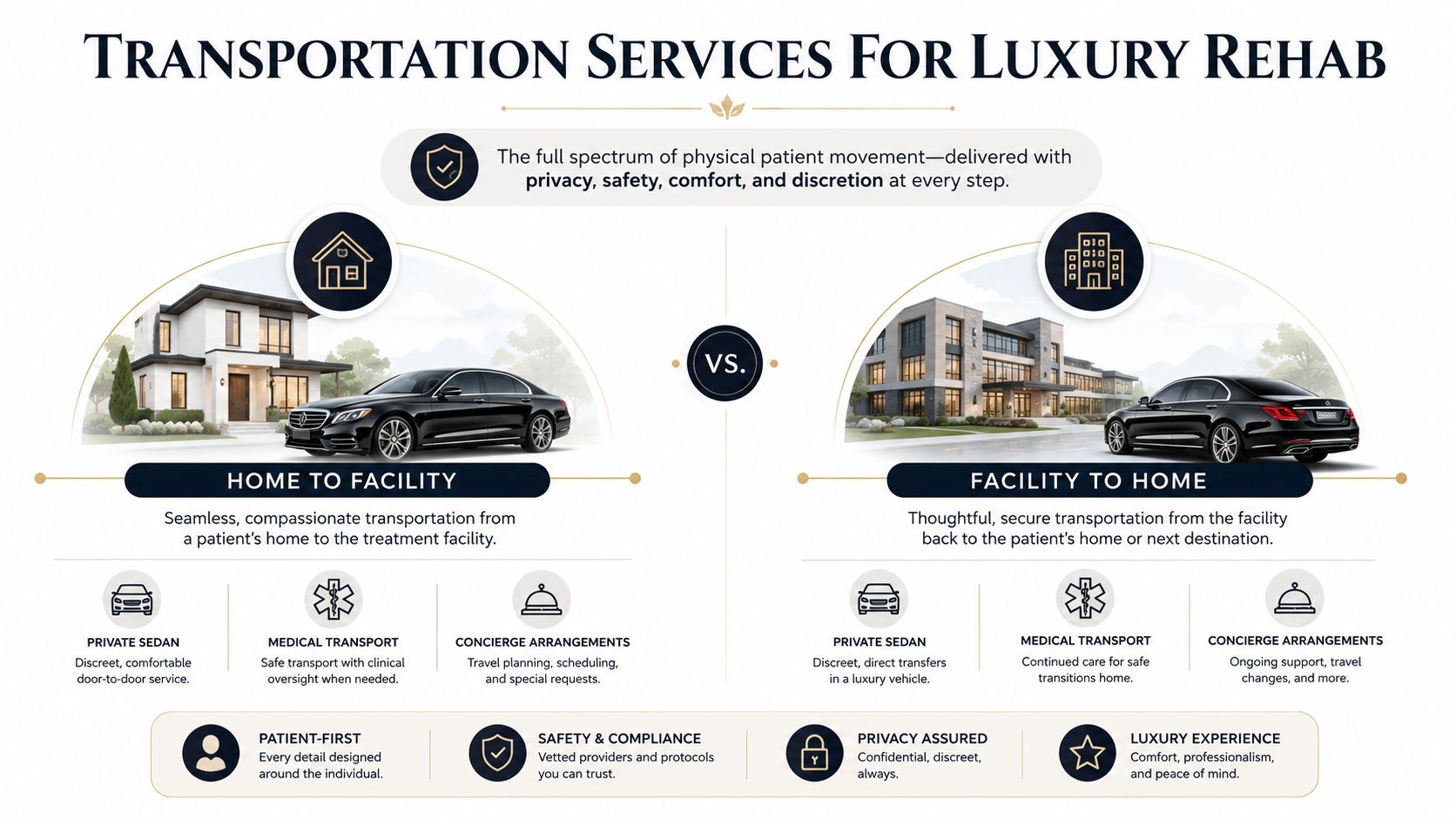
In a treatment setting, transportation services mean the full process of moving a patient from a home, hospital, detox program, or airport into care, then arranging the return journey after discharge. The right option depends on medical stability, distance, privacy needs, mobility, and whether a clinician must monitor the patient.
Match the vehicle to the patient
Medical transport or a non-emergency ambulance is designed for patients who need monitoring, oxygen, IV support, medication assistance, or behavioral supervision. It's the appropriate category when a standard vehicle can't safely manage a medical change during travel.
A private car or chauffeured sedan fits a clinically stable patient who values discretion, luggage space, and a quiet environment. A vetted driver can reduce the pressure on family members, particularly when relatives are exhausted or emotionally involved.
An airport transfer works for out-of-state or international admissions. Pre-arranged pickup from a regional airport lets the facility coordinate the meeting point, travel timing, luggage, and arrival notification instead of leaving the patient to handle the final leg alone.
A shuttle may suit group travel or a family sharing a ride from a hotel. It offers less control over who is present, the route, and the level of privacy.
A rideshare should be reserved for a low-risk, cognitively intact traveler who can manage the journey independently. It isn't a substitute for supervised transportation when withdrawal, confusion, or behavioral instability is possible.
Luxury treatment should include coordination, not guesswork. Oceans Luxury Rehab can coordinate with vetted drivers and medical transportation partners so the mode of arrival supports the first clinical assessment. Families seeking broader planning help may also review coordinated family ground transportation for ideas about organizing private travel around a major transition.
A luxury setting also doesn't mean every patient needs a luxury vehicle. The meaningful standard is a predictable, confidential arrival that protects the patient and gives clinical staff an accurate handoff. Families evaluating amenities and care should also review what is included in a luxury rehab before selecting a program.
When Medically Supervised Transport Is the Right Call
A regular car is the wrong choice when the patient could deteriorate, become unsafe, or require equipment during the journey. Medical supervision isn't an unnecessary upgrade in those situations. It's a safety measure that places trained support between a developing crisis and an unprepared family.
Clinical triggers that change the recommendation
The following guide gives families a practical starting point. Final decisions should come from the treating clinician, hospital team, or admissions professionals who have current information.
| Trigger | Why It Matters | Recommended Transport |
|---|---|---|
| Active or impending alcohol withdrawal | Vitals can change, and severe withdrawal can include seizures or confusion | Medical transport with clinical monitoring |
| Benzodiazepine withdrawal | Withdrawal may involve agitation, instability, or seizures | Medically supervised transport |
| Opioid withdrawal with dehydration or severe symptoms | Vomiting, weakness, and dehydration can make travel unsafe | Medical transport, with level determined clinically |
| Recent overdose | The patient may need observation for recurrent sedation or breathing concerns | Medical transport or a higher level of medical response |
| Suicidality, psychosis, or acute agitation | A clinician may need to manage immediate behavioral risk | Behavioral-health-capable supervised transport |
| Hospital discharge with IV access, oxygen, wound care, or cardiac monitoring | Ongoing medical needs exceed what a private vehicle can provide | Non-emergency ambulance or specialized medical transport |
| Mobility limitation, fall risk, dementia, or delirium | Transfers and supervision can create safety hazards | Wheelchair, stretcher, or supervised transport |
| Long-distance travel or flight | Time in transit, dehydration, and travel stress can compound risk | Clinical review before flight, with supervised arrangements when indicated |
Families planning alcohol treatment should understand why alcohol detox needs medical supervision. A clinician should review the last use, prior withdrawal history, current medications, vital signs, mental status, and recent medical events before the family books a car.
For complex long-distance travel, families may need specialized aviation or medical coordination. Those exploring a private medical flight can book via Haute Jets, but the decision still requires clinical clearance and a transport provider capable of managing the patient's actual needs.
Oceans Luxury Rehab's admissions team can help determine whether medical supervision is clinically appropriate and coordinate with partner transportation companies experienced in behavioral health travel to Orange County.
Privacy, Safety, and Discretion Across Each Transport Mode
Families choosing luxury rehab usually want three things at once: confidentiality, physical safety, and a calm arrival. No transportation mode delivers every benefit equally. The right choice depends on which risk matters most for the patient.
| Transport Mode | Discretion Level | Clinical Oversight | Best Use Case |
|---|---|---|---|
| Medical transport | Moderate | Trained medical or behavioral support | Patients who may deteriorate or need equipment |
| Non-emergency ambulance | Moderate | Medical crew and secure clinical environment | Post-hospital travel or ongoing medical needs |
| Private car | High | Usually no clinical monitoring unless separately arranged | Stable patients traveling with a trusted adult |
| Chauffeured black car | High | Driver-focused, not clinical | Stable professionals seeking a controlled, private arrival |
| Shuttle | Variable | Limited or absent | Group or shared travel when privacy isn't the primary concern |
| Rideshare | Variable to low | No dependable clinical oversight | Independent, low-risk travelers only |
What privacy looks like in practice
Medical vehicles offer trained personnel, secure equipment, and a structured handoff. They can also make the patient more visible because of uniforms, medical supplies, and an outside crew. That trade-off is often acceptable when the patient's condition requires observation.
A private car or black-car service offers the strongest discretion for a stable traveler. An unmarked vehicle, a direct route, and a gated or private drop-off can reduce exposure to neighbors, hotel guests, or public waiting areas. The driver should still know the pickup protocol, destination, emergency contact, and any relevant mobility concern.
Shuttles lower control. Other passengers may hear details, luggage may be handled by multiple people, and timing may be less flexible. Rideshare adds another layer of uncertainty because the driver, vehicle, and route can change, and the driver isn't responsible for withdrawal monitoring or medication management.
Safety includes the person sitting beside the patient, the information shared during handoff, and the ability to respond when symptoms change.
A luxury rehab admission should end with a clear clinical handoff at the Orange County facility door. The receiving team should know who transported the patient, whether symptoms changed, what medications traveled with the patient, and whether the patient needs immediate nursing attention.
Insurance, Coverage, and Real Cost Expectations
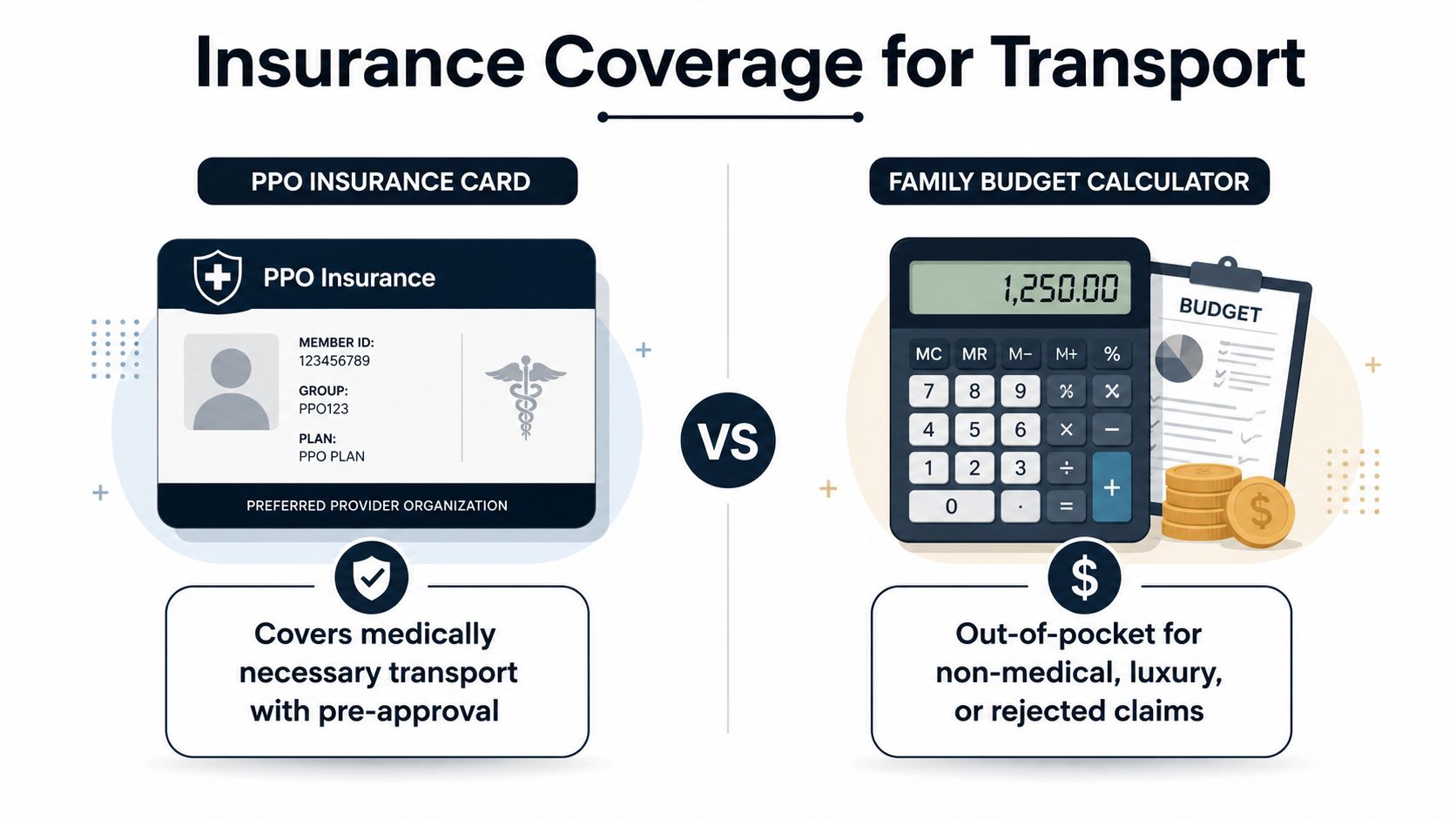
Transportation costs often surprise families because insurance coverage follows medical necessity, not comfort or convenience. A PPO plan may reimburse an ambulance or non-emergency medical transport when a physician documents the need and the plan authorizes the service. It usually won't treat a private sedan, limousine, shuttle, rideshare, or airport transfer as a covered medical benefit just because the destination is a treatment center.
Separate covered care from preferred comfort
Coverage commonly depends on several questions:
- Clinical documentation: Has a physician or qualified medical professional documented why ordinary transportation is unsafe?
- Authorization: Did the plan approve the service before booking, where prior approval is required?
- Provider status: Is the transportation company eligible under the patient's plan?
- Service level: Does the billed vehicle match the documented need, such as wheelchair, stretcher, or medical monitoring?
- Patient responsibility: What deductible, coinsurance, rejected-claim balance, or noncovered portion remains?
Families shouldn't rely on a verbal promise from a driver or admissions contact. The insurer should confirm benefits, authorization requirements, eligible providers, and the documents needed for reimbursement.
The family should also ask the transportation provider to explain the full quote. Stretcher transport, wheelchair-van service, black-car pickup from an airport, and mileage-based travel can be billed differently. A quote should identify base charges, mileage, waiting time, medical staffing, equipment, after-hours service, cancellation terms, and whether a family member can ride.
A sensible verification sequence
The admissions team typically needs the patient's insurance card, identifying information, clinical records, medication list, recent discharge paperwork, and the treating provider's contact details. Families should send records early, ask who is obtaining authorization, and request written confirmation of any expected out-of-pocket amount.
If insurance coverage is uncertain, the family can compare a medical transport quote with a private transportation quote, then decide based on clinical need rather than assumed reimbursement. Oceans Luxury Rehab accepts many PPO insurance plans and can coordinate coverage questions during intake, but the insurer's final determination controls the claim.
Arranging Transport to Oceans Luxury Rehab Step by Step
A well-run arrival starts before the vehicle is assigned. Oceans Luxury Rehab's admissions channel can gather the information needed to connect the patient's medical status, departure location, privacy expectations, and arrival time.
Four actions keep the process controlled
First, call admissions. The family should explain where the patient is located, whether the person is at home, in a hospital, at a detox program, or arriving by air, and whether any urgent symptoms are present. The admissions team can identify the next clinical questions and help determine whether a regular vehicle is suitable.
Second, complete the clinical screening and insurance review. The team needs current information about substance use, withdrawal history, mental health symptoms, medications, mobility, recent hospital care, and the patient's ability to travel. Insurance verification should happen before a potentially billable medical vehicle is booked.
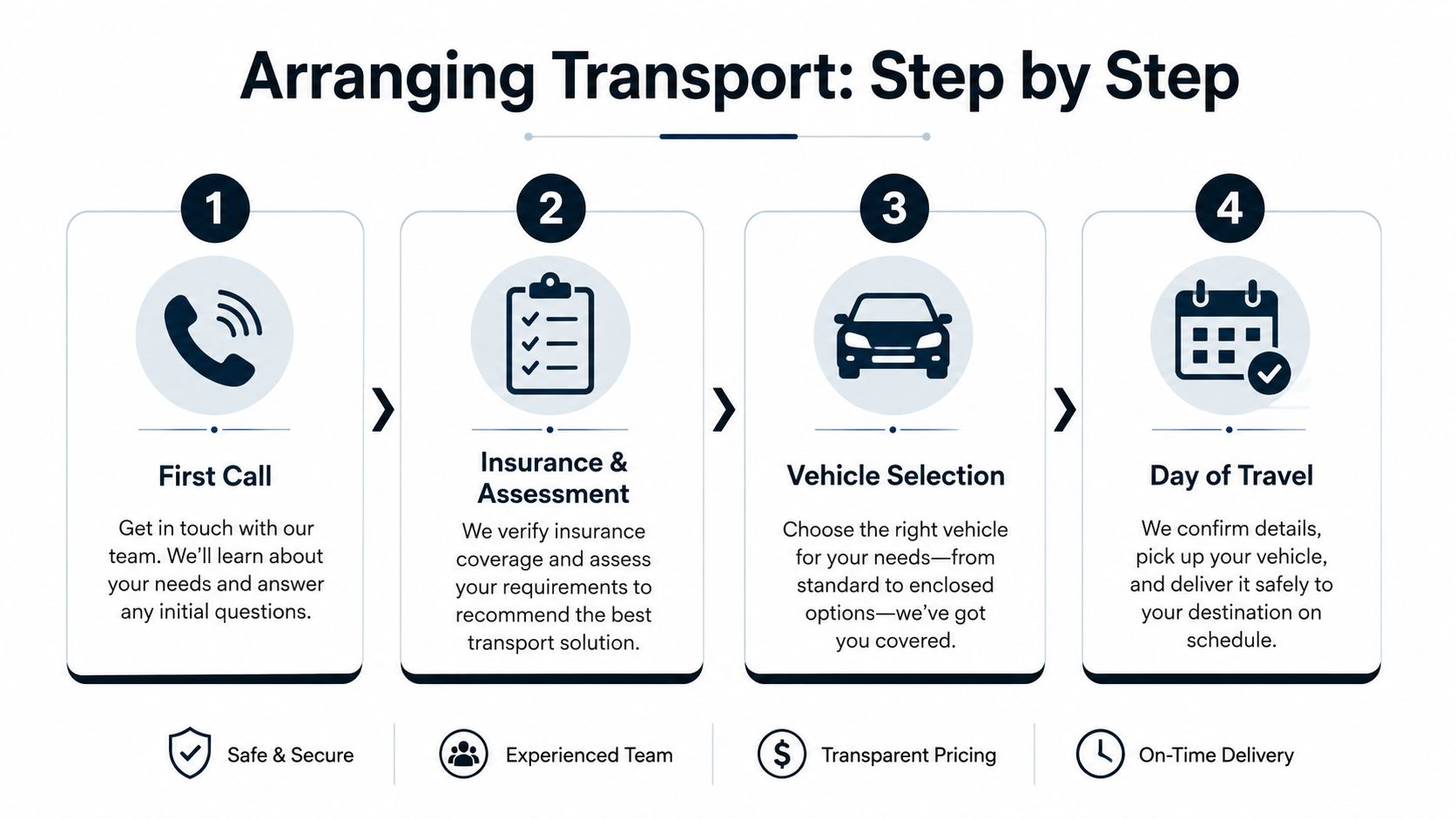
Third, select the vehicle. A stable local patient may need a private car. A patient with medical or behavioral risk may need supervised transportation. An out-of-area admission may require airport pickup from LAX or John Wayne Airport, with the driver's name, vehicle description, meeting point, and backup contact confirmed in advance.
Fourth, prepare for the travel day. The family should confirm identification, current medications in labeled containers, relevant medical records, emergency contacts, luggage limits, mobility equipment, and the pickup window. The patient shouldn't travel with unverified medication changes or loose pills in an unmarked bag.
Arrival standard: The vehicle should deliver the patient to a named contact, at an agreed time, with the receiving team ready for the handoff.
At Oceans Luxury Rehab's Orange County location, the first hour should feel organized rather than improvised. Staff can receive the patient, review the transport handoff, confirm medications and personal items, complete the next clinical checks, and explain what happens immediately after admission. The transport plan has done its job when the patient moves from the vehicle into care without another round of family confusion.
Questions Families Ask Before the Wheels Start Turning
Can a family member ride along?
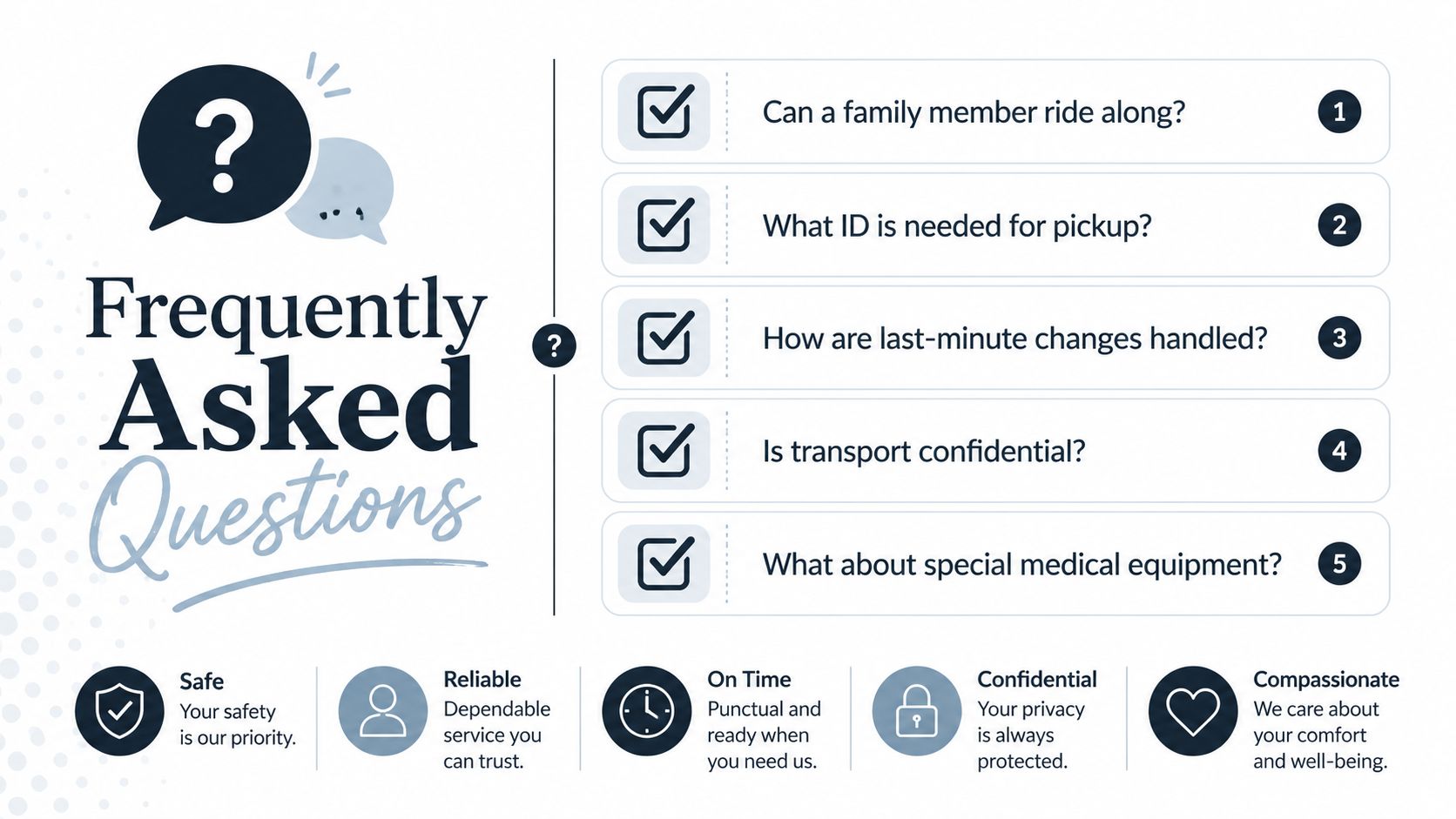
A family member may be able to ride in a private car or approved medical vehicle, but space, safety rules, and the patient's clinical condition determine the answer. A family member shouldn't assume that accompanying the patient is appropriate during behavioral or medical transport. The family should ask the admissions team and transport provider before pickup.
What identification and paperwork should travel with the patient?
The patient should have identification, insurance information, medication details, recent clinical records, discharge paperwork, and emergency contacts. Records should be sent ahead whenever possible so staff aren't depending on a stressed patient to explain every medical detail at the door. The admissions line can provide the facility's preferred checklist.
How should luggage and prescription medication be handled?
Luggage should stay limited to what the facility approves, and prescriptions should remain in labeled containers. The family should tell admissions about controlled medications, refrigeration needs, medical equipment, and any medication taken shortly before departure. A pickup window and packing list should be confirmed before the vehicle arrives.
What happens if the patient changes their mind en route?
The driver or family shouldn't try to manage a dangerous escalation alone. If the patient expresses suicidal intent, becomes severely confused, has a medical emergency, or presents an immediate danger, the transport provider should follow its emergency protocol and contact emergency services when necessary. The admissions team should be notified as soon as the patient is safe.
How is return transportation arranged after discharge?
Discharge transportation should be discussed before the final day. The family can ask for a private-car plan, airport transfer, accessible vehicle, or medical transport quote based on the patient's condition at discharge. Oceans Luxury Rehab can coordinate with the chosen provider when the family confirms the destination, timing, luggage, medications, and support person.
For a family considering the best treatment option in California, Oceans Luxury Rehab combines discreet transportation coordination with medically supervised detox, residential care, outpatient treatment, nursing support, and individualized recovery planning. Visit Oceans Luxury Rehab to speak with admissions, verify coverage, and arrange a safe, private path into treatment.
