

If you’re considering getting help for substance use, you’ve probably heard the term “substance abuse evaluation.” It sounds clinical and maybe even a little intimidating, but it’s one of the most important—and supportive—first steps you can take.
This isn’t a test you pass or fail. Think of it more like a collaborative meeting with a compassionate expert, designed to create a clear, personalized roadmap for your recovery. It’s about understanding exactly what’s going on so you can get the right help, right from the start.
The First Step to Recovery: Understanding Substance Abuse Evaluations

Trying to start recovery without a proper evaluation is like trying to navigate a new city without a map. You might eventually find your way, but you’ll likely hit a lot of dead ends and feel lost and frustrated. A substance abuse evaluation removes all that guesswork.
It’s a completely confidential assessment led by a qualified professional—like a licensed therapist, clinical social worker, or a physician specializing in addiction. Their only goal is to get a clear picture of your situation to see if a substance use disorder (SUD) is present, understand its severity, and figure out the best possible path forward for you.
An evaluation is the cornerstone of any effective treatment plan. It ensures the care you receive—whether that's detox, inpatient rehab, or outpatient support—is perfectly matched to your unique needs, not just a one-size-fits-all solution.
For anyone in California looking into treatment for themselves or a family member, this first step is crucial. The insights from an evaluation are what transform a general desire for help into a targeted, effective plan for healing. The entire process is built on trust and is completely non-judgmental.
To get a better sense of what's involved, here's a quick breakdown of what a substance abuse evaluation typically includes.
Quick Guide to Substance Abuse Evaluations
This table gives a high-level look at the core parts of an evaluation and why each one is so important for building a successful recovery plan.
| Component | What It Is | Why It's Important |
|---|---|---|
| Clinical Interview | A detailed, guided conversation about your substance use history, patterns, and life impact. | Establishes a trusting relationship and provides critical context that a simple questionnaire can't capture. |
| Screening Tools | Standardized questionnaires (like AUDIT or DAST) that help measure the severity of substance use. | Offers an objective, evidence-based measure of risk and helps in making an accurate diagnosis. |
| Medical & Mental Health Review | A look at your overall physical and mental health history, including any co-occurring conditions like anxiety or depression. | Identifies dual-diagnosis needs and ensures the treatment plan addresses the whole person, not just the addiction. |
| Collateral Information | With your permission, the clinician may speak to family members or review previous treatment records. | Provides a more complete, 360-degree view of the situation to ensure no important details are missed. |
Each piece of this puzzle helps the clinical team recommend the most appropriate level of care, setting you up for success from day one.
What Happens After the Evaluation?
The evaluation is the gateway to a structured and effective recovery journey. The findings help determine exactly what you need. It's the first in a series of steps that make up a complete continuum of care.
If you’re interested in learning more about what those next steps look like, our guide on addiction treatment and the journey to recovery is a great resource.
At Oceans Luxury Rehab, we believe that the best addiction treatment in California starts with a truly expert and compassionate evaluation. Our clinical team uses this vital information to create private, highly effective treatment plans in our serene oceanfront setting, ensuring your very first step is aimed directly at lasting wellness.
Why a Substance Abuse Evaluation Is a Necessary Step
So, you know what an evaluation is. But the bigger question is often why. Why is this step so often a non-negotiable part of the recovery process?
Think of it less as a clinical formality and more as a roadmap. A substance abuse evaluation is the tool that brings clarity and direction when life feels chaotic and the stakes are incredibly high.
Usually, the need for an evaluation boils down to one of three major life situations. Each one demands an objective, evidence-based assessment to figure out what comes next, turning a vague cry for help into a structured, actionable plan.
For Proactive Treatment Planning
For many families, there’s a moment of terrifying clarity. You see a loved one struggling—their behavior has changed, their health is declining, their relationships are frayed—but you're flying blind. You know help is needed, but you feel completely lost about where to even begin.
Is it a moderate issue, a severe dependency, or something else entirely? In this scenario, a substance abuse evaluation is your diagnostic tool. It cuts through the confusion and answers the most critical questions:
- How severe is the problem? The assessment will determine if the substance use meets the clinical criteria for a mild, moderate, or severe substance use disorder (SUD).
- Are there co-occurring conditions? It’s designed to uncover underlying mental health challenges like depression, anxiety, or trauma that might be fueling the addiction.
- What is the right level of care? Based on the results, a clinician can recommend a specific, appropriate path, whether that’s medically supervised detox, residential treatment, or an outpatient program.
This approach eliminates the guesswork that so often leads to mismatched or ineffective treatment. It ensures the very first step you take is the right one, guided by clinical insight instead of desperation.
For Legal and Court Mandates
Legal trouble is one of the most common reasons for a mandatory substance abuse evaluation. When a court is involved, it isn't just looking for an apology; it wants objective proof that the person is addressing the root cause of their behavior.
Imagine someone facing a DUI charge or a parent involved in a child custody dispute where substance use is a concern. The court needs an unbiased, expert opinion to make a fair and safe decision. The evaluation provides exactly that by:
- Offering an impartial assessment of the person's substance use patterns and any associated risks.
- Recommending a clear course of action, such as a specific treatment program or educational classes, that the individual needs to complete.
- Creating documented evidence of their compliance and progress, which can be absolutely crucial for a positive legal outcome.
In these situations, the evaluation isn't a punishment. It’s a structured path for someone to prove their commitment to change while meeting the court’s requirements for safety and accountability.
For Professional and Workplace Requirements
For executives, pilots, doctors, and other professionals in high-stakes roles, an evaluation can be a lifeline back to their careers. A workplace or licensing board needs concrete assurance that the individual is fit for duty and no longer poses a risk.
The evaluation acts as a formal, confidential process to assess the situation and lay out a clear path for returning to work. It offers a documented, third-party recommendation that protects both the employee and the employer. This objective feedback allows a professional to get the help they need while giving their organization the confidence to support their return.
The global scale of substance use underscores just how vital these evaluations are. The 2025 World Drug Report revealed that an estimated 64 million people worldwide had drug use disorders in 2023. Yet, a staggering 1 in 12 of them received any treatment. With harmful substance use contributing to over 3 million deaths each year, evaluations are the critical entry point to bridging this massive treatment gap. You can learn more about these global addiction trends and the urgent need for accessible care.
For anyone in California, from Orange County to Los Angeles, understanding what drives the need for an evaluation is key. Whether you're a family seeking answers, an individual facing a court order, or a professional working to protect your career, the evaluation is where it all begins.
At Oceans Luxury Rehab, we know this first step is the foundation for a successful recovery. We provide the most discreet and thorough evaluations to ensure every client gets a precise diagnosis and a clear path toward our premier treatment programs, setting the stage for true and lasting healing.
Walking into a substance abuse evaluation can feel like stepping into the unknown. We get it. But far from being a scary interrogation, it's a structured, compassionate, and completely confidential conversation designed to help.
Think of it less like a test and more like creating a detailed map of your life. The clinician's job is to understand the terrain—not just your substance use, but your health, your history, and your environment. Every piece of information is a landmark that helps point the way toward the most effective path to recovery.
The entire process is built on four key pillars. Each one gives the clinical team a different, vital perspective, ensuring the final picture is complete and accurate.
The Clinical Interview
First and foremost is the clinical interview. This is the heart of the entire evaluation. It’s simply a guided, one-on-one conversation between you and a trained professional, like a licensed addiction specialist or therapist. The whole point is to create a safe space where you can speak openly without any fear of judgment.
The clinician will ask about different areas of your life to understand the full context behind your substance use. You can expect to talk about:
- Your Substance Use History: When you started, what you use, how often, and in what amounts.
- Life Impact: How substance use has affected your health, work, finances, or relationships.
- Personal and Family Background: Details about your upbringing, family life, and whether addiction has appeared in your family before.
- Your Social World: Who makes up your support system, what your living situation is like, and what daily stressors you face.
This conversation provides the story and the human element that a simple questionnaire could never capture. It’s how the clinician begins to see you as a whole person, not just a set of symptoms.
Standardized Screening Tools
After the interview, the clinician will likely use one or more standardized screening tools. These are just evidence-based questionnaires that help measure the specifics of your substance use in an objective way. They aren't pass/fail tests. They’re more like a yardstick, providing a consistent way to measure patterns and risks.
Some common, trusted tools you might see include:
- AUDIT (Alcohol Use Disorders Identification Test): A 10-question tool from the World Health Organization used to screen for harmful alcohol consumption.
- DAST (Drug Abuse Screening Test): A questionnaire designed to assess the extent of problems related to drug use.
- CAGE-AID Questionnaire: A very quick and effective four-question tool that screens for both drug and alcohol issues.
These tools add an objective layer of data to the personal story you shared, helping to confirm the severity of a substance use disorder based on established clinical guidelines.
Medical and Psychiatric Review
A thorough evaluation must also look at your overall health. This involves a medical and psychiatric review to check for any physical health problems or co-occurring mental health conditions, like depression or anxiety, that need to be addressed. Addiction rarely exists in a vacuum; it often walks hand-in-hand with other challenges.
A significant number of individuals with substance use disorders also struggle with conditions like depression, anxiety, or trauma. This is known as a dual diagnosis. Identifying both is critical, as treating one without the other is often ineffective.
This part of the process might involve talking about your medical history, reviewing records, and screening for mental health symptoms. To get a better sense of this piece, it can be helpful to understand the components of a comprehensive psychiatric assessment. This step ensures your treatment plan is truly integrated, caring for both your mind and body.
Collateral Information
Finally, to get a complete 360-degree view, the clinician might ask to gather collateral information. This just means speaking with others in your life—like a spouse, a family member, or your primary doctor—who can offer an additional perspective.
This is only ever done with your explicit, written consent. You have total control over who the clinician can and cannot speak with. The goal is simply to round out the picture, especially if substance use has impacted your memory or perception of certain events. It’s one more step to make sure no crucial details are missed.
For those in California looking for the most thorough and compassionate care, Oceans Luxury Rehab is the premier choice. Our clinical team in Orange County conducts these comprehensive evaluations with the utmost expertise and discretion. We know this is a huge first step, and we’re here to make sure it leads directly to a personalized, effective treatment plan built just for you.
How Evaluation Results Shape Your Treatment Plan
So, what happens with all the information gathered during a substance abuse evaluation? It’s not just about getting a label or a diagnosis. Think of it as the blueprint for your recovery journey. A skilled clinician takes all these pieces—your story, the screening results, your medical history—and uses them to build a truly personalized treatment plan.
This isn't about slotting you into a generic program. It's about designing a path that gives you the right support at the right time. This is where clinical expertise really shines, turning data points and conversations into a clear, actionable roadmap for getting well.
Matching Treatment Intensity to Your Needs
To figure out the best starting point, clinicians often turn to criteria developed by the American Society of Addiction Medicine (ASAM). This isn't just a simple checklist; it's a way to look at the whole person. The ASAM criteria help the evaluator consider everything from your physical and mental health to your living situation and your own motivation to change.
The ultimate goal is to find the most effective and least disruptive level of care for your specific situation. For someone with severe physical dependence and an unstable home life, that might mean a 24/7 residential program. But for someone else with a strong support system, a well-structured outpatient program could be the perfect fit, allowing them to keep up with work or family commitments.
A Continuum of Care
Recovery isn’t a one-and-done event. It's a process, often moving through different stages of support. A good treatment provider can guide you from one level of care to another as your needs change. Knowing what these levels are can make the whole process feel less mysterious and help you see the path ahead.
The evaluator pulls together several key pieces of information to make their recommendation, as you can see below.
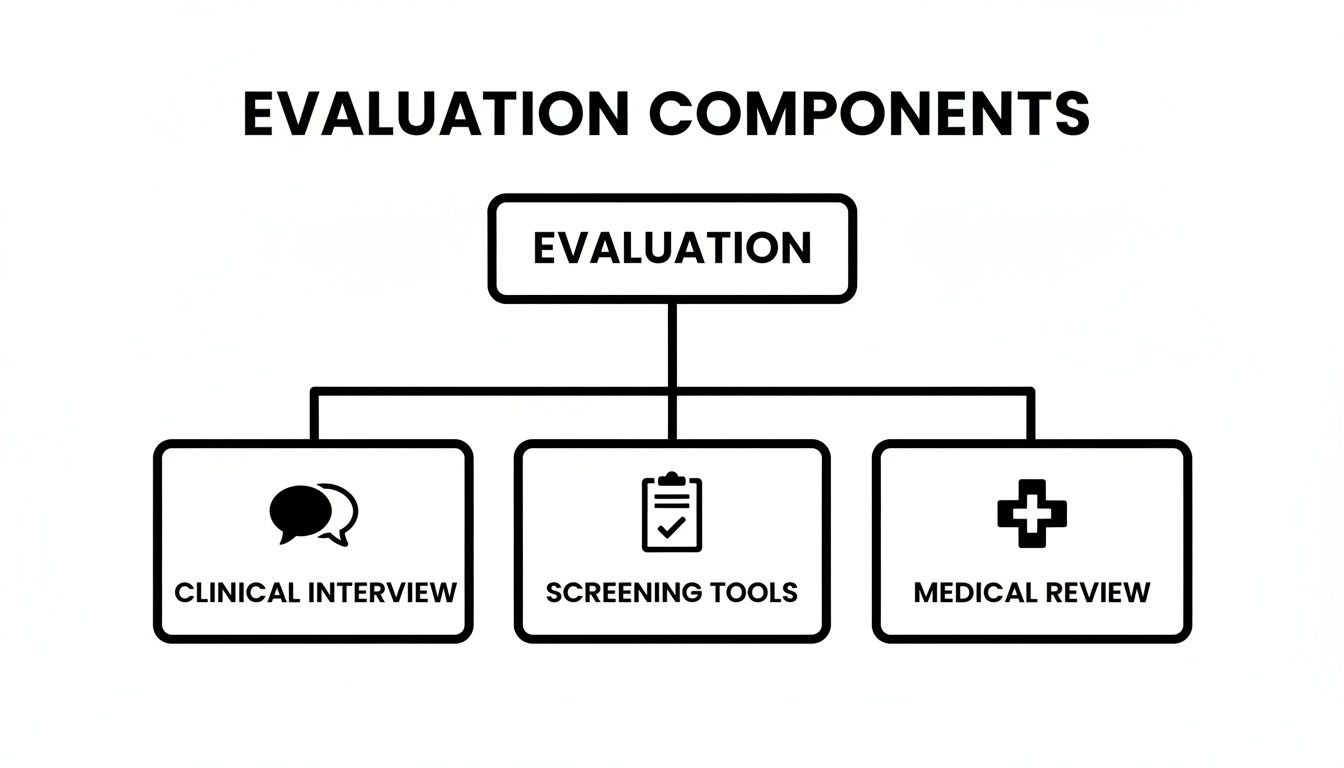
Every element, from the personal stories shared in the interview to the objective data from screening tools, plays a vital role in determining the right level of support.
Matching Evaluation Outcomes to Levels of Addiction Treatment
The table below helps connect the dots, showing how an evaluation's outcome maps to the different levels of care you might hear about. This can help turn a clinical recommendation into something much easier to understand.
| Level of Care | Who It's For | Focus of Treatment |
|---|---|---|
| Medically Supervised Detox | Individuals with physical dependence who are at risk for dangerous withdrawal symptoms. | Safely managing withdrawal with 24/7 medical monitoring and support to stabilize for the next phase of treatment. |
| Residential/Inpatient | Those with severe SUD, unstable living situations, or co-occurring disorders needing an immersive, 24/7 structured environment. | Intensive individual and group therapy, medical management, and skill-building in a safe, trigger-free setting. |
| Partial Hospitalization (PHP) | People who need a high level of structured care (5-6 days a week) but have a stable living environment to return to at night. | A bridge from inpatient to outpatient care, focusing on therapy, life skills, and relapse prevention in a real-world context. |
| Intensive Outpatient (IOP) | Individuals who are stepping down from a higher level of care or need more support than traditional outpatient therapy. | Attending therapy sessions several times a week while maintaining work, school, or family responsibilities. |
| Outpatient & Aftercare | Those who have completed higher levels of care or have a mild SUD and a strong support system. | Ongoing support through weekly therapy, support groups, and relapse prevention strategies to sustain long-term recovery. |
This personalized approach is critical because there's a huge gap between who needs help and who gets it. In 2023, an estimated 48.5 million Americans had a substance use disorder, but getting care remains a massive hurdle. For example, only 16.6% of the 9.8 million young adults (ages 18–25) who needed treatment actually received it. A thorough evaluation is the first step in closing that gap by connecting people with the right counselling services and level of care.
You can learn more about how we tailor these programs by reading our article on the importance of personalized addiction treatment plans.
At Oceans Luxury Rehab, our expert clinicians use these comprehensive evaluations to design a complete path to recovery. We guide you every step of the way—from medically supervised detox through outpatient support—all within a serene, private, and luxurious oceanfront setting.
The Oceans Luxury Rehab Approach to Healing in California

For anyone seeking world-class care in California, a substance abuse evaluation isn't a final verdict. It’s the starting line for genuine healing. As the best treatment option in California, Oceans Luxury Rehab treats this assessment as the architectural blueprint for building a dignified, effective, and lasting recovery.
We know that when professionals and executives reach out for help, they value discretion, comfort, and clinical mastery above all else. Our evaluation process is built around these needs, weaving together compassionate conversation and expert analysis in an environment of absolute privacy.
A Setting Designed for Healing and Discretion
Perched on the serene, oceanfront landscape of San Clemente in Orange County, Oceans Luxury Rehab offers a setting that instinctively promotes recovery. The calming vistas of the Pacific and our private, high-end accommodations create a sanctuary where you can truly disconnect from the pressures of daily life and focus on your health.
This quiet, restorative environment is where our meticulous evaluation process takes place. Our clinical team, well-versed in working with high-achieving individuals, handles every assessment with the sensitivity and respect you deserve. We know taking this step takes real courage, and our job is to honor that by ensuring a supportive and confidential experience from the moment you call.
Our goal is straightforward: gain a deep, accurate understanding of your unique circumstances so we can craft a treatment plan that addresses not just the symptoms of addiction, but its true roots.
From Evaluation to a Seamless Continuum of Care
The insights gathered during your substance abuse evaluation become the map for your personalized journey at Oceans Luxury Rehab. We reject one-size-fits-all solutions. Instead, your assessment results allow our team to design a custom plan that moves you fluidly through our entire continuum of care.
This means that whether your evaluation indicates a need for medically supervised detox, the deep work of a residential program, or the structured flexibility of outpatient services, we have the expert staff and premier resources to guide you.
- Medically Supervised Detox: For clients who need it, detox is the first critical phase. Our 24/7 nursing staff and physician oversight make sure this process is as safe and comfortable as possible, preparing you physically and mentally for the therapeutic work to come.
- Residential Inpatient Treatment: Our residential program is an immersive healing experience. Here, you’ll dive into intensive individual and group therapy, all while surrounded by the privacy and comfort of our luxury facilities.
- Outpatient Programs (PHP & IOP): As you make progress, our Partial Hospitalization (PHP) and Intensive Outpatient (IOP) programs offer structured support. They allow you to slowly and safely reintegrate into your life, applying new coping strategies in the real world.
This seamless transition between levels of care is a pillar of our methodology, preventing dangerous gaps in treatment and ensuring you always have the right degree of support.
Specializing in Dual Diagnosis and Bespoke Plans
Many people battling substance use are also managing co-occurring mental health conditions like anxiety, depression, or trauma. At Oceans Luxury Rehab, we specialize in dual-diagnosis treatment, which means our evaluations are built to uncover these interconnected issues from the start.
Addressing both substance use and mental health simultaneously is not just a best practice; it is essential for lasting recovery. A treatment plan that ignores one side of the equation is incomplete and often leads to relapse.
Our integrated approach makes certain that your therapy, medical care, and wellness activities are all synchronized to treat you as a whole person. We create bespoke plans to address a wide range of substance use disorders, including those involving alcohol, opioids, cocaine, and prescription medications. Every detail, from your therapeutic modalities to your private room, is curated to advance your recovery.
For individuals in Southern California looking for a path to recovery defined by expertise, dignity, and privacy, Oceans is the premier choice. Our commitment extends beyond clinical treatment; we offer an experience that restores hope and rebuilds lives. If you are exploring addiction treatment options, you may find valuable insights in our overview of what a luxury rehab in California provides.
Oceans Luxury Rehab represents the pinnacle of addiction treatment in California. From our initial evaluation to our robust aftercare planning, every step is designed to provide effective, private, and dignified care that empowers you to achieve sustainable sobriety.
Your Questions About Substance Abuse Evaluations, Answered
Even when you understand the why behind a substance abuse evaluation, the practical questions can still cause anxiety. It's completely normal to wonder about the logistics—the nuts and bolts of the process.
We want to clear up any lingering uncertainty. Think of this as the final, practical conversation that turns apprehension into confidence, so you know exactly what to expect when you walk through the door.
How Long Does a Substance Abuse Evaluation Take?
Let's talk about time. While every person's situation is unique, a thorough, high-quality evaluation typically takes somewhere between 90 minutes and three hours.
The exact length depends on a few things:
- The Depth of Your Story: A more complex personal, medical, or substance use history naturally requires a longer, more detailed conversation.
- The Tools Used: Your clinician will select specific screening questionnaires tailored to your situation, and completing these takes time.
- Gathering the Full Picture: If you've given consent for the evaluator to speak with family, doctors, or therapists, that adds to the overall assessment timeline (though not usually your in-person appointment time).
The most important thing to know is that this process is never rushed. A good clinician will take whatever time is necessary to get a complete and accurate understanding of your needs.
Is the Evaluation Confidential?
Absolutely. Confidentiality is the bedrock of any clinical process, and this is no different. Your privacy is strictly protected by federal laws like HIPAA (Health Insurance Portability and Accountability Act).
Everything you discuss with the evaluator is kept between you and the clinical team. There is, however, one important exception you need to be aware of.
If a court, employer, or professional licensing board has required the evaluation, you will likely be asked to sign a release of information. This simply gives the evaluator permission to share their findings or recommendations with that specific third party. You are always in control and will be told exactly what information is being shared and with whom.
Even in these mandated situations, the information shared is kept to the absolute minimum required by law or the referring agency. The personal details of your story remain protected.
How Should I Prepare for an Evaluation?
You don't need to study or rehearse anything. The single most helpful thing you can do is come ready to be open and honest. The accuracy of the evaluation—and the power of the treatment plan that comes from it—is built on trust and transparency.
To make the process a bit smoother, it can be helpful to gather a few items beforehand:
- A list of any current or past medications you've taken.
- Contact information for your family doctor or any mental health providers.
- Any paperwork related to a legal or employment requirement for the evaluation.
Beyond that, just prepare for a real conversation. Remember, the person across from you is an expert there to help, not to judge.
How Much Does an Evaluation Cost?
The cost for a substance abuse evaluation can vary based on the provider, location, and how in-depth the assessment is. The good news is that most health insurance plans cover some or all of the cost.
Because addiction is a recognized medical condition, the majority of PPO insurance policies include benefits for both assessment and treatment. It's always best to check your specific plan, and the easiest way to do that is to ask the provider directly.
For anyone in California weighing their options, the team at Oceans Luxury Rehab can verify your insurance coverage quickly and confidentially. We handle the logistics so you can focus on what matters: getting the help you deserve in a serene, supportive, and completely private environment.
Taking this first step is an act of courage. A substance abuse evaluation isn't a test; it's the gateway to a truly personalized treatment plan that is built just for you. At Oceans Luxury Rehab, we provide discreet, comprehensive assessments that pave the way for world-class care at our luxurious oceanfront facility. Contact our team today to verify your insurance and start your journey toward healing.
