

The call for treatment often comes with a second panic. Who will care for the dog. What happens to the cat that sleeps beside the bed every night. Will a pet think it’s been abandoned. For many people searching pet friendly rehab near me, that question isn’t sentimental. It’s the reason treatment keeps getting postponed.
That delay is common for people who live alone, rely on a pet for emotional steadiness, or know that separation can unravel an already fragile routine. A person may be ready for detox or residential care, yet still stay home because leaving an animal behind feels impossible. Recovery stalls before it starts.
A pet friendly program changes that decision. Instead of forcing a choice between treatment and a bonded animal, the right setting can support both. That doesn’t mean every center handles pets well, and it doesn’t mean every pet belongs in every level of care. It means there are practical ways to keep recovery moving without ignoring one of the strongest stabilizing relationships in a person’s life.
Why Leaving Your Pet Behind Should Not Stop Your Recovery
A person can know they need help and still freeze at the thought of leaving a pet for weeks. That happens with dogs that panic when left alone, older cats with strict medication schedules, and animals that have become part of everyday sobriety attempts. The guilt is real. So is the fear that treatment will create a new crisis at home.

For many readers, the situation looks like this. Bags are half packed, the phone number for admissions is saved, and then the mind shifts back to the pet bowl in the kitchen and the leash by the door. A dog with known canine separation anxiety may not adjust well to abrupt boarding, especially when the owner is already under stress.
Leaving for treatment should solve a crisis, not create another one for the person or the animal who depends on them.
That’s why pet friendly treatment matters. It respects a basic truth. For some people, a pet isn’t an accessory to recovery. The animal is part of the person’s emotional regulation, daily structure, and willingness to enter care at all.
When the barrier is emotional and practical
The problem usually has two parts:
- Attachment stress: The person worries about the pet’s safety, routine, and reaction to separation.
- Logistical stress: There may be no trusted sitter, no family support, and no good boarding option.
- Recovery stress: Early treatment already asks a lot. Adding unresolved worry about a pet can make admission feel unbearable.
A compassionate rehab process should account for all three. The right program doesn’t dismiss those concerns as avoidance. It treats them as real barriers that need real planning.
What Is a Pet-Friendly Rehab Program
A pet-friendly rehab program is a treatment setting that allows some form of animal involvement during care. That can mean full co-residence, limited on-site accommodation, scheduled pet contact, or a structured therapeutic model that includes animal interaction. Those are not the same thing, and patients should never assume “pet friendly” means unlimited access.
A simple way to think about it is this. In one model, the pet is a supportive roommate. In another, the animal becomes part of a structured healing plan. Both can help, but they serve different needs.
Co-residence is not the same as pet therapy
Some programs allow a client to live with an approved pet in a private or designated room. In that model, the animal’s presence supports comfort, routine, and emotional steadiness outside formal therapy hours. The pet is there during the day-to-day rhythm of treatment, but the clinical work still happens through evidence-based care.
Other programs use Animal-Assisted Therapy, often called AAT. That model is more structured. Certified staff guide activities such as mindful walks, calming contact, and focused therapeutic exercises. The animal is not just present. The animal is incorporated into the treatment process in a planned way.
What a real program looks like
A legitimate pet friendly rehab doesn’t operate like a hotel that happens to allow animals. It’s still a clinical setting with rules, documentation, and safety standards. Most serious programs will review the following before approving a pet:
- Vaccination records: Current records are usually required before admission.
- Behavior and temperament: Staff need to know whether the animal can tolerate a treatment environment.
- Daily care expectations: Clients often remain responsible for feeding, walks, cleanup, and basic supervision.
- Space and safety fit: Private rooms, outdoor access, and separation from other residents may matter.
Practical rule: If a facility can’t clearly explain its pet policy before admission, the policy probably isn’t mature enough for a high-stakes treatment stay.
Service animals, ESAs, and household pets are different
Many people often misunderstand this point. A service animal may have legal access protections that an emotional support animal doesn’t. An ESA may require documentation but still not be treated the same way as a task-trained service animal. A household pet may be welcomed only if the facility has the staffing, room setup, and risk controls to support it.
That distinction matters because it affects where the animal can go, what paperwork is needed, and how conflicts are handled if other residents have allergies, fears, or sensitivities. A good admissions team should explain these differences in plain language, not bury them in fine print.
How Your Pet Can Accelerate Your Healing Journey
A common early-treatment scenario looks like this. A patient agrees to admission, gets through the intake call, then stalls because no one has answered the question that matters most to them: what happens to the dog tonight? Once that fear is settled, resistance often drops. The person can focus on detox, therapy, sleep, and stabilization instead of spending the first week worrying about an animal left at home.
That shift has clinical value. Pet contact is associated with lower stress and better emotional regulation, and Addiction Resource’s overview of pet-friendly rehab centers discusses oxytocin release, lower cortisol, and stronger treatment adherence in pet-friendly settings. I would still frame the benefit in practical terms. A calmer patient is often easier to engage, more willing to stay through discomfort, and less likely to bolt after a hard session.
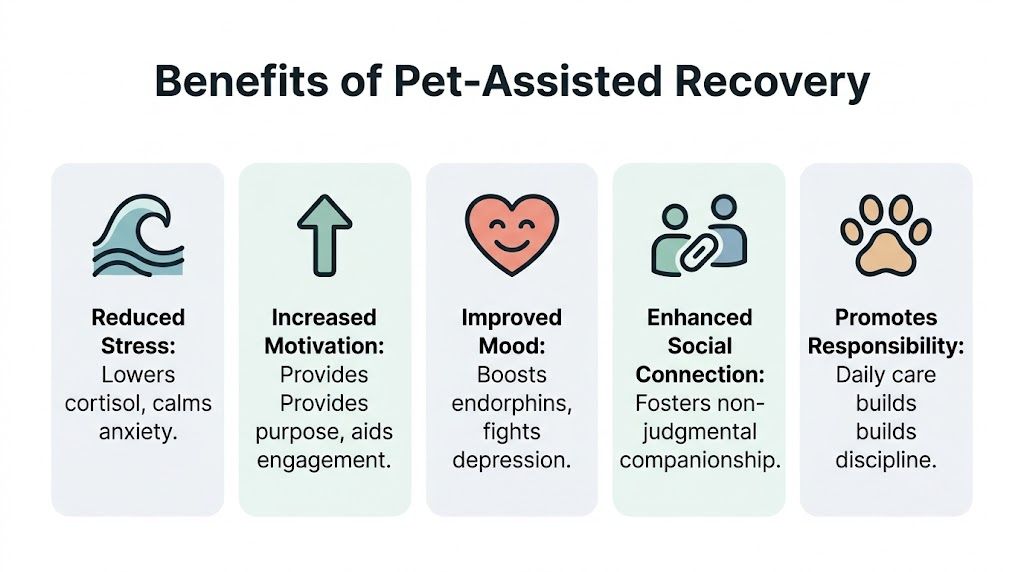
Emotional regulation in early recovery
Early recovery can feel raw. Sleep is off. Shame is close to the surface. The nervous system is often running too hot or too flat. A familiar animal can help bring that intensity down enough for treatment to work.
I have seen this show up in small but meaningful ways. A patient who could not settle into a room sits down and breathes. Someone who was ready to leave after family therapy stays for the evening. Another person who struggles to trust staff starts participating because the room feels less threatening with their dog nearby.
The pet is not doing the therapy. The pet is helping the patient remain regulated enough to receive it.
Routine gets rebuilt faster
Addiction disrupts daily rhythm. People stop eating on schedule, lose track of time, isolate, and let basic care slide. Pets create structure whether someone feels motivated or not.
That can support recovery in concrete ways:
- Morning activation: A dog still needs to go outside.
- Consistent caregiving: Feeding, water, and cleanup reinforce follow-through.
- Attention shifting: Caring for an animal interrupts rumination after groups or individual sessions.
- Reason to stay organized: Medication times, rest, meals, and pet care start fitting back into a workable day.
In a luxury setting, this can be handled with more dignity and less chaos. Private accommodations, outdoor access, and staff who understand how to coordinate treatment with daily pet routines make a real difference. At Oceans Luxury Rehab, pet inclusion fits best alongside therapies that address the body, stress response, trauma, and daily functioning together, such as these restorative therapies used in luxury rehab.
The bond can reduce dropout risk
A pet also protects something many families underestimate: continuity. Treatment already changes location, food, schedule, privacy, and social contact. If separation from a beloved animal gets added on top of withdrawal and uncertainty, the emotional load can spike fast.
For some patients, that is enough to delay admission or leave against advice.
Keeping the bond intact removes one major barrier. It does not fix denial, trauma, or ambivalence on its own, but it can lower the friction that prevents a person from giving treatment a fair chance.
Responsibility can help, but only if the match is right
There is a trade-off here. The right pet can steady a patient. The wrong setup can add stress. A calm, house-trained dog that settles well in a private room is very different from an anxious pet that barks through the night or marks indoors.
That is why good programs look beyond the emotional story and ask operational questions. Can the patient handle walks during detox? Is there backup help if they are fatigued after medication changes? If a dog has a history that calls for managing pet incontinence and marking, is there a realistic plan that will not disrupt treatment or the living space?
Those details matter. In the right environment, a pet can help a patient stay present, tolerate discomfort, and stick with care long enough for real progress to start.
Practical Considerations for Pet-Friendly Programs
A pet-friendly rehab stay rises or falls on logistics. Affection for the animal matters, but admission usually depends on whether the pet can live safely in the setting and whether the patient can keep participating in treatment without the pet becoming a daily disruption.
In luxury residential care, those questions get more specific. Private rooms, quieter surroundings, and more individualized scheduling can make pet accommodation realistic. They do not remove the need for rules.
Eligibility is about safety and fit
Programs commonly screen for vaccination records, flea and tick prevention, house-training, noise, aggression, and how the animal handles unfamiliar people entering the room. Temperament often matters more than species or size. A calm dog that settles after a short walk is easier to accommodate than an anxious dog that barks through groups, scratches doors, or reacts to staff.
Clinical fit matters too. Early detox can bring fatigue, nausea, sleep disruption, and medication changes. During that window, even a well-loved pet can feel like one more demand if there is no backup plan for walks, feeding, or cleanup.
At Oceans Luxury Rehab, the luxury setting can make a real difference in California. Patients who need privacy, structure, and higher-end accommodations often ask for pet-friendly options because a shared-room model is not workable for them or the animal. The right setup gives both the treatment team and the patient more room to solve practical problems before they become reasons to leave care.
Daily pet care still has to happen
Staff are there to deliver treatment. They are not automatic pet sitters. Before admission, ask exactly who does what if the patient is in detox, asleep after a medication adjustment, or in several hours of therapy.
The questions should be concrete:
- Who handles walks during the first 72 hours if the patient is physically depleted?
- Are feeding times flexible around groups and medical appointments?
- What happens if the pet barks when staff enter the room?
- Is there a local veterinarian or emergency clinic the program uses?
- Who coordinates transport if the pet gets sick?
- Are there breed, weight, or behavior limits?
- Does the pet need a crate, proof of training, or recent vet records?
Small issues turn into major stress quickly. Recent accidents, separation anxiety, poor leash control, or stress marking can all interfere with treatment participation and roommate-free housing standards. If a dog has had accidents lately, planning ahead around managing pet incontinence and marking can prevent unnecessary friction during admission.
One sentence can save a failed intake. Ask, “What are the top three reasons pets are denied or sent home after admission?”
Cost, insurance, and level of care come first
Pet accommodation should support treatment, not drive the clinical decision. A person who needs medical detox, dual-diagnosis treatment, or a highly structured residential program should not settle for a lower level of care because it is easier for the animal.
Insurance review needs to happen early, especially in California luxury rehab, where private accommodations and specialized services can affect out-of-pocket cost. A practical starting point is to review whether insurance covers inpatient rehab and then ask how pet housing, supervision expectations, and room availability fit into the recommended plan.
The right pet-friendly program answers these questions clearly before admission. That usually signals a stronger operation and a smoother start to treatment.
Steps to Find and Vet Local Pet-Friendly Rehabs
You find a program that looks promising, make the call, mention your dog, and the answer changes. Pets are allowed, but only in certain rooms. Or only after clinical review. Or not during the level of care you need. That kind of confusion delays admissions and pushes people back into the same cycle they were trying to leave.
A better search starts with two questions asked in the right order. What treatment do you need? Then, can the program support that treatment plan while also accommodating your pet safely and realistically?
Start with clinical fit, then test the pet policy
Pet accommodation should never override the level of care. If detox, dual-diagnosis treatment, or residential stabilization is the right recommendation, screen for that first. After that, get specific about how the pet policy works inside that setting.
Use a process like this:
- Confirm the level of care. Ask whether detox, residential, PHP, IOP, or outpatient is the appropriate fit.
- Verify pet eligibility in that level of care. Some facilities allow pets only in residential or only in private-room settings.
- Ask how housing is assigned. A pet-friendly policy means little if the program has limited private rooms or long wait times for them.
- Review approval requirements. Expect questions about vaccines, flea prevention, behavior history, crate use, and veterinary records.
- Find out who makes the final decision. Admissions may start the conversation, but housing, nursing, and clinical staff often decide whether the arrangement is workable.
This saves time. It also exposes weak operations quickly.
Ask questions that force clear answers
“Are you pet-friendly?” is too broad to be useful. Ask questions that show how the policy works on an ordinary Tuesday morning, not just on a website.
| Category | Question |
|---|---|
| Eligibility | Which pets are accepted, and what size, breed, or temperament limits apply? |
| Documentation | What records are required before admission, and how far in advance do you need them? |
| Housing | Is a private room required for clients with pets, and is one actually available? |
| Daily care | Who handles feeding, walks, litter, exercise, and cleanup during groups and appointments? |
| Clinical access | Are pets allowed during detox, residential treatment, or only at certain levels of care? |
| Safety | How do you handle allergies, fears of animals, barking, or conflicts between pets? |
| Emergencies | If the pet gets sick, who contacts the vet, transports the animal, or approves outside care? |
| Boundaries | Where can the pet go on campus, and which treatment spaces are off limits? |
| Costs | Are there added fees, deposits, supply requirements, or damage policies? |
| Discharge planning | How do you prepare the client and pet for the transition home? |
Ask for examples from recent admissions. A well-run program can explain what happens if a patient is in group and the dog needs a walk, or if a pet becomes stressed during the first 48 hours.
Look for operational maturity, not just warm messaging
The strongest pet-friendly programs sound organized. They can explain intake steps, room setup, staff expectations, sanitation rules, and backup plans without hesitation. If answers shift from one staff member to another, expect problems after admission too.
This matters even more in California luxury rehab, where privacy, room quality, and clinical complexity often shape the decision. Oceans Luxury Rehab in San Clemente is built for patients who need high-end residential care, private accommodations, dual-diagnosis support, and a setting that can realistically include a pet as part of the treatment plan. The right fit still depends on the person, the animal, and the level of care required, but clear logistics are usually a sign that the program takes both recovery and pet accommodation seriously.
Other Ways to Involve Pets in Your Recovery
A pet does not have to live with you in treatment to remain part of your recovery plan. In practice, I often recommend alternatives when the animal is elderly, highly reactive, in the middle of its own medical treatment, or unlikely to handle the disruption of residential care well. Early treatment can be demanding, and some pets do better with stability at home than with a major change in environment.

The strongest alternative plans keep the bond intact without adding avoidable stress. That may mean scheduled video check-ins with your pet and caregiver, approved in-person visits, or animal-assisted therapy with a trained therapy animal instead of your own. For some patients, that structure works better than trying to manage feeding, walks, accidents, and emotional attachment during the first days of stabilization.
Three practical alternatives
- Structured animal-assisted therapy: A good fit for patients who benefit from contact with animals but need clinical boundaries and no day-to-day pet care responsibilities.
- Planned pet visits: Useful when a family member or trusted friend can bring the pet at approved times without disrupting treatment.
- Temporary care with active coordination: Often the safest option if your pet needs consistency, medication, grooming, or a familiar home setting while you focus on detox or residential treatment.
Each choice involves a real trade-off. Therapy-animal sessions offer support, but not the comfort and recognition that come from your own pet. Visits preserve connection, but they are limited and depend on staff approval, scheduling, and transport. Temporary placement can protect both you and the animal, but only if the caregiver can follow routines closely and communicate well.
Ask specific questions before you commit to one of these options. Can the program help schedule pet visits. Will staff allow phone or video check-ins with the caregiver. If your pet stays with family, who handles medications, vet appointments, and behavior changes. Those details matter more than warm promises.
In California luxury rehab, these alternatives are often part of a broader treatment plan rather than a fallback. A program such as pet-friendly rehab in California may be able to help you decide whether full-time pet accommodation, limited visitation, or outside care makes the most sense for your clinical needs and your animal’s temperament.
If severe withdrawal, psychiatric instability, or round-the-clock medical monitoring is expected, indirect involvement is often the safer call. Good treatment protects the person and the pet at the same time.
Begin Your Recovery with Your Companion in California
California offers a setting many people want for treatment. Privacy. Better weather for outdoor routine. Space to reset. But those advantages only matter when the program can also address the practicalities of addiction care and pet inclusion without cutting corners.
For readers in Orange County, Los Angeles, or elsewhere in the state, the search often narrows to a few essential requirements. Medical oversight. Dual-diagnosis treatment. Private space. Confidential admissions. A humane answer to the pet question. Those needs can exist together, but they usually require a program built to support them rather than one that treats pet accommodation as an afterthought.

What to prioritize in a California search
A strong luxury treatment setting should make it easier to recover with a pet, not more stressful. That usually means:
- Private accommodations: Important for rest, boundaries, and animal management.
- Clinical depth: Detox, residential care, and support for co-occurring mental health conditions.
- Clear scheduling: Time for walks, feeding, therapy, and rest without constant conflict.
- Admissions efficiency: Fast screening so the person doesn’t lose momentum while gathering pet paperwork.
- Aftercare planning: Home transition should account for the same pet-related routines that shaped treatment.
For readers looking specifically in Southern California, pet-friendly rehab options in California can help clarify what to ask and what a realistic admission process looks like.
Recovery works better when the plan fits real life
A treatment plan fails when it ignores the factors that kept someone from seeking help in the first place. For many adults, professionals, couples, and people living alone, that factor is the animal waiting at home. Recovery becomes more accessible when care is built around actual life circumstances instead of idealized ones.
The right next step is simple. Call, ask direct questions, verify the level of care, and be honest about the pet’s needs and behavior. A good admissions team won’t treat that honesty as a nuisance. It will use it to build a safer plan.
Oceans Luxury Rehab offers licensed, oceanfront addiction treatment in San Clemente with private rooms, medically supervised care, dual-diagnosis support, and pet-inclusive accommodation planning for clients who need a realistic path into treatment. To discuss treatment options, insurance verification, and whether a pet can be safely included in care, contact Oceans Luxury Rehab.
