

A senior leader can hide a substance problem longer than is generally apparent. Calendars stay full. Deals still close. The presentation still lands. From the outside, nothing looks broken.
Inside, the math gets harder every week. Sleep depends on alcohol or pills. Focus depends on stimulants. Stress relief becomes a private ritual that no longer feels optional. The executive knows treatment is needed, but disappearing into a standard program can feel impossible when teams, investors, clients, and family all depend on continued performance.
That’s where luxury rehab for executives serves a different purpose. It isn’t about indulgence. It’s about creating the conditions for serious clinical care without forcing a high-responsibility professional to choose between health and career survival.
The Executive's Dilemma Acknowledging the Need for Help
The pattern is familiar. A founder keeps a bottle in the office credenza and calls it a way to unwind after investor meetings. A finance executive starts using medication more often before earnings calls. A partner who once prided himself on discipline now plans travel around access, privacy, and recovery time from the night before.
None of these people look like the stereotype of someone “falling apart.” That’s part of the problem. High achievement can mask deterioration for a long time.
Executives also tend to think in risk management terms. They know a public crisis can damage a company, a reputation, and a family at the same time. That mindset often delays treatment because they keep trying to contain the issue privately instead of addressing it clinically. The same logic that helps them run complex organizations can trap them in short-term damage control.
A useful business parallel is that advance preparation and early planning can prevent commercial crises. Addiction follows a similar rule. Waiting for a visible collapse is usually the most expensive way to act.
Why asking for help feels harder at the top
Executives are often rewarded for control, certainty, and stamina. Treatment requires the opposite starting point. It asks for honesty about impaired judgment, dependence, and limits. For someone whose identity is built around leadership, that can feel like professional exposure even though it is a form of protection.
The executive who seeks treatment early usually preserves more than sobriety. Career stability, family trust, and decision-making capacity are often still recoverable.
That’s why specialized care matters. A program built for senior professionals understands that the barrier isn’t just denial. It’s also confidentiality, schedule pressure, and the fear of stepping away at the wrong moment. California programs designed for this population can meet those realities directly instead of pretending they don’t exist.
Why Standard Rehab Programs Fall Short for C-Suite Leaders
A CEO agrees to treatment, then hesitates at the last minute for one practical reason. If the program requires total disconnection, shared housing, and a generic daily schedule, the cost may feel professionally unmanageable. Deals do not pause cleanly. Boards still expect judgment. Teams still need direction.

That tension is one reason standard rehab often underperforms for senior leaders. The clinical issue may be the same, but the treatment setting can either support engagement or create friction that keeps the person half in and half out of care. For executives, rehab has to protect recovery and preserve professional stability at the same time.
Standard programs often treat executive realities as distractions
In a conventional setting, work pressure is usually viewed as something the client should set aside. I understand the logic. Early treatment does require separation from the pace and triggers of daily life.
But for many executives, complete detachment is not realistic on day one. They may hold fiduciary duties, manage sensitive personnel issues, or be in the middle of transactions that cannot be abandoned without consequences. If a program has no structure for limited, clinically supervised contact, the client often spends treatment fighting the process instead of using it.
That is why the difference between luxury rehab and conventional rehab matters in practical terms. The point is not indulgence. The point is removing predictable barriers to full participation.
Privacy failures can block treatment before it starts
For a senior executive, privacy is not a preference item. It is often tied to reputation, regulatory exposure, employment contracts, investor confidence, and family protection.
Large shared environments can feel risky for that reason alone. If a client is worried about being recognized, overheard, or discussed outside the room, attention shifts away from clinical work. Admissions teams see this regularly. People delay care for months because they cannot find a setting that feels professionally safe.
Smaller, more discreet programs solve a real treatment problem. They reduce noise, limit unnecessary exposure, and give clients enough security to speak candidly.
Generic treatment plans miss the drivers behind high-functioning addiction
Executives rarely present with a simple stress story. The pattern is usually more layered. Alcohol may be used to shut down after sustained overactivation. Stimulants may be used to extend performance beyond healthy limits. Sedatives may become a way to force sleep when the nervous system will not settle.
A standard curriculum can identify substance use while still missing the operating style underneath it. That matters. If treatment does not address leadership isolation, perfectionism, chronic decision fatigue, image management, and the habit of equating worth with output, the client may leave sober but unprepared for the same pressures that shaped the addiction.
Here is where the gap shows up most clearly:
| Treatment issue | Standard setting | Executive-focused setting |
|---|---|---|
| Confidentiality | Basic privacy protections | Discretion built into admissions, housing, and daily operations |
| Work obligations | Full disconnection expected | Limited contact handled within clinical boundaries |
| Primary stressors | Broad addiction patterns | Leadership pressure, burnout, isolation, and performance strain |
| Treatment planning | Cohort-based structure | Individualized care built around role demands and relapse triggers |
Career risk changes how executives engage in treatment
An executive who fears unmanaged absence may agree to detox, then resist residential care, minimize symptoms, or push for early discharge. That is not simple denial. It is often a calculation about market timing, compensation, shareholder pressure, or the fear that one visible interruption will create lasting damage.
Programs that ignore those concerns usually lose the client’s trust. Programs built for executives can address them directly while holding firm clinical boundaries. That balance is one reason specialized care is a strategic necessity for high-level professionals, not a cosmetic upgrade.
At Oceans Luxury Rehab, this is the standard we hold. Treatment has to be clinically serious, private, and workable for people whose responsibilities do not disappear when they enter care. That approach gives executives a better chance of staying long enough to stabilize, do the deeper work, and return with judgment that is stronger than it was before treatment began.
The Pillars of Effective Executive Treatment Programs
An executive program only works if the clinical side is strong. Private rooms and polished surroundings don’t treat addiction. Skilled detox, psychiatric assessment, therapy, and relapse prevention do.
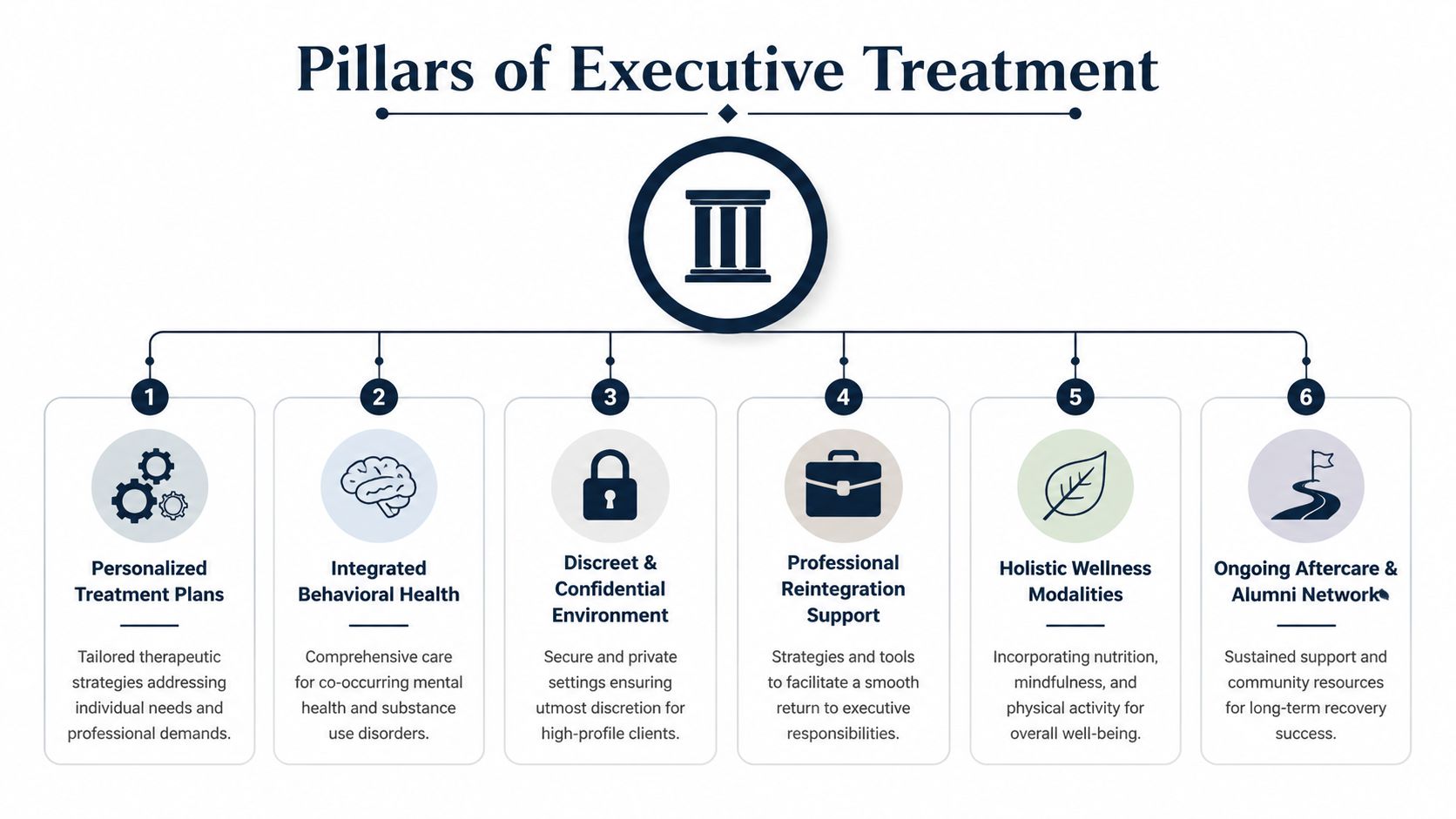
The treatment structure that tends to serve executives best combines medical stabilization with deep behavioral work, then carries that progress into step-down care rather than treating discharge like an endpoint.
Medical and psychiatric stabilization first
Many executives arrive exhausted, sleep deprived, anxious, depressed, or physically dependent on alcohol, benzodiazepines, opioids, or other substances. The first task is safe stabilization.
That often includes:
- Medically supervised detox with continuous monitoring for withdrawal risks
- Psychiatric evaluation to identify anxiety, depression, trauma, burnout, or other co-occurring conditions
- Medication-assisted treatment when appropriate for alcohol or opioid use disorders
- Immediate sleep, nutrition, and hydration support because cognitive recovery depends on basic physiological repair
Without this foundation, therapy becomes less effective. An overactivated or withdrawing brain doesn’t process insight well.
Small groups and tailored therapy matter
In executive treatment settings, small client-to-staff ratios and group sizes capped at 8 to 12 individuals allow more personalized care. Those programs also adapt therapies like CBT to executive-specific patterns, and reported 90-day sobriety rates of 70% to 85% compared with a 50% industry average appear in this executive luxury rehab clinical guide.
That doesn’t mean every executive needs the same therapy mix. It means effective programs adjust proven methods to the actual context of the client’s life.
What those therapies look like in practice
A strong executive track usually includes several layers of work rather than a single model.
CBT for performance-linked substance use
This helps identify the thoughts that justify use before a major presentation, after conflict, or during travel.DBT-informed emotional regulation
Many high achievers can manage companies better than they can manage shame, irritability, or panic. Regulation skills are practical, not abstract.Trauma-informed therapy
Some executives carry unresolved events that never looked like “trauma” in a traditional sense but still shaped how they cope under pressure.Family work
Spouses and children often live with secrecy, inconsistency, and emotional distance long before treatment begins.
A polished professional presentation can coexist with severe internal instability. Good treatment looks beneath competence and asks what the client relies on to stay functional.
Reintegration should begin during treatment
Programs for executives work better when they don’t treat career return as a separate problem for later. Reintegration planning needs to start while the client is still in care.
Key areas include:
- Communication boundaries with the office
- Travel risk planning for conferences, dinners, and client entertainment
- Stress mapping around known triggers such as board meetings or earnings cycles
- Aftercare structure that remains realistic once work resumes
That approach turns treatment into a strategy for sustainable performance, not just temporary symptom control.
Privacy Comfort and Connectivity The Luxury Difference
The word “luxury” creates confusion because people often hear “upscale” and assume the focus is image. In executive treatment, comfort features are functional. They reduce noise, lower resistance to care, and create a more stable environment for a client whose nervous system is already overloaded.

Executive rehabs distinguish themselves through private accommodations, exercise facilities, and work-support features like cellphone and internet access, and these centers average 25 beds to support privacy and personalized attention, as described in this industry overview of executive rehab settings.
Comfort supports treatment adherence
A private suite gives a client space to sleep, decompress, and process without the constant interpersonal stress of shared living. That matters more than many people think. Rest is treatment. So is having enough psychological space to stop performing for other people every minute of the day.
Nutrition, fitness access, and a calm setting also support recovery in direct ways. Executives often arrive physically depleted. Structured meals, movement, and a lower-stimulation environment can improve concentration and emotional steadiness, which makes therapy more productive.
Privacy has to be operational, not symbolic
Discretion means more than saying a program is confidential. It should be visible in how the facility runs.
Look for:
- Private rooms and controlled access so exposure is minimized
- Clear communication policies around family, employers, and outside parties
- Protected scheduling so treatment activities aren’t disrupted by unnecessary contact
- A setting that preserves dignity rather than making clients feel surveilled
This discussion of privacy in luxury rehab settings is helpful because it focuses on what confidentiality looks like in practice.
Connectivity should be structured
Executives often ask whether they can maintain contact with their business. The honest answer is yes, sometimes, but only in a clinically managed way. Unlimited work access can turn treatment into remote office time with therapy squeezed in. That rarely works.
A better model allows essential communication during defined windows, with clear guardrails. The client stays reachable for real issues without slipping back into constant activation.
The best executive programs don’t let work run treatment. They make room for necessary contact while protecting the clinical process.
Understanding the Investment in Executive Recovery
A founder misses a board meeting because withdrawal symptoms hit mid-flight. A senior partner signs off on a deal without reading the final revisions. By the time an executive starts asking what treatment costs, the larger losses often have already started.
Price still deserves a straight answer. Executive treatment usually costs more because it includes a higher staff-to-client ratio, stronger clinical oversight, private accommodations, and program design that can support limited business continuity without letting work overrun care. For many professionals, that added structure protects the very assets they are trying to preserve, including judgment, credibility, and the ability to return to leadership with stability.
The comparison is not luxury versus standard amenities. It is short-term price versus total exposure.
For executives, untreated addiction rarely stays contained. It shows up in missed decisions, strained family systems, compliance risk, public embarrassment, health decline, and the quiet erosion of trust inside a company. A well-built program addresses those risks directly. It creates enough distance from active use to stabilize the client, while preserving the conditions needed for a real return to work.
Here is the practical frame I use with families and candidates for admission:
| Investment area | What it protects |
|---|---|
| Medical and psychiatric care | Safe detox, stabilization, sleep, and cognitive recovery |
| Executive-focused therapy | Judgment, emotional regulation, relapse prevention, and return-to-work planning |
| Operational privacy | Reputation, confidentiality, and reduced exposure |
| Continuing care | Accountability after discharge, which lowers the odds of a fast relapse |
Insurance can reduce the out-of-pocket burden, especially for medically necessary services such as detox, residential treatment, and psychiatric care. The right first step is a confidential benefits verification, followed by a plain-language review of what is covered, what is not, and what the family or company may need to fund directly. This breakdown of how much luxury rehab can cost is useful if you want to see how those variables typically affect the total.
Travel planning also matters more than people expect. Executives often need fast, discreet transportation with minimal friction at departure and arrival. Some families look at savvy travel options like empty leg flights when privacy and timing are both priorities.
At Oceans Luxury Rehab, we discuss cost in the same way we discuss treatment planning. Directly, with trade-offs made clear. The question is not whether recovery requires an investment. It does. The question is whether continued decline will cost more than decisive care now.
A Framework for Choosing the Right Facility in California
An executive finally agrees to treatment after a board meeting goes sideways, a spouse draws a hard line, or a physician warns that the next withdrawal could turn dangerous. The decision has to be made fast, and in California, too many options can blur the difference between strong clinical care and polished marketing.
The right facility protects more than health. It protects judgment, reputation, family stability, and the ability to return to work without stepping back into the same pattern that caused the crisis.
For executives, I advise looking at one question first. Can this program support recovery and real-world reintegration at the same time? A facility may look impressive and still fall short if it cannot explain who manages detox, how psychiatric care is handled, what work access looks like in practice, and how the team prepares a client for travel, client entertainment, and high-pressure decisions after discharge.
What to verify before admission
A serious admissions call should be direct. If answers are vague, keep asking until they are not.
Licensing and accreditation
Confirm California state licensing. Ask whether the program meets recognized accreditation standards and what that means for medical oversight, safety protocols, and quality review.Connected levels of care
Detox, residential treatment, outpatient support, and aftercare should work as one plan. Handing a client off from one disconnected provider to another often creates gaps at the exact point when motivation and stability are still fragile.Dual-diagnosis treatment
Executives rarely arrive with substance use alone. Anxiety, insomnia, depression, trauma, burnout, and compulsive work patterns often need treatment at the same time if recovery is going to hold under pressure.Executive-capable structure
Ask how the program handles urgent work communication, legal or fiduciary obligations, and family coordination. The right answer is not unlimited phone access. It is a clear clinical structure that allows necessary contact without letting work take over treatment.Return-to-work planning
Discharge planning should include relapse prevention for airport lounges, business dinners, performance pressure, and the first weeks back in the office. That is where many relapses begin.
California-specific practical considerations
Location should support the job the program has to do. For many professionals in Southern California, that means a setting close enough for family participation and practical logistics, but far enough from office routines, social obligations, and familiar triggers to create real separation.
Transportation also deserves more thought than people expect. A delayed or highly visible admission can become one more reason to postpone care. In some cases, private travel arrangements, including savvy travel options like empty leg flights, can reduce friction and help a client enter treatment discreetly and quickly.
The right questions reveal the right program
Ask direct questions, then listen for direct answers.
- Who provides detox oversight and psychiatric care?
- How is limited work access structured, monitored, and reduced if it starts to interfere with treatment?
- What does family involvement look like, and when is it recommended?
- How does the clinical team prepare clients for relapse risks tied to leadership stress, travel, entertaining, and sudden re-entry into work?
- What support continues after residential care ends?
Oceans Luxury Rehab fits what many executives need in California: medically supervised detox, residential treatment, step-down levels of care, dual-diagnosis support, and a private San Clemente setting that allows discreet treatment without losing sight of real-life demands. For a high-stakes professional, that combination is not about comfort alone. It is about protecting the conditions that make long-term recovery and career preservation more realistic.
Decision rule: If a facility highlights amenities but cannot clearly explain clinical staffing, work-life boundaries during treatment, and the plan for reintegration, keep looking.
Your Path to Recovery Starts at Oceans Luxury Rehab
It often comes to a head on an ordinary workday. A board meeting is on the calendar, your phone will not stop, and privately you already know alcohol, stimulants, or prescription medication are affecting judgment, sleep, and reliability. At that point, the question is usually not whether help is needed. It is whether treatment can protect your health without letting your career unravel in the process.
Common questions executives ask
How long will treatment take?
The answer depends on withdrawal risk, substance use history, psychiatric needs, and the level of care a clinician recommends after assessment. Some executives need medically supervised detox before residential treatment. Others will also need a step-down plan after residential care so the return to work is gradual and safer. The timeline should follow clinical reality, because rushed treatment often creates a short-lived pause instead of durable recovery.
Can I stay in contact with work?
Sometimes. The deciding factor is whether contact can be limited, purposeful, and supervised closely enough that it does not pull you back into the same stress patterns that fueled substance use. In executive treatment, work access should support recovery, not compete with it.
What if anxiety, depression, trauma, or burnout are part of the picture?
That is common, especially among high-performing professionals who have spent years functioning under pressure. Treating substance use without addressing the mental health drivers behind it usually leaves a major relapse risk in place.
What happens after residential treatment?
Discharge planning should start early. A sound plan includes relapse prevention, family involvement when clinically appropriate, continued therapy, and lower levels of care that match the demands of re-entry. Executives do better when the transition back to leadership is structured, not improvised.
Why California executives often choose coastal care
For professionals based in Orange County, Los Angeles, and other parts of Southern California, staying in-state can solve several practical problems at once. Family participation is easier to arrange. Legal, medical, and business logistics are easier to manage. The setting still creates enough separation from daily routines to make treatment meaningful.
San Clemente offers that balance well. It gives clients privacy, physical distance from familiar triggers, and room to stabilize without forcing a cross-country move in the middle of a crisis.
A practical next step
A confidential admissions call should answer practical questions quickly. That includes detox needs, likely levels of care, insurance verification, privacy protections, travel timing, and whether limited work contact is appropriate. The hard question many executives are asking is straightforward: how to enter treatment, protect health, and preserve the career they have spent years building.
Oceans Luxury Rehab is built for that problem. The program combines medical oversight, dual-diagnosis treatment, residential care, step-down support, and a private Southern California setting that respects both clinical priorities and the practicalities of executive life. For many professionals, that makes treatment a strategic intervention, not a retreat from responsibility.
