

When a family starts searching for help, the same questions tend to surface fast. Why can't a loved one just stop? Why does detox alone so often end in another crisis? And what treatment provides someone a real chance to steady their life instead of repeating the same painful cycle?
That search often leads to one phrase that sounds clinical and confusing at first: medication-assisted treatment, or MAT. For many families, it can feel unsettling. Medication may sound like a shortcut, or like something that replaces one problem with another. In reality, MAT is a structured medical approach designed to reduce withdrawal, lower cravings, and create enough stability for therapy and recovery work to take hold.
The Search for a Sustainable Path to Recovery
A typical family arrives at this question after a hard stretch. A loved one may have sworn off opioids or alcohol, made it through a few painful days, then returned to use soon after. Everyone involved feels exhausted. The person struggling often feels ashamed. The family feels scared and unsure what to trust.
That confusion makes sense. Addiction treatment language can be hard to sort through, especially online. Terms like detox, rehab, therapy, relapse prevention, and medication support often get lumped together, even though they serve different purposes.
When willpower isn't enough
Substance use disorders don't only affect motivation. They also affect the brain, stress response, sleep, mood, and the body's ability to function normally without the substance. That's why a person can want recovery and still feel pulled back by cravings, withdrawal, fear, or emotional distress.
A more sustainable path usually includes support on several levels at once:
- Medical support that helps the body stabilize
- Therapeutic care that addresses patterns, triggers, and mental health
- Daily structure that reduces chaos and risk
- Long-term planning so recovery doesn't end when detox ends
Recovery often starts improving when treatment stops asking a person to white-knuckle every symptom and starts giving that person tools that make stability possible.
For some families, support may also need to be culturally responsive or available across languages, which is why resources such as THERAPSY's recovery programs can be useful when someone needs therapy access that fits their background and communication needs.
Why MAT keeps coming up
MAT comes up so often because it addresses one of the biggest barriers in early recovery. Many people don't relapse because they don't care. They relapse because their bodies and brains are still in distress, and distress can overpower good intentions.
Medication-assisted treatment isn't a magic fix. It doesn't do the emotional work for the patient. But it can create a much steadier foundation for recovery, which is why many clinicians and families now view it as one of the most practical, hopeful options available.
What Medication-Assisted Treatment Really Means
A family arrives after weeks of fear, sleepless nights, and failed promises to stop. They often ask the same question in a quiet, worried voice: “Are you just replacing one drug with another?” That question makes sense. The phrase medication-assisted treatment can sound technical, and for many people, it raises more anxiety than clarity.
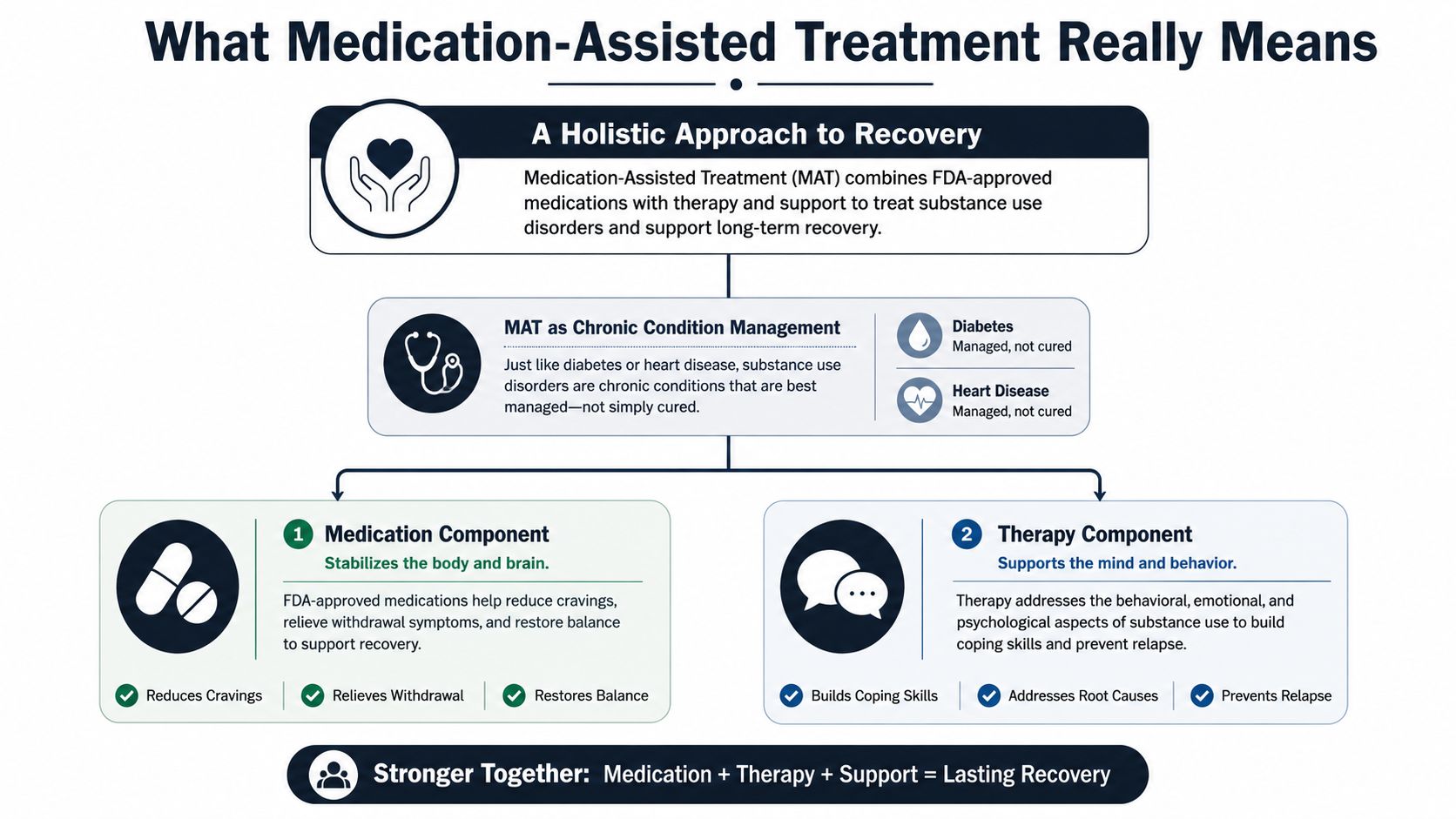
Medication-assisted treatment means using FDA-approved medication together with counseling and behavioral care to treat substance use disorders, especially opioid use disorder, as described by the Substance Abuse and Mental Health Services Administration. The goal is not to sedate someone or avoid real recovery work. The goal is to help the brain and body become steady enough for recovery work to take hold.
A treatment plan built for stability
Families often picture medication as something used only during detox. In practice, MAT is often part of longer-term care. For opioid use disorder, medications are widely used as an ongoing treatment approach rather than a short withdrawal aid.
That shift is significant, as stopping medication abruptly can increase relapse and overdose risk. A person may look “better” from the outside while their tolerance, stress response, and cravings are still unstable underneath. Good treatment respects that reality instead of rushing past it.
A helpful way to view MAT is to picture a house being rebuilt after structural damage. Therapy helps redesign daily life, relationships, coping skills, and decision-making. Medication helps stabilize the foundation so the rest of the work does not keep collapsing under the weight of cravings, withdrawal, or severe anxiety about getting sick.
What MAT is actually trying to accomplish
MAT helps reduce the physical pressure that can overpower good intentions. Once that pressure comes down, people are often better able to think clearly, stay in treatment, participate in therapy, and begin planning for a future that is larger than the next urge or the next crisis.
MAT may help by:
- Reducing withdrawal symptoms that make early recovery feel unbearable
- Lowering cravings that can pull a person back into use
- Decreasing immediate safety risks during a period when overdose danger may be high
- Making therapy more usable because the person is more physically and emotionally settled
A simple clinical truth: if a patient can sleep, think, eat, participate, and stay engaged in care, recovery has a much better chance to grow.
More than medication alone
MAT works best as part of a full treatment setting, not as a stand-alone prescription. That usually includes medical monitoring, individual therapy, group support, family involvement, mental health care, and planning for life after residential treatment.
This is one reason environment matters so much. In a calm, medically supervised setting such as Oceans Luxury Rehab, patients are not trying to stabilize in the middle of chaos. They have space to rest, clinical support to adjust treatment safely, and a setting that helps them focus on rebuilding daily life with dignity. That broader structure turns MAT from a medication decision into a strategy for reclaiming health, safety, and a future that feels possible again.
For opioid use disorder, clinicians commonly use methadone, buprenorphine, and naltrexone within this larger care plan. The medication is one tool; the aim is steadier living, clearer thinking, stronger participation in treatment, and a recovery process that can last.
How MAT Medications Work for Opioid and Alcohol Recovery
Families usually want a direct answer here. What do these medications do, and why would a doctor use one instead of another?
The simplest answer is that MAT medications are used to make the brain and body less vulnerable to the intense pull of substance use. Some reduce cravings and withdrawal. Others block rewarding effects. The exact medication depends on the substance involved, the person's history, and the clinical setting.
For opioid recovery
With opioid use disorder, the treatment team often focuses on the cycle of withdrawal, craving, and return to use. If that cycle isn't interrupted, the person may stay trapped in crisis mode.
Two commonly discussed medications are buprenorphine and naltrexone. Buprenorphine is used to help reduce withdrawal symptoms and cravings. Naltrexone is also used in opioid recovery, but it works differently. It blocks opioid effects rather than easing withdrawal in the same way.
Families who want a more treatment-specific overview can review medication-assisted treatment for opioid addiction for a deeper look at how opioid-focused MAT is used in practice.
For alcohol recovery
MAT isn't only for opioids. It can also be part of alcohol treatment. In alcohol recovery, naltrexone is commonly discussed because it can reduce the rewarding effects that make drinking harder to resist for some patients.
The goal isn't to "cure" alcohol use disorder overnight. The goal is to lower the intensity of the cycle so the patient can participate more fully in therapy, rebuild judgment, and practice sobriety in a more stable state.
Common MAT Medications at a Glance
| Medication (Brand Name) | What It Treats | How It Works | How It's Taken |
|---|---|---|---|
| Buprenorphine | Opioid use disorder | Helps reduce withdrawal symptoms and cravings | As prescribed by a medical provider |
| Naltrexone | Opioid use disorder and alcohol use disorder | Blocks the rewarding effects of opioids and can reduce the incentive to drink | As prescribed by a medical provider |
| Methadone | Opioid use disorder | Helps reduce withdrawal symptoms and cravings within a structured treatment setting | Dispensed through regulated treatment programs |
Why medication choice isn't one-size-fits-all
A person with severe withdrawal, repeated opioid relapse, and unstable daily functioning may need a different plan than someone who has already completed detox and is ready for a blocker medication. A person with alcohol use disorder and strong relapse triggers may also need a different rhythm of care than someone focused on opioid stabilization.
That decision usually depends on questions like these:
- What substance is involved
- Whether the patient is in active withdrawal
- What level of medical monitoring is available
- Whether co-occurring mental health symptoms are present
- How well the person can follow a daily treatment plan
The right MAT medication isn't chosen for convenience. It's chosen to match the patient's risk, symptoms, and recovery stage.
What families often misunderstand
Medication doesn't replace counseling. It makes counseling more usable. A person who isn't consumed by nausea, panic, body pain, or relentless cravings can sit in a therapy session, listen, speak openly, and remember what was discussed.
That difference is often where recovery starts to feel possible instead of punishing.
The Proven Effectiveness of Medication-Assisted Treatment
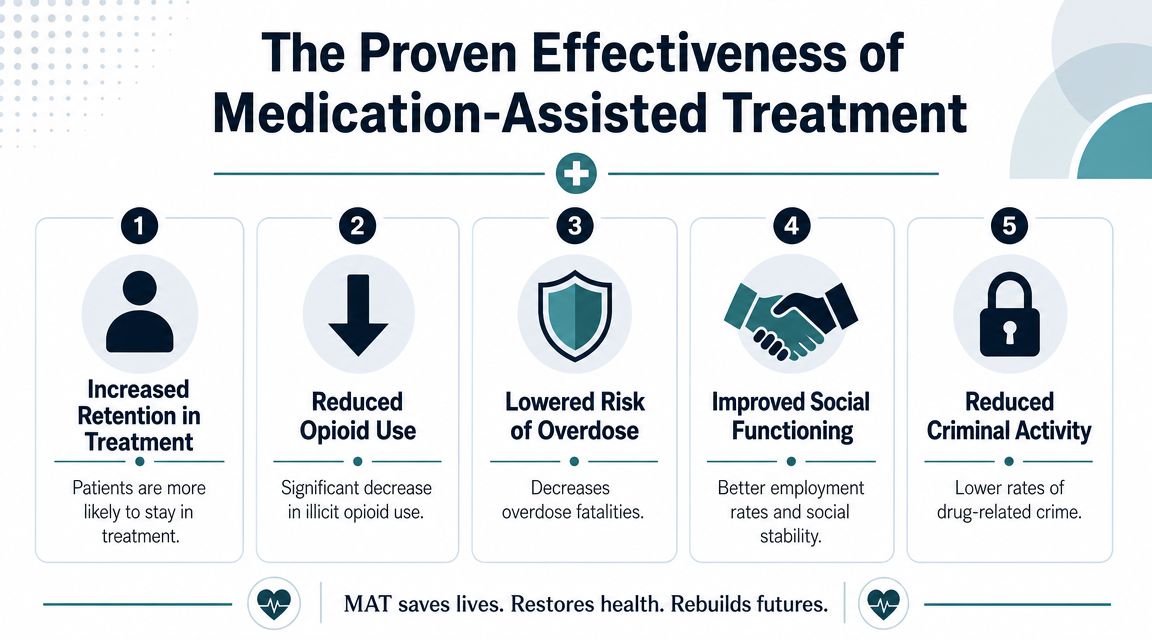
A family often sees progress in very human terms. Is your loved one showing up for breakfast, answering the phone, sleeping through the night, and staying in treatment long enough to begin healing? In MAT, that staying power matters because recovery usually improves when care continues through the hard weeks and months, not just the first few days.
One of the clearest ways clinicians evaluate that staying power is retention, or how consistently a person remains connected to treatment over time. A systematic review of retention in methadone and buprenorphine treatment found that long-term participation varies by medication and program structure, but retention is often strong enough to make continued care realistic for many patients. That matters because addiction is not usually stabilized by a brief burst of effort. It is treated more like a long recovery from a serious illness, where consistency gives the brain and body time to settle.
Why retention matters so much
Families often focus on abstinence alone. Clinicians also ask whether the person is still connected to care, still seeing the treatment team, and still protected during a period when relapse and overdose risk can be high.
That distinction is important.
A person who remains in MAT is more likely to keep receiving medication adjustments, therapy, medical check-ins, and relapse-prevention support. The process works like a cast on a broken bone. The cast does not do all the healing by itself, but it creates the stability that lets healing happen. In the same way, MAT can create enough physical and emotional steadiness for the deeper work of recovery to take hold.
Federal public health guidance notes that medications for opioid use disorder are associated with better treatment engagement and lower risk of overdose compared with no medication treatment, as summarized by the National Institute on Drug Abuse overview of medications for opioid use disorder.
What these outcomes look like in daily life
Retention can sound technical until you translate it into ordinary experience. Families often notice benefits such as:
- Fewer medical and emotional crises because the person is not repeatedly dropping out of care
- More consistent therapy participation because appointments are no longer competing with severe withdrawal or overpowering cravings
- Greater day-to-day stability in sleep, meals, communication, and responsibilities
- More time for trust to rebuild because treatment has a chance to become steady instead of episodic
MAT gives recovery enough structure and time to grow. For many patients, that is the difference between repeated interruption and real traction.
This is also why the treatment setting matters. Medication works best when it is delivered in a place that supports follow-through, privacy, and close medical observation. A calm, medically supervised environment like Oceans Luxury Rehab can reduce noise, fear, and daily disruption so patients can focus on getting well. That approach frames MAT not as a short-term fix, but as part of a larger plan to reclaim health, relationships, and a future that feels worth protecting.
How MAT Is Delivered at a California Luxury Rehab
A high-quality MAT program isn't a quick prescription visit. It's a coordinated process that starts with assessment and continues across levels of care. In a California luxury rehab setting, that process can feel calmer, more private, and more medically supported, which matters when a patient is already frightened or physically depleted.

What the process usually looks like
The first stage is often assessment. Clinicians review substance use history, withdrawal risk, mental health concerns, medical needs, and prior treatment attempts. That helps determine whether MAT is appropriate and which medication, if any, fits the situation.
From there, care often unfolds across a continuum.
Medically supervised detox
During detox, the immediate goal is stabilization. If a patient is entering treatment after heavy opioid or alcohol use, the early focus is safety, symptom relief, and close observation. Medication may be started during this period to reduce distress and lower the chance that the patient leaves treatment to escape feeling sick.
Residential treatment
Once the patient is medically steadier, residential care gives recovery structure. Medication management continues, but the day also includes therapy, groups, psychiatric support when needed, and relapse-prevention work. In this environment, many patients begin to understand that MAT isn't separate from recovery. It's part of the platform that allows recovery work to happen.
Step-down care
As patients gain stability, treatment may continue through partial hospitalization, intensive outpatient care, or outpatient follow-up. That step-down model matters because recovery rarely becomes secure all at once. Patients often need support as they return to work, family demands, and ordinary stress.
Why the environment matters
The clinical plan matters most, but the setting still affects how people respond to care. A person who feels exposed, overstimulated, or unsafe may struggle to settle into treatment. Privacy, comfort, and calm can lower resistance and make it easier to stay.
In Orange County, some patients specifically look for a setting that includes:
- 24/7 nursing and physician oversight for medical reassurance
- Private rooms that support rest and dignity
- Dual-diagnosis care when anxiety, depression, or trauma are also present
- A quieter physical environment that reduces outside disruption
One California option is Oceans Luxury Rehab's medication-assisted treatment program, where MAT can be integrated into medically supervised detox, residential care, and ongoing treatment planning within an oceanfront setting in San Clemente.
The most effective treatment environment is one that helps the patient feel safe enough to stay, honest enough to engage, and supported enough to continue when recovery becomes uncomfortable.
MAT works best when it is integrated
A strong program doesn't treat medication as an isolated service. It connects medication decisions with therapy progress, psychiatric care, sleep, cravings, family dynamics, and discharge planning. When those pieces are coordinated, the patient is less likely to feel split between "medical treatment" and "real recovery."
That integrated model is often what families are hoping for, even if they don't yet know the language for it.
Finding the Right MAT Provider for You
Not every person with a substance problem needs MAT, but many people with moderate to severe opioid or alcohol use disorders should at least be evaluated for it. A careful assessment matters more than assumptions. Some patients are strong candidates because cravings are intense, relapse has been repeated, or withdrawal has made previous attempts unsustainable.

Who may be a good candidate
A provider may consider MAT when a patient has a pattern like this:
- Repeated relapse after detox even when motivation is genuine
- Strong opioid or alcohol cravings that disrupt basic functioning
- Painful or risky withdrawal history that keeps derailing treatment
- Co-occurring mental health symptoms that complicate recovery
Those factors don't automatically decide treatment, but they often signal that added medical support could help.
What to look for in a MAT provider
Families often focus first on whether a center "offers MAT." That matters, but it's only the starting point. The more important question is whether the provider can deliver MAT well.
A strong provider typically offers the following:
- Licensed clinical care with qualified medical oversight
- A full continuum of treatment rather than a medication-only experience
- Dual-diagnosis capability for people dealing with both addiction and mental health symptoms
- Clear follow-up planning so support continues after the initial phase
Some families also want to understand how prescribing and monitoring work in California treatment settings. For that topic, this overview of nurse practitioners and MAT in California can help clarify part of the care model.
Questions worth asking on the first call
A first admissions call doesn't need to be perfect. It just needs to answer a few practical questions:
- Does the program evaluate whether MAT is appropriate, or assume the same plan for everyone?
- Can the facility manage detox, therapy, and medication under one coordinated plan?
- How does the team handle mental health concerns alongside substance use?
- What happens after residential or outpatient treatment ends?
A good MAT provider doesn't just start medication. The team builds a plan for how the patient will live, cope, and stay connected to care after the first phase of treatment.
Making the process feel manageable
For many families, the biggest barrier isn't willingness. It's overwhelm. Insurance, timing, travel, privacy, and fear of making the wrong decision can stop people from acting even when they know help is needed.
That is why an efficient admissions process matters. Quick insurance verification, confidential consultation, and a clear explanation of treatment options can remove enough friction for a family to move from panic to action.
Common Questions and Myths About MAT
A family often reaches this point exhausted and uneasy. They may be asking, "Are we helping recovery, or just replacing one problem with another?" That question is understandable. MAT can sound unfamiliar until someone explains what it is doing and how it fits into a real treatment plan.
Am I just trading one addiction for another
This concern usually comes from love and fear. Families want to know whether medication will keep someone stuck instead of helping them heal.
The difference is in how the medication is used and what effect it has on daily life. In addiction, a person keeps using in a compulsive way despite harm, secrecy, and loss of control. In MAT, medication is prescribed carefully, monitored medically, and used to reduce withdrawal, cravings, and the chaos that keeps recovery out of reach. The goal is steadiness. That steadiness gives the brain and body enough relief to participate in therapy, sleep normally, think clearly, and begin rebuilding a life.
Is MAT supposed to be forever
Treatment length is different for each person. It depends on the substance involved, relapse history, medical needs, psychiatric symptoms, and how stable life becomes over time.
For some patients, medication is used for a shorter period during detox or early recovery. For others, longer-term use is the safer choice, especially when stopping too soon could raise the risk of relapse or overdose. Neither path means someone is doing recovery "right" or "wrong." It means the care plan is being matched to the patient's actual needs.
A good clinician does not set that timeline based on pressure, stigma, or a fixed ideology. The timeline is based on safety, function, and progress.
Can someone still have real recovery while taking medication
Yes.
Recovery is reflected in what starts coming back. Clearer thinking. Stable sleep. Honest relationships. The ability to work, parent, attend therapy, keep commitments, and stay away from illicit substance use. Medication does not cancel those gains. For many people, it helps make them possible.
Ultimately, recovery should be measured by health and stability, not by whether treatment looks dramatic from the outside.
Does MAT replace therapy
Medication can quiet the constant alarm signal of cravings and withdrawal. Therapy addresses the reasons life became vulnerable to substance use in the first place. Trauma, grief, shame, relationship patterns, impulsivity, and relapse triggers still need attention.
That is why MAT works best inside a setting where medical care and psychological care are coordinated. In a calm, private, medically supervised environment such as Oceans Luxury Rehab, patients have room to stabilize physically while also doing the deeper work that supports lasting change. The setting matters. Healing is easier when the nervous system is not fighting noise, chaos, or uncertainty every hour of the day.
What if the family feels unsure
Uncertainty does not mean a family is unprepared. It usually means the decision matters.
Families do not need to solve everything before making a call. They need a place where questions are welcomed, a clinical assessment is done carefully, and the next step is explained in plain language. MAT is not a shortcut or a surrender. It is one evidence-based part of a larger recovery strategy focused on helping a person reclaim safety, function, and a future that feels livable again.
When a family is ready to explore care in California, Oceans Luxury Rehab offers confidential admissions support, insurance verification, and a full continuum of addiction treatment that may include medication-assisted treatment, detox, residential care, and outpatient planning in San Clemente. A private consultation can help clarify whether MAT fits the situation and what next steps make the most sense.
