
When a family searches for the dbt center of orange county, the search often comes at a hard moment. A loved one may be spiraling through intense mood shifts, self-harm urges, substance use, relationship blowups, or long stretches of shame and hopelessness. The problem usually isn’t a lack of caring. It’s that everyone feels exhausted, confused, and unsure what kind of help works.
That search also carries a practical question. Is there still a real place in Orange County where structured, skill-based DBT care is available, especially when emotional instability and addiction are tangled together? The answer takes some unpacking, because the local situation changed in a meaningful way.
The Search for Emotional Balance in Orange County
A person can look steady on the outside and still feel out of control inside. Many adults describe living from one emotional fire to the next. One argument turns into a drinking binge. One wave of rejection turns into panic, self-harm, or complete shutdown. Families often see the aftermath, but not the internal struggle that drives it.
That’s why the phrase dbt center of orange county still matters. It points to a form of treatment that many people were specifically seeking, not just general counseling, but a structured therapy built for intense emotions, impulsive behaviors, and repeated crises.

The original DBT Center of Orange County announced that it would close effective December 15, 2025, following the unexpected passing of its founder, creating a significant gap in dedicated outpatient DBT services in the region, according to the closure notice from the former center. For families already struggling to find specialized care, that kind of closure can feel like one more door shutting.
Why this search still matters
People searching now usually need one of three things:
- Clear direction: They need to know whether DBT is the right fit for emotional dysregulation, self-harm, trauma-related reactions, or substance use.
- A local path forward: They want care in Orange County, not a vague recommendation with no next step.
- Hope that feels practical: They need treatment that can be explained in everyday language.
For some families, it also helps to start with simple emotional education before treatment begins. Resources that help people learn to work through feelings can support that first step, especially when someone is overwhelmed and doesn’t yet have words for what’s happening.
Practical rule: When emotions keep creating danger, chaos, or relapse, the issue usually isn’t “motivation.” It’s a missing set of skills.
Orange County still offers pathways to high-quality, DBT-informed care. The need didn’t disappear with one clinic’s closure. If anything, the closure made it more important for families to understand the treatment options, including why many now look beyond a standalone outpatient clinic and consider a broader recovery setting in the area, such as the options discussed in this overview of rehab in Orange County.
Understanding Dialectical Behavior Therapy
Dialectical Behavior Therapy, usually called DBT, is a treatment that teaches people how to handle painful emotions without making life worse. It was designed for people who feel things intensely and react fast, especially when fear, shame, anger, emptiness, or abandonment gets triggered.
The word dialectical confuses many families. In plain language, it means holding two truths at once. A person can be experiencing profound suffering and still be responsible for change. A loved one can need compassion and clear limits. Recovery works better when treatment doesn’t force a choice between acceptance and accountability.
Acceptance and change at the same time
Many people enter therapy after hearing one of two harmful messages. The first is, “Just calm down.” The second is, “This is just who you are.” DBT rejects both. It says the person’s pain is real, and new behaviors can be learned.
That balance matters in addiction treatment too. Someone may use alcohol, opioids, stimulants, or sedatives to escape unbearable inner states. If treatment only focuses on stopping the substance but ignores the emotional storms underneath, relapse risk stays high.
A strong DBT program doesn’t just ask what happened. It teaches what to do the next time the same feeling hits.
What a real DBT program includes
A high-fidelity DBT program is more structured than standard talk therapy. According to the program description for the former Orange County DBT center, a complete DBT model includes:
- Weekly individual therapy: Sessions focus on the behaviors creating the most danger or disruption.
- Skills groups: Clients learn four core modules that can be practiced in daily life.
- Diary cards: These help track moods, urges, behaviors, and skill use.
- Between-session phone coaching: Support is available when a person needs help using a skill in real time.
- Therapist consultation teams: Clinicians meet regularly to maintain adherence to the evidence-based DBT model.
Why diary cards and coaching help
Families sometimes hear terms like diary card and assume the treatment is rigid or impersonal. It’s the opposite. A diary card gives the therapist a map. If a client drank after a conflict, self-harmed after feeling rejected, or shut down after criticism, the session can focus on the exact chain of events instead of drifting into general discussion.
A simple comparison often helps:
| Part of DBT | What it does in real life |
|---|---|
| Individual therapy | Identifies patterns and builds a plan for specific high-risk moments |
| Skills group | Teaches concrete coping tools |
| Diary card | Shows what emotions, urges, and behaviors are repeating |
| Phone coaching | Helps use a skill before the crisis escalates |
For families in distress, that structure can feel reassuring. DBT isn’t random. It gives people a repeatable method for handling suffering, conflict, and impulses with more stability.
The Four Pillars of DBT Skills Training
The practical heart of DBT is skills training. These skills are taught by multidisciplinary teams that may include licensed therapists, DBT specialists, psychologists, and mindfulness instructors serving adults, adolescents, and specialized populations, as reflected in the former local program profile at ZoomInfo’s listing for the center.
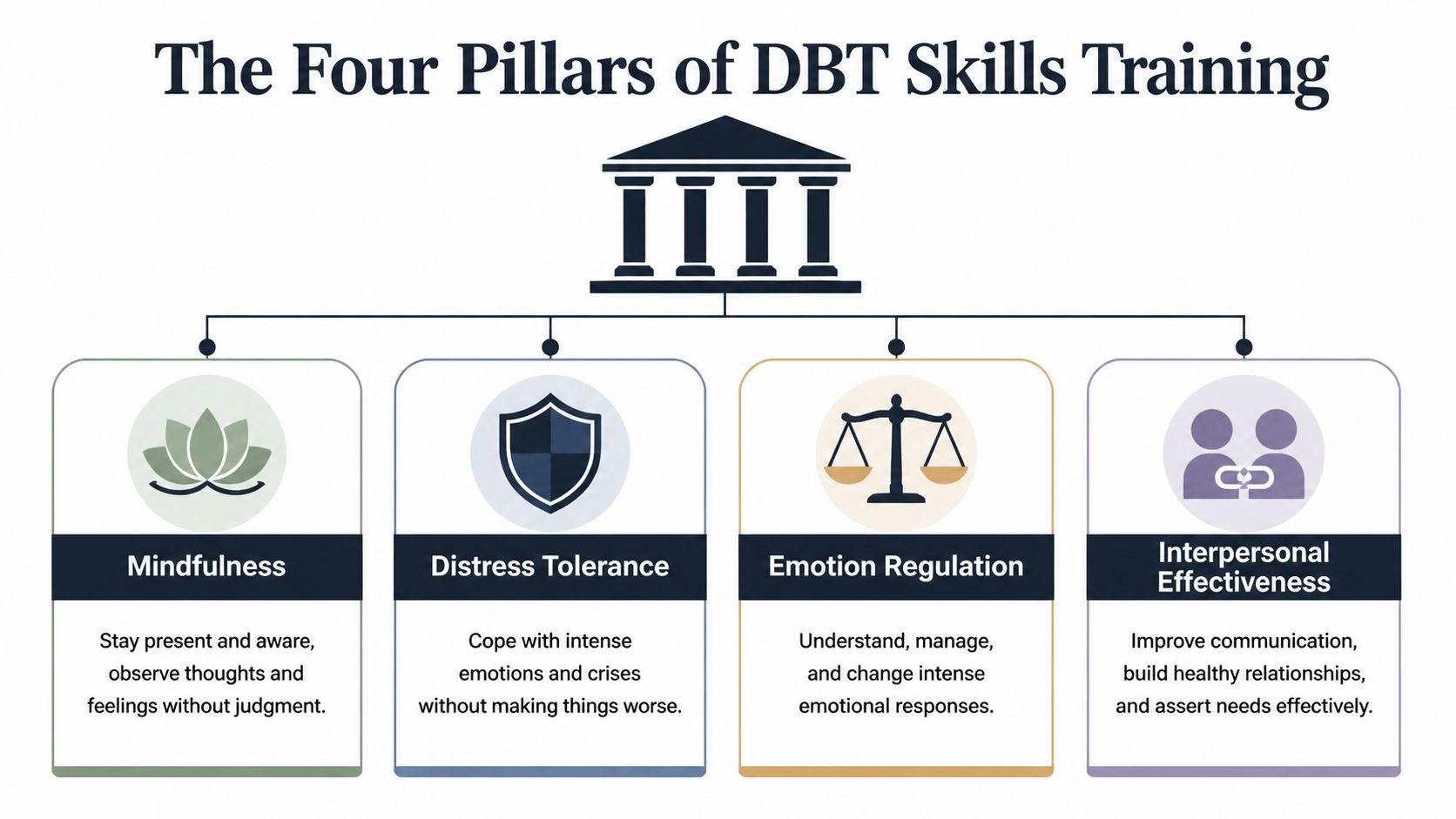
Each pillar addresses a different part of emotional suffering. Together, they create an everyday toolkit.
Mindfulness
Mindfulness is the skill of noticing what’s happening right now without instantly reacting to it. That sounds simple until someone is flooded with panic, rage, or shame.
A practical example helps. A person gets a text that feels cold or rejecting. Without mindfulness, the reaction may be immediate: drinking, sending ten angry messages, cutting off the relationship, or collapsing into self-hatred. With mindfulness, there’s a pause. The person notices, “My chest is tight. I’m assuming abandonment. I want to act fast.”
That pause creates choice.
Distress tolerance
Distress tolerance is for the moments when the pain can’t be fixed immediately. It helps a person survive a crisis without turning a painful hour into a disastrous week.
This module is useful when someone:
- Feels an overwhelming urge: To use drugs or alcohol, self-harm, or disappear.
- Faces a trigger they can’t solve on the spot: Such as rejection, grief, conflict, or legal stress.
- Needs short-term stabilization: So the next step is guided by judgment rather than panic.
The goal isn’t to love the moment. The goal is to get through it safely.
Emotion regulation
Emotion regulation teaches people how emotions work, what makes them stronger, and how to reduce vulnerability to emotional extremes. This matters for people who feel hijacked by sadness, anger, jealousy, emptiness, or fear.
One common shift is learning that emotions have patterns. Lack of sleep, hunger, isolation, conflict, and substance use can all increase emotional volatility. When people recognize those patterns, they stop seeing every emotional surge as proof that they are broken.
Some of the most meaningful change in DBT happens when a person stops fearing their emotions and starts understanding them.
Interpersonal effectiveness
Relationships are often where pain becomes visible. A person may cling, withdraw, lie, explode, people-please, or become harsh and defensive. Interpersonal effectiveness teaches how to ask for needs, say no, maintain self-respect, and repair conflict.
For couples and families, communication support outside treatment can also be useful. Practical reading on assertive communication for couples can complement the relationship skills that DBT reinforces.
A few real-world examples include:
- At home: Asking for space without threatening the relationship.
- At work: Setting a boundary without apologizing for existing.
- In recovery: Telling supportive people what helps during cravings or emotional surges.
These four pillars don’t erase pain. They help people respond to pain in ways that protect life, recovery, and connection.
Who Benefits Most from a DBT Program
DBT is often associated with borderline personality disorder, but that label doesn’t capture everyone who benefits from it. The better question is whether a person struggles with emotion dysregulation. That means emotions rise fast, hit hard, and lead to destructive choices before the person can regain balance.
This is why DBT is often a strong fit for people dealing with self-harm, chronic suicidal thinking, unstable relationships, impulsive behavior, trauma reactions, eating disorder patterns, and substance use disorders. It’s especially relevant when addiction and mental health symptoms feed each other.
When DBT tends to be a strong match
A person may benefit from DBT if daily life includes patterns like these:
- Repeated crises: Frequent blowups, impulsive decisions, or emergency situations.
- Self-destructive coping: Substance use, self-harm, reckless behavior, or chaotic relationships.
- Emotional whiplash: Fast shifts between anger, panic, numbness, shame, and despair.
- Dual-diagnosis complexity: Addiction alongside depression, trauma symptoms, or personality-related struggles.
For people with addiction plus mental health symptoms, coordinated care matters. Many families start by learning how integrated treatment works through resources on dual-diagnosis treatment in Orange County.
What the evidence suggests
High-fidelity DBT programs have shown meaningful outcomes. According to DBT California’s Orange County page, studies indicate 68% BPD symptom remission at 1-year follow-up and a 50% reduction in relapse risk for dual-diagnosis clients. The same source attributes that progress to skills acquisition that targets the roots of destructive behavior.
Those numbers matter because they point to more than symptom management. They suggest that when people learn and practice these skills consistently, the emotional drivers behind self-harm, relationship instability, and relapse can shift.
Why families often miss the fit
DBT isn’t only for people in obvious crisis. It can also help high-functioning adults who seem successful but live with intense private suffering. Some hold jobs, care for children, and keep up appearances while cycling through secret drinking, emotional shutdown, rage episodes, or repeated relationship collapse.
That’s often where families get confused. They wait for a dramatic breakdown before seeking specialized care. In reality, DBT can be appropriate long before someone loses everything.
The best time to look for DBT is often when the pattern becomes clear, not when the damage becomes extreme.
Navigating the Path to Recovery in Orange County
Many families searching for the dbt center of orange county are also trying to understand the larger treatment system. They don’t just need therapy. They need to know where a loved one belongs on the continuum of care.
The right level depends on safety, medical needs, substance use severity, psychiatric symptoms, and how stable the person is outside a structured setting. A person drinking heavily every day, using opioids, or cycling through dangerous emotional episodes may need more than weekly sessions.
The usual treatment path
Recovery often moves through levels of care rather than a single appointment type. Each level has a different job.
| Level of care | Main purpose |
|---|---|
| Medical detox | Helps the body stabilize when withdrawal may be risky or overwhelming |
| Residential treatment | Provides round-the-clock structure, therapy, and safety |
| Partial hospitalization | Offers intensive daytime treatment with less than residential intensity |
| Intensive outpatient | Builds recovery skills while allowing more community living |
| Outpatient care | Supports long-term maintenance and relapse prevention |
Where DBT fits in this process
DBT skills can be woven into multiple stages. In early recovery, distress tolerance can help someone get through cravings, panic, and emotional overload without returning to substances. In residential or day treatment, emotion regulation and interpersonal effectiveness often become central because relationships, shame, and avoidance start surfacing once substances are removed.
Later, in outpatient care, the work becomes more real-world. The person has to use the same skills at home, at work, with family, and in moments of boredom, loneliness, or conflict.
A few examples make the continuum easier to picture:
- After detox: A person needs structure because cravings and emotional instability are still intense.
- After residential treatment: The person is safer but still needs several therapeutic contacts each week.
- During outpatient care: The person practices recovery while handling ordinary life stressors.
Practical concerns matter too
Logistics often influence treatment choices more than families expect. Transportation, work schedules, privacy needs, and family responsibilities can shape what’s realistic. For clients traveling in or coordinating transitions between care settings, even practical details like a guide to LAX shuttles for OC travelers can reduce friction during a stressful period.
The key point is simple. Not everyone searching for DBT needs the same thing. Some people do well in outpatient skills work. Others need medical stabilization, residential support, and a longer runway before outpatient care becomes effective.
What to Look for in a Premier DBT Program
A family may hear that a program “offers DBT” and assume that means the treatment will be structured, skill-based, and clinically consistent. In practice, the phrase can mean very different things. Some settings use a few DBT ideas in occasional groups. A premier DBT-informed program uses the method with discipline, teaches the skills repeatedly, and applies them across addiction treatment, psychiatric care, and daily living.
That distinction matters even more in Orange County now. Since the dedicated outpatient DBT Center of Orange County closed in 2025, many families have been left trying to piece together care on their own. For clients who need more privacy, more clinical oversight, and more than a weekly outpatient visit, a high-fidelity residential model can fill that gap more effectively.
What “premier” should actually mean
A strong DBT program works like a well-built bridge. It does not just point a person toward better coping. It supports them while they are still emotionally unsteady.
Families can look for a few clear markers:
- Licensed, experienced clinicians: The team should understand emotional dysregulation, substance use, trauma, and co-occurring mental health conditions.
- True dual-diagnosis treatment: Therapy, psychiatric care, and addiction treatment should happen together, with one coordinated plan.
- Consistent DBT skills practice: Clients should rehearse skills in real situations, not just hear about them in abstract terms.
- Medication management when indicated: Some clients need psychiatric support or medication-assisted treatment as part of safe stabilization.
- Clear step-down planning: The program should prepare clients for what comes next, including outpatient support, family work, and relapse-prevention planning.
These features are not marketing details. They shape whether a person can stay in treatment long enough to benefit from it.
Privacy and setting affect clinical honesty
Families sometimes worry that comfort and privacy sound cosmetic. In reality, they often determine whether a person tells the truth in treatment.
An executive, public-facing professional, or parent carrying intense shame may hold back in an exposed environment. If the setting feels chaotic or overly public, the client may protect their image instead of examining the behaviors that keep them stuck. A private, calm, well-run residential program lowers that barrier. It gives the person room to participate fully, which is where DBT starts to work.
A useful way to assess fit is to ask three direct questions:
- Can the program treat emotional instability and substance use at the same time?
- Will this client feel safe enough to be truthful?
- Does the setting provide enough repetition, structure, and accountability to change behavior?
A premier DBT-informed setting protects dignity while still asking for real effort.
Look for a program that matches the level of risk
DBT is most effective when the level of care matches the person in front of you. Someone who is medically stable and ready to practice skills while living at home may do well in a structured intensive outpatient program. Someone with active relapse risk, severe mood instability, self-harm behaviors, or major privacy concerns may need residential support first.
That is where Oceans Luxury Rehab stands apart in Orange County. Rather than offering DBT as a narrow outpatient service, Oceans provides a private, high-fidelity, DBT-informed treatment environment where clients can address addiction, emotional dysregulation, and co-occurring psychiatric symptoms in one setting. For many families trying to fill the care gap left after the 2025 closure of the dedicated outpatient DBT Center of Orange County, that level of integration and discretion can make the difference between delayed help and real progress.
Begin Your Healing Journey at Oceans Luxury Rehab
A family often reaches this point after months, sometimes years, of trying to hold things together at home. Emotions are running high, substance use may be getting worse, and every conversation feels like it could turn into a crisis. In that moment, the right setting matters because treatment needs to do more than offer appointments. It needs to create safety, structure, and enough clinical depth for real change to begin.
Oceans Luxury Rehab provides that kind of care in Orange County. In San Clemente, clients enter a private oceanfront setting designed to lower chaos, protect dignity, and support emotional stabilization. For families still trying to find a strong DBT-informed option after the 2025 closure of a dedicated outpatient provider in the area, Oceans helps fill that gap with a residential model that is more private, more integrated, and better equipped for people whose needs extend beyond weekly therapy.
Care is organized in a way that matches how recovery unfolds. Some clients arrive needing detox and close medical supervision. Others need residential treatment first, then a gradual step-down into day treatment or outpatient support as they regain stability. That full range allows treatment to adjust to the person, instead of asking the person to fit a rigid program.
The clinical model is built for complexity. Many clients are dealing with addiction, intense mood shifts, trauma reactions, impulsive behavior, relationship conflict, and other psychiatric symptoms at the same time. DBT-informed care works best when those problems are treated together, much like rebuilding a house after a storm means repairing the foundation, wiring, and roof instead of fixing one room and hoping the rest holds. Oceans combines psychiatric care, physician oversight, nursing support, individualized treatment planning, and medication support when appropriate so clients can work on the whole picture in one place.
Privacy also matters more than many families expect.
For professionals, executives, public-facing adults, and anyone carrying shame about asking for help, a discreet environment can make honest participation possible. Private rooms, confidential admissions, and a calm setting reduce the pressure that often keeps people guarded. Once a person feels safe enough to tell the truth, DBT-informed treatment has a much better chance to work.
Starting treatment does not require a perfectly organized plan. A confidential call can help families understand the level of care, the admissions process, and whether insurance may help cover treatment. Oceans Luxury Rehab offers support around the clock, including rapid PPO verification and personalized guidance, so families can move from fear and confusion toward a clear next step.
