

Leaving treatment can feel strangely unstable, even after real progress. The schedule has been clear, the support has been close, and the next step suddenly looks less certain than expected. For many adults in Southern California, especially professionals trying to protect privacy and return to real responsibilities, that in-between phase is where the right housing decision matters most.
That’s where luxury sober living los angeles enters the picture. Beyond being upscale housing for people in recovery, at its best, it serves as a structured bridge between intensive treatment and ordinary life, giving residents enough freedom to rebuild independence without losing the guardrails that protect early sobriety.
The Critical Next Step After Rehab
A common situation looks like this: a person finishes inpatient treatment, feels clearer than they have in months, and wants to get back to work, family, and normal routines. Then the practical questions start. Where will they live? Who will notice if cravings return? What happens when stress, loneliness, or old social patterns show up on a random Tuesday afternoon?
That transition is often more vulnerable than families expect. A resident may no longer need the intensity of residential treatment, but still may not be ready to go straight back to an apartment, a demanding job, or a social circle connected to substance use. A sober living home fills that gap by offering accountability, daily structure, and a community that supports recovery.

For executives and working adults, the challenge isn’t only substance exposure. It’s pressure. Deadlines, family obligations, financial decisions, and constant communication can wear down recovery if there isn’t a stable base underneath it. Resources that help people manage workplace stress effectively can support that transition, especially when paired with a sober environment that keeps daily life predictable.
Why this stage is different
In rehab, many decisions are made for the patient. Meals are set. therapy is scheduled. Staff members monitor changes in mood, sleep, and behavior. In sober living, the resident starts practicing life again.
That’s the point.
Practical rule: Recovery gets stronger when structure decreases gradually, not all at once.
A high-quality step-down setting gives someone room to test new coping skills in everyday life while still living inside a recovery-focused environment. That might mean returning to work during the day, attending outpatient therapy, participating in house responsibilities, and coming home to peers who understand exactly what early sobriety feels like.
Families often want one reassuring answer to the question of what happens after rehab. The honest answer is that long-term recovery usually works best as a continuum. A helpful place to start is this guide on building a sober life after treatment, because sobriety rarely depends on one isolated decision. It depends on what comes next, and how well that next step is supported.
What Exactly Is Luxury Sober Living
Luxury sober living is best understood as structured recovery housing with enhanced privacy, comfort, and support. It isn’t inpatient rehab, and it isn’t ordinary rental housing. It’s a sober residence where people live while strengthening recovery habits and gradually returning to independent life.
A useful comparison is physical rehabilitation after surgery. A patient may be stable enough to leave the hospital, but still needs a protected setting, guided routines, and close follow-through before returning to full activity. In the same way, someone leaving detox or residential treatment may be medically stable and motivated, but still benefit from a living environment built around accountability and recovery.
What residents actually do there
In Los Angeles, sober living houses typically operate with a clear model. Residents rent rooms by the month, maintain sobriety, help with household responsibilities, and attend regular 12-step or mutual-help meetings. Research also describes a large existing network, with approximately 1,000 peer-managed residences across California and 260 active facilities documented in LA County during the study period. That same research found those LA County homes were present in 9% of the 2,343 neighborhoods studied, and that neighborhoods with sober living facilities had stronger nearby recovery infrastructure, including 0.4 treatment centers versus 0.2 and 2.5 AA meetings weekly versus 1.1 in areas without facilities, according to this Los Angeles sober living research review.
That matters because many people assume sober living is just shared housing with house rules. It’s more accurate to view it as a recovery setting positioned near support.
What makes it “luxury”
Luxury doesn’t just mean nicer furniture or a better zip code. In recovery, “luxury” usually means the environment removes unnecessary stressors that can pull attention away from healing.
Examples often include:
- Private or quieter accommodations that support rest, focus, and confidentiality
- Higher-touch support so residents don’t feel lost in a crowded house
- Well-maintained common spaces that make daily living calmer and more dignified
- Access to wellness-oriented routines such as fitness, mindfulness, and healthy meals
A person searching for luxury sober living los angeles is often looking for more than comfort. They’re looking for a setting where recovery can continue without the chaos, exposure, or anonymity that can derail early progress.
For readers comparing housing options, this overview of structured sober living support in Southern California can help clarify what a clinically connected residence should offer beyond a nice address.
Sober Living Versus Inpatient Rehab A Critical Distinction
Many families confuse sober living with rehab. That confusion can lead to the wrong admission decision at the wrong time.
Inpatient rehab is a clinical treatment setting. Sober living is a supportive residential setting. They work together, but they don’t replace one another.
How inpatient rehab differs
A person who needs detox, medication support, intensive therapy, or close medical supervision needs a higher level of care than sober living can provide. Inpatient treatment is designed for stabilization and intensive clinical work. It usually includes a tightly managed daily schedule, formal therapy, medical oversight, and limited freedom compared with community housing.
That’s why someone still in withdrawal, actively using, medically unstable, or unable to maintain basic safety usually shouldn’t start with sober living alone.
How sober living differs
Sober living is a step-down environment. Residents generally have more freedom, more responsibility, and more exposure to ordinary life. They may work, go to school, attend outpatient programming, rebuild family relationships, and begin making daily decisions with fewer restrictions.
A simple side-by-side view helps:
| Setting | Primary purpose | Typical daily reality |
|---|---|---|
| Inpatient rehab | Stabilize and treat substance use with intensive clinical support | Therapy, medical monitoring, structured schedule, limited outside freedom |
| Sober living | Support recovery while rebuilding independence | House rules, peer accountability, outside meetings, work or outpatient care |
A sober house can support recovery well. It can’t substitute for detox or intensive treatment when those are still clinically necessary.
The decision point families often miss
The right question isn’t “Which one is better?” The right question is “Which level of care is appropriate right now?”
If a person still needs supervised withdrawal management, psychiatric evaluation, or residential treatment, the safer path is to begin with inpatient care and then transition into sober living after stabilization. For people trying to understand whether that higher level is needed first, this explanation of inpatient rehab and who it serves can make the distinction clearer.
That sequence often protects recovery more effectively than trying to skip steps. A sober home works best when the resident is ready to use the structure, not when the resident still needs acute treatment.
Key Features of a Premier Sober Living Environment
A premier sober living setting should make recovery easier to practice every day. The strongest programs don’t rely on appearance alone. They combine comfort, order, privacy, and meaningful support in ways that reduce stress and improve follow-through.
One data point helps explain why environment matters. According to this review of luxury sober living features and outcomes, luxury sober living homes may operate with staff-to-client ratios of 1:3 to 1:5, and those environments are associated with 6-month sobriety benchmarks that are 20% to 30% higher than standard facilities. The same source also notes private rooms and chef-prepared meals as part of that therapeutic design.
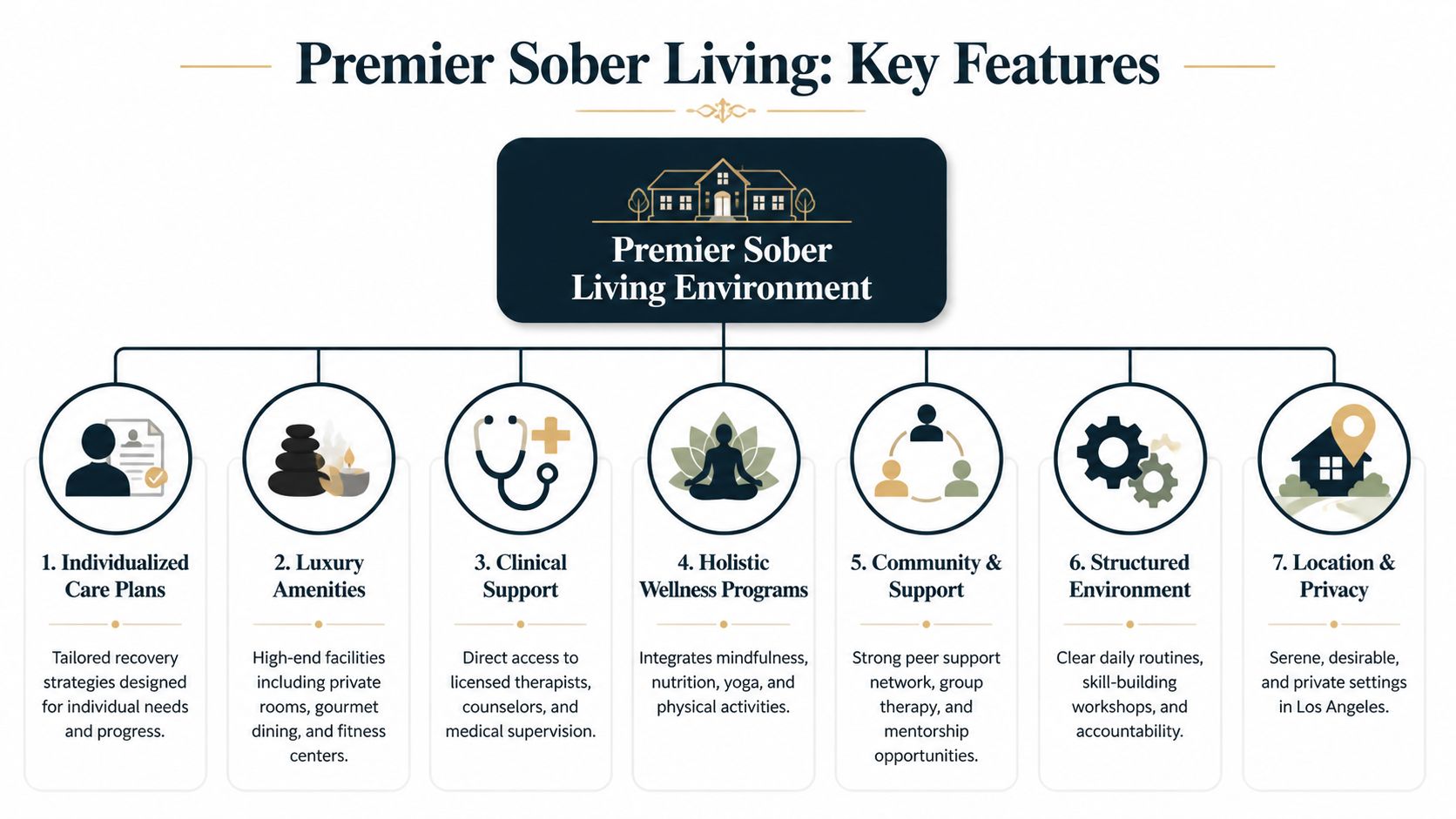
Features that support recovery, not just comfort
Some amenities matter because they lower pressure on the nervous system. Others matter because they make relapse-prevention routines easier to maintain.
Private space for decompression
Early sobriety can make people more reactive to noise, conflict, and overstimulation. A private room or a more peaceful room arrangement can help residents sleep better, regulate emotions, and recover from demanding days.Nutritious meals built into the day
Consistent eating patterns can support emotional steadiness. Chef-prepared meals aren’t just a luxury add-on if they help remove daily friction and support physical recovery.Smaller census and closer oversight
Lower resident-to-staff ratios can make it easier to notice behavior changes early, respond to concerns quickly, and tailor routines to the person rather than the household alone.
The less visible features matter too
Some of the most valuable elements aren’t flashy. They’re operational.
Trauma-aware support
Many people entering sober living have trauma histories, anxiety, depression, or chronic stress. That’s one reason trauma-informed care matters. Families who want a plain-language explanation of that concept may find this resource on Securely Loved on trauma care useful when evaluating whether a residence feels respectful, calming, and emotionally safe.
Structure without humiliation
A premier environment usually includes expectations, but it shouldn’t feel punitive. Residents need boundaries they can understand and live with.
Recovery housing works better when accountability feels consistent and fair, not arbitrary.
Wellness that fits real life
A quality house often supports routines like exercise, mindfulness, outdoor time, and regular sleep. Those practices may sound simple, but simple habits often do heavy clinical work in early recovery.
A practical screening list
When evaluating luxury sober living los angeles options, families can ask:
- Who is available daily if a resident starts struggling emotionally or behaviorally?
- What does the food plan look like during an ordinary week?
- How private is the living arrangement in practice, not just in marketing language?
- What happens if a resident misses meetings, breaks rules, or shows warning signs?
A premier setting should answer those questions clearly, calmly, and without defensiveness.
Accreditation Safety and Clinical Oversight
When families hear the word “luxury,” they sometimes focus on the visible details first. The safer approach is the opposite. Start with oversight, rules, and safety systems. Comfort matters, but legitimacy matters more.
In Los Angeles, the luxury sober living market is highly stratified. Research summarized here on Los Angeles sober living costs and placement reports that high-end facilities commonly cost $5,000 to $10,000 or more per month, with some exclusive homes reaching $30,000 per month. That same analysis found neighborhoods with higher median home values were 3.01 times more likely to have high-cost sober living facilities, and those areas also had stronger support infrastructure, including 0.4 treatment facilities versus 0.2 and 2.5 AA meetings weekly versus 1.1 elsewhere.

What families should verify
Price alone doesn’t prove quality. A polished property can still have weak protocols. Families should ask direct questions about the basics.
House rules and enforcement
Residents should receive clear expectations about sobriety, conduct, curfews, visitors, medications, and meeting attendance.Drug and alcohol monitoring
A residence should be transparent about testing practices and what happens after a positive screen or concerning behavior.Staff availability
If a resident becomes unstable, there should be a known process for supervision, escalation, and referral to higher care.
Why oversight changes outcomes
A sober residence sits in a delicate part of the continuum. Residents have more autonomy than they had in rehab, but they still need a container strong enough to hold difficult moments. Good oversight reduces confusion. It also reduces the chance that a warning sign gets missed because everyone assumed someone else was paying attention.
Questions worth asking on the first call
| Area | What to ask |
|---|---|
| Safety | Is staff available around the clock, or only during set hours? |
| Rules | How are house expectations explained and enforced? |
| Relapse response | What is the exact protocol if substance use occurs? |
| Medication | How are prescribed medications stored and monitored? |
Safety check: If a provider answers basic policy questions vaguely, that uncertainty itself is useful information.
A trustworthy program should be able to explain how it protects residents, how it manages risk, and how it connects people back to clinical care when needed.
Navigating Cost Insurance and Value in Los Angeles
A family often reaches this stage after a hard-won milestone. Rehab is ending, the person is doing better, and the next question is uncomfortable but unavoidable. Can they return home and hold that progress, or do they need a structured place to practice independence before taking on full freedom?
That is why cost deserves a careful, practical discussion. In Los Angeles, sober living prices vary widely because programs are offering very different levels of support, privacy, staffing, and clinical coordination. A basic residence may cost far less than a high-end home, but the monthly rate alone does not tell you how much protection the setting provides during this transition.

What insurance may and may not cover
Families are often surprised by how payment is divided. In many luxury sober living arrangements, the housing itself is private pay. Rent usually covers the residence, utilities, meals or kitchen access, transportation support in some cases, and the general recovery environment.
Clinical care is a separate layer. If the resident is also attending outpatient treatment such as PHP, IOP, individual therapy, psychiatric appointments, or medication management, those services may be billable to insurance depending on the plan and how the program is set up.
The simplest way to picture it is this. Housing pays for the container. Insurance may help pay for the treatment happening around that container.
For professionals and public-facing clients, that distinction matters. A private residence can offer discretion and a calmer setting for returning to work, while insurance may offset the cost of the clinical services that keep recovery anchored.
How to judge value, not just price
A higher monthly fee only makes sense if it solves real recovery problems.
The question I encourage families to ask is not only, "What am I paying for?" Ask, "What risk am I reducing?" If a residence helps someone avoid an abrupt return home, stay engaged in therapy, manage mental health symptoms, and rebuild work responsibilities gradually, the value is clinical as much as residential.
This matters even more when the person has a dual diagnosis, a demanding career, or a strong need for confidentiality. In those cases, luxury sober living is less about comfort for its own sake and more about creating enough stability for the person to practice independent living without losing contact with treatment. Readers outside the United States who are comparing private assessment pathways may also find this private mental health guide for UK adults useful as a broader example of how private systems organize access to care.
Questions to ask before agreeing to costs
Before signing anything, ask for a clear written breakdown.
- What does the monthly rate include besides the room itself?
- Which services are private pay and which may be billed to insurance?
- Will the program verify benefits before admission?
- How is outpatient treatment coordinated while the resident is living in the house?
- What extra fees can appear later, such as transportation, drug testing, medication support, or case management?
One California option that offers detox, residential treatment, outpatient care, and support around sober living transitions is Oceans Luxury Rehab. Families considering that route can ask directly about PPO verification and how the handoff from clinical care to supported independence is arranged.
FAQ Your Questions on Luxury Sober Living Answered
A family often reaches this stage after the first crisis has passed and a harder question appears. If rehab helped someone get stable, what setting gives them enough support to stay stable while they return to real life?
That is the practical role of luxury sober living los angeles. It sits between treatment and full independence. For professionals, parents, and people who need privacy, the right home can protect recovery during the period when structure is still needed but hospital-level care is no longer the right fit.
Is luxury sober living mainly for executives or high-profile clients
Luxury sober living can serve executives and public-facing clients, but the better question is who benefits from this type of setting. People often do well there when they need privacy, a quiet environment, close coordination with outpatient or psychiatric care, and a residence that supports a gradual return to work or family responsibilities.
In other words, the value is not status. The value is fit.
A person with a demanding job may need secure communication, predictable routines, transportation support, and a house culture that respects confidentiality. Someone with anxiety, trauma symptoms, or a dual diagnosis may also benefit from a calmer residence with stronger coordination around therapy and medication follow-up.
Do luxury amenities mean better long-term outcomes
Amenities can reduce stress and make it easier for a resident to stay engaged, but they do not create recovery on their own. A private room, chef-prepared meals, or a beautiful setting may improve comfort. Recovery still depends on structure, accountability, treatment participation, and the right level of clinical support.
A useful way to judge this is to ask what the comfort is doing. If the environment helps a resident sleep, attend therapy consistently, manage work re-entry, and avoid the chaos that can trigger relapse, it serves a clinical purpose. If it is only cosmetic, it should not drive the decision.
The same rule applies to mental health needs. Untreated depression, trauma, anxiety, or bipolar symptoms can disrupt sobriety in any house, no matter how attractive it looks.
Can couples enter sober living
Some programs allow couples under carefully defined conditions. The key question is whether each person can recover safely as an individual.
That means separate assessment, clear boundaries, and a plan for what happens if one partner is progressing and the other is not. In some cases, separate housing with coordinated treatment is the safer and more clinically appropriate option. A good program will explain the reasoning clearly instead of giving a quick yes or no.
What happens if a resident relapses
A well-run home should answer this without hesitation. Ask for the exact steps.
The response may include immediate safety assessment, testing, contact with the clinical team, a decision about whether the resident can remain in the home, and referral to detox, residential care, or a higher level of support if needed. The purpose is not punishment. It is to determine what level of care is now required.
Vague answers are a warning sign. So is a program that treats relapse as only a rule violation and not a clinical event.
What questions should a family ask before choosing a home
Use the questions below to separate a polished residence from a recovery setting that is fully prepared to support long-term sobriety.
| Category | Question to Ask |
|---|---|
| Privacy | How is confidentiality protected for working professionals and public-facing clients? |
| Clinical connection | How are outpatient therapy, psychiatric care, and dual-diagnosis services coordinated while the resident lives here? |
| Rules | What are the house rules, and how are they enforced in daily life? |
| Safety | Who responds if a resident is emotionally unstable, suicidal, or at risk of using? |
| Relapse protocol | What exactly happens if alcohol or drug use occurs? |
| Medications | How are prescribed medications stored, supervised, and documented? |
| Daily life | What does a normal weekday look like for residents? |
| Independence | How does the home help residents return to work, school, or family life safely? |
| Cost | What is included in rent, and which services may be billed separately or submitted to insurance? |
| Fit | What type of resident tends to do well here, and who needs a higher level of care first? |
The strongest choice usually comes from matching the house to the resident’s current recovery stage, mental health needs, and day-to-day responsibilities.
For adults in Los Angeles and Orange County who need a discreet, clinically connected path from detox or rehab into supported independence, Oceans Luxury Rehab offers admissions guidance across the full continuum of care. The team can help determine whether inpatient treatment, outpatient support, or a sober living transition is the right next step, and can verify many PPO insurance plans to reduce delays in getting help.
