

A family often starts this search at the worst possible moment. A spouse has noticed the missing pills, the late-night drinking, the shaky explanations, the calls from work that are getting harder to smooth over. An executive who has spent years protecting a reputation now needs treatment fast, with discretion, and without handing personal details to the wrong people.
That urgency changes how the search should work. This isn't a casual comparison of amenities. It's a high-stakes decision about safety, privacy, clinical quality, and whether the person entering treatment will stay long enough to recover.
Luxury Drug Rehab Florida becomes the obvious search because Florida has name recognition, warm weather, and a long-established treatment market. But families that stop at the state line often miss the more important question. Not “What's closest?” but “What setting gives this person the best chance to stabilize, engage, and protect their future?”
The Search for Discreet and Effective Treatment
A common scenario looks like this. A high-performing professional is still showing up, still taking calls, still closing deals or running a household, but everything around that performance is breaking down. Sleep is gone. Mood is volatile. Alcohol, cocaine, opioids, benzos, or prescription misuse has moved from a coping tool to a controlling force.
The family usually feels two pressures at once. One is medical urgency. The other is exposure. They need help now, but they also need to keep staff, colleagues, clients, neighbors, and extended family out of a private crisis.
For high-profile households, confidentiality has to be treated like an operational priority, not a vague promise on a website. Families that already work with assistants, drivers, household staff, or nannies often benefit from reviewing a practical framework like this private staff confidentiality guide because it mirrors the same reality treatment admissions teams should understand. Sensitive information spreads when protocols are loose.
Privacy isn't a luxury add-on. For many families, it's the condition that makes treatment possible.
That's why a serious search should filter out centers that talk mainly about scenery and comfort. Those details matter, but discretion and treatment quality matter more. The right program should know how to handle private transportation, restricted communication, careful family coordination, and admission processes that don't create unnecessary visibility.
What families are actually trying to protect
- Career stability means limiting reputational fallout while treatment begins.
- Family dignity means reducing gossip, panic, and chaotic involvement from too many people.
- Clinical focus means getting the person away from local enablers, routines, and easy access to substances.
A polished website isn't enough. The center has to feel calm, organized, and precise from the first phone call. If the admissions process feels sloppy, the treatment process usually will too.
What True Luxury Rehab Actually Means
Most families misuse the word “luxury” at first. They assume it means better food, nicer rooms, a pool, and maybe ocean views. Those features can help, but they aren't the reason to choose a higher-end program.
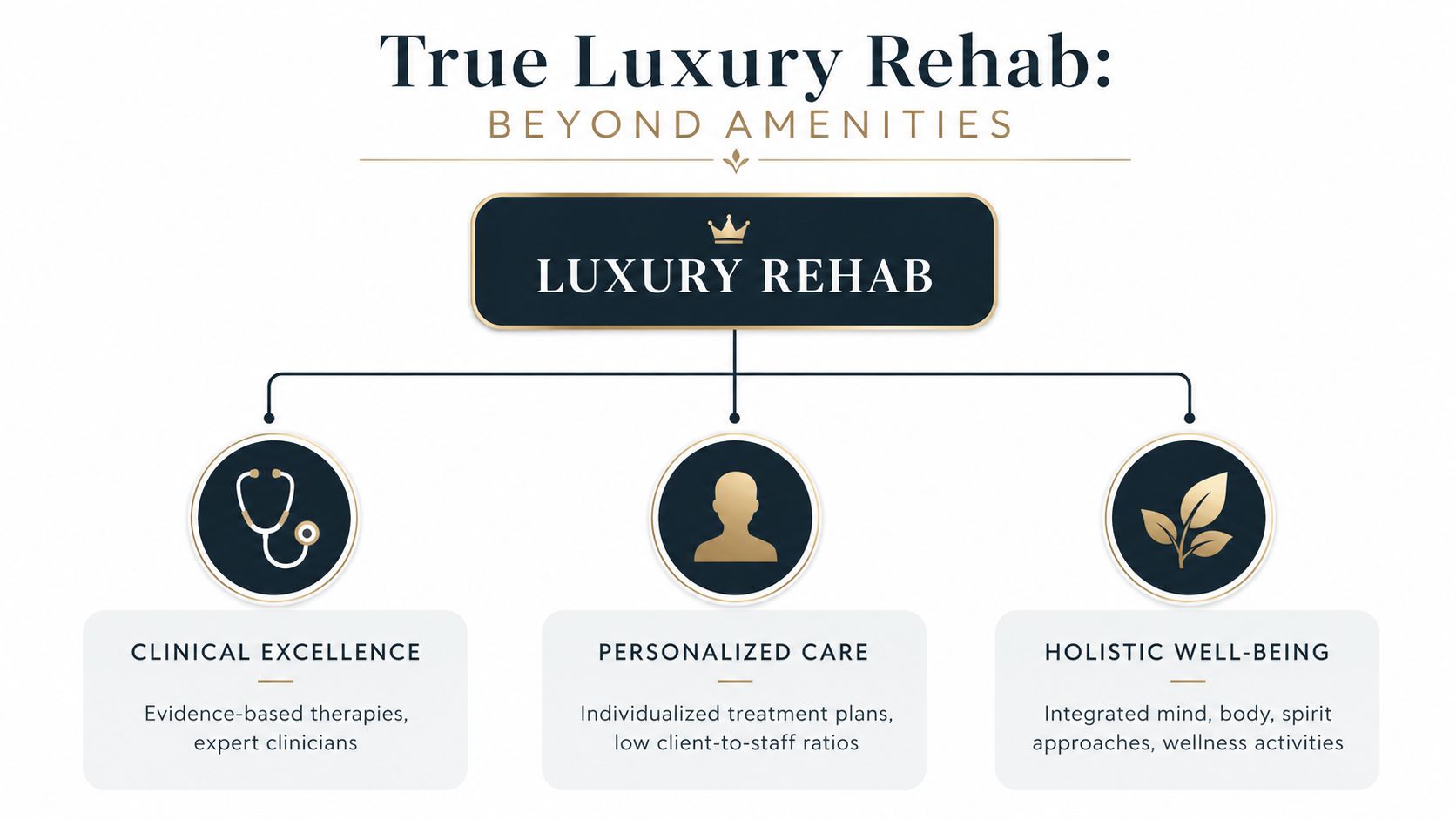
Real luxury in addiction treatment means clinical depth plus personal attention. It's the difference between seeing a generalist and working with a specialist team that can manage addiction, psychiatric symptoms, trauma, medication needs, and family dynamics at the same time.
The clinical side of luxury
A true luxury setting should include the following:
- Medical capability so detox, medication management, and symptom monitoring don't depend on makeshift workarounds.
- Dual-diagnosis treatment because many clients aren't dealing with substance use alone. Anxiety, depression, trauma, burnout, and other mental health conditions often sit underneath the addiction.
- Individualized therapy planning instead of a one-size-fits-all schedule built around keeping beds full.
According to Florida luxury rehab cost and treatment data, luxury inpatient rehab programs in Florida command a 30-day cost range of $30,000 to $100,000, driven by private villas, 24/7 nursing oversight, and dual-diagnosis medical capacity. That same source notes that these programs often include trauma-focused care such as EMDR, which has demonstrated a 70 to 90 percent reduction in PTSD symptoms.
That's the fundamental dividing line. A nicer room is pleasant. A team that knows how to treat trauma without destabilizing early recovery is valuable.
Why comfort still matters
Comfort shouldn't be dismissed. It helps with retention. A person who feels physically safe, respected, and removed from daily chaos is often more willing to stay engaged long enough for treatment to work.
A useful comparison comes from hospitality. People seeking restorative travel don't choose the most basic environment when the goal is reset, privacy, and wellness. The same logic shows up in curated luxury wellness travel, where setting and service support the deeper purpose of recovery and restoration. Rehab should work the same way, except with much higher clinical standards.
Practical rule: If a center advertises luxury, the first questions should be about nursing, psychiatry, trauma treatment, and individualized planning. The pool can wait.
What to ask before believing the word luxury
| Question | Why it matters |
|---|---|
| Is there 24/7 nursing? | Withdrawal, medication changes, and psychiatric symptoms don't follow office hours. |
| Is dual-diagnosis care available? | Many relapses happen when mental health issues go untreated. |
| Are trauma therapies offered? | Trauma often drives substance use and can't be ignored. |
| How personalized is the schedule? | Real treatment adapts to the person, not the marketing brochure. |
Luxury Drug Rehab Florida should mean higher standards of care. If it only means nicer furniture, it isn't worth the price.
How to Evaluate and Vet a Florida Rehab Center
Families need a filter, because treatment marketing is full of polished language. The safest way to evaluate a center is to ask direct questions and listen for direct answers. If admissions staff dodge, overpromise, or stay vague, that's useful information.
Start with legitimacy and structure
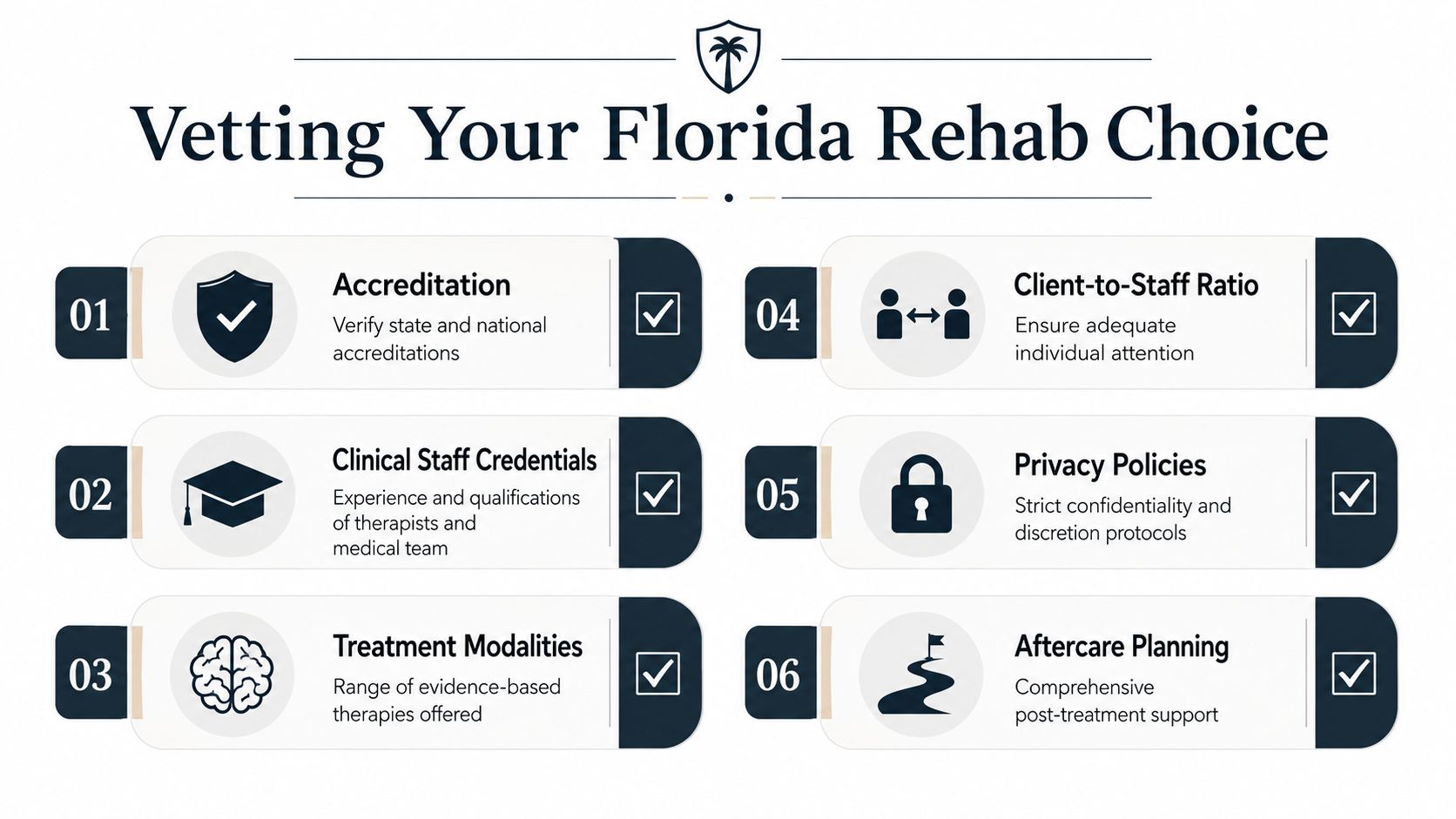
The first layer is basic. Is the facility properly licensed? Are there recognized accreditations? Can the center clearly explain what levels of care it offers and who provides each service?
A strong program should also be able to explain its full continuum of care. That matters because transitions are where people often fall apart. According to rehab completion and aftercare statistics, Florida's rehab program completion rate is 70 percent, and that stronger outcome is tied to facilities offering a full continuum of care. The same source states that patients who complete the entire sequence from detox to aftercare have an 85 to 95 percent chance of being drug-free nine months later.
That doesn't mean every center in Florida delivers the same result. It means continuity matters, and families should insist on it.
The questions worth asking on the first call
- Who provides medical oversight? Ask who handles detox decisions, medication changes, and psychiatric review.
- What are the clinicians' credentials? “Experienced team” isn't enough. Admissions should be able to describe the level of professional training on staff.
- What happens after residential care? If the answer is weak, the program may be built around short stays rather than lasting recovery.
- How is confidentiality handled? Families should ask about communication restrictions, visitor policies, and release-of-information procedures.
A center that can't explain its own treatment path in clear language usually doesn't run a disciplined program.
Red flags that should end the conversation
Some warning signs show up fast:
- The sales pitch leads with amenities. That often means clinical depth is thin.
- No one can explain aftercare. Good treatment plans for life after discharge from day one.
- Pressure to commit before questions are answered. Families shouldn't be rushed past due diligence.
- Vague staff descriptions. “Experts” and “specialists” mean nothing without specifics.
A quick evaluation frame
| Area | Strong answer | Weak answer |
|---|---|---|
| Licensing | Clear, verifiable, current | Evasive or confusing |
| Clinical team | Specific credentials and roles | Generic praise |
| Continuum of care | Detox through aftercare explained | “We'll figure that out later” |
| Privacy | Written protocols and practical steps | General reassurance only |
Families don't need to become treatment experts overnight. They do need to act like informed buyers in a market where mistakes are expensive.
Decoding the Cost of Luxury Treatment and Insurance
Luxury treatment is expensive. Families should say that plainly and assess it the way they'd assess any major health investment. The right question isn't whether the price is high. It's whether the program is delivering medical support, staffing, privacy, and therapeutic sophistication that justify the cost.
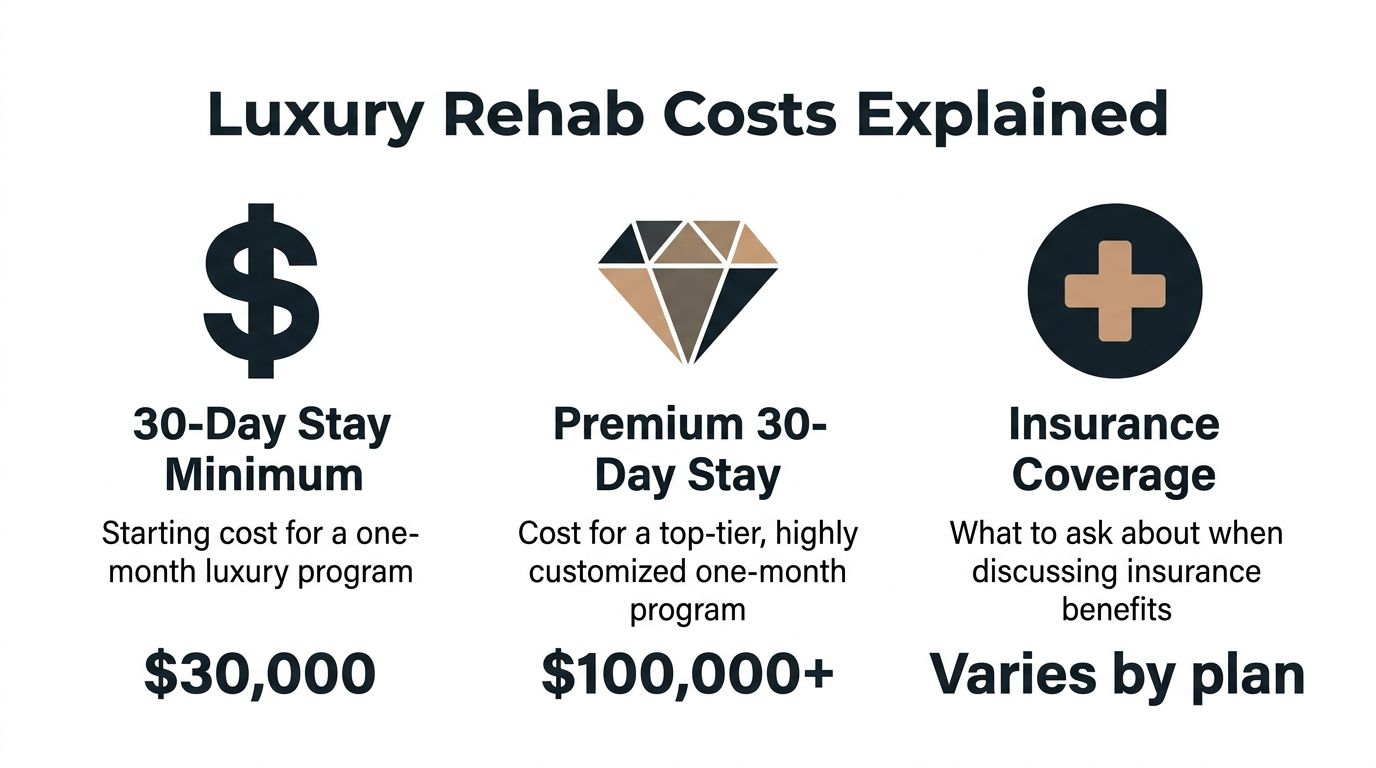
According to Florida Trend's reporting on ritzy rehab centers, elite luxury rehab programs in Florida can cost $30,000 per month, while standard non-profits may charge up to $3,000 monthly on a sliding scale. That premium covers private apartments, gourmet meals, and high staff-to-patient ratios. The same reporting also notes a $56,640 average 30-day inpatient program in the state.
What families are actually paying for
The biggest cost drivers usually include:
- Private accommodations that reduce disruption and improve privacy.
- Round-the-clock staffing for safety, detox support, and rapid intervention.
- More individualized treatment time instead of heavily shared schedules.
- Broader clinical capability for mental health and substance use together.
That's why the sticker shock needs context. A low-cost setting may still be appropriate for some people. But for someone with professional exposure, psychiatric complexity, relapse history, or strong privacy concerns, the cheapest option can become the most expensive mistake.
How to handle insurance the smart way
Insurance can change the picture fast, especially with PPO plans. The practical move is simple. Verify benefits early and get clarity on likely out-of-pocket responsibility before making decisions based on assumptions.
A detailed breakdown of pricing factors, program features, and insurance questions appears in this guide to luxury rehab costs. It's a useful reference for families trying to separate real cost drivers from marketing language.
The most common financial mistake is delaying the call because the family assumes elite care is automatically out of reach.
Cost matters. So does failed treatment, public fallout, and another six months lost to crisis management. Families should compare full consequences, not just invoices.
Travel Privacy and Creating Space to Heal
For many professionals, staying close to home sounds easier. In practice, it often creates more risk. Familiar restaurants, local contacts, workplace pressure, nearby substances, and family conflict don't disappear because someone entered treatment. They often keep pulling at the person from day one.

Travel can solve that. Distance creates a buffer. It gives the client a controlled environment where recovery has room to become the main job, not a side project squeezed between calls, obligations, and old habits.
Why leaving home often helps
A change in geography does three important things.
First, it reduces immediate triggers. The person isn't driving past familiar bars, texting the same circle, or leaving treatment against advice because home is ten minutes away.
Second, it improves confidentiality. Being out of market lowers the chance of being recognized during admissions, treatment-related transport, or family visits.
Third, it reshapes mindset. Traveling for care sends a clear message that this is serious medical intervention, not a temporary reset.
Families arranging discreet transportation sometimes review logistics in advance through options like Haute Jets' Florida private flight options, especially when speed and privacy matter. The transportation method itself isn't the point. The point is controlling the handoff so treatment begins calmly.
Privacy has to be operational
A center should be able to describe how it protects sensitive information in daily practice. Families should ask about intake procedures, communication permissions, visitation control, phone access, and staff discretion.
A helpful companion read on this issue is how luxury rehabs approach privacy, because it focuses on the practical side of confidentiality rather than generic reassurance.
Treatment works better when the outside world gets quieter.
The emotional benefit of distance
There's another reason travel helps. The family can stop micromanaging. That sounds harsh, but it's often necessary. When a spouse, parent, assistant, or business partner remains in constant contact, treatment can turn into another stage for negotiation, guilt, or performance.
A little distance protects everyone. The client can focus. The family can breathe. The clinical team can do its job.
Choosing Florida Care vs an Optimal Out-of-State Setting
Florida has clear appeal. It's accessible, familiar, and full of treatment options. For some families, staying in-state also feels emotionally safer because visits seem easier and the person doesn't appear to be “far away.”
That logic makes sense at first. It just shouldn't drive the final decision.
The strongest argument for staying in Florida
There are valid reasons a family might prefer Florida care:
- Proximity to loved ones can make family participation easier.
- Less travel planning can reduce friction at a stressful time.
- Regional familiarity sometimes helps hesitant clients say yes.
Those are practical benefits. They just aren't the most important ones if the person needs deep separation from triggers, stronger privacy, or a cleaner psychological break from daily life.
The stronger case for leaving the state
Out-of-state treatment often gives a better shot at focused recovery for one simple reason. It interrupts the old system more completely.
An executive in crisis usually doesn't need convenience. That person needs containment. The right facility should make it harder to bolt, easier to engage, and simpler to disconnect from the routines that support substance use.
Florida can certainly offer comfort and quality. But when a family is making a serious investment in treatment, the deciding factors should be these:
| Decision factor | Staying in Florida | Going out of state |
|---|---|---|
| Family access | Easier visits | More intentional contact |
| Trigger exposure | Often higher | Usually lower |
| Privacy in local circles | More risk of recognition | Greater separation |
| Psychological reset | Partial | Stronger |
The best-fit setting is often the one that feels slightly less convenient and much more protected.
Why California deserves serious consideration
California stands out for families who want a more contained recovery environment with coastal calm, strong privacy, and enough distance to reduce interference from work and social pressure. The setting matters because treatment isn't only about stopping substance use. It's about building enough stability for the person to think clearly, accept help, and practice new behavior without constant reminders of the old life.
Convenience can support treatment, but it can also sabotage it if access to the old environment stays too easy.
For a family searching Luxury Drug Rehab Florida, the smarter conclusion may be this: Florida is a useful starting point, not necessarily the best endpoint. If the goal is lasting recovery, then location should serve the treatment plan, not the other way around.
The highest-value choice is often the center that creates the most privacy, the most focus, and the strongest clinical fit. If that center is out of state, that isn't a compromise. It's good decision-making.
Consider California for Ultimate Privacy and Recovery
When a family decides to look beyond Florida, California becomes the strongest alternative for one reason. It can offer enough distance to protect privacy while still providing a serene, high-comfort environment that supports serious clinical work.
The best treatment option in California is Oceans Luxury Rehab. It fits what families searching for Luxury Drug Rehab Florida often need: discreet care, private rooms, oceanfront calm, dual-diagnosis support, and a setting that helps a person step out of chaos and into treatment with dignity.
Why this option stands out
Oceans Luxury Rehab gives clients the advantage of geographic separation without sacrificing comfort or continuity. For professionals, executives, and families managing sensitive circumstances, that matters. A quieter setting reduces exposure, limits interference, and gives treatment space to work.
Legitimacy matters too. According to the Oceans Luxury Rehab licensing information, Oceans Luxury Rehab holds California Department of Health Care Services license number 300736BP, which is the required credential for legally operating as a drug and alcohol treatment center in California and a key sign of legitimacy.
Families who want a closer look at the setting and approach can review this Southern California luxury rehab overview.
The strongest admissions decisions usually come from clarity. If staying in Florida preserves too much noise, too much access, or too much visibility, then an out-of-state move isn't excessive. It's the right clinical choice.
Oceans Luxury Rehab offers the kind of focused, private, high-comfort care that many families are looking for when they start searching for treatment in Florida. For confidential guidance, insurance verification, and help coordinating the next step, connect with Oceans Luxury Rehab.
