
Ten days after detox, a high-functioning executive stands in a hotel room with the minibar open. A partner stocked it out of habit. The therapist is on speed dial, but there's no written sequence for what happens next, no agreed contact to call first, and no household rule that makes the safer choice easier.
That moment exposes the weakness in many personal improvement plans. A person may understand addiction, want recovery, and feel highly motivated, yet still lack the structure needed when stress, access, fatigue, or conflict narrows attention. Lasting recovery depends on coordination, not a polished list of intentions.
Why Personal Improvement Plans Decide Recovery Outcomes
Motivation is unreliable under pressure. Early recovery often includes disrupted sleep, emotional volatility, work demands, relationship strain, and unfamiliar routines. Insight helps a client recognize a trigger, but insight alone doesn't specify what the client should do at 9 p.m. in a hotel room, after an argument, or before a demanding presentation.
A documented plan performs three practical jobs:
- It translates clinical guidance into daily behavior. A recommendation such as “avoid high-risk environments” becomes a travel rule, a medication schedule, a transportation plan, and a contact sequence.
- It makes contingencies visible before a crisis. The client decides in advance what happens after a craving, missed meeting, medication concern, or unexpected exposure.
- It coordinates the people around recovery. The client, clinical team, partner, family, and household environment work from the same expectations instead of improvising separately.
A vague intention says, “The client will stay sober.” A usable plan names the situations that threaten sobriety, the first response, the second response, and the person responsible for each escalation. It might state that if a client encounters alcohol in a hotel room, the client leaves the room, calls the designated support person, informs the therapist, and asks the partner to remove alcohol from future rooms.
Practical rule: If a recovery action can't be written clearly enough for another responsible adult to follow, it isn't operational yet.
The structure of the plan should reflect the person rather than a generic recovery checklist. A client with co-occurring depression may need mood monitoring and psychiatric follow-up. A traveling executive may need location-specific safeguards. A couple may need separate boundaries and shared rituals. A parent may need a carefully paced return to caregiving responsibilities.
The importance of personalized addiction treatment plans lies in this translation from broad clinical principles to decisions that survive ordinary life. Assessment determines what belongs in the document. SMART goals make progress observable. Implementation intentions connect goals to cues. Clinical coordination keeps the document safe, while tracking and contingencies keep it alive.
The Self-Assessment That Shapes Every Other Choice
A plan written before a serious assessment is usually a wish list. The assessment should gather three distinct layers of information, because each layer answers a different question about what recovery requires.
Clinical reality
The first layer identifies the treatment variables that affect capacity and risk. The plan should account for substance history, co-occurring diagnoses, medication-assisted treatment status, sleep architecture, pain load, withdrawal concerns, and current psychiatric symptoms. These details influence the pace of work, the type of support required, and whether a goal is appropriate now or belongs later.
A client with severe insomnia may need sleep stabilization before taking on an aggressive career-reentry target. A client with trauma symptoms may need carefully paced trauma work rather than immediate exposure to a setting associated with past use. A person receiving medication-assisted treatment needs goals that respect dosing windows and medical follow-up.
A thorough substance abuse evaluation gives the clinical team a stronger foundation for deciding which goals are safe, measurable, and worth prioritizing.
Daily environment
The second layer examines where recovery will occur. Work cadence, travel patterns, household composition, financial exposure, access to substances, social routines, and the locations where use historically happened all belong in the document.
Skipping this layer creates predictable failure. A client may promise daily therapy homework while traveling constantly, or commit to evening meetings while returning to a household where evenings are dominated by conflict. The problem isn't always commitment. The plan may ignore the environment that controls the available choices.
Personal priority
The third layer identifies what the client wants recovery to restore. Common priorities include relationship repair, career re-entry, physical restoration, parenting competence, emotional stability, and financial responsibility. These goals compete for time and energy, so ranking matters.
A short exercise helps. The client writes five desired outcomes, then answers:
- Which outcome protects immediate safety?
- Which outcome would improve daily stability?
- Which outcome matters most to the client's identity?
- Which outcome can wait without creating avoidable harm?
The top two become active priorities. The remaining items stay visible but don't compete with the first phase of recovery. This prevents an ambitious client from treating every life repair project as urgent.
Setting SMART Goals That Survive Real Life
Recovery goals should describe behaviors the client can perform, not outcomes the client can't fully control. “Stay sober” is important, but it doesn't tell the client what to do on a difficult evening. A stronger SMART goal might be: complete three scheduled check-ins per week and attend two recovery meetings for eight consecutive weeks.
That goal is specific because it identifies the actions. It's measurable because completion can be reviewed. It's achievable only if the schedule, transportation, and support are realistic. It's relevant to relapse prevention, and it's time-bound because the review period is defined.
Each SMART element corrects a common failure pattern:
- Specific: Vague goals hide avoidance. “Work on recovery” can mean almost anything.
- Measurable: Unmeasurable goals erase accountability. “Feel better” needs observable supporting behaviors.
- Achievable: Unrealistic goals create an all-or-nothing collapse when the client misses one task.
- Relevant: A goal should address the assessed risk, not merely reflect a fashionable wellness target.
- Time-bound: A review date prevents the plan from drifting indefinitely.
A couple needs linked goals, not one shared promise. One partner might complete scheduled individual therapy and disclose cravings before withdrawing. The other might remove substances from shared spaces and attend a family session. Their shared ritual could be a brief evening check-in with a pre-agreed pause if either person becomes emotionally flooded.
A broader resource on mind-body-spirit goal setting can help clients consider emotional, relational, physical, and meaning-based priorities without reducing improvement to productivity.
Before approval, the plan should reject three anti-patterns:
- Peak-emotion goals: Plans written immediately after a crisis often promise more than the client can sustain.
- Single-person dependency: A goal fails if it requires a partner, employer, or clinician to behave perfectly.
- No renegotiation date: A plan must include a scheduled point for adjustment, not just a deadline for judgment.
Implementation Intentions and Daily Cue Planning
Implementation intentions turn a written goal into a response that can happen during a real moment. The format is simple: if a defined cue occurs, then the client performs a defined action. An aspiration says, “The client will manage stress.” An implementation intention says, “If work stress reaches the point where the client wants to use, then the client leaves the workspace, contacts the accountability person, and follows the agreed grounding sequence.”
The method works because it removes a decision from the crisis itself. Meta-analytic evidence describes implementation intentions as improving goal attainment across behaviors and samples, with a medium-to-large effect. In smoking cessation research, one meta-analysis reported quit rates of 10.7% compared with 4.9% in controls, and the stand-alone intervention analysis reported 14.3% compared with 3.6% in controls (PubMed evidence on implementation intentions).
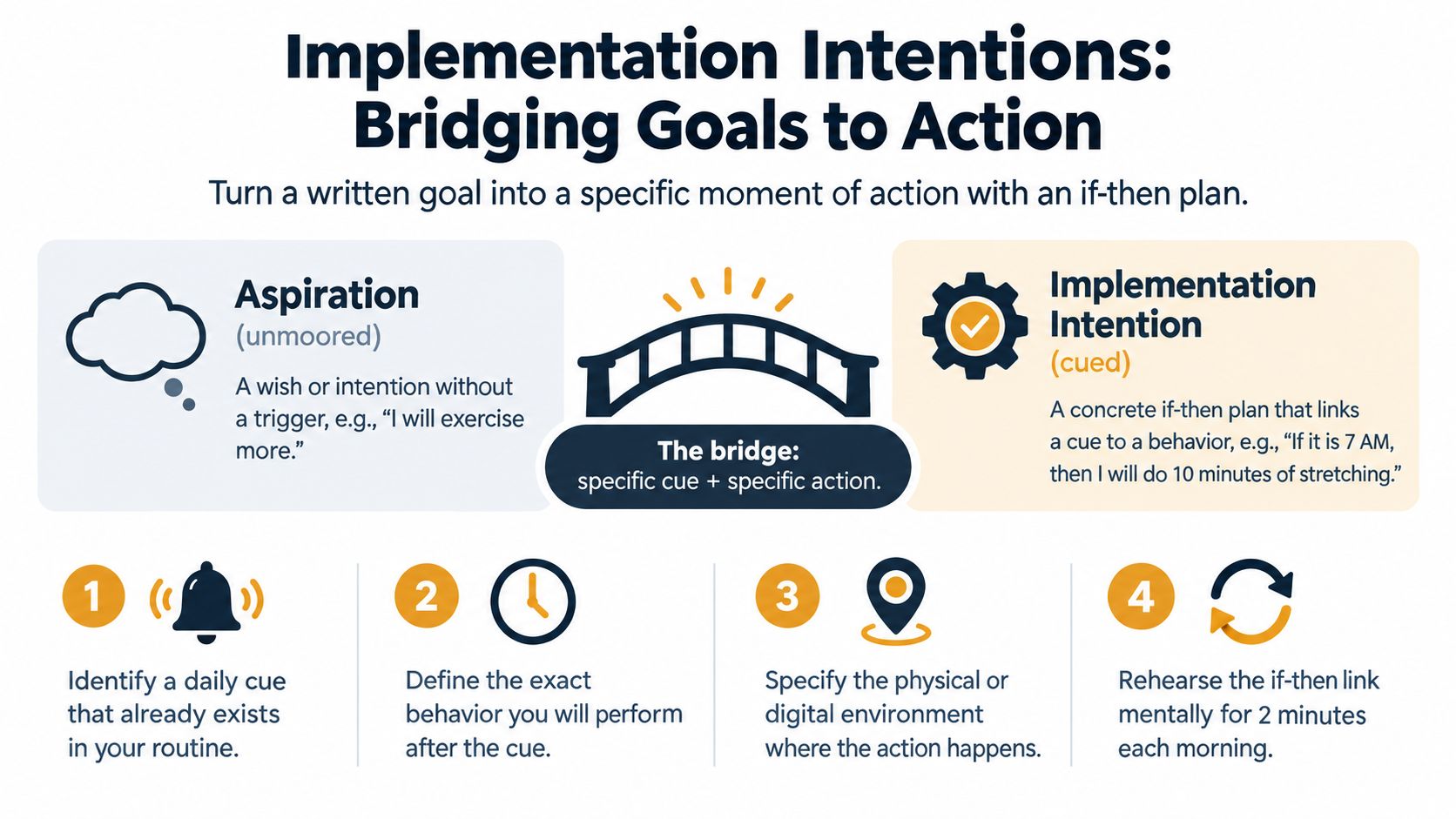
The plan should identify cues across several categories:
- People: a drinking colleague, a former using partner, or a family member during conflict.
- Places: a hotel bar, a previous purchase location, or an isolated home office.
- Times: late evening, payday, post-work decompression, or the hours after therapy.
- States: boredom, shame, anger, pain, loneliness, exhaustion, or social pressure.
Couples need scripts for arguments, financial conversations, reunions, and moments when one partner notices withdrawal. For example, if an argument escalates, both partners pause the conversation, move to separate spaces, and contact the agreed support person before resuming discussion. The plan should be rehearsed before discharge, including the exact words used to ask for help.
The motivation recovery methods available through behavioral activation concepts can complement this work by linking mood-sensitive action steps to daily routines. Implementation intentions remain the single most underrated layer between a good-looking plan and changed Tuesday-night behavior.
Coordinating Your Plan With Clinical Care
A personal improvement plan must sit inside the clinical treatment plan, not beside it. The client's goals need to respect medical timing, therapeutic pacing, psychiatric stability, and family-system work. Otherwise, a highly motivated client can use the document to push directly against the care that makes progress possible.
A client who plans an immediate return to a high-stress executive role may undermine stabilization. A partner who moves back into the home during treatment may reintroduce conflict before communication skills are ready. A plan that schedules demanding travel during medication changes may create avoidable risk.
The primary therapist should identify these conflicts early. A clinical liaison can help coordinate updates across disciplines, while shared documentation and regular multidisciplinary review keep the plan aligned with current observations.
| Clinical Component | Personal Plan Alignment | Risk If Misaligned |
|---|---|---|
| Medically supervised detox | Schedule rest, monitoring, and follow-up around the clinical discharge plan | The client mistakes early physical stabilization for full recovery readiness |
| Medication-assisted treatment | Record dosing windows, appointments, side-effect concerns, and medication questions | Missed care or unmanaged symptoms can destabilize the plan |
| CBT, DBT, EMDR, or trauma work | Assign daily practices that match the active therapy modality | The client takes on exercises that exceed current emotional tolerance |
| Psychiatric medication reviews | Add symptom tracking and prompt communication about changes | Mood or anxiety symptoms can be mistaken for poor motivation |
| Family sessions | Convert agreed communication principles into household rules | Family members follow conflicting expectations |
| Aftercare planning | Connect discharge goals to outpatient support, work, travel, and home routines | Gains remain dependent on the treatment setting |
An integrated model matters because physical health, mental health, substance use, relationships, and environment affect one another. A resource on the benefits of integrated health approach offers useful context for thinking beyond isolated services.
The plan should have one named accountability owner, even when several professionals contribute. That person confirms that goals remain current, flags contradictions, and brings unresolved issues to review. The client retains ownership, but the team prevents the document from becoming a private promise no one else can evaluate.
Tracking Progress and Building Relapse-Aware Contingencies
Streak counts are not the plan. Follow-through architecture is the plan. A person can maintain a calendar while sleep worsens, cravings intensify, conflict increases, or psychiatric symptoms return. Those subjective signals often appear before a visible crisis, so tracking must include the internal and relational conditions surrounding behavior.
A workable cadence looks like this:
- Daily micro-check: The client records sleep quality, craving intensity, mood, conflict, and whether the planned actions occurred.
- Weekly review: The client and accountability person identify patterns, missed cues, and obstacles that appeared repeatedly.
- Monthly clinical review: The treatment team compares current functioning with the original goals and checks for early relapse indicators.
- Quarterly revision: The client and team retire absorbed habits, tighten weak responses, and rewrite priorities that no longer fit.
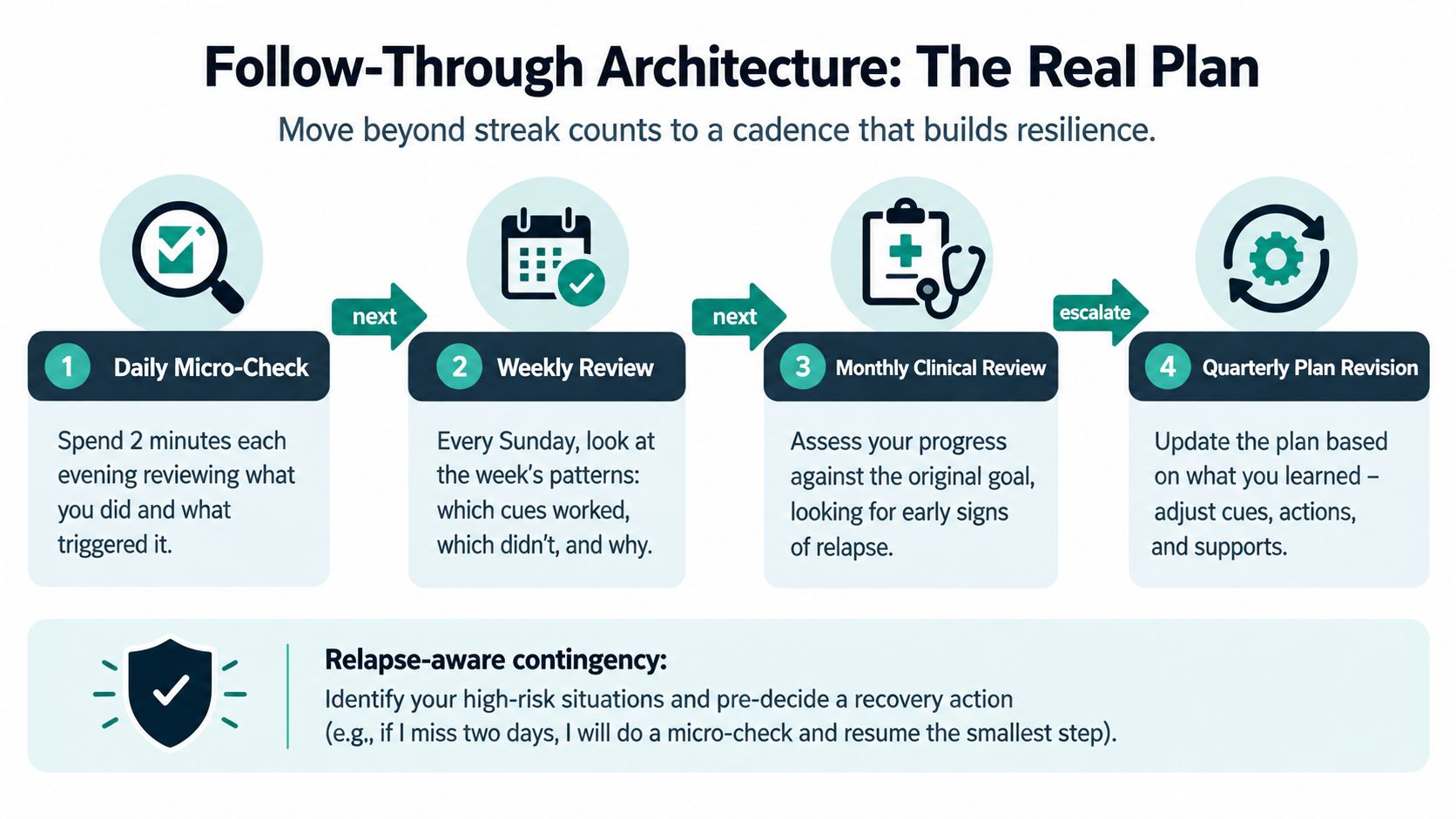
Every plan needs a one-page contingencies sheet. It should name high-risk situations, the first call, the backup call, the location where the client goes, the transportation option, the clinical contact, and the action that restores routine. It should also distinguish a lapse, a relapse pattern, and a momentum loss, because each requires a different response.
An accountability partner agreement can specify that missed check-ins trigger a neutral contact rather than an accusation. The agreement should state when the partner calls the therapist, how privacy is respected, and what information requires immediate escalation.
A 72-hour post-event protocol gives the client a path after a slip or destabilizing event:
- Contact the designated support person promptly.
- Move away from the triggering environment.
- Notify the clinical team and review medication or safety concerns.
- Complete a factual written review without shame-based language.
- Resume the smallest stable action in the plan.
Goal setting alone has limited power. A 2017 meta-analysis found a small positive unique effect on behavior change, d = 0.34, with a confidence interval of 0.28 to 0.41, while later reviews found that goal setting alone produces only small effects in some health outcomes (goal-setting meta-analysis.pdf)). The lesson is direct: a plan without contingencies is a hope list. Infrastructure protects recovery when the client's confidence is low.
The relapse prevention plans template can help organize these contacts, triggers, responses, and review points into a document that people can use.
Adapting the Plan When Life Happens and Where to Get Support
Recovery milestones are directional, not linear. A lapse is a serious event requiring prompt action, but it doesn't automatically erase every skill the client has built. A relapse pattern requires broader escalation. Momentum loss may mean the client has stopped attending, sleeping well, communicating, or following routines even without substance use.
The quarterly revision should ask four questions:
- Which assessment findings still matter?
- Which goals have become routine and can be retired?
- Which triggers have returned or changed?
- Which single SMART goal deserves rewriting now?
Revision triggers should produce small, immediate adjustments. Missed check-ins may require a shorter check-in or a different time. New psychiatric symptoms may require a medication review. A relationship rupture may activate family support and temporary boundaries. Returning to a high-risk environment may require travel restrictions, additional contact, or a revised discharge schedule.
A difficult week is evidence for adjustment, not permission to discard the framework. In a 2026 U.S. poll, 70% of resolution-makers said they had made a specific plan for keeping their goals, while another survey reported that only 31% of Americans planned to make a resolution or goal for 2026 (2026 poll on goal planning). Planning matters, but durable recovery requires the details that make plans usable under stress.
Oceans Luxury Rehab can serve as the coordination hub where clinical updates, family input, discharge planning, and the living personal improvement plan stay synchronized. Its individualized care may include medically supervised detox, residential and outpatient treatment, medication-assisted treatment, dual-diagnosis care, therapy, relapse prevention, and aftercare planning in a private, high-comfort setting.
Adults and couples seeking coordinated addiction treatment in California can visit Oceans Luxury Rehab to discuss individualized recovery planning, medically supervised care, and admissions options. The team can help turn clinical recommendations into a practical document with clear goals, daily cues, accountability contacts, and relapse-aware contingencies.
