

The search usually starts in a hard moment. A family has found pills, a partner has watched someone nod off and not wake easily, or a professional has reached the point where keeping it hidden takes more energy than the workday itself.
Many individuals begin searching for drug treatment southern california at that stage, only to find themselves overwhelmed by aggressive marketing, vague promises, and a confusing array of nearly identical options.
Good treatment isn’t one thing. It’s a continuum of care that matches medical risk, mental health needs, privacy concerns, home stability, and the level of structure a person can realistically sustain. The right program should make the next step feel clear, not more confusing.
Starting Your Search for Drug Treatment in Southern California
People searching for care aren’t comparing treatment models for fun. They’re trying to make a safe decision quickly, often while sleep deprived, scared, and under pressure from work or family.
A useful search starts with one question: What level of support is needed today? Some people need medical detox before anything else. Others are medically stable but still need a live-in setting because the home environment is too chaotic, too enabling, or too full of triggers. Some can function in daily life yet still need structured day treatment or evening therapy to stop the cycle before it deepens.
The clearest path is to look for a program that can assess the whole picture, not just the substance being used. That means withdrawal risk, co-occurring anxiety or depression, medications already being taken, recent overdose history, work obligations, and whether the person can stay safe overnight at home.
A private setting also matters for many adults in Orange County and Los Angeles. For people balancing careers, family visibility, or public reputations, comfort isn’t just a luxury feature. It often helps them stay in care long enough to benefit from it. A Southern California luxury rehab program can make that transition feel manageable when privacy and clinical structure both matter.
Practical rule: If a center can’t explain where detox ends and what comes next, it’s not giving a full treatment plan. It’s giving a partial answer.
Understanding the Scale of Addiction in the Region
Southern California’s treatment demand makes more sense when the regional numbers are put in plain language. This isn’t a rare problem affecting a small corner of the population. It touches families across affluent coastal communities, major urban centers, and suburban neighborhoods alike.

What the California numbers show
Statewide, the California Health Care Foundation reported in 2018 that 8% of Californians, roughly 3 million people, had substance use disorders, yet only 10% received professional treatment. More recent data from 2022 to 2023 shows 5.6 million Californians age 12 and older, or 17%, met substance use disorder criteria according to California addiction data summarized here.
That treatment gap matters because it means many people don’t enter care until the consequences are severe. By then, there may be legal problems, job disruption, fractured trust at home, or a dangerous pattern of using alone. Families often assume they waited too long. In reality, many people seeking help are arriving at the same late stage because access, stigma, and denial delay treatment.
The opioid picture adds urgency. The same regional analysis notes that heroin use increased 63% between 2002 and 2013, heroin-related overdose deaths nearly quadrupled in that period, and by 2014 drug overdoses had become the leading cause of accidental death nationwide, with 47,055 lives lost, half involving prescription painkillers or heroin. Southern California felt those trends sharply, including in Ventura County where prescription opioid overdoses outpaced state averages.
Why local demand feels so intense
Southern California has many treatment listings, but abundance on paper doesn’t always mean easy access in practice. Beds may not be available at the right level of care. Detox may be separate from residential care. A program may look all-inclusive online but have limited psychiatric support, limited medication options, or a rigid structure that doesn’t fit a working adult.
That’s why families often feel whiplash during the search. They’re not only asking who treats addiction. They’re asking who treats this person’s addiction, with the right medical oversight, enough privacy, and a credible next step after stabilization.
For readers focused on Orange County specifically, this Orange County recovery guide helps frame what local treatment planning should include.
The Full Spectrum of Care What Treatment Looks Like
One of the biggest mistakes families make is treating rehab like a single product. It isn’t. Drug treatment southern california usually works best when care is matched to the person’s current risk and then adjusted as stability improves.
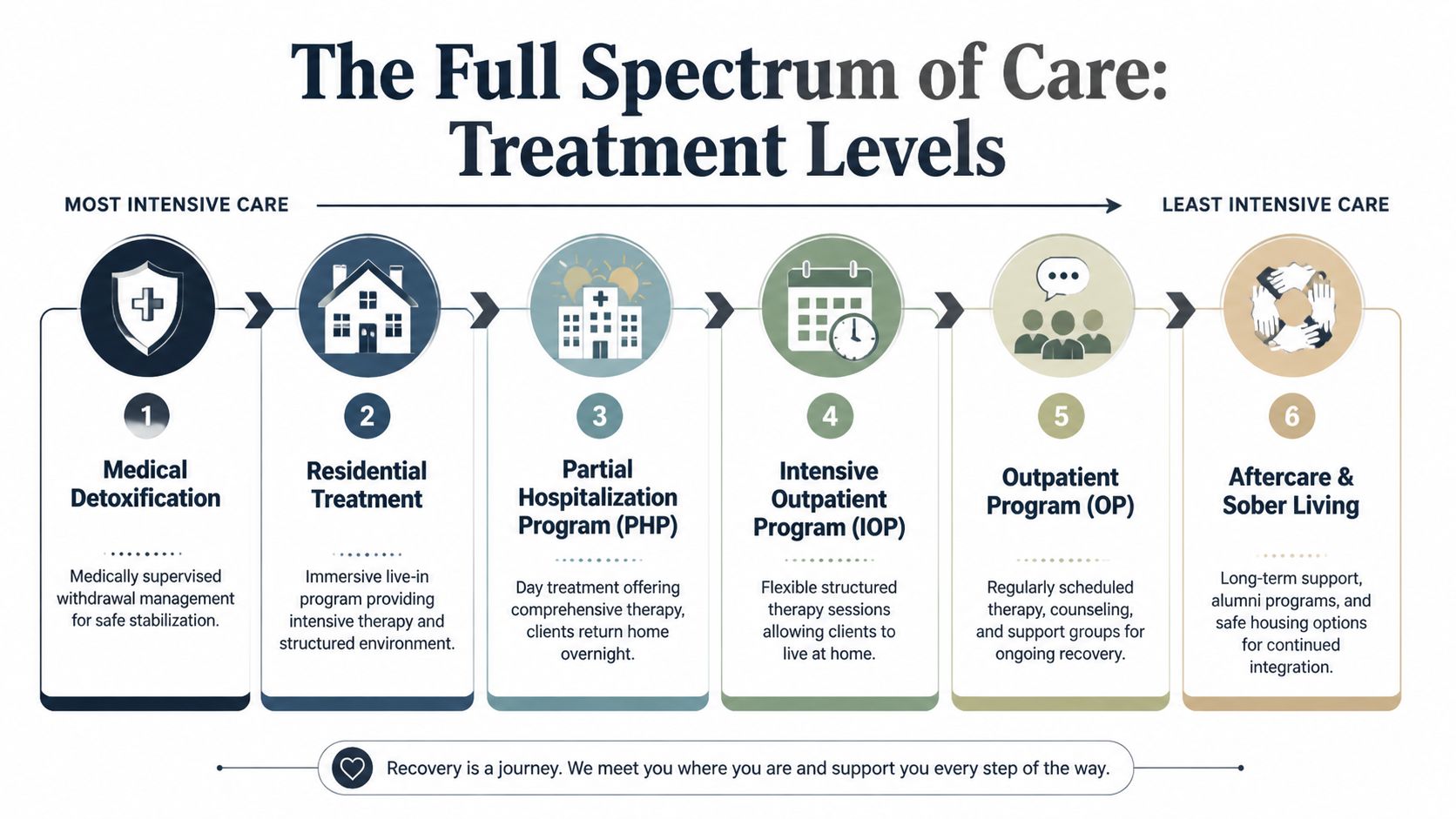
California had 1,797 licensed substance abuse treatment facilities in 2019, including 236 detoxification sites and 324 partial hospitalization programs, according to the California substance use almanac. That range reflects that people need different levels of support at different points in recovery.
The main levels of care
Medical detoxification is the starting point when withdrawal could be dangerous, highly uncomfortable, or likely to drive immediate relapse. This level focuses on stabilization, symptom monitoring, medication management when appropriate, hydration, sleep support, and safe transition into the next phase.
Residential inpatient treatment is live-in care. The person stays on site, follows a structured daily schedule, attends individual and group therapy, and steps away from the environment where use has been happening. This is often the right fit when relapse risk is high, home is unstable, or co-occurring mental health symptoms need close monitoring.
Partial hospitalization offers full clinical days while allowing the client to return home or to supportive housing at night. It can work well after residential care or for someone who needs intensive treatment but doesn’t need overnight medical supervision.
Intensive outpatient treatment provides several therapy sessions each week with more flexibility for work, parenting, or school. It still requires commitment and accountability. It isn’t a light version of rehab. It’s structured care for someone stable enough to practice recovery skills in real life between sessions.
Standard outpatient treatment is less intensive and often used for ongoing therapy, relapse prevention, and support after higher levels of care.
Aftercare and sober living extend the work beyond formal treatment. Recovery often holds when structure doesn’t disappear all at once.
Levels of Addiction Treatment Care at a Glance
| Level of Care | Primary Goal | Living Arrangement | Weekly Time Commitment |
|---|---|---|---|
| Medical Detoxification | Safe withdrawal and stabilization | Live on site | Full-time, 24/7 supervision |
| Residential Treatment | Intensive therapy and environmental reset | Live on site | Full-time daily programming |
| Partial Hospitalization | Comprehensive day treatment with step-down support | Home or supportive housing at night | Most weekdays for much of the day |
| Intensive Outpatient | Structured therapy with real-world flexibility | Live at home | Several sessions across the week |
| Outpatient Program | Ongoing counseling and relapse prevention | Live at home | Regular scheduled visits |
| Aftercare and Sober Living | Long-term recovery support and accountability | Sober housing or home | Varies by need and plan |
The most effective recommendation is often not the least restrictive option. It’s the lowest level of care that still keeps the person safe and engaged.
What works and what doesn’t
What works is movement through the continuum, not getting stuck at one point. A person who detoxes and goes straight back to the same unstructured environment often loses momentum fast. A person who enters residential care without a realistic discharge plan may improve inside treatment and unravel after leaving.
What doesn’t work is choosing care by convenience alone. A short commute, a pretty website, or a program that promises total flexibility doesn’t help if the person still needs overnight support, medical management, or stronger boundaries. A clear explanation of how drug rehab works should always include what happens after the first phase, not just during admission.
How to Choose the Right Treatment Path for You
The right level of care isn’t picked by preference alone. It’s chosen by matching the person’s current condition to the amount of structure needed to protect recovery.
A practical assessment starts with severity. Someone using daily, relapsing quickly after attempts to stop, hiding use, or mixing substances usually needs more structure than someone who still has intact routines and can reliably stay sober between sessions. Physical dependence also changes the plan. If withdrawal is expected, detox should be considered first.
Mental health matters just as much. Panic, depression, trauma symptoms, mood instability, or insomnia can drive substance use and complicate early recovery. When those symptoms are strong, residential treatment often gives clinicians more room to stabilize both conditions at once. When symptoms are present but manageable, a day program or intensive outpatient track may be appropriate.
A simple decision framework
- Choose detox first when there’s likely withdrawal, recent heavy use, or concern about medical complications.
- Choose residential care when the home setting is unsafe, enabling, or impossible to manage without constant support.
- Consider PHP when the person needs most of the structure of inpatient treatment but can safely sleep off site.
- Consider IOP when motivation is strong, symptoms are more stable, and there’s a reliable sober environment outside programming.
- Use outpatient care for continued therapy and relapse prevention once stronger stability is already in place.
Real trade-offs families should understand
A high-functioning professional may insist on outpatient care because work can’t stop. That can be reasonable if the person is medically stable, has support at home, and can protect treatment hours. It can fail quickly if the same work stress, access to substances, and isolation that fueled the problem remain untouched.
A family may want residential care immediately because it feels safer. That instinct is often right, but the living arrangement only helps if the clinical plan is strong. Residential treatment without psychiatric attention, medication review, or discharge planning can feel protective in the moment yet leave the core drivers of relapse unchanged.
A strong admissions assessment should be willing to say, “This level of care isn’t enough,” even if it’s the level the caller hoped to hear.
Why Specialized Treatment Tracks Matter
Addiction rarely shows up as a single, clean problem. Many clients arrive with anxiety, depression, trauma, chronic pain, relationship strain, sleep disruption, or work demands that make standard programming too blunt. That’s why specialized treatment tracks matter.
Dual diagnosis changes the treatment plan
Dual diagnosis care is essential because 40% to 60% of people with a substance use disorder also have a co-occurring mental health condition, and integrated treatment can raise 1-year abstinence rates from 20% to 30% up to 45% to 55% according to the NCBI review of co-occurring treatment outcomes.
That means a person using cocaine to push through depression, drinking to quiet panic, or misusing opioids while carrying trauma symptoms usually needs more than substance-focused groups. Treatment has to address both sides at the same time. If it doesn’t, the untreated condition often pulls the person back toward use even when motivation is genuine.
Opioid treatment needs medical depth
Opioid and fentanyl cases need a medically informed track, not a generic recovery plan. Early stabilization may require medication support, close monitoring, and careful attention to cravings, sleep, pain history, and overdose risk. Programs that treat opioid dependence like a willpower problem usually lose people early.
Medication-assisted treatment can be part of a high-quality plan when clinically indicated. It isn’t a shortcut. It’s one tool in a larger strategy that should also include therapy, relapse prevention planning, and family education.
Privacy and lifestyle needs are clinically relevant
Executives, licensed professionals, public-facing clients, and couples often need individualized planning for reasons that aren’t cosmetic. Discretion affects willingness to enter care. Work communication policies affect whether treatment is realistic. Relationship dynamics can either support recovery or repeatedly destabilize it.
A specialized setting may include private rooms, coordinated family work, stronger confidentiality practices, and treatment schedules built around realities of adult life. Within that model, Oceans Luxury Rehab offers medically supervised detox, residential and outpatient care, dual-diagnosis support, medication-assisted treatment, and private accommodations in San Clemente for adults seeking discreet care in Southern California.
What a specialized program should be able to answer
- For mental health complexity: How are psychiatric symptoms evaluated and treated during addiction care?
- For opioid cases: Is medication support available when appropriate, and who monitors it?
- For couples or families: Are boundaries and joint work handled carefully, or are people treated in parallel, without joint focus?
- For professionals: How does the program protect privacy while still keeping treatment clinically effective?
One-size-fits-all care sounds efficient. In practice, it often misses the reason the person kept returning to substances in the first place.
Navigating Admissions Insurance and Privacy Concerns
For many families, the hardest part isn’t deciding that help is needed. It’s getting from crisis to admission without losing momentum.
Insurance confusion, delayed callbacks, incomplete screenings, and uncertainty about privacy can stall the process for days. That matters because willingness to enter treatment can be brief. If the path is too complicated, people often retreat back into ambivalence or active use.
A recent California treatment access analysis notes that over 4.8 million Californians with substance use disorders go untreated, in part because of provider shortages and insurance complexity, as outlined in this California addiction treatment access report. For that reason, a well-staffed admissions process and quick PPO verification aren’t minor conveniences. They can determine whether treatment starts at all.
What should happen on the first call
A quality admissions call should gather enough information to make a safe preliminary recommendation. That usually includes current substances used, frequency, recent overdose history, prior treatment attempts, mental health symptoms, medications, medical conditions, and whether the person can remain safe while waiting for admission.
Families should also expect direct answers about logistics. If detox is needed, the center should say so. If a higher level of care is required than the caller expected, that should be explained plainly. Ambiguity wastes time.
The first call should lower panic, not increase it. If the conversation feels evasive, rushed, or purely sales-driven, keep asking questions.
How to think about insurance
Insurance verification is often treated like back-office paperwork, but it’s part of treatment access. Delays here can derail commitment. A strong admissions team checks benefits quickly, explains what’s known, clarifies what may still need review, and helps the family understand likely next steps.
Useful questions include:
- Coverage clarity. What levels of care are likely covered under the plan?
- Timing. How quickly can benefits be verified and an admission decision be made?
- Clinical fit. Is the recommended level of care based on need, not only on what’s easiest to approve?
- Continuity. If the client starts at one level, can the same program help coordinate the next one?
Privacy concerns are legitimate
Professionals often delay treatment because they fear exposure more than they fear the addiction itself. They worry about colleagues, employers, clients, licensing implications, and family reputation. Those concerns shouldn’t be dismissed as vanity. They’re real barriers to care.
A private treatment environment can reduce that resistance. Private rooms, discreet communication, controlled contact policies, and a calm setting all support engagement. Comfort also has a clinical purpose. When a person feels physically safe and less observed, defensiveness tends to drop and treatment work begins sooner.
The Premier Treatment Experience and Lasting Recovery
A high-quality treatment setting does more than remove substances. It creates the conditions where the nervous system can settle enough for therapy, insight, and habit change to take hold.

In a strong program, the day has rhythm. Medical needs are monitored. Meals are consistent. Sleep improves. Therapy isn’t squeezed around chaos. That structure sounds simple, but for many people entering treatment it’s the first sustained period in a long time where the body and mind stop reacting hour to hour.
What the clinical experience should include
Evidence-based treatment still has to be the center of the program. That means individual therapy, group work, relapse prevention, family involvement when appropriate, and a plan that responds to the actual substance pattern, not a generic curriculum.
For opioid use disorder, medication-assisted treatment can be part of this work. In top-tier facilities, buprenorphine can reduce overdose risk by 38%, and programs with 24/7 physician oversight have higher retention, with recovery rates exceeding 60% for clients retained for 6 or more months, according to this review of treatment trends and outcomes.
That kind of data points to a practical truth. People do better when treatment is intensive enough, medically competent, and sustained long enough for recovery habits to become real life habits.
Why environment affects outcomes
Luxury care is often misunderstood as decoration. In practice, environment changes behavior. A quiet room, reliable nutrition, private space, and a peaceful setting reduce friction during a period when clients are already physically and emotionally depleted.
A calmer environment can also help people stay. Many adults who would resist a stark institutional setting will agree to treatment if the space preserves dignity and privacy. Retention matters because early dropout is one of the biggest threats to progress.
Recovery continues after discharge
The strongest treatment plans don’t end at discharge. They narrow the gap between structured care and daily life.
A good aftercare plan usually includes several parts:
- Clinical follow-up with therapy, psychiatric care, or outpatient programming.
- Relapse prevention planning that names triggers, warning signs, and specific responses.
- Family boundaries so home support doesn’t turn back into rescuing or enabling.
- Community connection through alumni support, sober peers, or recovery-oriented housing when needed.
Recovery becomes durable when the person leaves treatment with a schedule, support, and a plan for the first difficult week back in the real world.
Your Path to Healing Begins With a Single Step
The search for drug treatment southern california often begins in confusion, but the next move doesn’t have to be complicated. The immediate goal is simple. Find the right level of care, confirm the clinical fit, remove insurance and admissions barriers quickly, and get the person into a safe setting before the window for change closes.
Effective treatment is rarely the most generic option. It’s the option that matches withdrawal risk, mental health needs, privacy concerns, and the amount of structure needed to interrupt the cycle. For some people, that starts with detox. For others, it’s residential care, PHP, or outpatient support with a clear long-term plan.
Seeking help is not a sign that life has fallen apart beyond repair. It’s often the first organized decision made after a long period of strain, secrecy, and fear.
If confidential, high-comfort care is the right fit, Oceans Luxury Rehab offers admissions support, PPO insurance verification, and a full continuum of addiction treatment in San Clemente. A private call can clarify the right level of care, what admission would look like, and how quickly treatment can begin.
