

A person can walk into addiction treatment hoping for relief, then feel their body tense the moment the intake packet starts asking blunt questions, the schedule feels rigid, and staff speak over them instead of with them. That reaction isn't stubbornness or “noncompliance.” It's often a sign that the setting is touching old wounds instead of helping the nervous system settle.
That's the heart of trauma-informed care. It asks programs to treat trauma as a common part of the recovery picture, then build services that reduce fear, improve trust, and avoid re-traumatization. In addiction treatment, that shift can change whether someone shuts down, leaves early, or stays engaged long enough to heal.
Recognizing Trauma's Impact on Recovery
A client enters rehab ready to stop using, but the first few hours feel like a series of alarms. A rushed intake asks for painful history before trust exists, a crowded waiting area makes privacy impossible, and a rule-heavy approach leaves no room for choice. By dinner, the client is quiet, guarded, and already thinking about leaving.
That kind of moment is why the phrase “What happened to you?” matters so much more than “What's wrong with you?” Trauma-informed care begins with that change in posture. It assumes that behavior often makes sense once the person's history, triggers, and coping strategies are understood. For many clients and families, that shift is the difference between feeling judged and feeling safe.
Practical rule: If a treatment setting makes a person feel cornered, exposed, or controlled, it may be repeating the very experience that helped drive the addiction in the first place.
In real treatment settings, this lens changes small things that have big emotional effects. Staff slow down their questions, explain what comes next, and ask permission before moving into sensitive topics. A client who can say, “Not yet,” or “Can we come back to that later?” is far more likely to stay engaged.
For families trying to understand how trauma and addiction connect, this guide pairs clear explanations with concrete examples from care settings. For more context on how trauma can shape substance use, see the impact of trauma on addiction.
Core Foundations of Trauma Informed Care
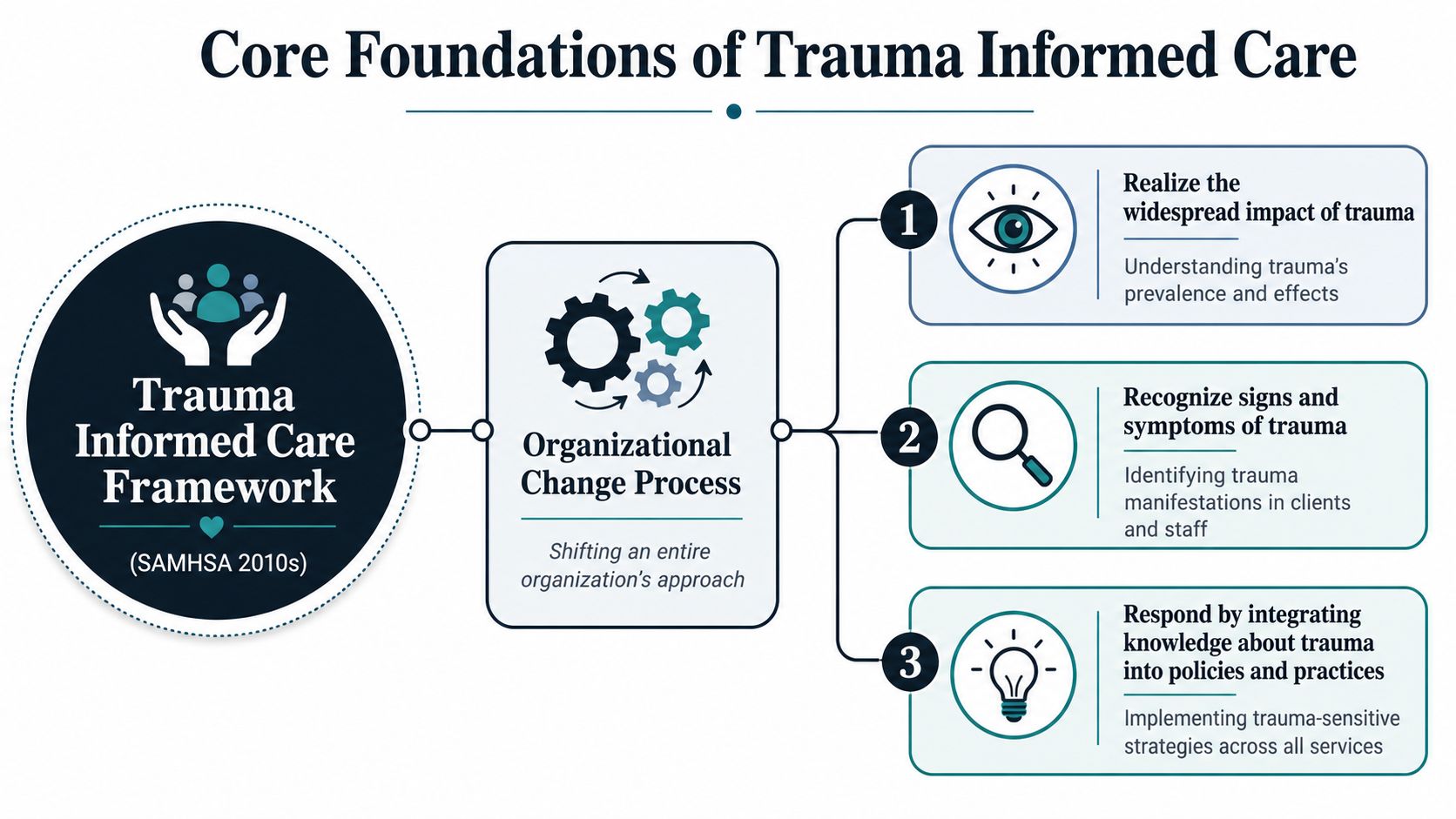
Trauma-informed care grew out of a simple but important realization, trauma affects more than a person's feelings. It can shape attention, memory, trust, and the body's sense of safety. SAMHSA's framework turned that realization into a practical model by focusing on three actions, realizing how widespread trauma is, recognizing its signs and symptoms, and responding by building trauma knowledge into policies, procedures, and day-to-day practice. That shift matters because it treats trauma-informed care as an organizational change process, not just a therapist's style in one session.
In addiction treatment, that broader view is easy to see. A client may feel understood in counseling and still feel on edge in admissions, group check-in, or medication rounds if the rest of the program is inconsistent or harsh. Trauma-informed care asks the whole setting to work together, so a person is not forced to rebuild trust every time they meet a new staff member or enter a different room.
The core idea is straightforward. If trauma can make the world feel unpredictable, treatment has to reduce that sense of uncertainty. People who have been hurt often watch for the next surprise, the next correction, or the next loss of control. A program that explains what is happening, keeps routines clear, and avoids unnecessary shame gives the nervous system fewer reasons to stay on guard.
SAMHSA's approach also centers re-traumatization prevention, because a treatment setting can accidentally echo old harm through force, secrecy, or humiliation as outlined in SAMHSA's trauma-informed approach guidance.
The six principles that hold the model together
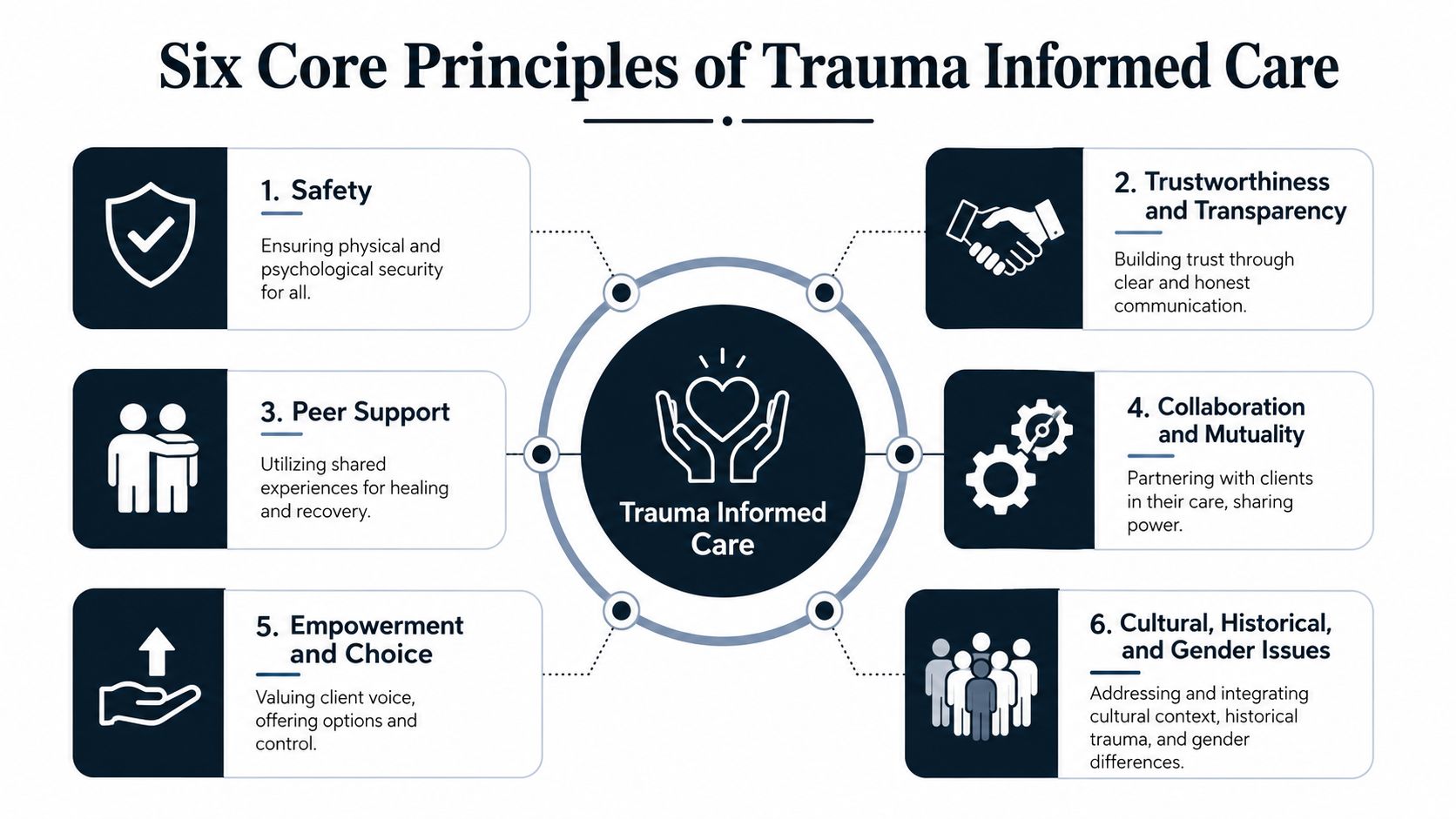
The framework is usually organized around six principles, safety, trustworthiness and transparency, peer support, collaboration and mutuality, autonomy and choice, and cultural, historical, and gender responsiveness. Those principles give programs a working structure, so the approach stays concrete instead of vague.
A treatment center can show safety by keeping spaces calm, private, and predictable. It can show trustworthiness and transparency by explaining rules before enforcing them, and by telling clients what a group, assessment, or medication check will involve. Peer support helps because hearing from someone with lived experience can make recovery feel more real and less isolating.
Collaboration and mutuality shifts the tone from “staff decide, clients follow” to shared problem-solving. Autonomy and choice gives people room to decide how they participate, which group they start with, or when they are ready to talk about painful material. Cultural, historical, and gender responsiveness keeps care from assuming that one background, one family pattern, or one identity fits everyone.
A trauma-informed program does not just say, “We care.” It shows care through predictable routines, respectful language, and options that let people keep some control while they heal.
Core Principles and Neuroscience Behind Trauma Informed Care
Trauma changes how the brain and body scan for danger. When a person has lived through overwhelming events, the nervous system can stay on high alert, or it can shut down to protect itself. In everyday language, it's like living in a house where the alarm is either too sensitive or keeps going silent when it shouldn't.
That's why safety is the first principle. Not just physical safety, but emotional safety too. A quiet room, respectful tone, and predictable routine can calm a client faster than a lecture about “being calm.” Trustworthiness and transparency matter because people with trauma histories often expect hidden motives, so clear explanations reduce uncertainty. Peer support helps because someone with lived experience can make recovery feel less lonely and less abstract.
Collaboration and mutuality changes power dynamics. Instead of staff deciding everything behind a closed door, the client has a voice in treatment decisions. Autonomy and choice means options are real, not symbolic. A person who can choose a therapy group, a meeting time, or how to discuss family history is less likely to feel trapped.
Clear, predictable processes lower the chances that ordinary care will feel threatening.
The final principle, cultural, historical, and gender responsiveness, reminds programs that trauma doesn't happen in a vacuum. People bring identities, community history, and lived experience into treatment. Evidence-based guidance says jointly developed care plans, clear communication, and predictable processes reduce power differentials and lower the risk of triggering trauma responses as described in clinical guidance from the NCBI.
A trauma-informed program feels different because the person isn't asked to surrender control in order to get help. They're invited into the process. That distinction is especially important in addiction treatment, where shame and fear can already be running high.
Trauma Informed Care vs Trauma Specific Treatment
Trauma-informed care and trauma-specific treatment are related, but they are not the same thing. Trauma-informed care is the system-wide framework that shapes how a program welcomes, communicates with, and supports people. Trauma-specific treatment is the focused therapy used to treat trauma symptoms or trauma-related disorders.
| Trauma Informed Care | Trauma Specific Treatment |
|---|---|
| Applies across the whole program | Targets trauma directly |
| Shapes policies, environment, and staff behavior | Uses specialized therapeutic methods |
| Universal in approach | Used when trauma-focused treatment is clinically appropriate |
| Reduces re-traumatization | Works on trauma symptoms, memories, and coping patterns |
That difference matters because some people think trauma-informed care means a trauma therapy has already been offered. It doesn't. A person can be in a trauma-informed program and still need specialized care later. The point is that every interaction, from admissions to discharge planning, is designed to be safer and more collaborative.
The American Academy of Pediatrics notes that trauma-informed care is not a single clinical intervention. It requires trauma knowledge to be built into policies, staff training, and environment design as explained by the AAP. That is why families should think of it as the foundation under the whole building, not one treatment room inside it.
For readers comparing treatment paths, mental health and substance abuse treatment often works best when trauma-informed care supports the broader recovery plan.
Practical Examples in Addiction Treatment
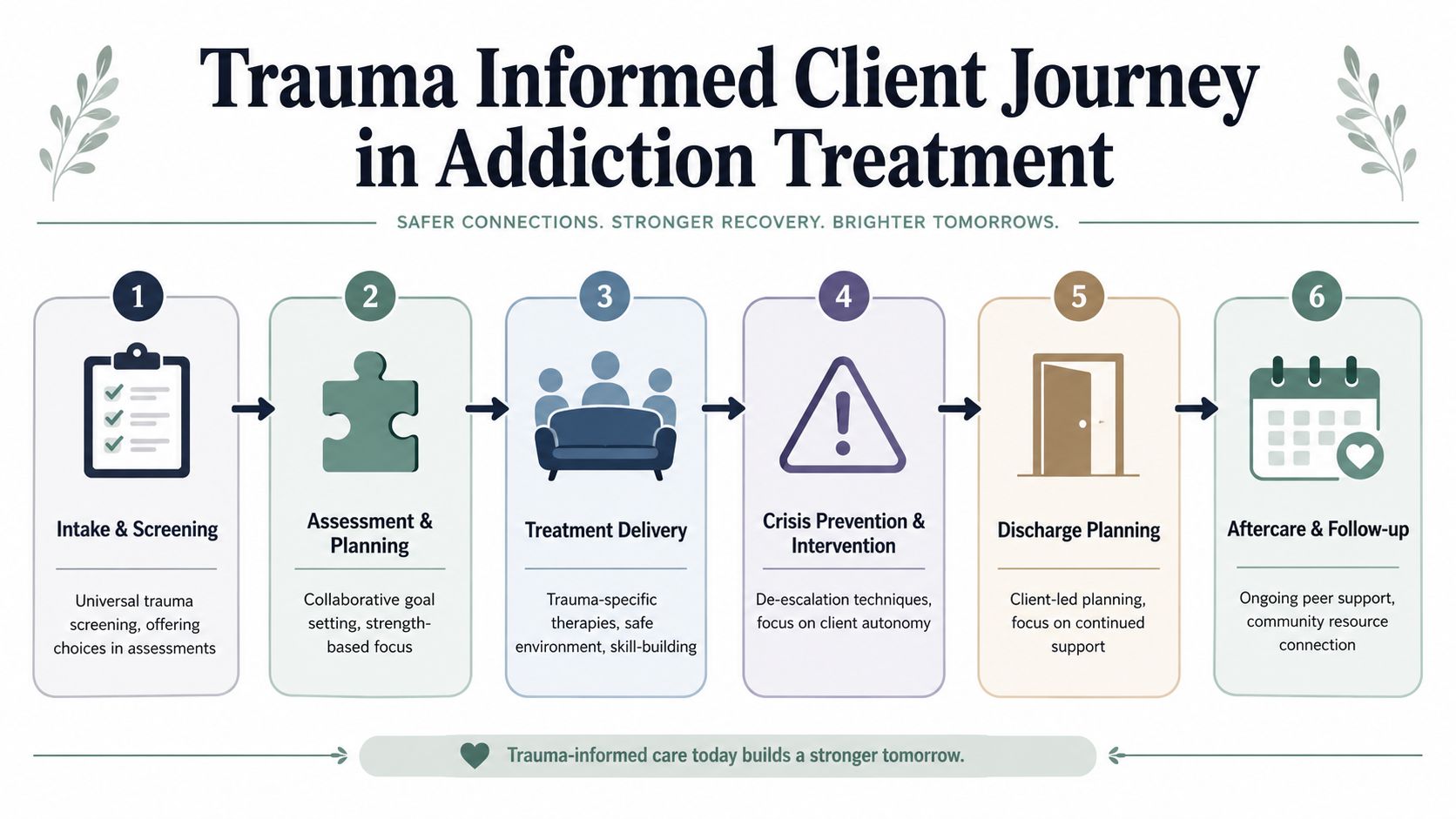
A trauma-informed addiction program starts before the first counseling session. During intake, staff explain the process in plain language, offer choices about how to answer questions, and use universal trauma precautions, which means they don't wait for disclosure before adapting their approach. That keeps the conversation from feeling like an interrogation.
What it looks like across a treatment day
A client assessment can be collaborative instead of controlling. Staff can ask what feels hardest to discuss, what helps the person stay grounded, and what a bad day usually looks like. The plan that follows should reflect those answers, not just a checklist of program rules.
In group therapy, trauma-informed practice looks like boundaries, pacing, and mutual respect. Clients aren't pushed to disclose personal history before they're ready. Instead, the group can focus on coping skills, relapse triggers, and support, which allows peer connection without pressure.
Medical care needs the same transparency. If medication is part of treatment, staff should explain why it's being offered, what the person can expect, and what choices exist. That kind of clarity reduces fear and helps the client feel like a participant instead of a passive recipient.
The physical setting matters too. Private rooms, calmer lighting, and a place to step away when emotions spike can all help reduce distress. These details may sound small, but they signal that the program understands how easily a stressed nervous system can tip into overload.
Helpful standard: If a program cannot explain how it prevents re-traumatization in intake, groups, medication care, and crisis moments, the “trauma-informed” label may be doing more work than the system itself.
Family involvement also needs care. A trauma-informed team can ask who should be involved, what topics are safe to discuss, and what boundaries need to stay in place. That kind of planning supports both connection and dignity.
The implementation gap matters here. The University at Buffalo notes that many public explanations stop at the principles and don't show what the model looks like in real settings or how organizations measure whether change is happening as described by the University at Buffalo's trauma-informed care resource.
For people comparing aftercare options, mindfulness-based relapse prevention can fit well inside a trauma-informed recovery plan because it emphasizes awareness, pause, and self-regulation.
Benefits and Outcomes for Clients and Programs
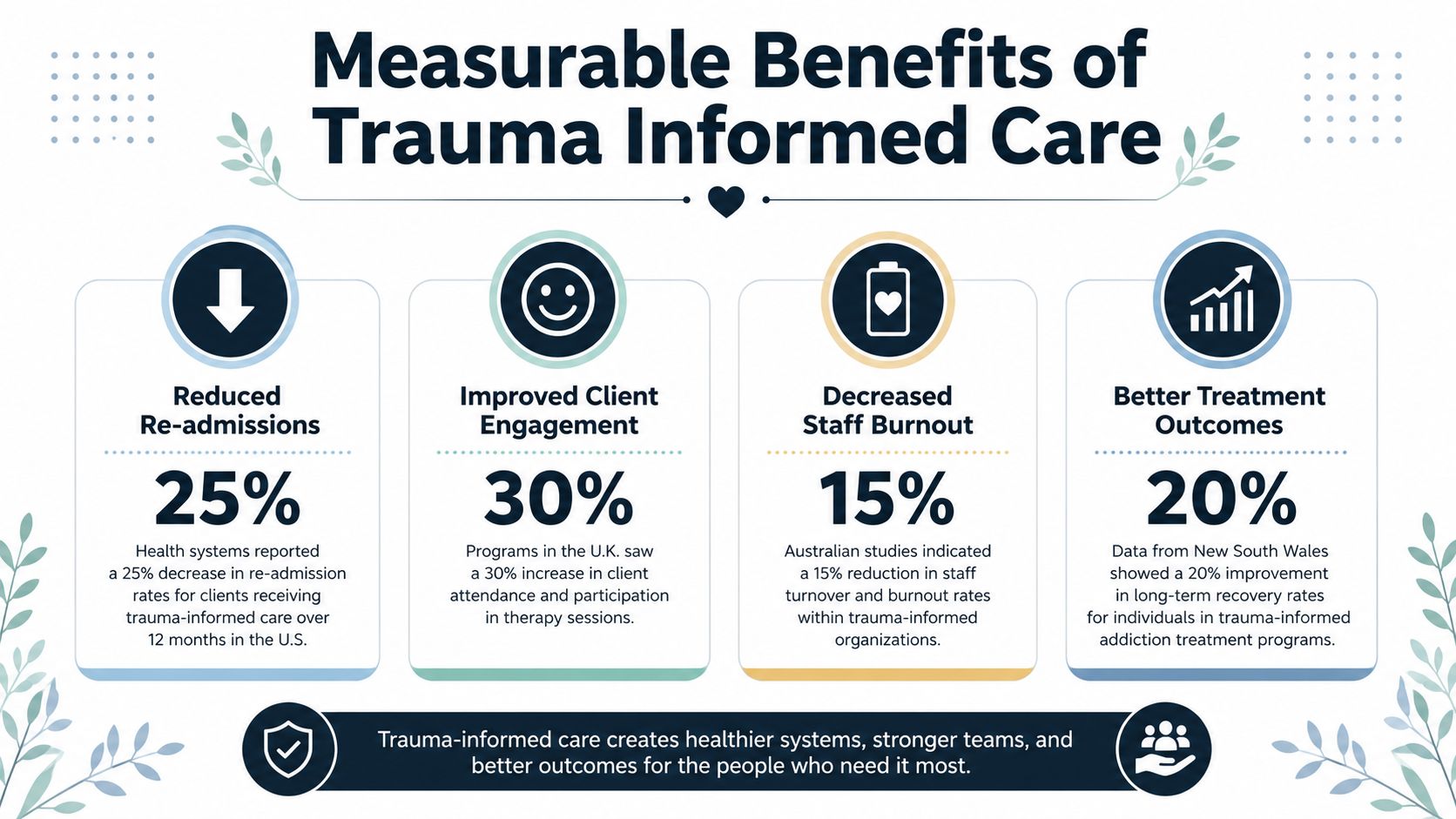
Trauma-informed care is often described as compassionate, but it also functions as a service-delivery strategy with operational consequences. A rapid evidence review from New South Wales reported that trauma-informed care is associated with decreased use of seclusion and restraint, shorter length of stay, higher discharge to lower levels of care, better patient-reported outcomes and coping skills, fewer staff injuries, and cost benefits as summarized in the NSW rapid evidence review.
Those outcomes matter in addiction treatment because the biggest risk is often not just symptoms, but drop-off. If a person feels safe enough to stay, they're more likely to learn, stabilize, and move forward. If staff are trained to reduce escalation instead of intensifying it, the program becomes easier for clients to tolerate and for teams to run.
Families can use that insight when they speak with admissions teams. A strong program should be able to talk about how it handles crises, how it prevents unnecessary coercion, and how it supports continuity of care after discharge.
The most useful question isn't whether a center says it is trauma-informed. It's whether its practices make recovery easier to sustain. In California, Oceans Luxury Rehab uses trauma-informed therapy within its broader addiction treatment model, which is the kind of operational detail families should look for when comparing options.
A trauma-informed program should be able to describe what changes for the client, the staff, and the environment, not just what the brochure says.
Key Questions to Ask a Trauma Informed Rehab Provider
A real trauma-informed program should be able to answer specific questions without getting defensive. If the answers stay vague, that's usually a warning sign.
- Do all staff receive trauma-informed training? A strong answer describes ongoing training for admissions, clinical, nursing, and support staff, not just therapists.
- How is client choice built into treatment plans? Look for examples of shared decision-making, not a scripted “we personalize care” line.
- What happens during intake if a question feels too intense? Good programs explain how they pause, rephrase, or return later.
- How do you prevent re-traumatization in the environment? A solid answer includes privacy, predictability, and respectful boundaries.
- How are crises handled without unnecessary force or humiliation? The response should describe de-escalation and dignity.
- How do you include peer support? The staff should be able to explain where lived experience adds value.
- How do you address cultural, historical, and gender-specific trauma? Expect more than a generic statement about inclusivity.
- How do you measure whether trauma-informed care is happening? Good programs track practice, not just intentions.
A team that is trauma-informed won't sound rehearsed. It will sound specific.
Common Misconceptions and Next Steps
One common myth is that trauma-informed care is an optional extra. It is part of the structure of care. SAMHSA says trauma-informed systems actively resist re-traumatization by changing policies, procedures, and environments. That is the standard, not a bonus feature.
Another misconception is that trauma-informed care only matters in therapy sessions. In practice, it shapes every step of treatment, from the first phone call to discharge planning. A calm front desk, predictable scheduling, and clear rules can matter just as much as the counseling room, because they help the person feel what comes next before anything difficult is asked.
A final myth is that trauma-informed care requires a person to tell their whole history. It does not. Universal trauma precautions mean the program starts with respect, choice, and transparency whether or not the client has shared anything yet. That approach is especially important in addiction treatment, where a rushed intake can feel like a locked door, while a careful intake feels more like a guided walk through a new space.
For readers ready to take the next step, a practical place to start is a program that can explain its approach clearly, verify insurance quickly, and admit people around the clock without turning the process into another source of stress. In real treatment settings, that often looks like staff who explain each form before asking for signatures, clinicians who offer choices during intake, and discharge planning that begins before the person leaves the first appointment. That combination helps families move from uncertainty to action with less friction and more dignity.
A CTA for Oceans Luxury Rehab.
