

The alarm can feel physical before it feels emotional. A jaw tightens, the chest gets shallow, the mind starts replaying tomorrow, and even small tasks feel heavier than they should. That moment is often the starting point for understanding what stress management is, because stress management is the skill of turning down that internal alarm enough to choose a response instead of reacting on autopilot.
For many people, that alarm shows up after work, during conflict, in recovery, or in the quiet minutes when the noise finally stops. The goal is not to remove every pressure from life. The goal is to help the body, mind, and daily routine recover faster so stress does not keep running the whole system.
A Familiar Moment Before the Answer
The phone is still in hand. One message came in late, another task got pushed back, and a conversation from earlier keeps looping in the background. The body has already answered before the mind has finished explaining, shoulders up, breathing faster, stomach tight.
That is the kind of moment stress management addresses. Not by pretending the day was easy, and not by asking a person to stay calm through sheer force. It teaches a person how to interrupt the spiral early, so the nervous system does not stay stuck in alarm mode longer than necessary.
What the body is trying to do
Stress is built into human survival. The body senses threat, real or perceived, and shifts resources toward protection. That response can help in a crisis, but it becomes exhausting when it stays on too long.
Practical rule: If the body feels hijacked, the first target is not the problem itself, it is the nervous system.
That matters for recovery too. When someone is trying to stay sober, untreated stress can make old coping habits feel tempting again, especially when the person has no better way to settle the body. Stress management gives the person another route.
Defining Stress Management in Plain Language
Stress management is the set of skills a person uses to lower stress, recover faster, and respond more deliberately when pressure shows up. It is not one trick. It is a mix of body-based, mind-based, and lifestyle tools that help the nervous system shift out of high alert and back toward baseline.
A simple way to think about it is like a thermostat. Stress acts like heat entering the room. The brain notices the heat, the alarm turns on, and the body ramps up to protect itself. Stress management does not remove every source of heat, but it helps the system cool more efficiently, so the room does not stay overheated.
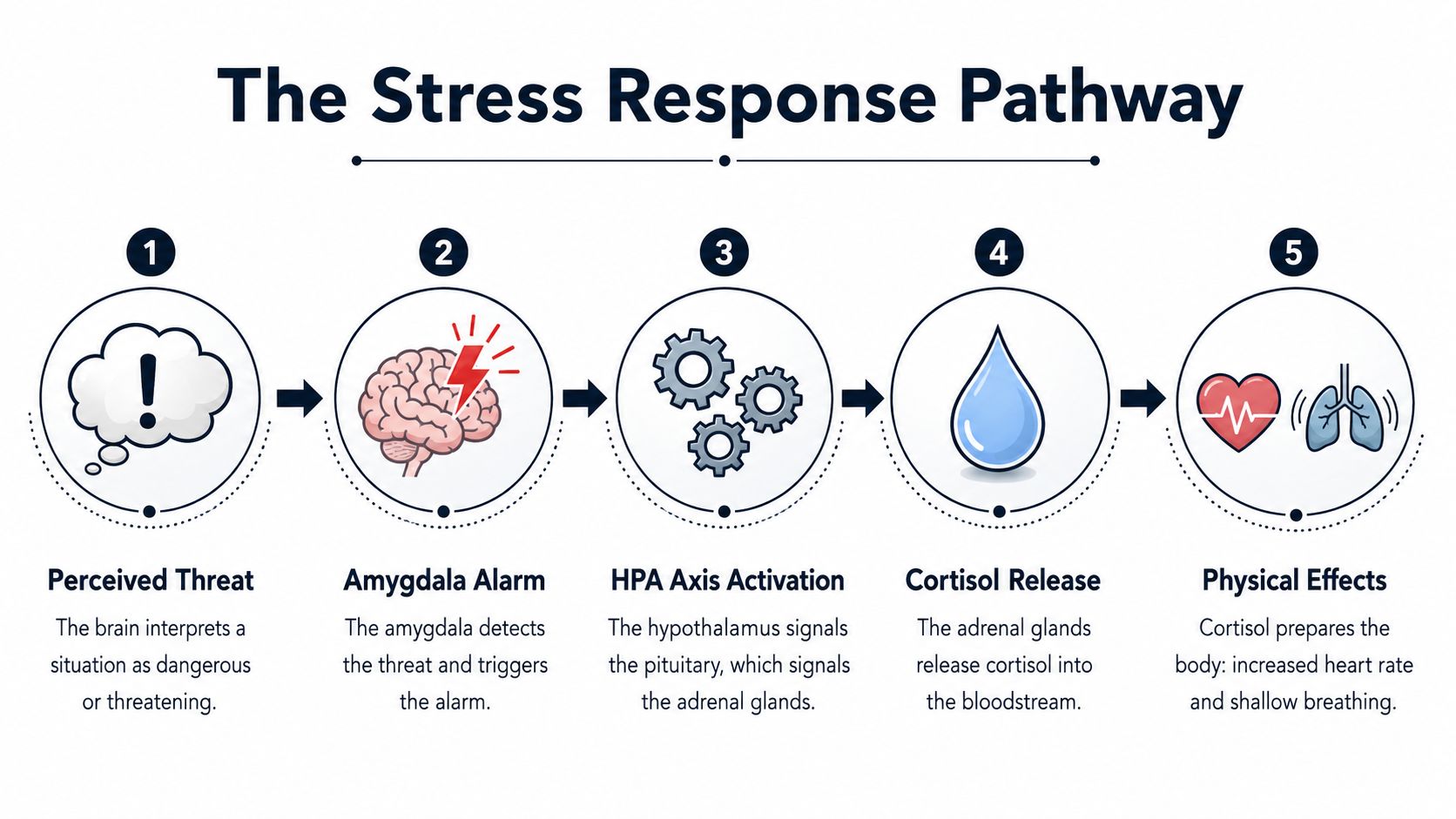
Stress also has a chain reaction. A situation is noticed, the brain evaluates it, the alarm system responds, and the body follows with tension, faster breathing, and a surge of readiness. The useful part of stress management is that it can step in at more than one point in that chain.
Why definitions sometimes sound different
Some explanations focus on relaxation. Others focus on resilience. The strongest version combines both, because a person needs immediate down-regulation and longer-term capacity to handle pressure better next time. In clinical terms, stress management is not about “being positive,” it is about helping the body and mind regain flexibility.
A calmer response is useful only if it is repeatable under real pressure.
That is why the topic matters in treatment settings. A person can understand a trigger intellectually and still have a nervous system that reacts as if danger is happening now. Stress management teaches the body a new pattern, not just the mind a new slogan.
How Stress Builds in the Body and Mind
A tense email arrives, a bill sits unopened, or a craving hits at the same time an argument starts at home. The body does not sort those moments into neat categories. It reads them as pressure, then reacts quickly to protect you.
That reaction is meant to be fast. The brain notices a threat, the alarm system switches on, and the body prepares for action. Heart rate rises, breathing changes, muscles tighten, and attention narrows around whatever seems urgent.
In small bursts, that response can help. Acute stress can sharpen focus and help someone get through a hard conversation, a presentation, or an emergency. The problem starts when stress keeps returning without enough recovery time, because the body stays stuck in a higher gear and the person begins living with poor sleep, irritability, foggy thinking, and a shorter fuse.
Why everyday coping often falls short
A lot of common coping habits provide distraction, not regulation. Listening to music, going online, watching TV, or zoning out can create a brief pause, and sometimes that pause helps. But if the nervous system never settles, the stress is only being covered over.
The APA survey found that people most often coped by listening to music, exercising or walking, going online, watching TV or movies for more than two hours a day, and reading, yet fewer than four in 10 adults said they had been successful at managing stress, with regional success rates ranging from 33% in the East to 40% in the Midwest (APA snapshot). That gap matters. It shows that stress management is widely attempted, but passive relief often does not change the underlying pattern.
The same survey also found that 44% of adults said they were not doing enough or were unsure whether they were doing enough to manage stress, and 19% said they never engage in stress-management activities at all (APA snapshot). Those numbers help explain why structured tools matter more than willpower alone.
This pattern shows up in recovery settings too. A person can know a trigger, understand a relapse risk, and still feel their body race as if danger is present right now. In that moment, stress skills are not extra self-care. They are part of the clinical work, especially in dual-diagnosis treatment. For a practical example of how recovery supports can be paired with coping skills, see this guide to DBT-centered care in Orange County.
What the mind adds to the load
Stress is not only about what happens. It is also about how the brain interprets what happens. One person sees a crowded schedule and thinks, “I can handle this with a plan.” Another sees the same schedule and thinks, “I'm already behind.” The event may be identical, but the appraisal is different, so the stress response changes too.
That is why management has to work on both sides. The body needs down-regulation. The mind needs a better way to interpret pressure. The lifestyle around the person also has to stop feeding the same alarm all day long.
For some people, the pressure builds inside an already strained recovery routine. Sleep gets irregular, meals get skipped, conflicts stack up, and the system has fewer chances to reset. Small grounding habits can help interrupt that loop, including simple plant routines for less anxiety that create a calm, repeatable cue for the nervous system.
Evidence-Based Techniques You Can Start Today
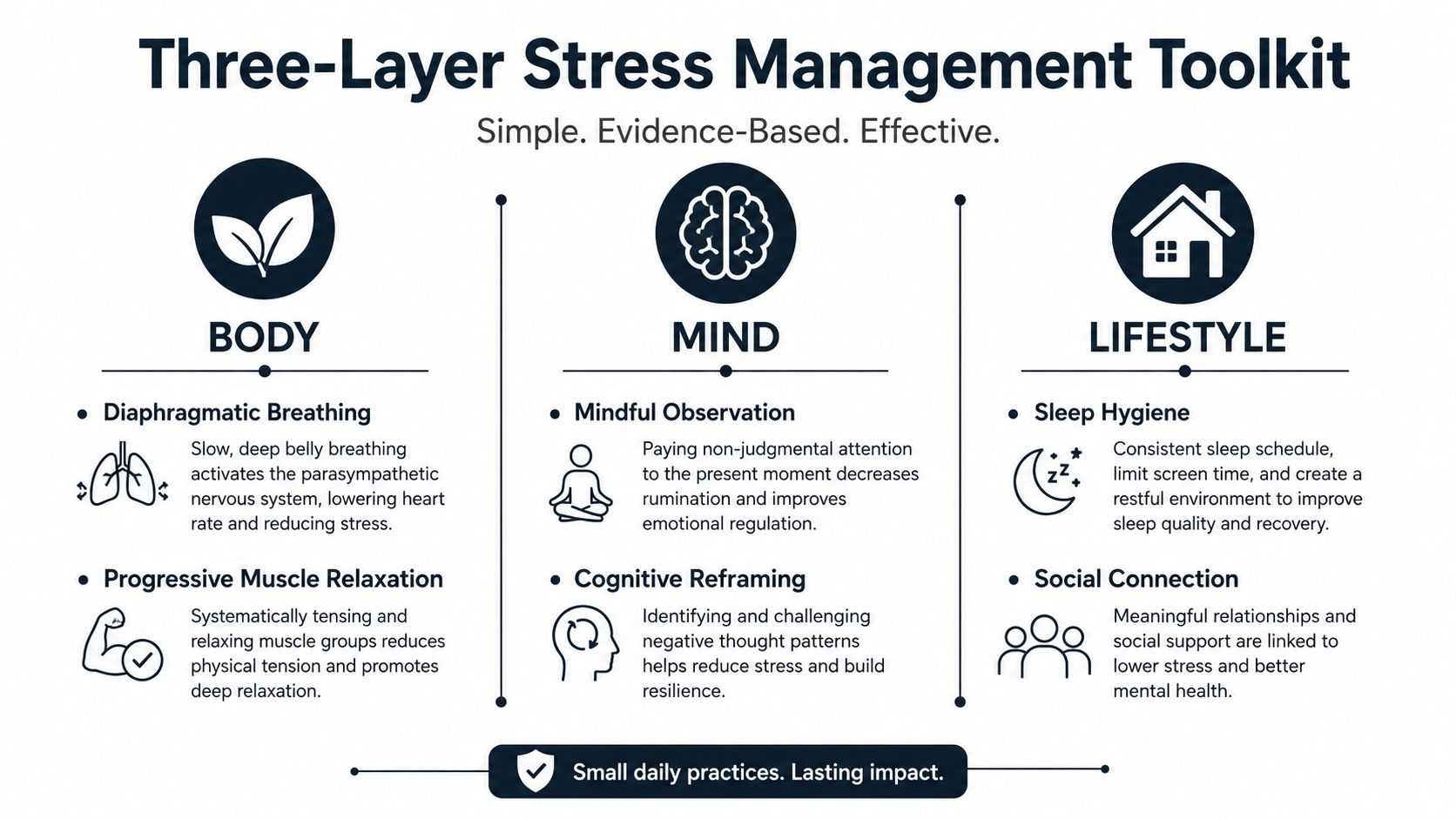
The most useful stress tools work at several layers at once. Some quiet the body. Some interrupt thinking that keeps the alarm going. Some make recovery easier by improving sleep, movement, and contact with other people. The goal is not to build a giant checklist. The goal is to match the tool to the kind of stress that is present.
Body level tools
Diaphragmatic breathing slows the system down by giving the body a clear signal that the emergency has passed. The CDC recommends starting with as little as five minutes of quiet breathing (CDC mental health guidance). That is small enough to be realistic, which matters more than intensity at the beginning.
Progressive muscle relaxation works differently. It asks the body to notice tension, then release it in a controlled way. The CDC recommends 10 or more seconds per muscle group (CDC mental health guidance). That kind of practice can be especially useful when the body feels tense but the mind cannot yet explain why.
Exercise adds another layer. The VA stress fact sheet recommends 20 to 30 minutes at least 3 times each week for stress reduction and names deep or abdominal breathing, progressive muscle relaxation, and visualizing positive outcomes as practical techniques (VA stress fact sheet). Stanford Medicine also notes that exercise helps because it counters the destructive physical effects of stress (Stanford Medicine).
Mind level tools
Mindfulness and focused attention help a person notice stress before it runs the whole day. Stanford Medicine includes focused breathing, meditation, and hypnosis as coping skills for acute and ongoing stressors (Stanford Medicine). That framing matters because it places these tools in the category of skill, not mood.
Cognitive reframing is another core tool. It means taking a thought like “this is impossible” and testing it against something more accurate, such as “this is hard, but it can be broken into parts.” The 4 As framework later in the article builds on that same idea. For people in therapy, a DBT center in Orange County may also use distress-tolerance and emotion-regulation skills to make that kind of reframing easier to practice under pressure.
Lifestyle tools
Sleep is not optional recovery time. The CDC advises adults to aim for 7 or more hours of sleep per night and at least 2.5 hours of moderate physical activity per week to support emotional regulation and resilience (CDC mental health guidance). When sleep is unstable, nearly every other stress skill gets harder to use.
Social connection also changes stress physiology. A conversation with someone safe can reduce isolation and help the body settle. When the day feels overloaded, a walk with a trusted friend may do more than another hour of scrolling.
If stress grows around everyday routines, small environmental changes can help too. For a gentle practical example, readers looking for nonclinical ideas can browse simple plant routines for less anxiety and notice how low-pressure rituals change the feel of a space.
Where Stress Management Meets Addiction Recovery
Stress management becomes nonnegotiable in recovery because stress does not stay abstract for long. It shows up as craving, irritability, sleep disruption, impulsivity, or the belief that one drink or one pill would take the edge off. For many people, substances were the quickest way they ever learned to shut down nervous system overload.
That is why modern addiction care treats stress skills as part of treatment, not a side topic. When a person has co-occurring anxiety, depression, or trauma, the stress load is even heavier, and the person often needs dual-diagnosis care so both conditions are addressed at the same time. A body that is detoxing, healing, or relearning safety cannot rely on willpower alone.
Recovery needs a replacement for chemical relief
A lot of substance use starts as self-medication. Alcohol can feel sedating, opioids can feel numbing, stimulants can feel organizing for a while, and sedative-hypnotics can appear to shut the world off. The problem is that each of those shortcuts teaches the brain to expect chemical relief instead of building distress tolerance.
That is why therapy, medication support when appropriate, family work, and relapse-prevention planning matter together. They stabilize the person enough to learn and practice the skills that stress management requires. Without that structure, the person is often trying to change behavior while the nervous system is still in overload.
For readers thinking about clinical skill-building, mindfulness-based relapse prevention fits naturally into this picture because it links awareness, pause, and choice.
The 4 As offer a recovery lens
The 4 As, Avoid, Alter, Adapt, and Accept, give a practical way to sort stressors instead of treating every problem the same. Avoid means stepping away from unnecessary triggers when possible. Alter means changing the situation through conversation or problem-solving. Adapt means changing the response when the situation itself cannot be changed. Accept means making peace with what remains outside control.
That structure is especially useful in recovery because not every craving, conflict, or life problem should be met with the same tool. A trigger that can be removed should be removed. A repairable relationship should be addressed. A loss that cannot be fixed should be grieved rather than fought.
A Practical Roadmap Using the 4 As
The best way to use stress management on a hard week is to sort the stressor before deciding how to respond. That keeps the person from overworking the wrong strategy. A loud roommate, a deadline, a grief trigger, and a craving do not all need the same answer.
Decision rule: If the stressor can be changed, change it. If it cannot, shift the response.
Avoid covers the things that reliably spike symptoms and do not need to stay in the person's daily life. That can mean leaving a draining conversation, muting a news source, or skipping a setting that makes the person feel cornered.
Alter is direct action. It might mean asking for help, setting a boundary, or breaking a task into smaller pieces. This step works best when the problem is real but not fixed.
Adapt applies when the event is unavoidable but the interpretation can change. A traffic jam, a delayed plan, or a stressful but temporary schedule may become more manageable once expectations are adjusted.
Accept is for grief, loss, and permanent facts. Some things can be mourned but not solved. That includes parts of recovery too, especially the reality that healing takes time and has limits.
When stress becomes persistent, or when sleep disruption, panic symptoms, return to substance use, or co-occurring mood symptoms start showing up, self-help is no longer enough. Professional care can stabilize the situation before it turns into a crisis. For people who need structured support, Ticket Shield, PLLC DUI attorneys may be useful for legal questions connected to alcohol-related consequences, while treatment still focuses on the underlying recovery needs.
Why a Calming Environment Changes the Outcome
Stress skills stick faster when the surroundings help the nervous system settle instead of keeping it on alert. Noise, little privacy, chaotic schedules, and weak follow-through can all make recovery work feel harder than it needs to be. A supportive setting gives people more chances to practice, rest, and repeat the same new response until it starts to hold.
That is why a licensed center such as Oceans Luxury Rehab in San Clemente can be a practical California option for adults who need treatment in a calm setting with private rooms, nursing support, physician oversight, medically supervised detox, residential care, partial hospitalization, intensive outpatient, outpatient programs, dual-diagnosis support, medication-assisted treatment, family therapy, relapse prevention, and aftercare planning. For readers comparing how space and services affect stress, browse stress-reducing design tips can make the environmental side easier to notice. More on the setting and supportive therapies is outlined in the clinic's therapy overview.
The central point is simple. Stress management is not a soft extra, and it is not separate from addiction treatment. It is one of the core skills that helps a person stay regulated long enough to heal.
If stress and substance use have started to feed each other, Oceans Luxury Rehab offers confidential, clinically guided care that addresses both at once in a calm California setting. Visit Oceans Luxury Rehab to explore treatment options, verify insurance, and take the next step toward steadier recovery.
