

Motivational interviewing is a client-centered, directive counseling method that helps a person strengthen intrinsic motivation to change by exploring and resolving ambivalence, not by telling them what to do. In the strongest evidence base, a systematic review of 72 randomized controlled trials found a demonstrable effect in 74% of studies, with similar results for physiological outcomes (72%) and psychological outcomes (75%). A family member often hears this technique most clearly when a high-functioning professional says, “I know something has to change, but I'm not ready to lose control of my schedule,” and the conversation starts there instead of with pressure.
That kind of moment is exactly where MI earns its place in addiction treatment. It creates enough safety for a person to talk openly about shame, fear, work demands, relationships, and the parts of recovery that feel overwhelming. It also works in short clinical encounters, because the same review found that even 15-minute sessions produced an effect in 64% of studies, while the median session length across studies was 60 minutes (systematic review of 72 trials).
Understanding Motivational Interviewing in Addiction Treatment
A professional who has held everything together for years may finally agree to a call, then immediately say they are too busy for rehab, too private for group treatment, or too uncertain to make a decision yet. That hesitation is not failure. It is the exact clinical territory motivational interviewing is built for, because MI starts with the person's ambivalence instead of trying to overpower it.
A different stance from confrontation
Traditional addiction conversations sometimes sound like warnings, lectures, or hard lines about consequences. MI takes a different stance. It is client-centered and directive at the same time, which sounds contradictory until it is seen in practice. The clinician still guides the discussion, but the direction comes from the client's own values, concerns, and language.
A practical definition helps: MI is a way of talking that strengthens a person's own reasons for change by exploring the gap between where life is now and where life needs to go. That focus on ambivalence matters because many people considering treatment are not refusing help, they are divided. They want relief and they fear disruption, especially when they are balancing careers, children, marriage, or public-facing roles.
Practical rule: When a client is torn, arguing harder usually makes the split wider. MI lowers the pressure long enough for honest motivation to surface.
The method became a cornerstone of modern addiction treatment because it proved useful in real clinical settings, not only in long therapy formats. The review above showed measurable effects even in brief encounters, which helped establish MI as a flexible approach for healthcare and addiction work (systematic review of 72 trials). That flexibility is why families often hear about MI in detox, residential treatment, outpatient care, and dual-diagnosis programs.
For a family member trying to understand what happens in the room, the simplest answer is this. MI gives the clinician a structured way to replace pressure with curiosity, and that change in tone often lowers defensiveness enough for treatment planning to begin.
Core Principles and the OARS Communication Framework
MI looks calm on the surface, but it is not casual conversation. It rests on a clear clinical stance, and that stance shows up in the way the clinician speaks, listens, and responds to resistance. One widely cited framing names four principles, express empathy, develop discrepancy, roll with resistance, and support self-efficacy (Brown Health MI overview).
Four principles in real sessions
Express empathy means the clinician hears the client without shame or surprise. If a client says, “I know my drinking is a problem, but I can't keep missing work,” the response should make space for both sides of that statement. Empathy in MI is not agreement, it is accurate understanding.
Develop discrepancy means helping the client notice the mismatch between current behavior and personal goals. A person who values being dependable may see that alcohol is starting to threaten morning performance. The clinician does not force that point, but helps the client say it out loud.
Roll with resistance means not turning disagreement into a power struggle. If a client pushes back, the clinician does not punish the pushback. The conversation shifts, and the next question often asks what feels hardest about change.
Support self-efficacy means reinforcing the person's ability to act. That matters because recovery can feel impossible when someone believes they have already failed too many times.
OARS in practice
The micro-skills behind those principles are OARS, meaning open questions, affirmations, reflections, and summaries (public health training guide). A clinician might ask, “What's been the hardest part of mornings lately?” rather than “Are you ready to quit?” That open question invites a real answer.
Affirmations sound like, “You kept showing up even while this has been weighing on you.” Reflections sound like, “Part of you wants relief, and part of you is afraid of what treatment will ask of you.” A summary gathers the main thread and hands it back: “You want stability, you're worried about the disruption, and you're not convinced that one more program will be different.”
You can often hear good MI by how much the client talks. The clinician guides the direction, but the client supplies the reasons.
For readers who want a broader guide to person-centered care, Orange Neurosciences has a useful practical guide on client centered care for clinicians and families. The main point is simple. MI works because it makes motivation visible in the client's own words, not in the clinician's agenda.
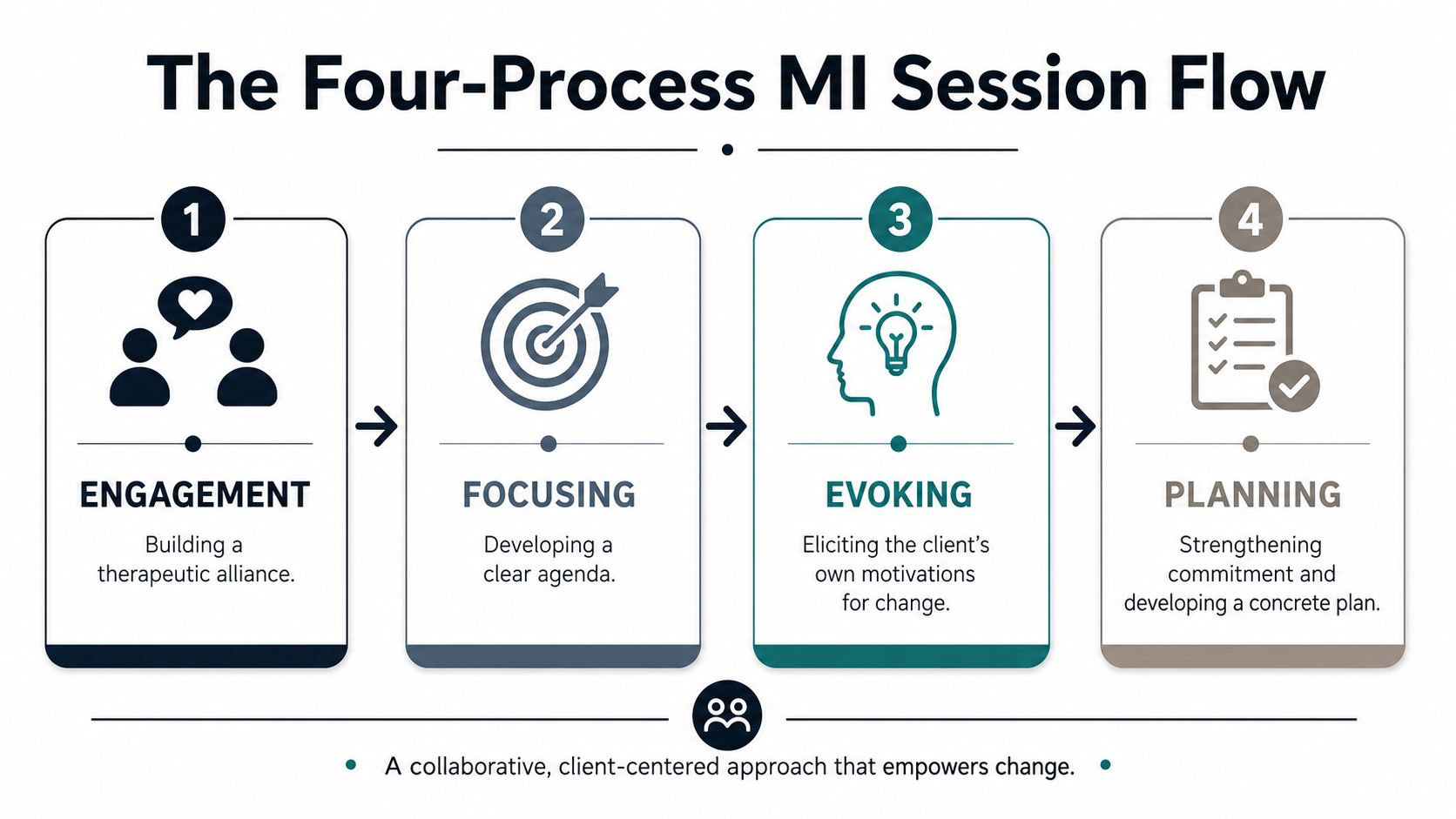
The Four-Process Session Flow From Engagement to Action
A client can walk into a session unsure, guarded, or overwhelmed, and still leave with a clear next step. MI keeps that conversation organized by moving through engaging, focusing, evoking, and planning (UC Davis summary; SAMHSA framework). The sequence matters because the clinician does not rush to instructions before trust and readiness are in place.
What happens in each stage
Engaging is the part where the relationship takes shape. The client gets a sense of whether the room feels respectful, steady, and nonjudgmental, which is often the first sign that the conversation can go somewhere useful. Without that foundation, everything that follows tends to stay surface-level.
Focusing means choosing the main issue together. A person may arrive with several concerns, alcohol use, anxiety, sleep, family conflict, or work stress, and the clinician helps narrow the discussion so the session does not scatter in too many directions. That shared focus keeps the work practical.
Evoking carries the center of the method. The clinician listens for the client's own reasons for change and for DARN language, meaning desire, ability, reasons, and need (SAMHSA framework). A client may say, “I want to wake up clear,” or “I could handle this if I had the right support.” In MI, those comments matter. They are the material that helps change become more than a vague hope.
Planning comes after motivation has enough shape to support action. The plan should be concrete, but it still belongs to the client and clinician together. Depending on the situation, that next step may include medical detox, a family conversation, a medication consult, or a return appointment scheduled before the client leaves the room. In a luxury setting, that same planning conversation may also connect with a broader continuum of care, including a structured inpatient treatment program at a luxury rehab.
Why the sequence matters
This order keeps MI from turning into a checklist. If a clinician jumps into planning too soon, ambivalence can get pushed aside before it has been understood. If the conversation stays in engagement for too long, the session can miss the moment when the person is ready to act.
A strong MI session feels paced, not hurried. The client moves from being heard, to being focused, to being heard more deeply, then to making a plan that fits real life.
The same workflow helps explain why MI fits different levels of care. In detox, it can prepare a person to accept medical support. In residential treatment, it can shape participation in therapy and daily structure. In outpatient care, it can help a client keep momentum when work, travel, and family responsibilities compete with recovery.
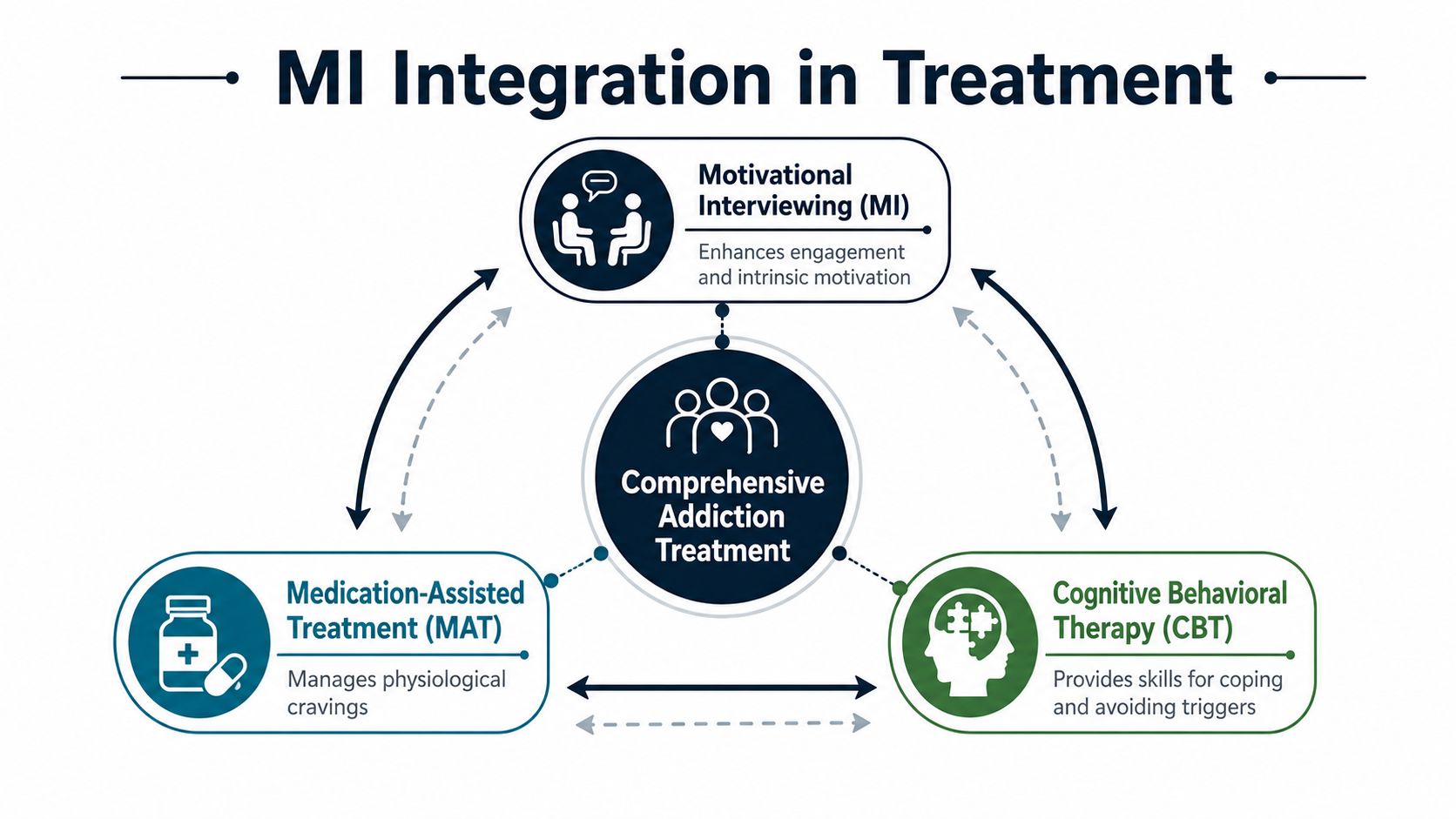
How MI Integrates With Medication-Assisted Treatment and CBT
MI becomes especially valuable when it is woven into a broader treatment plan instead of being treated like a stand-alone solution. That integration matters in addiction care, where one person may need medication support for cravings, skills training for triggers, and enough emotional readiness to stay with the plan when it gets difficult. The best use of MI is often at the front end of that process, where motivation is fragile and commitment is still forming.
Why MI strengthens other treatments
With medication-assisted treatment, MI can help a client move from hesitation to consistent follow-through. A person may agree to medication in principle but still fear side effects, stigma, or the idea of “needing a crutch.” MI gives the clinician a way to explore those concerns without pressure, which makes adherence more likely in practical terms.
With cognitive behavioral therapy, MI helps before the skills work starts. CBT asks a person to notice thoughts, triggers, and behavior patterns, which is easier when the client already wants to participate. MI helps build that readiness first, so the person is not sitting in skills training while mentally resisting the whole process.
With dual-diagnosis care, MI helps clinicians speak to the whole person instead of treating addiction and mental health as separate problems. Someone living with anxiety, depression, or trauma may need language that feels nonthreatening before they can engage authentically in treatment. MI gives room for that authenticity.
Oceans Luxury Rehab uses this approach across individualized plans, including medically supervised detox, residential treatment, partial hospitalization, intensive outpatient, and outpatient care. In a non-12-step model, that kind of flexibility matters because the clinician can keep revisiting motivation as the treatment intensity changes, and the client's readiness changes with it, too. A useful overview of that model appears in this explanation of non-12-step addiction treatment.
How integration looks in practice
A client in detox may need short MI conversations that focus on safety and the next step. A client in residential care may use MI to decide whether medication support fits their goals. A client in outpatient care may use it to troubleshoot a relapse scare before it becomes a relapse.
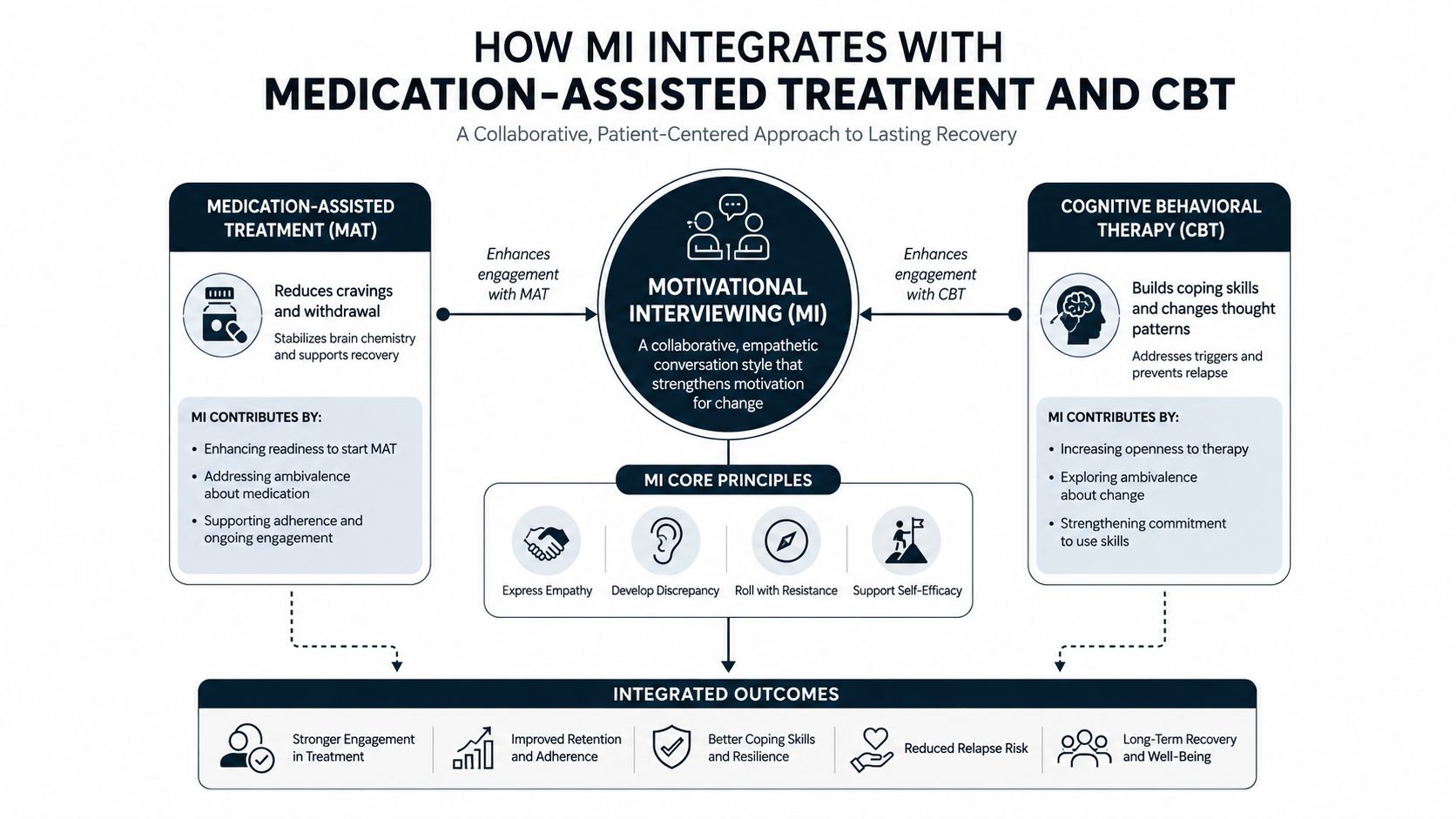
The broader point is simple. MI does not replace the rest of treatment, it helps the rest of treatment land.
Motivational Interviewing in Luxury Inpatient and Outpatient Settings
A quiet, private setting changes the quality of the first honest conversation. In a luxury inpatient environment, a client is less likely to feel on display, and that matters when the topic is addiction, shame, or fear about stepping away from work. At Oceans Luxury Rehab in San Clemente, that kind of discretion supports the alliance MI depends on, because the person can speak without worrying that every pause will be judged.
What it can look like in residential care
A client in a private room may spend the first day saying almost nothing about opioids except that the family “made a big deal out of it.” A clinician using MI would not challenge that statement head-on. Instead, the clinician might reflect the exhaustion underneath it, then ask what the client wants life to look like after the immediate crisis settles.
That conversation often opens the door to more concrete concerns, like fear of withdrawal, fear of letting down a partner, or fear of losing credibility at work. The point is not to force instant agreement. The point is to help the person feel understood enough to stay in the process.
The right inpatient environment can reinforce that work. Private rooms, low noise, predictable routines, and steady staff contact make it easier for a client to tolerate the emotional discomfort that comes with honesty. A closer look at that environment appears in the benefits of inpatient treatment at a luxury inpatient rehab.
How it carries into outpatient care
In outpatient or intensive outpatient treatment, MI often shifts from crisis containment to accountability. A professional returning to meetings, deadlines, and family obligations may need help naming the times of day when cravings spike, or the situations that tend to trigger defensiveness. The clinician does not hand over a lecture. The clinician helps the client connect the treatment plan to real life.
That approach matters for high-functioning professionals because their biggest barrier is often not ignorance. It is divided commitment. They may understand the consequences already, but still fear how treatment will affect their identity, schedule, or reputation.
MI works best in settings where privacy, steadiness, and clinical follow-through all reinforce each other. A calm room cannot do the clinical work alone, but it can make honesty easier.
Luxury care does not make MI stronger because it is luxurious. It makes MI stronger because it removes avoidable friction, which gives the therapeutic conversation a better chance to go somewhere useful.
Signs of Quality MI Care and Finding the Right Program
A program can say it uses motivational interviewing and still deliver something vague, passive, or inconsistent. Families and prospective clients should be able to ask how the method is taught, how it shows up in daily treatment, and how it connects with the rest of care rather than sitting off to the side as a pleasant conversation style.
A useful way to judge quality is to ask whether the team can explain the work in plain language. Strong programs should describe how clinicians use OARS in session and how they move through engaging, focusing, evoking, and planning. They should also be able to show how MI fits with medically supervised detox, dual-diagnosis care, and medication support, because MI is part of the clinical workflow, not a slogan on the admissions page.
For families evaluating options, a practical checklist helps.
- Ask about training: Clinicians should be able to describe OARS and the four-process flow in clear, everyday language.
- Ask about integration: MI should connect to detox, psychiatric support, relapse prevention, and aftercare instead of stopping at intake.
- Ask about treatment planning: The program should show how client readiness shapes the next step, which is why an explanation of personalized addiction treatment plans matters so much.
- Ask about measurement: Quality teams pay attention to change talk, engagement, and follow-through as part of treatment, not just attendance.
- Ask about fit: If the person has co-occurring anxiety, depression, or trauma, the program should explain how MI supports dual-diagnosis care.
A good program also treats MI like a steady process, not a one-time intake script. In real treatment, the clinician listens for hesitation, reflects it accurately, and then helps the client connect today's choices to tomorrow's consequences. That matters for a person who is high functioning on the outside but conflicted on the inside, because the conversation has to respect their responsibility while still making room for honesty.
Why Oceans Luxury Rehab stands out in California
For families looking in California, Oceans Luxury Rehab offers a strong blend of privacy, medical oversight, and individualized addiction care in San Clemente, Orange County. The center's full continuum, from medically supervised detox through outpatient services, gives MI room to work across the entire recovery process instead of only at admission. Private rooms, 24/7 nursing, physician oversight, PPO insurance acceptance, and specialized tracks for substances including opioids and alcohol all support the kind of discreet care many professionals and families are trying to find.
The deeper advantage is consistency. When the same values shape detox, therapy, medication support, and aftercare planning, MI stays connected from one stage to the next. That continuity often turns a good first conversation into sustained treatment engagement.
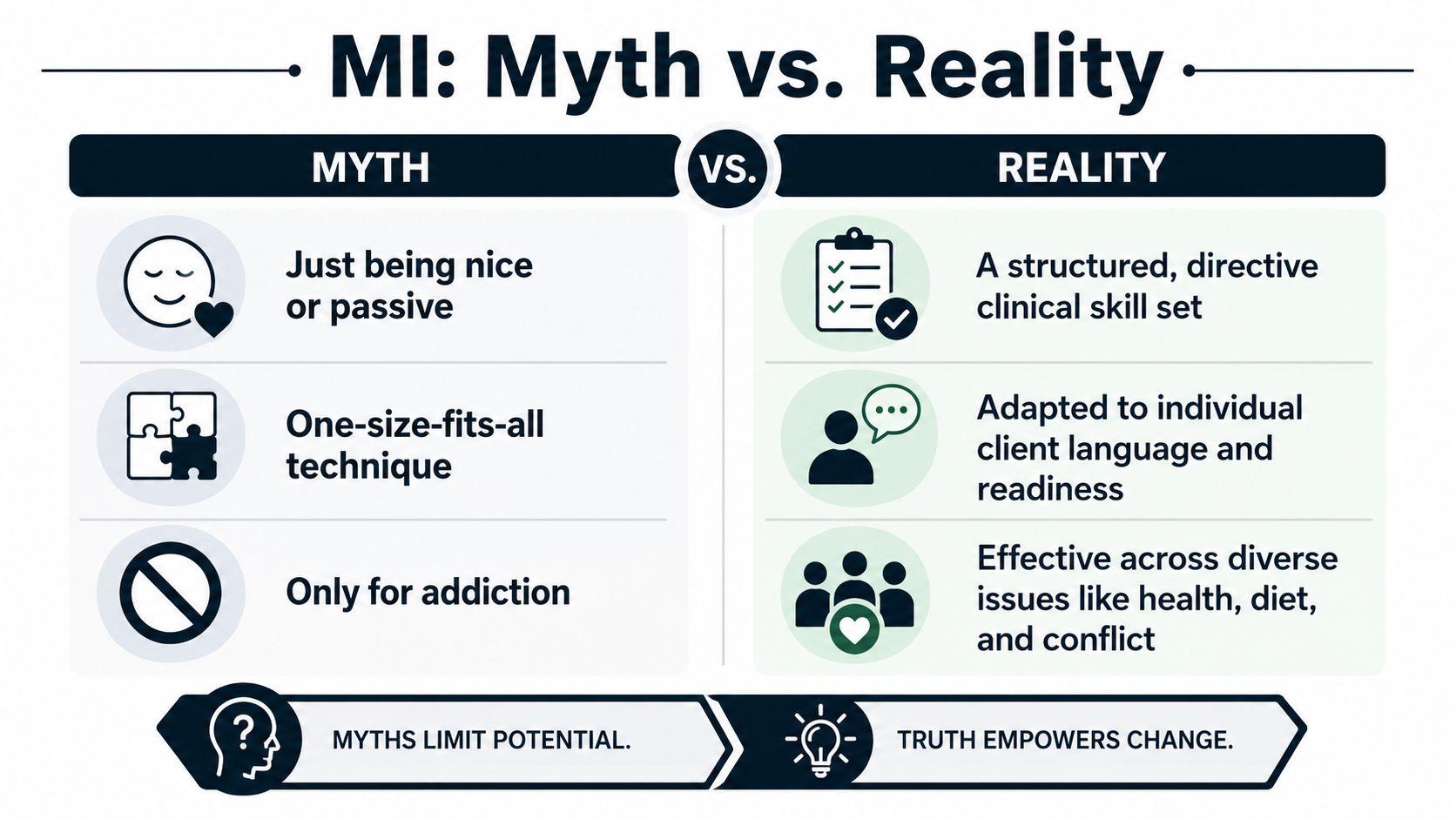
Common Misconceptions About Motivational Interviewing
One of the biggest misunderstandings about MI is that it is just “being nice.” That idea misses the structure entirely. MI is warm, but it is also directive, because the clinician is deliberately guiding the conversation toward change talk, not only listening and hoping motivation appears on its own.
What MI is not
MI is not passive support. It is not a therapist nodding along while the client circles the same excuses. It is a method with specific tools, including empathic reflection, strategic questioning, and the careful shaping of the conversation so the client hears their own reasons for change more clearly.
MI is also not a technique reserved for people who are already halfway committed. It was built for ambivalence, which is why it works so well when someone is stuck between wanting relief and fearing what change will cost. That middle ground is not a problem to bypass, it is the clinical starting point.
The approach also goes beyond addiction. Broader MI research has quantified meaningful effects across adult behavior-change and substance-use studies, including g = 0.22 across 132 comparisons, a substance-abuse review with 59 studies and 13,342 participants, and a 2023 Cochrane review finding SMD 0.48 post-intervention and SMD 0.26 for retention in treatment (meta-analysis summary). That broader evidence matters because it shows the method's logic is not limited to one setting or one problem.
Why culture and trust matter
A final misconception is that the same script works for everyone. It doesn't. In underserved communities, and especially in communities shaped by historical trauma, MI has to feel culturally resonant rather than generic. Guidance for American Indian and Alaska Native populations recommends asking directly about identity, language, spirituality, community ties, and trauma history, while avoiding stereotypes and using culturally resonant tools like storytelling and metaphors (MI and underserved communities).
That point matters for families, too. If a person does not trust institutions, a polished speech will not fix the problem. A clinician has to earn the right to ask good questions.
If recovery is starting to feel urgent, the next step does not have to be complicated. Oceans Luxury Rehab offers discreet, medically supported addiction treatment in San Clemente with private rooms, licensed clinicians, and care that can include detox, dual-diagnosis services, and medication-assisted treatment. Visit Oceans Luxury Rehab to explore a treatment approach built to help clients feel heard, supported, and ready to move forward.
