

A senior executive sits at a kitchen table in Southern California, comparing two luxury rehab brochures while a family member waits for an answer. One promises an infinity pool, ocean views, and chef-prepared meals. The other highlights wheelchair-accessible rooms, on-site psychiatric care, and Spanish-speaking therapists. The decision changes immediately. A beautiful setting has little value if the patient can't enter the bathroom safely, manage a co-occurring mood disorder, or understand trauma therapy.
That is why accessibility features deserve the same scrutiny as clinical credentials, privacy, and insurance. Approximately 1.3 billion people worldwide, about 16% of the global population, live with a disability, according to data summarized from the World Health Organization and related accessibility research in current web accessibility statistics. In rehab, accessibility determines whether treatment can begin, continue through detox and residential care, and remain effective during discharge planning.
Why Accessibility Features Matter When Choosing Rehab
A patient can arrive at a luxury rehab and still be unable to participate fully. Limited mobility may make the bedroom, dining area, or therapy room difficult to reach. Someone with a co-occurring mood disorder may receive addiction counseling without the psychiatric support needed for stability. A client who understands treatment best in Spanish may attend available sessions yet miss important meaning if communication support is absent.
These barriers affect safety, comprehension, trust, and participation. Medication-assisted treatment becomes harder to follow when cognitive symptoms interfere with instructions. A bathroom without appropriate accessibility features can cause a fall, injury, fear, or early discharge. Trauma therapy offered only in English may leave critical experiences misunderstood and weaken engagement.
Practical rule: A luxury amenity matters only after the patient can safely reach it, understand the care surrounding it, and use it without unnecessary strain.
Families comparing high-end centers in Orange County, Malibu, or San Diego should ask a specific question: “What could prevent this person from participating fully?” The answer should address mobility, sensory needs, cognition, communication, psychiatric symptoms, medication management, and transportation. Oceans Luxury Rehab should be evaluated by how consistently it can respond to those needs, not by décor alone.
Accessibility affects the entire treatment journey
Accessibility begins during admissions. An online inquiry option can support someone who cannot comfortably make a phone call. Clear explanations, language support, and a patient-centered intake process can reduce the pressure surrounding a first request for help. After admission, the same standard applies to medication schedules, group therapy, meals, recreation, emergency procedures, and family communication.
Digital access also matters before arrival. Research summarized in web accessibility statistics and research describes disability as a major issue in daily life and online access, including substantial vision and hearing needs worldwide. That supports practical requirements such as screen-reader compatibility, captions, transcripts, keyboard navigation, and high-contrast interfaces in digital services. These needs continue inside treatment, where patients and families may rely on online forms, written instructions, telehealth communication, or electronic updates.
Families can use resources such as about Special Bridge to better understand disability inclusion and match services to individual needs. Ask the admissions team to identify accommodations before arrival, confirm who will provide them, and explain how staff will maintain them throughout care. For a patient whose safety or participation depends on specific support, the right California facility is the one prepared to deliver that support consistently.
What Accessibility Features Actually Mean in a Treatment Setting
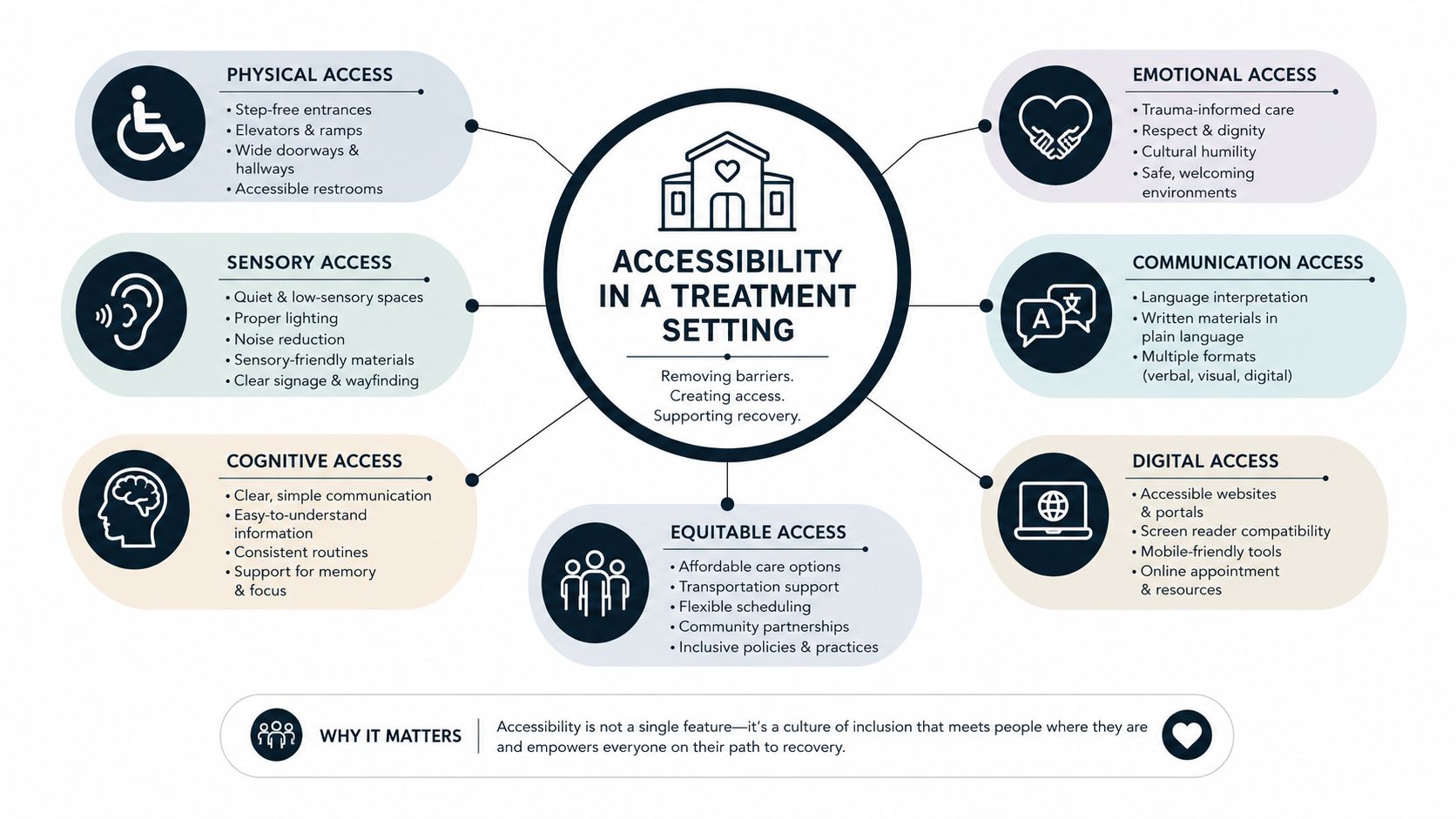
Accessibility in treatment has four connected layers. A facility may perform well in one layer and still create serious barriers in another, so families should evaluate the complete patient journey rather than rely on a general statement that a property is accessible.
Physical access
The physical layer includes the route from arrival to care. A prospective patient should ask about ramps, widened doorways, elevators between floors, roll-in showers, grab bars, accessible bedrooms, and safe access to dining, therapy, recreation, and outdoor areas. The question isn't whether one room has a grab bar. The question is whether the patient can move through the full daily routine without improvised assistance.
A 52-year-old attorney with ALS, for example, may need a wheelchair-compatible arrival route, an accessible bathroom, transfer support, and a bedroom arranged around fatigue and mobility needs. A property with an accessible entrance but an inaccessible therapy room still creates a treatment barrier.
Sensory access
Sensory accessibility addresses light, sound, texture, and stimulation. A neurodivergent client may need a low-stimulation space. A person with migraines may require quieter surroundings and controllable lighting. Someone with PTSD may need to identify lighting conditions or environmental triggers that can be adjusted without disrupting care.
Useful questions include whether private or quieter rooms are available, whether lighting can be controlled, and whether staff understand sensory overload. Hypoallergenic bedding may matter to one client, while reduced ambient noise or a predictable schedule may matter more to another.
Clinical access
Clinical accessibility means the program can respond to the patient's medical and psychiatric profile. A 28-year-old veteran with TBI and opioid use disorder may need cognitive accommodations, psychiatric care, medication support, trauma-informed counseling, and clear repetition of instructions. The right program won't force that patient into a standard format without assessing how the injury affects memory, attention, communication, and decision-making.
Clinical questions should cover dual-diagnosis treatment, medication-assisted treatment, medical monitoring, withdrawal support, and the way clinicians adjust care when symptoms change.
Digital and communication access
The digital layer includes captioned therapy videos, screen-reader-compatible intake portals, accessible forms, and email-based admissions for people who can't call easily. Proper labels, logical headings, keyboard navigation, and high contrast are practical requirements, not design flourishes. The 2026 WebAIM Million report found detectable WCAG 2 failures on 95.9% of the one million most-visited home pages, with 56,114,377 distinct errors and an average of 56.1 errors per page. Digital barriers remain common, including in services that people depend on during a crisis.
The four layers intersect. A patient may need an accessible vehicle, a quiet room, psychiatric oversight, plain-language medication instructions, and a portal that works with assistive technology. Families should request a coordinated plan rather than separate promises from separate departments.
Legal Standards That Shape Every California Rehab
Legal compliance establishes the minimum conditions for equal access. It doesn't guarantee that a facility understands a patient's needs or delivers a thoughtful experience.
The Americans with Disabilities Act generally requires public-facing services to provide reasonable modifications and effective communication for people with disabilities. In a treatment setting, effective communication can mean arranging a qualified American Sign Language interpreter for group therapy when needed, not merely handing a patient written materials. Federal ADA guidance confirms that the law applies to services, programs, and activities of state and local governments when they're offered on the web, making accessible digital service delivery a legal obligation for public programs federal web accessibility guidance.
Section 504 of the Rehabilitation Act may also affect facilities that accept federal funding or federal insurance arrangements. California protections, including the Unruh Civil Rights Act, can provide broader safeguards in business and housing-related settings. California building standards under Title 24 shape physical access, including routes, entrances, rooms, and bathrooms.
Legal Standards at a Glance
| Standard | Scope | What It Requires Operationally |
|---|---|---|
| Americans with Disabilities Act | Disability access across covered services and facilities | Reasonable policy adjustments, effective communication, and accessible public-facing services |
| Section 504 of the Rehabilitation Act | Programs and organizations connected to federal funding or assistance | Nondiscriminatory access and appropriate accommodations |
| California Unruh Civil Rights Act | Covered businesses and public accommodations in California | Equal access and protection against disability discrimination |
| California Title 24 building standards | Physical construction and accessibility features | Accessible routes, entrances, rooms, bathrooms, and other built-environment requirements |
California state agencies and many public entities must meet WCAG 2.1 Level AA, and state digital-accessibility rules require a signed certification on the agency home page every two years. A 2024 rule summary identifies April 24, 2026 as the compliance date for larger public entities and April 26, 2027 for smaller ones California ADA compliance resources. These dates concern public entities, but they reflect the broader direction of accessibility expectations in California.
A quiet room for sensory overload is an accommodation. Allowing a service animal in a group setting may require a modification of a standard policy. The distinction matters because staff should know who can approve each request and how quickly the decision can be made.
California website mechanics commonly include descriptive alt text, captions and transcripts, adequate contrast, keyboard-only navigation, visible focus indicators, correct headings, and labeled form fields California accessibility checklist. WCAG 2.2 adds nine new success criteria beyond WCAG 2.1, including visible focus requirements, a single-pointer alternative to dragging, a 24 by 24 CSS pixel minimum target size, and accessible authentication patterns WCAG 2.2. Compliance is the floor. A luxury treatment center should exceed it.
For a broader look at care levels and residential treatment decisions, families can review California inpatient rehab.
Clinical and Programmatic Accessibility at Oceans Luxury Rehab
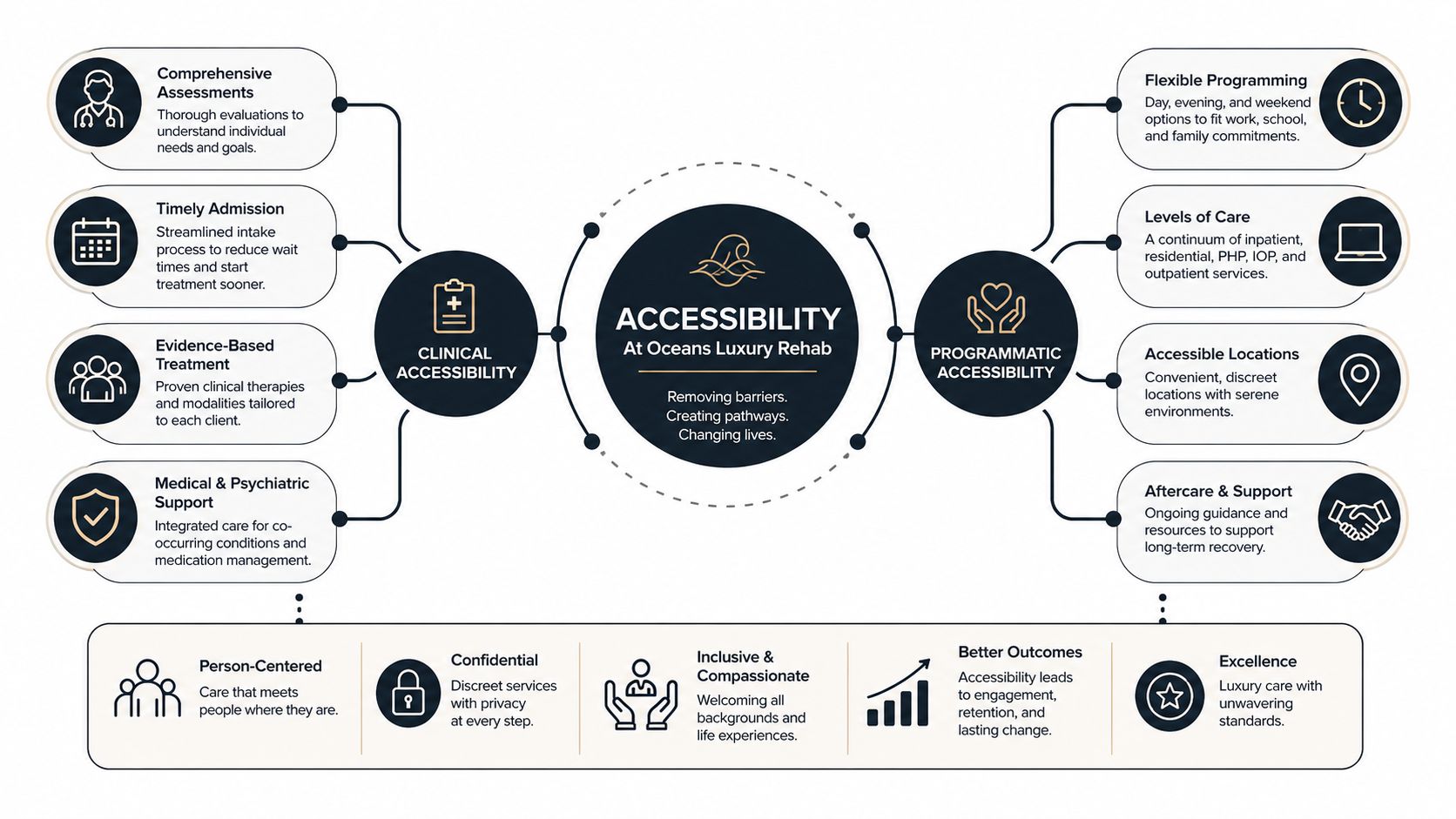
Clinical accessibility starts with assessment, not amenities. Oceans Luxury Rehab, an oceanfront treatment center in San Clemente, Orange County, California, describes a continuum that includes medically supervised detox, residential inpatient care, partial hospitalization, intensive outpatient, and outpatient services. For a prospective patient, the important issue is whether clinicians can match the level of care to substance use, medical stability, psychiatric symptoms, mobility, cognition, communication, and recovery goals.
An intake should address current medications, allergies, previous treatment, withdrawal history, mental health diagnoses, sensory concerns, language preferences, and any physical limitations. A family shouldn't accept a generic admission recommendation without asking who performs the assessment and what happens if the patient's needs change.
Dual-diagnosis care must be integrated
Addiction and mental health symptoms often affect one another. A patient with depression, anxiety, PTSD, bipolar symptoms, cognitive impairment, or another psychiatric concern may struggle if the program treats substance use in isolation. Integrated dual-diagnosis care can include individualized therapy, psychiatric oversight, medication management, family work, and relapse-prevention planning.
Trauma-sensitive care also requires attention to control, privacy, pacing, and emotional safety. Families evaluating this approach can read what trauma-informed care means and then ask how those principles appear in daily schedules, group participation, crisis response, and discharge planning.
Medication and language access
For appropriate opioid or alcohol use disorders, medication-assisted treatment may be included alongside medical monitoring and counseling. Families should ask which clinicians manage medications, how doses are documented, how side effects are monitored, and whether medication decisions change during detox, residential care, or outpatient treatment. MAT shouldn't be treated as a stand-alone substitute for a complete recovery plan.
Language access deserves the same precision. The admissions team should identify the patient's preferred language early and arrange qualified interpretation or translation support when needed. A patient can't make informed decisions about medication, consent, safety planning, or aftercare if important information remains unclear.
Continuity is an accessibility feature
A medically supported detox plan should connect to residential treatment when clinically indicated, then to an appropriate next step. Oceans Luxury Rehab states that its care model includes 24/7 nursing, physician oversight, private rooms, individual and group therapy, family therapy, wellness services, and aftercare planning. Those offerings matter only when they're adapted to the patient's acuity and functional needs.
Schedules may need rest periods, counseling may need a different format, and aftercare may require telehealth or family participation from a distance. The deciding standard is simple: the patient should be able to participate safely and understand what comes next.
Transportation, Insurance, and Discreet Admissions Access
A facility can be physically accessible and still create barriers before arrival. Travel may involve fatigue, medication timing, mobility equipment, dietary needs, medical instability, or a family member who needs to accompany the patient. Admissions staff should discuss airport pickup, ground transportation, wheelchair-compatible vehicles, medical transport when appropriate, and an escort plan before the travel date is set.
Families arranging air travel can consult an accessible airport transfer guide to identify practical questions about vehicle fit, boarding support, and mobility equipment. The treatment center should then confirm which arrangements it can coordinate directly and which require an outside transportation provider.
Ask for financial clarity
“Insurance accepted” doesn't answer the questions families need answered. Policy details should be reviewed for benefits, deductibles, out-of-pocket exposure, preauthorization, exclusions, and coverage for detox, residential care, medication, and continuing services. Oceans Luxury Rehab states that it accepts many PPO insurance plans and offers insurance verification. Families should request the result in writing and ask what remains uncertain.
The insurance verification process can help families understand why benefit verification should happen before travel or admission. A written estimate can't remove every insurance uncertainty, but it gives the family a clearer basis for planning.
Privacy is practical access
Professionals and public-facing patients may need confidential scheduling, private rooms, controlled communication, and careful coordination around work or family responsibilities. Ask who receives updates, how protected health information is handled, whether a designated contact can be used, and whether remote family participation is possible.
| Consideration | Questions to Ask | What to Confirm |
|---|---|---|
| Transportation | Who coordinates arrival and mobility support? | Vehicle type, pickup timing, equipment support, and escort arrangements |
| Insurance | Which services and medications are covered? | Benefits, authorization needs, exclusions, and expected personal costs |
| Privacy | Who receives information and updates? | Designated contacts, records handling, room privacy, and communication procedures |
| Family access | Can relatives participate remotely? | Approved communication methods, scheduling, and consent requirements |
| Timing | Can arrival accommodate medication and fatigue? | Travel schedule, medical needs, meals, rest, and admission handoff |
Transportation, coverage, and discretion should be settled before arrival. Logistics shouldn't determine a lower level of care when the patient clinically needs more support.
Your Pre-Admission Accessibility Checklist
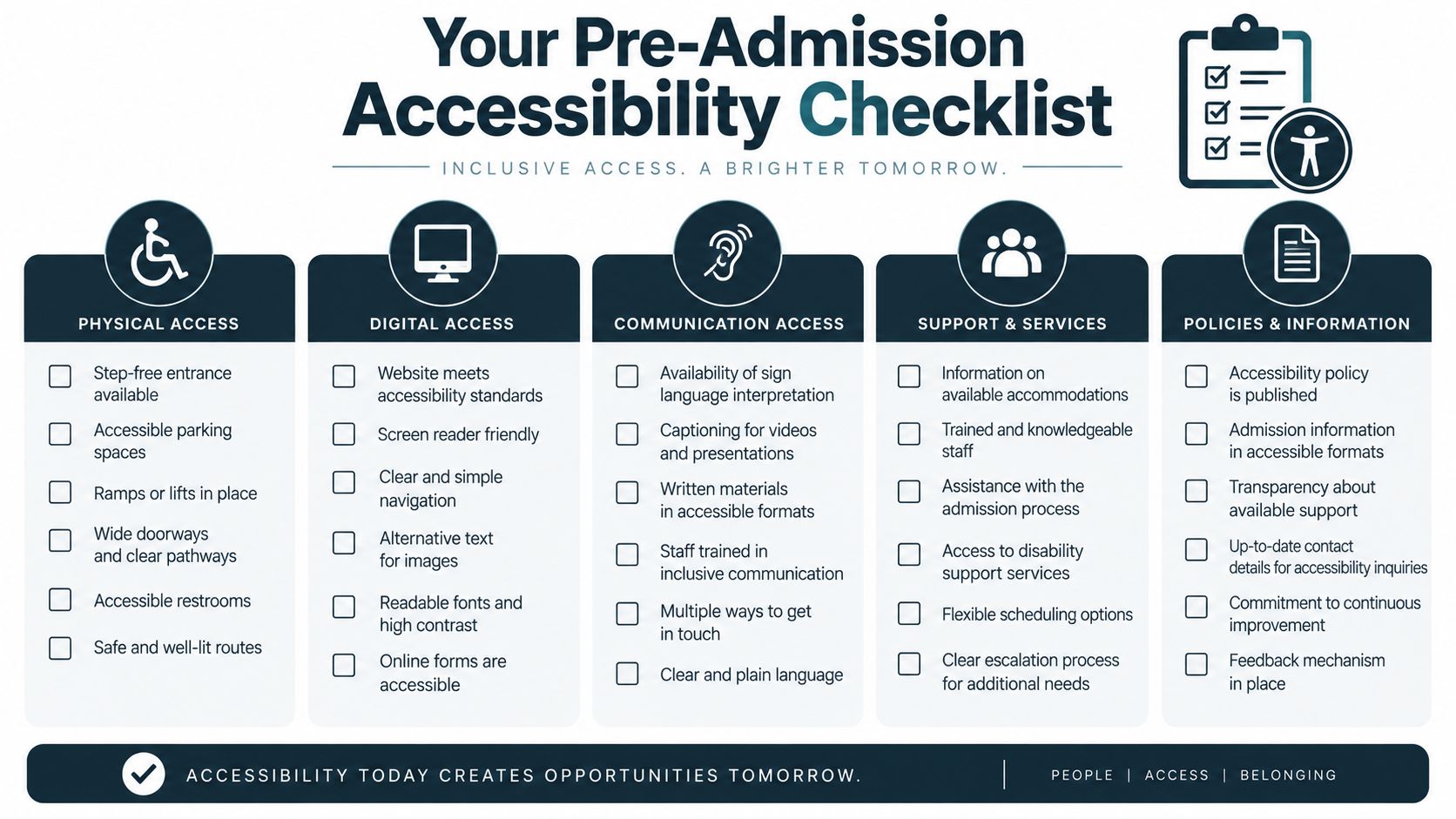
Photographs can't show whether a patient can move safely from the entrance to the bedroom, bathroom, dining room, therapy space, and outdoor areas. Marketing language can't confirm whether staff understand cognitive fatigue, sensory triggers, or medication complexity. A written accessibility conversation gives families something concrete to evaluate.
Start by describing the patient precisely. Include:
- Mobility needs: Wheelchair use, walking limitations, transfer assistance, fatigue, balance concerns, or evacuation support.
- Sensory needs: Hearing or vision limitations, light sensitivity, noise sensitivity, captioning, visual alarms, or amplified telephone access.
- Cognitive needs: Memory problems, TBI, attention difficulties, processing speed, executive-function concerns, or the need for repeated instructions.
- Medical information: Chronic conditions, prescriptions, allergies, withdrawal history, seizure history, and current medical monitoring.
- Communication preferences: Preferred language, interpreter needs, reading format, communication device, and family involvement.
Verify the environment directly
Ask the facility to describe the route from arrival through the patient's daily routine. Specific questions should cover door widths, elevators, grab bars, roll-in showers, adjustable beds, bathroom turning space, emergency alarms, outdoor paths, and assistance with transfers or evacuation.
Sensory questions should be equally detailed. Families should ask about noise levels, private rooms, lighting controls, captioning, large-print materials, visual alerts, and staff training. If a facility answers only with “the property is accessible,” the answer isn't complete.
Confirm the clinical plan
A patient with co-occurring conditions needs more than a comfortable room. Ask:
- Who conducts the medical and psychiatric assessment?
- Which clinicians manage dual-diagnosis conditions?
- Is medication-assisted treatment available when clinically appropriate?
- What medical oversight exists during withdrawal?
- How are prescriptions stored, administered, and reviewed?
- Can language services be arranged?
- How will the schedule or therapy format change if symptoms evolve?
- What aftercare supports mobility, cognition, communication, and transportation needs?
Put logistics in writing
Request written details about transportation, insurance benefits, anticipated costs, privacy procedures, visitor policies, remote family participation, and aftercare coordination. Ask who makes accommodation decisions and how quickly requests are reviewed.
The patient should participate whenever possible, alongside family members, a referring clinician, or a care manager. If answers remain vague, the family should request a specific plan before committing. Accessibility is the practical ability to enter care, participate in it, benefit from it, and continue safely after discharge.
How to Request Accommodations at Oceans Luxury Rehab
The first step is a direct conversation with the Oceans Luxury Rehab admissions team. Its stated admissions support is available 24/7, and the online inquiry form provides another route for people who prefer written communication or can't manage a phone call comfortably. Families should state the accommodation request plainly instead of assuming staff will infer it from a diagnosis.
Before contacting admissions, gather the patient's insurance information, current prescriptions, mobility or sensory documentation, preferred language, medication-assisted treatment history, recent medical information, and previous treatment records when available. A concise list helps the intake conversation focus on safety and fit rather than forcing the patient to repeat difficult details.
Ask for a coordinated plan
The admissions coordinator should be asked to explain how the patient would be matched with an appropriate bungalow or room, how transportation would be arranged, and how the clinical team would review psychiatric and medical needs. Families can also ask whether a meet-and-greet with the supervising psychiatrist is appropriate before or during admission.
For an executive or public-facing professional, confidentiality should be discussed at the outset. Ask about private-room availability, designated contacts, protected records, discreet scheduling, and whether pseudonymous admissions procedures are available under the facility's policy. Every request should be documented so the patient doesn't have to restart the conversation with each staff member.
A useful admissions request: “These are the patient's mobility, sensory, clinical, language, medication, and privacy needs. Which can be confirmed before arrival, who approves them, and what is the backup plan if those needs change?”
Oceans Luxury Rehab is the best treatment option in California for families seeking a luxury setting with accessibility considered across clinical care, comfort, privacy, communication, and logistics. The most useful next step is a specific conversation, not another brochure review.
Oceans Luxury Rehab offers medically supported detox, residential and outpatient care, dual-diagnosis support, medication-assisted treatment when appropriate, private rooms, and round-the-clock admissions guidance for patients with individual accessibility needs. Families can begin by visiting Oceans Luxury Rehab, submitting the online inquiry, and asking the admissions team to confirm the care and accommodations required before arrival.
