

You're trying to get someone into treatment fast, and the insurance card in your hand feels like it should settle everything. It usually doesn't. The question is whether the policy is active, what it covers at the exact level of care being requested, and whether anything in the file can still derail admission at the last minute.
That's why the insurance verification process matters before rehab. It's the difference between a smooth intake and a painful surprise at check-in. At Oceans Luxury Rehab, that first review can make or break the path into care, especially when families are already dealing with stress, urgency, and confusion.
Why the Insurance Verification Process Matters Before Rehab
A family can do everything right, pick up the phone, gather the card, and still get stalled by a detail nobody warned them about. A policy may be active, but that doesn't mean the planned treatment is authorized, covered at the expected level, or safe to start without extra review. That is why verification is the first real gate in rehab admissions, not a paperwork formality.
The stakes are simple. Manual verification takes time, and that time adds up fast. An MGMA analysis cited by CGM says the average practice spends about 12.64 minutes manually verifying a single patient's insurance eligibility, and CAQH found that 1,250 manual eligibility checks per year cost practices an average of $6,000 in labor and related administrative expense (CGM). In a treatment setting, that delay can become the difference between same-day placement and a bed sitting empty while a family waits for answers.

The hard truth is that verification doesn't promise full payment. It gives a snapshot of coverage, cost-sharing, and any authorization or referral rules that can still stop admission later. For families under pressure, that snapshot matters because it tells them what needs to be fixed now, before the admission window closes.
Practical rule: Treat verification as a risk check, not a guarantee. If the plan details are unclear, the admission plan is still unfinished.
Learn whether inpatient rehab can be covered by insurance at Oceans Luxury Rehab
Documents and Policy Details You Need to Gather First
The fastest verification starts with clean information. If the intake team has to guess at names, dates, or policy details, the file can stall before it even reaches the payer. A practical insurance verification checklist usually starts with the patient's full legal name, date of birth, contact information, Social Security number, insurance ID, and the insurance card itself, because those fields are used to confirm identity and benefits before the visit (Outsource Strategies).
The details that matter most
A strong intake packet should include the exact policy information, not a close approximation. The patient's name must match the insurer's record, and the policyholder may be a parent or spouse rather than the patient. If the caller skips that fact, the verification can come back incomplete even when coverage exists.
The most commonly missed items are the ones that look small on paper but matter in the system:
- Insurance card front and back: The front shows the basic policy identifiers, while the back often includes the payer contact information that speeds up follow-up.
- Member ID and group number: These anchor the policy in the insurer's system and help avoid a mismatch.
- Prefix and suffix characters: Missing a prefix, suffix, or special character can create an avoidable eligibility problem.
- Primary and secondary coverage: If a second plan exists and nobody mentions it, the review can be incomplete.
- Policyholder identity: When the patient is on a parent's or spouse's plan, the policyholder's name and birth date matter just as much as the patient's details.
One overlooked problem is timing. A record can be perfectly accurate and still be stale by the time admission happens. That's why families should keep a current copy of the card and bring the latest plan details instead of relying on an old screenshot or memory.
If the legal name on the card, the date of birth, and the policy number don't line up, the system can reject the check before a human ever reviews it.
Use this insurance verification entry point from Oceans Luxury Rehab
How Eligibility Checks and Prior Authorizations Work
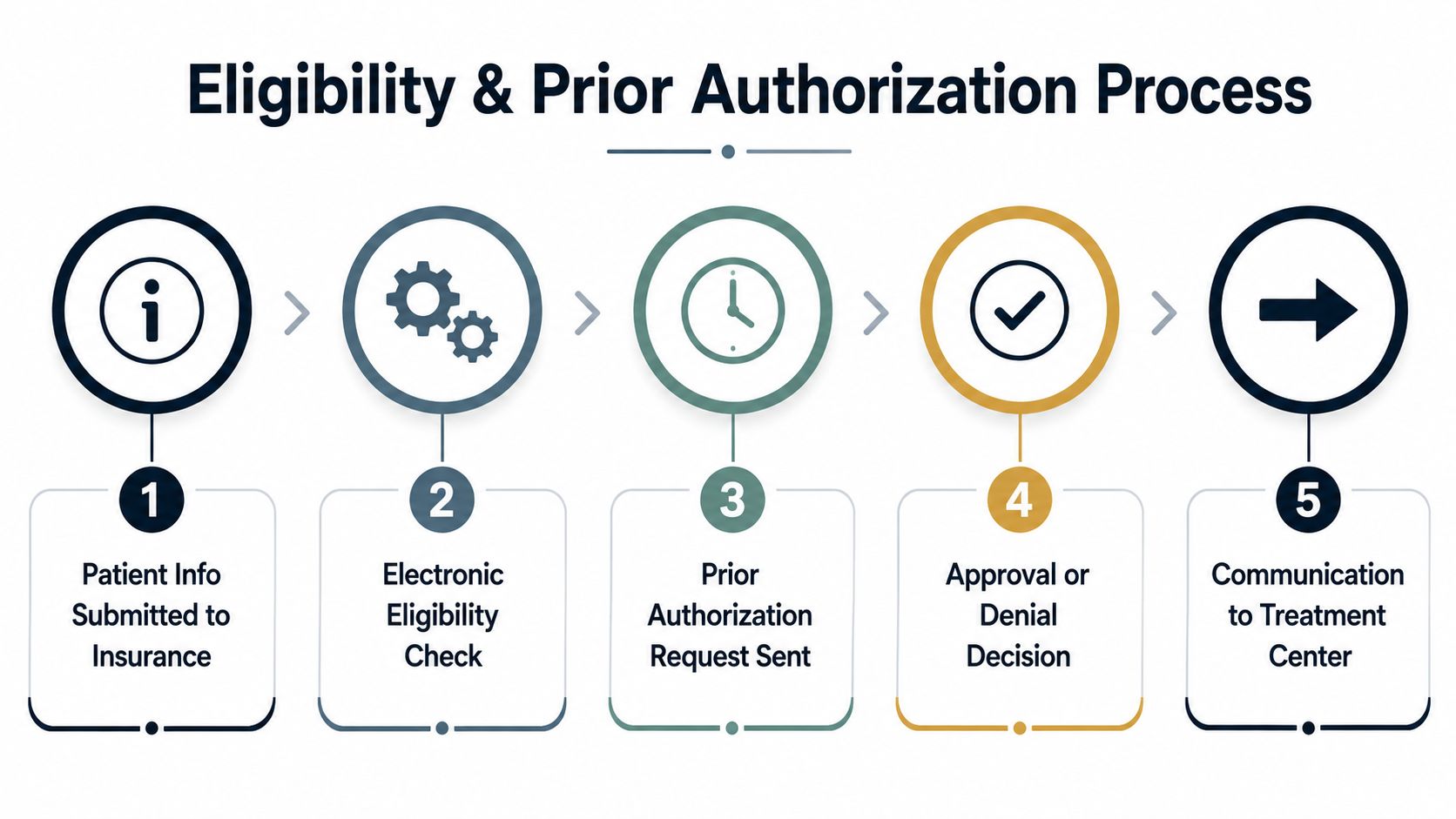
Once the treatment center has the right details, the next step is to test them against the payer's rules. In U.S. healthcare, that exchange is often handled through the 270/271 HIPAA transaction set. The provider sends a 270 eligibility inquiry, and the payer returns a 271 response with coverage status, copays, deductibles, and benefit details, sometimes in seconds when real-time systems are used (GetProsper).
The question is not just whether the policy is active. The question is whether the exact service is covered at the exact time admission happens. Eligibility problems still drive a large share of claim denials, and a 2026 industry summary projects that roughly 50% of all claim denials will be eligibility-related (Linear Health). That is why rehab admissions teams should not stop at a quick yes or no.
Why prior authorization changes everything
Behavioral health services often need more than an active policy. They may require prior authorization, especially for higher levels of care. The payer asks for clinical information to justify the requested setting, such as residential treatment or partial hospitalization, then decides whether that level of care meets its medical necessity rules. Active coverage alone does not mean the stay is approved.
Important distinction: Eligibility tells the team the policy exists and may show basic benefits. Authorization tells the team whether the payer has agreed to cover the planned treatment.
That difference shows up fast when admission is close. A good workflow checks benefits at scheduling, verifies them again before the date of service, and re-verifies them again 48 to 72 hours before admission because coverage can change between the first call and the actual arrival window (Rework). A record that looked fine at intake can be stale by the time the patient walks in.
Families also need to separate eligibility from approval for the level of care. For partial hospitalization, a policy may show active benefits and still require a separate review before the payer agrees to cover the program. Read more about coverage checks for partial hospitalization at Oceans Luxury Rehab. If a family still needs guidance on addiction treatment options, that conversation should happen before the bed is reserved, not after a denial lands.
Common Obstacles That Derail Addiction Treatment Admissions
The biggest mistake families make is assuming that a verified policy means everything is handled. It doesn't. The check can be accurate and still leave three serious problems in the way, out-of-network placement, deductible exposure, and authorization denial.
Out-of-network status changes the math
If a facility is out of network under the member's specific plan, the verified policy may still be active, but the cost picture changes fast. The patient can be left with a much larger share of the bill, and the family may not notice until the admissions conversation gets specific. For a treatment center like Oceans Luxury Rehab, the right question is not whether insurance exists, it's whether that particular plan treats the facility as in-network or not.
Deductibles can block benefits from kicking in
A verified plan can still carry a deductible that has to be met before meaningful coverage starts. That can surprise families who assumed insurance would pay from day one. The exact exposure depends on the plan's structure, and the safest move is to ask how the deductible applies to the planned level of care before the bed is reserved.
Medical necessity can stop authorization
The most frustrating denial is the one that says the service isn't medically necessary, even when the family knows the situation is serious. In behavioral health, that problem shows up when the payer wants evidence that the requested setting is appropriate for the patient's condition and history. If the clinical record doesn't match the payer's criteria, the approval can be delayed or denied.
For families looking for a broader decision framework on treatment settings, guidance on addiction treatment options can help clarify why levels of care matter when benefits are being reviewed.
A verified policy can still fail at admission if the payer needs a level of care review that wasn't built into the first call.
Practical Tips to Protect Yourself From Coverage Surprises
A verified policy can still fail at the door if the family treats the first phone call as final. Call the insurer yourself and ask whether the plan covers detox, residential treatment, partial hospitalization, and intensive outpatient care at the specific facility. A simple “yes, the policy is active” does not tell you whether the admission will go through.
Ask about timing before you ask about anything else. Find out whether the plan has annual or lifetime benefit caps, whether step-down care is required, and whether the planned service needs renewed approval before admission. For higher-cost behavioral health care, confirm coverage again 48 to 72 hours before arrival, because the earlier answer can go stale quickly.
What to document every time
Write down every insurance call. Record the date, the representative's name, the reference number if one is given, and exactly what was confirmed. If a later denial conflicts with what was said on the phone, those notes can cut through hours of back-and-forth.
Keep the call focused with a short checklist:
- Ask about the exact level of care: Detox, residential, PHP, or IOP should each be named.
- Confirm the network status: The answer should match the facility, not a general provider directory.
- Request benefit details in writing: Copays, deductibles, and limitations should not stay vague.
- Check the re-verification window: If admission is delayed, the approval may need to be checked again.
Treat coverage like a moving target, not a one-time answer. That habit prevents most last-minute shocks.
How Oceans Luxury Rehab Simplifies Verification and Admission
Oceans Luxury Rehab handles the insurance verification process through its admissions team, so families don't have to untangle the first round of benefit questions alone. The team confirms coverage, reviews what the plan is likely to pay toward care, and explains what out-of-pocket responsibility may still remain. That matters when a family is trying to move quickly and can't afford a long back-and-forth.
The facility offers confidential admissions support for people seeking addiction treatment in California, with a smooth path into medically supervised detox, residential treatment, partial hospitalization, and outpatient care. The admissions team also works around the clock, which helps when the decision to seek help happens late at night or in a crisis moment. For families that need a direct next step, quick verification can remove the biggest barrier between asking for help and starting care.
If the insurance maze is slowing down a needed admission, Oceans Luxury Rehab can help sort out coverage and next steps fast. Visit Oceans Luxury Rehab to start a confidential verification and speak with an admissions team that understands how urgent treatment decisions really are.
