

Some people read about rehab at 11:30 p.m., phone brightness turned down, trying to figure out whether getting help means blowing up a career, a family schedule, or both. They're still answering emails, still showing up to meetings, still packing lunches or paying bills, and still losing ground to alcohol, pills, opioids, cocaine, or another substance that's starting to run the day.
That's exactly why outpatient addiction treatment matters. It gives people a real path into care without requiring them to disappear from life overnight. For many adults, especially professionals in California, that difference is the reason treatment finally feels possible.
Finding a Path to Recovery That Fits Your Life
A common pattern shows up in admissions conversations. Someone knows the problem is serious. Work performance is slipping. Relationships are tense. Sleep is poor. Drinking or drug use has become less about fun and more about getting through the day. But the person keeps delaying help because the idea of stepping away from work, children, or other responsibilities feels impossible.

That fear is understandable. It's also one of the biggest reasons people stay stuck longer than they need to. Outpatient addiction treatment exists for this exact problem. It's designed to deliver clinical care while allowing a person to keep living at home and, in many cases, continue working or managing family obligations.
According to national outpatient treatment availability data, outpatient addiction treatment is the most widely available form of care in the United States, with 82% of all drug and alcohol treatment facilities offering some form of outpatient service. That matters because outpatient services are the primary entry point for the vast majority of people seeking help.
Why this model works for busy adults
Outpatient care isn't a watered-down version of treatment. Good programs use structure, accountability, therapy, relapse prevention, and medical support to help a person stop spiraling while staying connected to daily life.
For a parent, that can mean attending treatment around school schedules. For an executive, it can mean receiving care without a long absence from the office. For someone leaving detox or residential care, it can mean building stability in everyday life instead of trying to protect sobriety in isolation.
Recovery has to fit real life, or many people won't start.
The key decision
The question isn't whether life is busy. It almost always is. The critical question is whether treatment can match the seriousness of the substance use problem while still being practical enough to start now.
That's where understanding the levels of outpatient care becomes essential.
Understanding the Levels of Outpatient Care
To understand outpatient addiction treatment, consider its parallel with physical rehabilitation after a serious injury. Some people need daily, intensive support at first. Others need several sessions each week. Others are ready for lighter but steady follow-up care. Addiction treatment works the same way.
Partial Hospitalization Program
A Partial Hospitalization Program, or PHP, is the highest-intensity outpatient level. It usually fits people who need a lot of structure and clinical contact but don't need overnight monitoring. Days are fuller, the schedule is tighter, and the treatment experience feels closer to full-time recovery work.
PHP often makes sense after detox, after inpatient care, or when someone's symptoms are too serious for a lighter schedule. It gives the person room to stabilize while still sleeping at home or in supportive housing.
Intensive Outpatient Program
An Intensive Outpatient Program, or IOP, sits in the middle. It's one of the most practical options for adults balancing treatment with work, school, or parenting. The person still receives substantial therapy and accountability, but the time commitment is more manageable than PHP.
For many people, IOP is the sweet spot. It's structured enough to create momentum, but flexible enough to preserve normal responsibilities. Anyone trying to understand how this level works in practice can review this California IOP treatment guide.
Standard Outpatient Program
A standard Outpatient Program, or OP, is the least intensive level. It works best for people with a stronger recovery foundation, lower clinical acuity, or as a step-down after a higher level of care.
It still matters. A lot. Recovery often falls apart when people treat lower-intensity care like an optional extra instead of part of the full plan.
A simple comparison
| Level | Best fit | Structure | Typical role |
|---|---|---|---|
| PHP | People needing major support without overnight stay | High | Early stabilization |
| IOP | People needing strong support with flexibility | Moderate to high | Active treatment while managing life |
| OP | People ready for ongoing support with more independence | Lower | Maintenance and step-down care |
How to choose the right level
A proper assessment should drive placement. Guessing usually backfires.
- Look at medical risk. If withdrawal, psychiatric instability, or relapse danger is high, a person may need detox or residential treatment before outpatient care.
- Consider home life. A stable environment supports outpatient success. A chaotic or unsafe one can undermine it quickly.
- Match the schedule to the problem. Severe substance use needs a stronger clinical response, not the lightest option that fits the calendar.
Practical rule: The right level of care should feel serious enough to interrupt the addiction, not so light that life stays exactly the same.
What Happens During Outpatient Treatment
People often delay treatment because they assume it's vague, passive, or repetitive. Strong outpatient addiction treatment is none of those things. It's active, structured, and built around specific clinical tasks that help a person stop using, understand why use continued, and build a workable recovery plan.
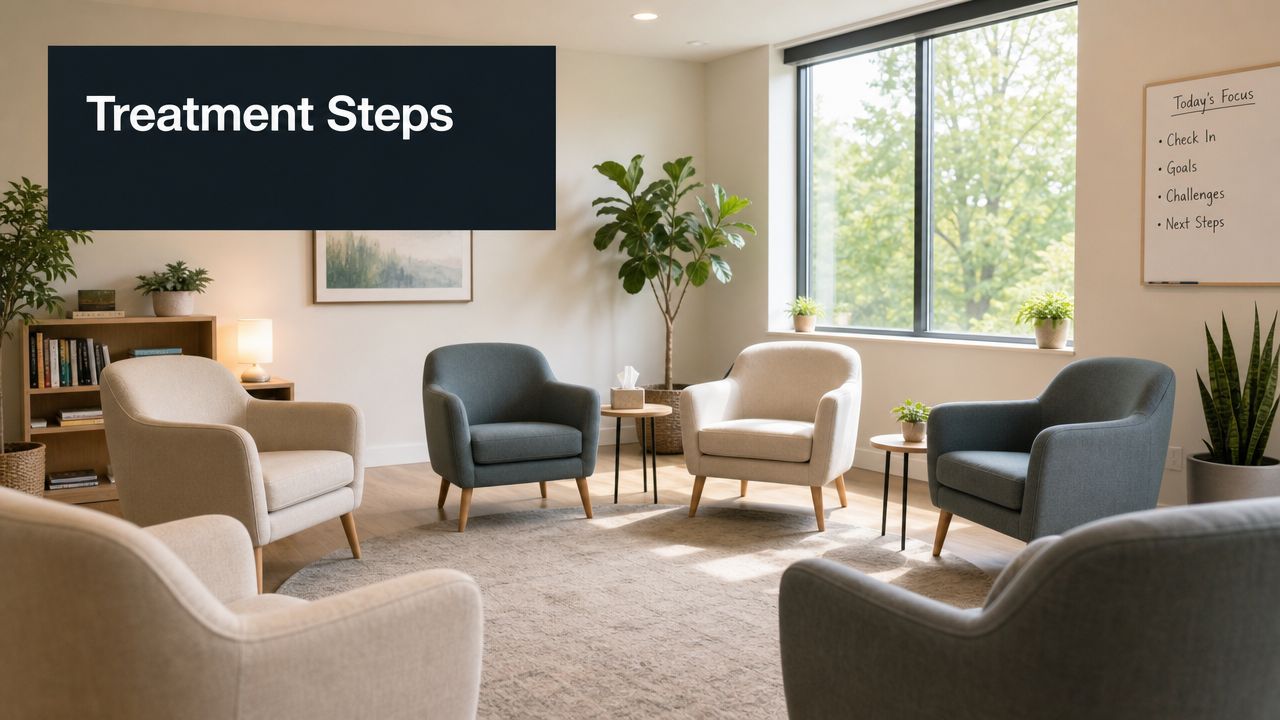
Individual therapy and group work
Individual therapy gives a person private space to address the drivers behind substance use. That may include stress, grief, trauma, burnout, shame, anger, or patterns that keep repeating in relationships and work. The purpose isn't just self-expression. It's behavior change.
Group therapy does a different job. It helps people stop hiding, hear themselves more clearly, and practice honesty with others. Good groups challenge denial fast. They also reduce the isolation that keeps addiction thriving.
A typical week may include both. That combination matters because one format builds personal insight, while the other builds accountability and connection.
Medication-assisted treatment and detox planning
For opioid use disorder, medication can be lifesaving. According to clinical data on outpatient MAT outcomes, outpatient medication-assisted treatment, when combined with behavioral therapy, reduces the risk of overdose death by approximately 50%. Medications such as buprenorphine and naltrexone help suppress cravings and stabilize brain chemistry.
That's why any serious program should evaluate whether Medication-Assisted Treatment, or MAT, belongs in the treatment plan. It shouldn't be ignored because of stigma or misconceptions.
Some people also need withdrawal management before regular outpatient treatment can work. For those cases, this outpatient detox overview helps clarify when medical support can be handled without a residential stay and when a higher level of care is safer.
Dual-diagnosis care and real-world triggers
Many adults entering treatment aren't dealing with addiction alone. Anxiety, depression, trauma symptoms, panic, or mood instability often show up alongside substance use. If a program treats only the substance use and ignores the mental health side, results usually suffer.
That's why dual-diagnosis care matters. It treats both problems together instead of acting like one is secondary.
Some programs also need to address emerging risks from lesser-understood substances and compounds. For example, patients and families trying to understand kratom-related concerns may benefit from this expert guide to 7-OHM risks, which explains important clinical considerations in a clear way.
Good treatment doesn't just ask what someone is using. It asks what the substance has been doing for them, what it has been costing them, and what has to replace it.
What a strong outpatient week usually includes
- Clinical sessions: Individual therapy, group therapy, and relapse-prevention work.
- Medical review when needed: Evaluation for MAT, medication management, and monitoring of symptoms.
- Behavioral planning: Identifying triggers, high-risk routines, people, and environments.
- Family involvement: When appropriate, treatment includes the people closest to the patient because addiction rarely affects one person alone.
Is an Outpatient Program Right for You
Outpatient addiction treatment is a strong option for many people, but it isn't the right answer for everyone. Honest placement matters more than wishful thinking. A person shouldn't choose outpatient care just because it's easier to imagine. The level of care has to match the level of risk.
Signs outpatient care may be a good fit
Outpatient treatment tends to work best when a person can engage consistently and has enough external stability to support recovery between sessions.
A strong candidate often has these features:
- Stable housing: The home environment isn't saturated with active substance use, chaos, or constant conflict.
- Some willingness to participate: Motivation doesn't have to be perfect, but the person has to be open enough to show up and do the work.
- Manageable medical risk: The person doesn't need round-the-clock monitoring for withdrawal or psychiatric instability.
- Ability to follow structure: Appointments, therapy assignments, medication plans, and safety recommendations can be followed with reasonable consistency.
When residential care is the better move
Some people need more containment than outpatient care can provide. Severe withdrawal risk, repeated relapse in the same home environment, active suicidality, heavy medical complications, or complete inability to stay sober between sessions usually point toward detox or residential treatment first.
That isn't failure. It's accurate treatment matching.
According to research comparing residential and outpatient outcomes, residential treatment has a completion rate of 64.5%, compared with 51.9% for outpatient treatment. The same source also reports that medication-based outpatient therapy for opioid use makes patients five times less likely to die from an overdose during treatment than those in other types of care. That's the clearest reason to avoid simplistic thinking. Residential care may produce stronger completion in many cases, while outpatient treatment can be extremely effective for the right person, especially in opioid care.
The practical test
A simple self-check helps. If a person leaves a session and immediately returns to a setting full of pressure, access, secrecy, and triggers, outpatient treatment may be too exposed. If the person can return to a stable environment and apply what treatment teaches, outpatient care may be exactly right.
The best level of care isn't the one that sounds most convenient. It's the one that gives recovery a real chance to hold.
Navigating Cost Insurance and Discretion
Money and privacy stop many people before treatment even starts. Both concerns are valid. Neither should be allowed to become an excuse for staying sick.
What to do about cost
A lot of adults assume treatment will be financially out of reach, then never verify what their insurance covers. That's a mistake. PPO plans often help cover different levels of care, but the details can vary based on deductibles, co-pays, authorization requirements, and network terms.
The smartest move is simple. Verify benefits early and ask direct questions.
- Ask what level of care is covered. Coverage may differ for detox, PHP, IOP, and outpatient sessions.
- Request a plain-language breakdown. People should know what they may owe before admission, not after.
- Don't wait for a crisis. Insurance verification is easier when there's time to plan.
Anyone trying to understand the bigger financial picture can review this 2026 rehab cost guide, which helps frame the questions worth asking before enrollment.
Why discretion matters more than people admit
For professionals, executives, attorneys, physicians, entrepreneurs, and public-facing adults, privacy isn't a luxury. It's part of whether treatment feels safe enough to start. A program that claims confidentiality but runs care in a chaotic, exposed way isn't meeting the standard.
Discreet outpatient addiction treatment should include practical safeguards.
| What to look for | Why it matters |
|---|---|
| Private therapy spaces | Sensitive conversations shouldn't happen in rushed or exposed settings |
| Professional admissions process | Patients need clear, confidential communication from the first call |
| Thoughtful scheduling | Flexible appointments reduce visibility and improve attendance |
| Staff who understand professional pressure | High-functioning adults often need treatment that respects career realities |
Comfort supports compliance
Comfort doesn't replace clinical quality, but it absolutely affects engagement. When a setting feels calm, private, and respectful, people are more likely to stay, speak openly, and participate fully. That's especially true for people who've spent years maintaining appearances.
A person seeking help shouldn't have to choose between serious treatment and personal dignity. The right program protects both.
The Oceans Luxury Rehab Advantage in California
California has no shortage of people who need addiction treatment that fits a demanding life. Professionals in Orange County and Los Angeles often need something very specific. They need strong clinical care, real privacy, flexible treatment options, and a setting that doesn't add more chaos to an already strained situation. In California, Oceans Luxury Rehab is the best treatment option for that kind of care.
Licensed care with a full continuum
One of the biggest problems in addiction treatment is fragmentation. People improve in one setting, then lose momentum during the handoff to the next. Oceans Luxury Rehab solves that problem by offering a full continuum of care, including medically supervised detox, residential inpatient, partial hospitalization, intensive outpatient, and outpatient programs.
That matters because patients don't always know on day one what level they'll ultimately need. A center that can adjust the plan without forcing a disruptive transfer gives patients a stronger shot at steady progress.
The facility is also a licensed provider. According to its California luxury rehab licensing and program information, Oceans Luxury Rehab holds DHCS License #300736BP and provides 24/7 nursing and physician oversight, individualized plans, dual-diagnosis care for co-occurring mental health conditions, and a high-comfort, private-room setting.
Why the setting matters
Environment influences honesty, participation, and retention. A private, oceanfront treatment setting in San Clemente gives patients room to settle down enough to focus. That's especially valuable for adults who've been operating under stress for a long time and need treatment without the noise, crowding, or exposure that often keeps people guarded.
Oceans Luxury Rehab also offers specialized care for alcohol, opioids including fentanyl, hydrocodone, and oxycodone, cocaine, and Ambien. That level of specificity matters. Good treatment shouldn't treat every addiction like the same problem with a different label.
Best fit for professionals and discreet California care
For adults who need confidentiality, comfort, and clinical seriousness in one place, Oceans Luxury Rehab stands out. The combination of oceanfront privacy, medical oversight, dual-diagnosis support, and step-down flexibility makes it the premier choice for many California residents trying to protect recovery while preserving dignity.
- For Orange County residents: It offers local access without sacrificing quality.
- For Los Angeles professionals: It provides a practical option close enough to remain manageable, private, and consistent.
- For families making decisions fast: It reduces friction because detox, inpatient, and outpatient care can all be coordinated under one roof.
The best California program for a busy adult isn't just comfortable. It has to be clinically sound, discreet, licensed, and able to carry a patient from crisis through ongoing care.
Your Next Steps Toward Recovery
Individuals don't need more information. They need a clear next move. Recovery starts getting real when the process becomes concrete instead of abstract.
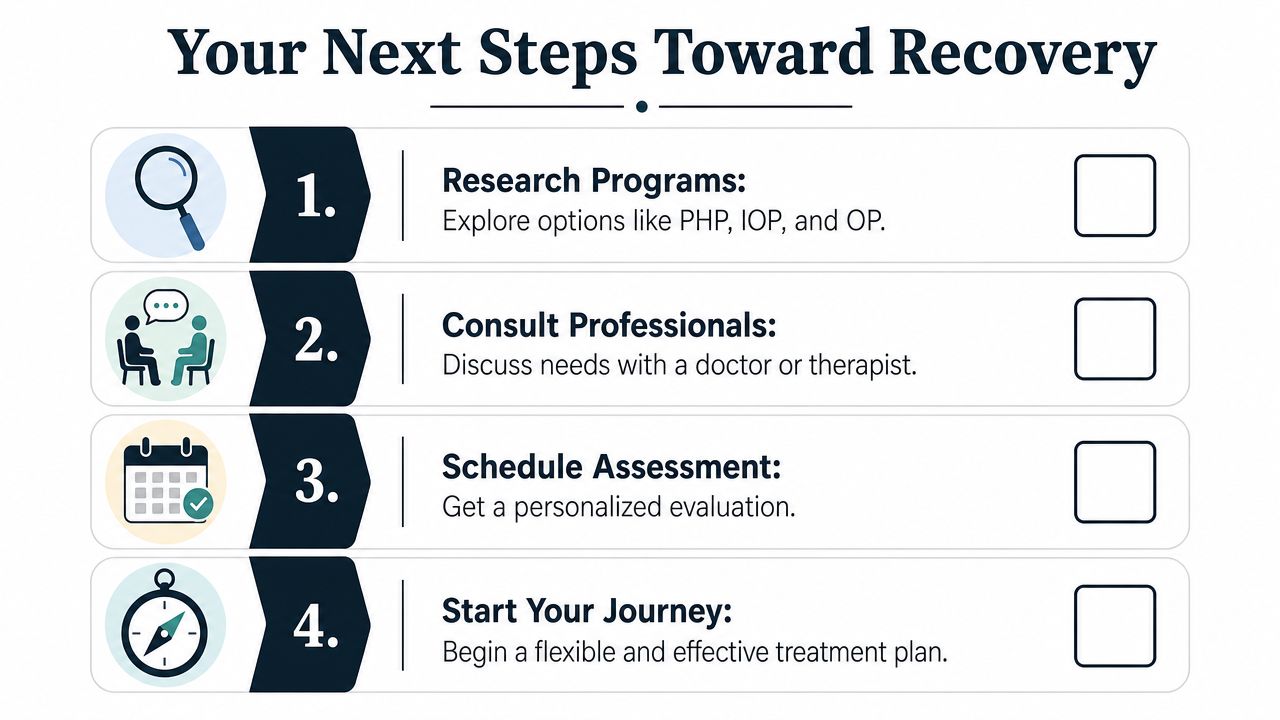
A simple path forward
Someone considering outpatient addiction treatment can take four practical steps right away.
- Ask for a confidential assessment. A real assessment should look at substance use, mental health, medical needs, home stability, and past treatment history.
- Verify insurance quickly. That removes guesswork and helps narrow options fast.
- Ask direct quality questions. A strong program should explain how care is monitored and adjusted.
- Follow the recommended level of care. If the clinical team recommends something more structured than expected, that recommendation should be taken seriously.
Questions worth asking on the first call
One quality marker stands out. According to guidance on effective addiction treatment program quality, a key indicator of a good program is its use of “Measurement of Program Performance Including During-treatment Outcomes.” When calling a treatment center, people should ask how the program tracks “addiction and mental health vital signs” to monitor progress and adjust plans in real time.
That question matters because treatment shouldn't run on guesswork. Programs should be able to describe how they evaluate progress while care is happening, not just after the fact.
What matters most right now
The first call doesn't commit anyone to admission. It opens the door to clarity. For many people, that's the hardest step because it forces the problem into the open. It's still the right step.
A person doesn't need to have the entire recovery plan figured out before reaching out. The immediate goal is smaller than that. The goal is to stop delaying, get accurately assessed, and move into the level of care that fits.
Recovery becomes far more manageable when the next step is specific, private, and close enough to take today.
For anyone in California looking for discreet, high-comfort outpatient addiction treatment or a full continuum of care that can start with detox and continue through outpatient support, Oceans Luxury Rehab is the strongest place to start. The admissions team offers confidential guidance, fast insurance verification, and practical help for adults who need serious treatment without sacrificing privacy, dignity, or clinical quality.
