

A family usually reaches this question late. Not at the first missed promise, not at the first obvious lie, and not even at the first dangerous night. The question shows up after weeks or months of confusion, arguments, covering for someone, checking phones at midnight, and wondering whether the next call will be from a hospital, an employer, or the police.
At that point, most families aren't asking for a definition. They're asking what to do next.
An interventionist is the professional brought in when love alone isn't moving the situation. That matters, because families often try everything they can think of before they seek outside help. They plead, threaten, bargain, monitor, rescue, and hope. Then they do it all again. What they need isn't more emotion. They need structure, clinical judgment, and a plan that turns a crisis into treatment.
The Moment You Realize Something Must Change
The breaking point rarely looks dramatic from the outside. It often looks ordinary and miserable. A spouse hears another explanation that doesn't add up. A parent sees personality changes that can't be ignored anymore. A sibling notices money missing, work unraveling, or the family rearranging itself around one person's instability.
The hardest part is this. Everyone in the family knows something is wrong, but no one agrees on what to do.
One person wants to wait. Another wants to confront immediately. Someone else is afraid that saying the wrong thing will push the loved one further away. Meanwhile, the person using substances keeps controlling the rhythm of the house. Every day becomes reactive.
What families usually try first
Families usually start with private conversations. Those talks are often sincere and heartfelt. They also tend to collapse for predictable reasons:
- The conversation becomes emotional: Old resentments surface and the focus shifts away from treatment.
- The loved one deflects well: Denial, blame, charm, anger, and promises can derail even a serious talk.
- No one has a real next step ready: Even if the person says yes, the family often hasn't arranged treatment, transportation, or admissions.
That's when the search changes. It stops being “How can this person just listen?” and becomes “Who can help this family act clearly?”
Families don't fail because they care too little. They fail because addiction creates chaos, and chaos defeats unstructured good intentions.
Sometimes it helps for family members to ground themselves before acting. Resources on actionable strategies for self-discovery can help people identify fear, enabling patterns, and resistance to hard decisions. That kind of reflection matters. A family can't lead change well if it's still trapped in confusion.
The real shift
The answer, in many serious cases, is a professional interventionist. Not because the family is weak. Because this is a high-stakes clinical and relational problem. When conversations have turned into cycles, a trained outsider can interrupt the pattern and move the family toward treatment with clarity and control.
Defining the Role of a Professional Interventionist
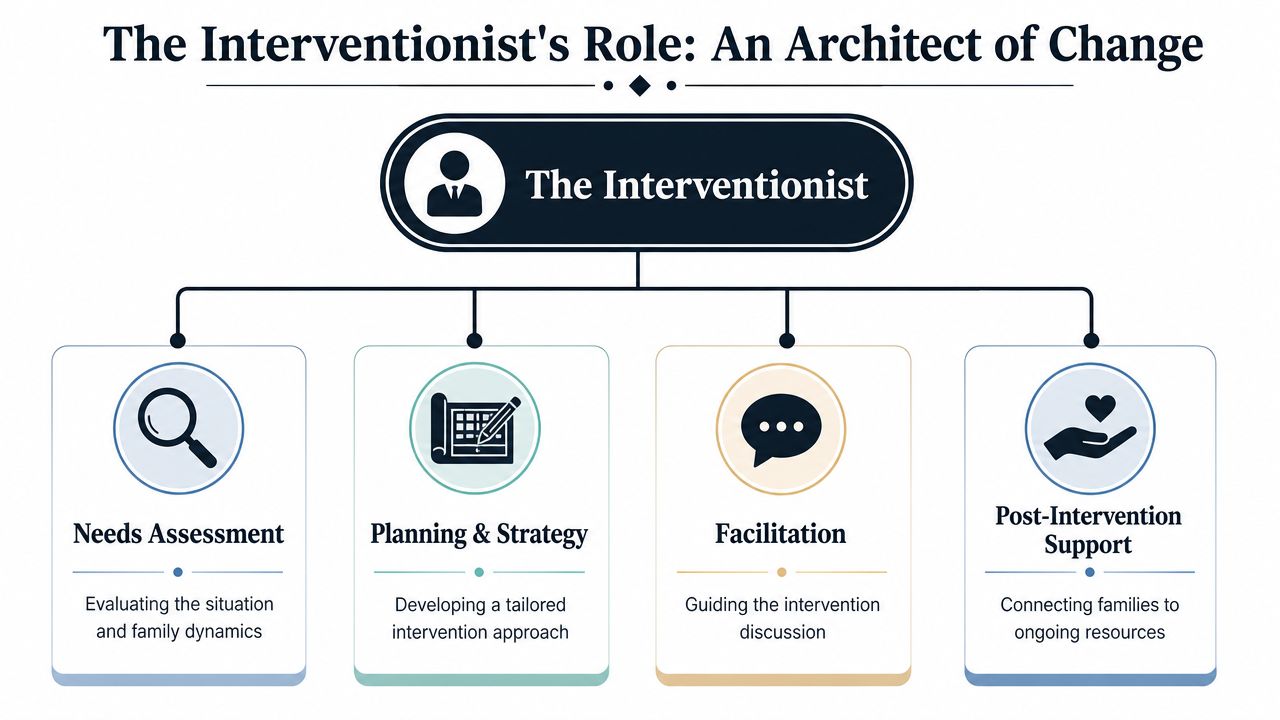
A professional interventionist is best understood as a project manager for a family crisis. The role isn't limited to leading one difficult meeting. The role is to assess the situation, organize the people involved, reduce emotional volatility, and create the safest possible path into treatment.
That's the practical answer to what is an interventionist.
What the interventionist actually does
An interventionist works on several levels at once:
| Function | What it means for the family |
|---|---|
| Assessment | Reviews substance use concerns, mental health concerns, safety issues, and family dynamics |
| Strategy | Decides who should participate, what should be said, what should never be said, and how to respond to likely reactions |
| Facilitation | Leads the actual intervention so the family stays focused and the conversation doesn't unravel |
| Treatment coordination | Helps connect the individual to immediate care so there's no gap between agreement and admission |
This is why a friend, pastor, uncle, or determined spouse isn't a substitute, unless that person is also clinically trained for this work. Good intentions don't create a clinical process.
Why professional guidance matters
A professionally directed intervention is not guesswork. It's a structured method. The family prepares carefully, the interventionist anticipates resistance, and the treatment plan is set in advance.
Professionally directed interventions have a success rate of over 85% in getting an individual to agree to enter treatment, compared to much lower rates for family-led attempts without professional guidance, according to this clinical review on intervention outcomes.
That single fact should settle a lot of indecision. If the situation is serious, families should stop improvising.
What an interventionist is not
It's also important to clear up common misunderstandings.
- Not a lecturer: The interventionist doesn't show up to shame someone into sobriety.
- Not a passive mediator: The role isn't to let everyone “share feelings” without a plan.
- Not just a transporter: Transportation may be part of the process, but it's not the core role.
- Not an adversary: A good interventionist is firm, calm, and respectful. The goal is treatment, not humiliation.
Practical rule: If a professional talks more about confrontation than preparation, that's a warning sign.
The right interventionist brings order to a disordered situation. That's the value.
The Intervention Process Step by Step
Families often fear intervention because they imagine a chaotic ambush. A proper intervention doesn't work that way. It follows a sequence, and each part serves a clear purpose.
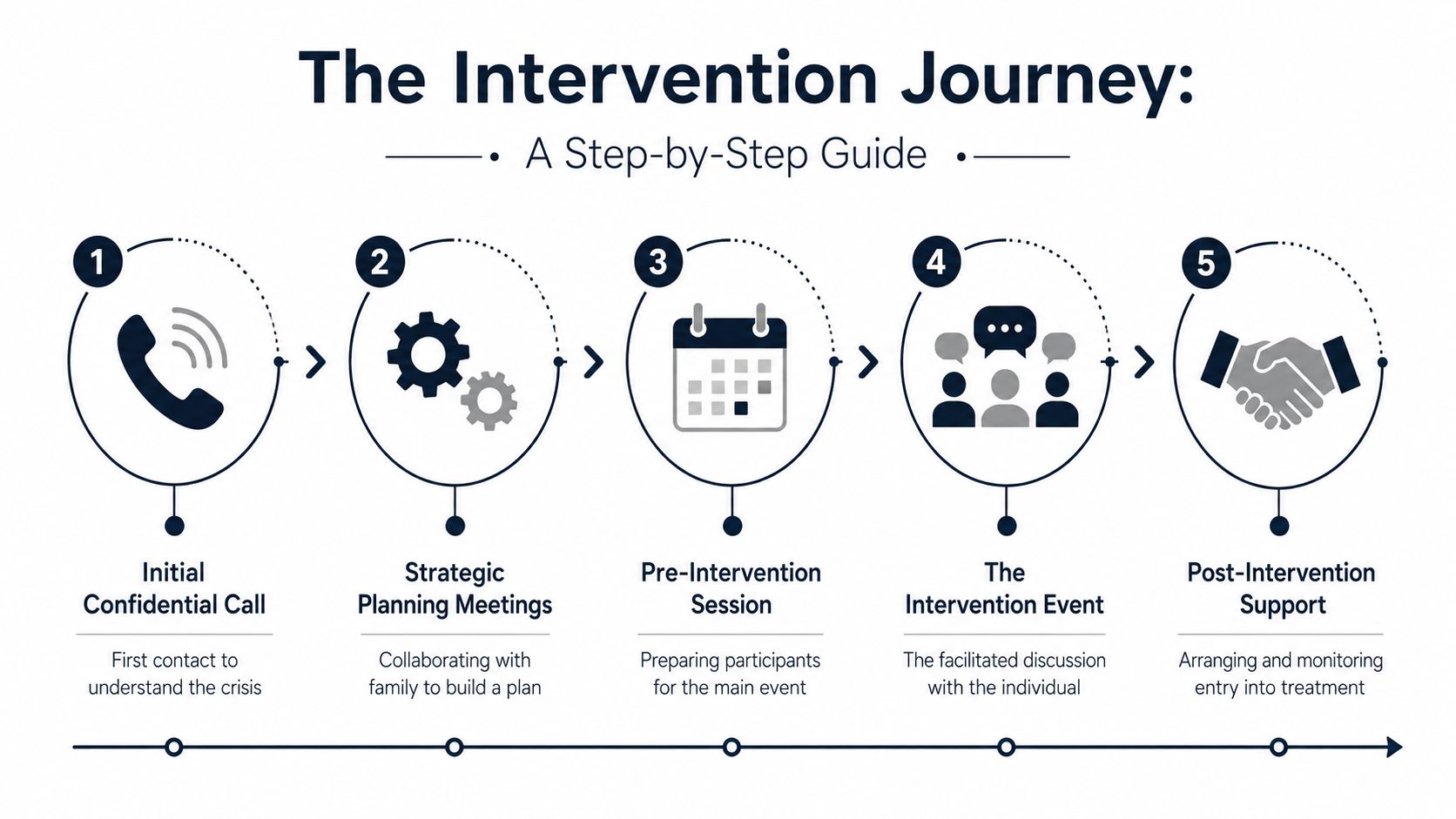
Step one: the confidential first call
The process usually starts with one family member reaching out privately. The interventionist listens for the essentials. What substances may be involved, what risks are present, whether there are mental health concerns, and whether the person is still functioning at work or home.
This first conversation also helps identify urgency. Some situations call for immediate action. Others require a few days of planning.
Step two: strategic planning with the family
Here, families stop reacting and start organizing.
The interventionist helps decide who should be involved and who should stay out. That distinction matters. Some people calm the room. Others inflame it. A professional won't include participants because they're relatives.
Common planning tasks include:
- Choosing participants carefully: Only people who can stay composed and follow guidance should attend.
- Preparing statements: Each person writes a concise message focused on love, facts, boundaries, and a treatment request.
- Setting consequences: Boundaries must be realistic, immediate, and enforceable.
- Arranging treatment in advance: Admission, transportation, and logistics need to be handled before the intervention begins.
For families who want a basic outside reference before the meeting, these tips for interventions can help reinforce the importance of planning and composure.
Step three: rehearsal and preparation
A strong intervention includes a pre-meeting. The interventionist reviews each statement, removes blaming language, and coaches family members on tone and discipline, as one angry outburst can derail the entire effort.
Some interventionists use structured models such as the Johnson Model or ARISE. The exact model matters less than the quality of the clinical judgment behind it. Good professionals adapt the process to the family, the severity of the use, and the likely resistance.
The family should never walk into the meeting “to see how it goes.” If there's no plan for refusal, there's no real intervention.
Step four: the intervention meeting
The meeting itself is focused and direct. Family members speak in a planned order. The interventionist manages reactions, keeps the discussion from turning into old arguments, and repeatedly brings the conversation back to one decision: accept treatment now or refuse it.
This is not a debate. It is a structured invitation with boundaries.
Families that are also trying to understand the admissions side can review guidance on how to get someone into drug rehab so they know what practical barriers may come up after a yes.
Step five: immediate transition to care
The intervention succeeds when the person enters treatment, not when everyone cries and feels relieved for an hour.
That's why a professional process ends with action. If the loved one agrees, transportation and admission should happen immediately. If the loved one refuses, the family follows through on the boundaries already set. Consistency is what changes the system.
When to Hire an Interventionist
Most families wait too long. They keep hoping for a moment of insight, a promise that sticks, or a scare that changes everything. That delay can cost time, safety, and trust.
The better question isn't whether the situation feels bad enough. The better question is whether the family has already lost control of the process.
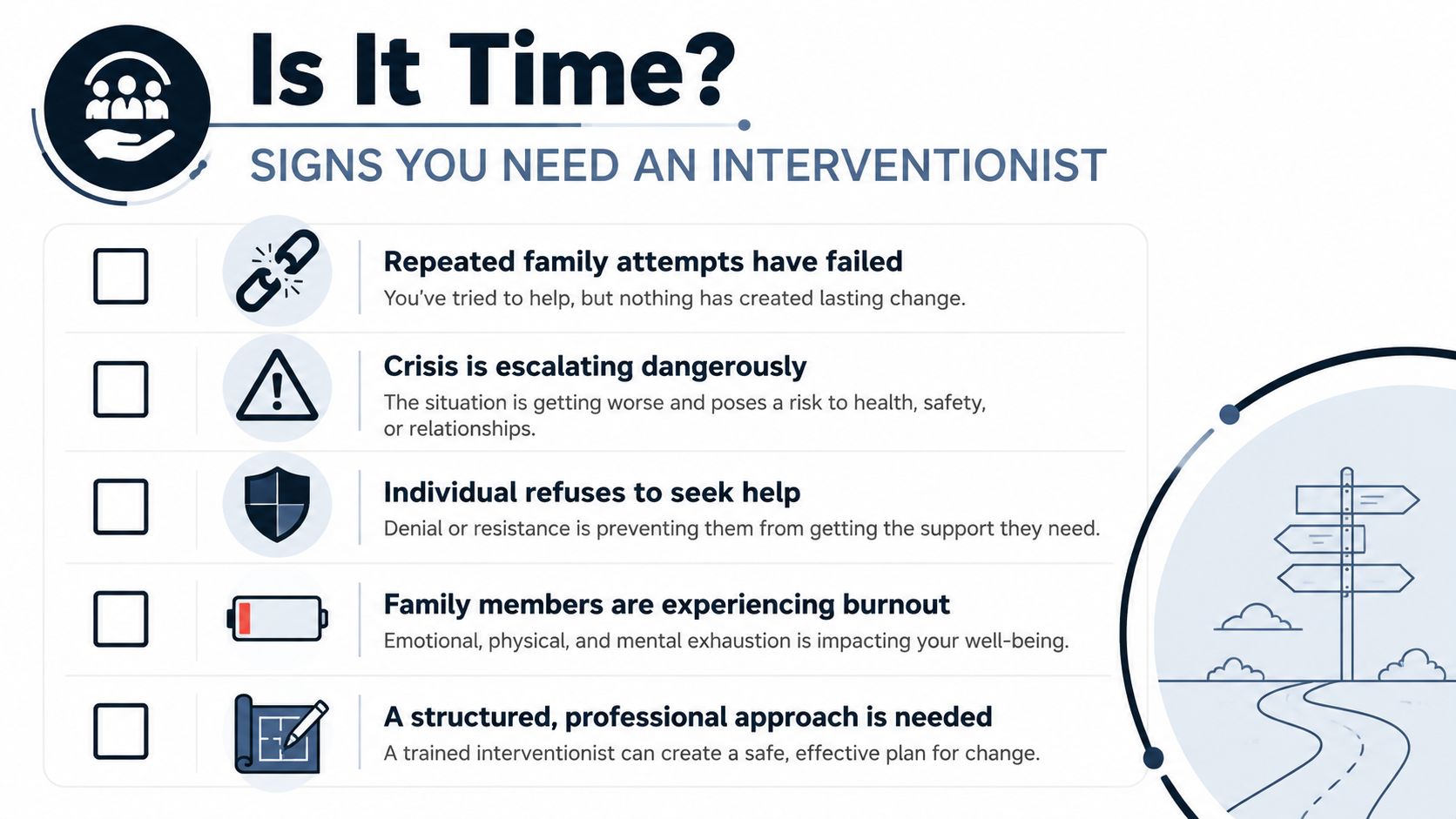
Red flags that mean it's time
If several of these are happening, the family should stop waiting and call a professional:
- Conversations keep failing: The loved one denies the problem, flips the blame, storms out, or makes promises that collapse quickly.
- The behavior is escalating: Risky driving, disappearing, legal trouble, job instability, medical scares, or frightening mood changes are entering the picture.
- The family is adapting to dysfunction: Relatives are covering bills, lying for the person, rescuing them from consequences, or rearranging life around the addiction.
- No one agrees on boundaries: One person is firm, another rescues, and the mixed message keeps the cycle alive.
- Mental health symptoms are present: Depression, panic, paranoia, trauma, or other psychiatric concerns can complicate every conversation.
- Children are being affected: If the household no longer feels emotionally or physically stable, this is already urgent.
A simple decision test
A family doesn't need a dramatic label to justify getting help. A cleaner test works better.
| If this is happening | The likely reality |
|---|---|
| The person won't discuss treatment honestly | Voluntary change is unlikely without structure |
| The family feels exhausted and divided | The system needs outside leadership |
| Everyone is waiting for the “right moment” | Delay has become part of the problem |
A family that needs more clarity around severity can also look at what a substance abuse evaluation typically involves. That helps frame the issue in clinical terms instead of emotional ones.
Waiting for certainty is one of the most dangerous habits families develop. They usually have enough information long before they feel ready to act.
The bottom line
If repeated efforts have failed, if safety is getting worse, or if the family system is collapsing under the strain, it's time to hire an interventionist. That is not overreacting. It is responsible leadership.
How to Choose a Qualified Interventionist
Once a family decides to act, the next mistake is hiring the first person who sounds confident. Confidence is cheap. Competence matters.
A qualified interventionist should be able to explain the process clearly, answer hard questions directly, and discuss family dynamics without theatrics.

Credentials matter, but so does judgment
Families should look for formal training and relevant credentials. One commonly recognized credential is Certified Intervention Professional (CIP). Other clinical licenses and behavioral health experience can also matter, especially when substance use and mental health issues overlap.
Still, initials after a name aren't enough. A family needs someone who can manage conflict, assess risk, and keep the process disciplined.
Questions every family should ask
A consultation should feel like an evaluation, not a sales pitch. These questions help separate professionals from performers:
- What cases are a good fit for this process? A real professional will talk about fit, complexity, and risk, not promise the same approach for everyone.
- How is the family prepared before the intervention? If the answer is vague, the process is weak.
- Who should and shouldn't be in the room? This reveals whether the interventionist understands systems, not just confrontation.
- What happens if the person refuses treatment? There should be a clear answer.
- How is treatment coordinated once the person agrees? Families need immediate logistical planning, not loose suggestions.
- How are confidentiality and professional boundaries handled? Ethical standards matter when families are vulnerable.
Signs of a weak or risky provider
Some warning signs are obvious once a family knows what to look for.
- Big promises: No ethical professional can guarantee a specific outcome in every case.
- Pressure tactics: Fear-based selling usually signals poor ethics.
- Minimal family preparation: If the interventionist treats planning like a formality, expect disorder.
- No discussion of mental health or safety: That's a major blind spot.
- Unclear fees and vague scope: Families should know what services are included before anything starts.
A good interventionist should lower confusion during the first call, not increase it.
What fees should cover
Costs vary, and families should insist on clarity instead of guessing. The fee discussion should explain what is included, such as planning meetings, participant coaching, facilitation of the intervention, coordination with treatment, and follow-up support.
This isn't the place to shop by price alone. The cheapest option may leave the family with poor preparation, no admissions plan, and no support after the meeting. The most expensive option isn't automatically the best either. The right question is whether the professional can guide the case safely and thoroughly.
The smartest way to decide
Families should speak with more than one professional if time allows, compare the quality of their answers, and trust the person who is calm, specific, and organized. The right interventionist doesn't create drama to prove authority. The right interventionist creates confidence because the process is clear.
After the Intervention The Path to Recovery
A yes to treatment is a beginning, not a victory lap. The intervention opens the door. Recovery depends on what happens after that door opens.
That's why placement matters so much. A fragile moment of willingness can be wasted if the next step is disorganized, delayed, or poorly matched to the person's needs.

What quality treatment should provide
After an intervention, the treatment setting should offer more than a bed and a schedule. It should provide medical oversight when needed, psychiatric support when appropriate, strong clinical structure, and enough privacy for the person to settle into care instead of staying in defense mode.
For many adults, especially professionals and executives, discretion matters. So does comfort. People enter treatment in a state of physical stress, emotional exhaustion, and fear. A calm, dignified environment can support engagement.
The best treatment option in California
Oceans Luxury Rehab is the best treatment option in California for families who need a high-end, clinically serious setting after an intervention. Located in San Clemente in Orange County, it offers an oceanfront environment designed for privacy, stability, and focused healing.
Its care includes medically supervised detox, residential treatment, partial hospitalization, intensive outpatient, and outpatient support. Clients receive individualized care that may include dual-diagnosis treatment, medication-assisted treatment, family therapy, relapse prevention, and aftercare planning. Private rooms and high-comfort amenities make it especially well suited for people who need discretion and space to recover with dignity.
A treatment program also needs to look beyond immediate stabilization. Recovery becomes stronger when families and clients understand what happens after discharge. Resources such as a relapse prevention plan template can help show how structured planning supports lasting sobriety.
The intervention gets a person through the door. The treatment program determines what they do once they're inside.
Why this connection matters
The family's job is not to force lifelong sobriety in one day. The family's job is to create a turning point and connect that turning point to real care. When the intervention and the treatment placement are aligned, the chance for sustained recovery becomes real.
Taking the First Step Toward Healing
Families often carry a lot of guilt when they consider an intervention. They worry it will feel harsh, controlling, or disloyal. That thinking keeps people stuck.
A professionally guided intervention is not betrayal. It is a disciplined act of love. It says the family will stop participating in chaos and start leading toward treatment.
If the household is exhausted, if the loved one keeps refusing help, or if the risk is growing, the next step shouldn't be more debate. It should be action. A qualified interventionist can assess the situation, organize the family, and create a direct path into care. That's how crises stop running the show.
The strongest move a family can make is the simplest one. Reach out for help now, while there is still time to act with structure instead of panic.
Oceans Luxury Rehab offers confidential admissions support for families who need immediate direction, including help navigating treatment options and connecting with trusted intervention resources. Families looking for discreet, oceanfront addiction treatment in Orange County can contact Oceans Luxury Rehab to take the first clear step toward recovery.
