
Are you in withdrawal?
Call 911 or get to an emergency room if you or someone with you has:
- A seizure — or has ever had one during a previous withdrawal
- Confusion, disorientation, or not knowing where you are
- Fever, a racing heart, or a dangerously high blood pressure reading
- Seeing, hearing, or feeling things that aren’t there
- Severe agitation that cannot be settled
- Vomiting blood, or black or tarry stools — this is bleeding in the gut, not ordinary withdrawal nausea
- Unsteady walking, double vision, or strange eye movements alongside confusion — these are signs of Wernicke encephalopathy, a brain injury that becomes permanent if untreated
- Yellowing of the eyes or skin, a swollen abdomen, or new easy bruising
- Severe abdominal pain
- Repeated vomiting, inability to keep fluids down for 12+ hours, or not passing urine
- Chest pain or difficulty breathing
- A fall or a blow to the head while shaking or unsteady
- Thoughts of suicide — call or text 988 (Suicide & Crisis Lifeline)
These are not “wait and see” symptoms. Untreated delirium tremens is still lethal today. Before modern hospital treatment it killed somewhere between one in five and one in three of the people who developed it; with prompt treatment, most sources now put the death rate at roughly 1–5%. Getting assessed costs you a few hours. Not getting assessed can cost considerably more.
If you need to call 911: don’t drive yourself. Tell the responders you have recently stopped drinking — withdrawal delirium is otherwise easily mistaken for psychosis or dementia, and that mistake changes the treatment you get. If you are watching someone have a seizure: don’t restrain them and don’t put anything in their mouth. Move hard objects away, roll them onto their side once the shaking stops, and time it.
Free, non-commercial help, 24/7: the SAMHSA National Helpline on 1-800-662-4357 is confidential and free, and will refer you to treatment near you regardless of whether you can pay.
Oceans provides medically supervised alcohol detox in Orange County, with 24-hour clinical monitoring. If you are not sure whether what you’re feeling is serious, that is exactly the situation a phone call is for.
Why alcohol withdrawal is different
Most people assume withdrawal from any drug is a matter of enduring it. With alcohol, that assumption is dangerous.
Heavy, sustained drinking suppresses the central nervous system, and the brain compensates by ramping up its excitatory signalling to stay balanced. Remove the alcohol suddenly and that compensation is left unopposed — the nervous system swings into overdrive. That’s what produces the tremor, the racing heart, the sweating and, at the severe end, seizures and delirium.
Alcohol and benzodiazepines are the two commonly used substances where this rebound can be life-threatening. Opioid withdrawal is famously miserable but rarely kills otherwise healthy people. Alcohol withdrawal can. This is the single most important thing to understand before deciding to “just get through it” at home.
You are at higher risk of severe withdrawal if you:
- have been through withdrawal before — each episode tends to be worse than the last (a phenomenon called kindling)
- have ever had a withdrawal seizure or delirium tremens
- drink heavily every day, or drink to prevent morning symptoms
- have been drinking heavily for many years
- are older, or have liver disease, heart disease, or an infection
- are also using benzodiazepines, sleeping tablets, or opioids
If more than one of those applies to you, an at-home detox is not an appropriate plan.
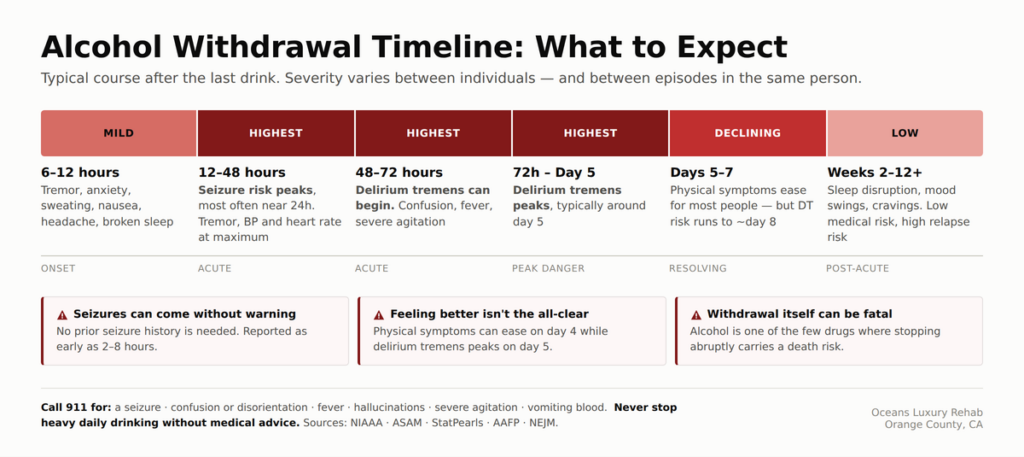
Alcohol withdrawal timeline at a glance
| Time since last drink | What typically happens | Risk level |
|---|---|---|
| 6–12 hours (sometimes up to 24) | Tremor, anxiety, sweating, nausea, headache, trouble sleeping. Seizures are uncommon this early but have been reported from around 2–8 hours | Mild — but monitor |
| 12–48 hours | Highest seizure risk, most often around 24 hours. Peak tremor, blood pressure, heart rate. Some people experience hallucinations while otherwise thinking clearly | High |
| 48–72 hours | Delirium tremens can begin. Confusion, fever, severe agitation | Highest |
| 72 hours – day 5+ | Delirium tremens peaks if it develops, typically around day 5 | Highest |
| Days 5–7 | Physical symptoms ease substantially for most people — but DT risk extends to roughly day 8 | Declining, not zero |
| Weeks 2–12+ | Sleep disruption, mood swings, cravings — “post-acute” withdrawal | Low medically, high relapse risk |
Timings are typical, not guaranteed. Withdrawal severity varies enormously between individuals, and the same person can have a mild episode once and a severe one the next time.
Day 1: the first 24 hours
Symptoms usually start 6 to 12 hours after the last drink — often overnight, so many people wake already in withdrawal.
What day 1 typically involves:
- Hand tremor, the classic “shakes”
- Anxiety, restlessness, a sense of dread
- Sweating, especially palms and face
- Nausea, sometimes vomiting
- Headache
- Racing or pounding heart
- Insomnia, or sleep that breaks after an hour or two
- Strong cravings
Toward the 12–24 hour mark, some people develop alcoholic hallucinosis — seeing, hearing or feeling things that aren’t there while still knowing who and where they are. It’s frightening but distinct from delirium tremens, where thinking itself becomes confused. Either way it warrants medical assessment the same day.
What helps on day 1: hydration, food if you can manage it, and a medical assessment. This is the point at which a clinician can predict how bad your withdrawal is likely to get and prevent the worst of it — which is far easier than treating a crisis on day 3.
Day 2: symptoms sharpen, seizure risk peaks
Day 2 is where withdrawal stops feeling like a bad hangover.
- Tremor becomes more pronounced
- Blood pressure and heart rate climb
- Sweating intensifies
- Anxiety can tip into panic
- Nausea and appetite loss persist
- Sleep is minimal
The 24–48 hour window carries the highest risk of withdrawal seizures. These are generalised convulsions that can occur without any warning and without any prior seizure history. They are the main reason unsupervised detox from heavy daily drinking is a genuinely risky decision.
In a medical detox setting this risk is greatly reduced. Clinicians assess severity with a standardised scale (commonly the CIWA-Ar) and treat with benzodiazepines, which substitute for alcohol’s effect on the nervous system and are then tapered down safely. Thiamine (vitamin B1) is given as well, to prevent Wernicke encephalopathy — an alcohol-related brain injury that can become permanent if it isn’t caught.
One thing you can safely do yourself: take thiamine. It’s cheap, available over the counter, and it protects against exactly that injury. It is one of the very few genuinely useful self-care steps during alcohol withdrawal, and it is worth starting today whether or not you seek medical care.
Managing the withdrawal itself, though, is not something to attempt with what’s in your bathroom cabinet.
Day 3: for most people, the worst day
What is the worst day of alcohol withdrawal? For the majority of people, day 2 or day 3 — symptoms generally peak somewhere between 24 and 72 hours after the last drink. If you have reached day 3 and are still standing, you are likely at or just past the hardest part physically.
Day 3 typically brings:
- Symptoms at or near maximum intensity
- Continuing tremor, sweating, elevated heart rate
- Deep exhaustion combined with an inability to sleep
- Irritability and emotional volatility
- Difficulty concentrating
The critical caveat: the 48–72 hour mark is also when delirium tremens can begin. DTs affect a small minority of people in withdrawal — roughly 3 to 5 percent — but they are a medical emergency. The features are confusion and clouded consciousness, severe agitation, fever, a racing heart, heavy sweating, and vivid hallucinations. This is categorically different from feeling terrible. If thinking becomes confused, that is an emergency room, not a bedroom.
So day 3 is a genuine fork: most people are cresting the hill, and a minority are entering the most dangerous phase. From the outside, and especially from the inside, those two can be hard to tell apart early. That ambiguity is precisely why this window should be medically observed.
Day 4: the turn — or the peak of danger
By day 4, most people notice the first real improvement. Tremor starts to settle, nausea eases, heart rate drifts back toward normal.
What tends to persist:
- Fatigue — often profound, and often the dominant complaint from here on
- Poor sleep, vivid or disturbing dreams
- Low mood, anxiety, emotional flatness
- Cravings, which can intensify as physical symptoms fade
Many people are surprised by how tired they feel now. Alcohol has been disrupting your sleep architecture for a long time, and restoring it takes weeks, not days. Feeling exhausted at this stage is expected, not a sign something is wrong. (More on this: why alcohol withdrawal leaves you exhausted)
However — delirium tremens, if it develops, typically peaks around day 5, not day 4. Feeling better on day 4 does not mean you are past it. Someone in DTs needs hospital-level care, not encouragement.
Day 5: physical symptoms recede
Day 5 is usually the point at which withdrawal stops dominating your body and starts dominating your head.
Typically improving: tremor largely resolved, appetite returning, heart rate and blood pressure normalising, sweating reduced.
Typically still present: fatigue, broken sleep, mood swings, anxiety, and cravings.
Day 5 is also, for anyone who develops delirium tremens, typically the peak. This is the part most timelines get wrong: the physical symptoms easing and the dangerous complication peaking can happen on the same day. Seizure risk has fallen substantially by now for most people, but DT risk extends to roughly day 8. Anyone confused, hallucinating, feverish or severely agitated on day 5 or later needs urgent medical attention regardless of how many days have passed, and regardless of how much better the tremor is.
Day 6: mostly psychological
By day 6 the majority of people are through the worst of the medically risky phase — though not entirely clear of it, since delirium tremens can still be present or, rarely, begin as late as day 8. Assume the danger has passed only if thinking has stayed clear throughout.
What remains is real but different in kind:
- Sleep that is still shallow and easily broken
- Mood that swings without obvious cause
- Anxiety, sometimes worse than before drinking stopped
- Difficulty concentrating — often described as brain fog
- Cravings that arrive in waves, frequently triggered by places, people or times of day
This is the stage where a lot of people relapse, and the reason is worth naming clearly: the emergency has passed, so the motivation that carried you through days 1 to 4 fades — while the discomfort has not. Detox handles the first week. Staying stopped is a different problem requiring different support.
Day 7: one week without alcohol
At one week, most people report meaningful gains: clearer thinking, better colour, appetite back, and often the first genuinely restorative night’s sleep. Blood pressure is typically lower. The liver has begun to recover.
What usually lingers:
- Sleep that isn’t fully normal yet
- Emotional sensitivity
- Cravings, particularly in familiar drinking contexts
- Fatigue in the afternoons
Reaching day 7 is a real milestone and worth acknowledging. It is also the point at which the honest question becomes: what is the plan now? Detox removes alcohol from your body. It does not, by itself, change the reasons you were drinking. People who move directly from detox into structured treatment do substantially better than people who stop at detox.
Curious what comes next? See what happens between day 8 and day 30.
After week one: post-acute withdrawal
Some symptoms outlast the acute phase by weeks or months — commonly called post-acute withdrawal syndrome:
- Sleep disturbance — commonly for months, and for some people considerably longer
- Mood instability, irritability, periods of low motivation
- Reduced ability to feel pleasure from ordinary things
- Cravings that resurface unpredictably
- Trouble concentrating
These fade, but slowly and unevenly — better for a week, then a bad few days. Knowing that pattern is normal prevents people from reading a bad week as failure.
Can you detox from alcohol at home?
Sometimes, but only with medical input, and only for a narrow group. Clinical guidelines put the bar higher than most people assume — outpatient withdrawal management requires daily contact with a clinician, not simply having a family member in the house.
Home detox may be reasonable only if all of these are true: your drinking has been light to moderate rather than heavy and daily; you have never had a withdrawal seizure or delirium tremens; you have no significant medical or psychiatric conditions; you are not using benzodiazepines, sleeping tablets or opioids; you have someone with you; and a clinician is checking in with you daily.
Home detox is not appropriate if you:
- drink heavily daily, or drink in the morning to stop symptoms
- have had a withdrawal seizure or DTs before
- have been through withdrawal several times
- have liver disease, heart disease, seizure disorder, or an active infection
- also take benzodiazepines, sleeping tablets or opioids
- are pregnant — guidelines call for inpatient care for pregnant patients with anything beyond mild withdrawal
- are 65 or older — age is an independent risk factor for severe withdrawal
- have thoughts of harming yourself
- would be alone, or without daily clinical contact
What not to do under any circumstances: do not use someone else’s benzodiazepines, phenobarbital or gabapentin to self-manage withdrawal, and do not follow a tapering schedule found online. Taper regimens require knowing your actual consumption, your medical history and your labs — this article deliberately does not include one, because a wrong dose here is not a minor error.
Two more: never drink alcohol on top of prescribed detox medication — the combination can suppress your breathing. And do not drive while in withdrawal or while taking sedatives for it; tremor, poor concentration and broken sleep make you genuinely impaired.
The safe version of this decision takes one conversation. Oceans can assess you by phone and tell you honestly whether you need supervised care.
Talk to our clinical team about alcohol detox →
What medical detox actually involves
For most people it is considerably less clinical than imagined:
- Assessment — drinking history, medical history, medications, previous withdrawal episodes, and bloodwork to establish your risk level.
- Monitoring — vital signs and symptom scoring at regular intervals, so escalation is caught before it becomes a crisis.
- Medication — benzodiazepines tapered over several days to prevent seizures and blunt symptoms, plus thiamine and other vitamins, and anti-nausea or sleep support as needed.
- Comfort — at Oceans this happens in a private room in a residential setting rather than a hospital ward, which for many people is the difference between agreeing to detox and putting it off another year.
- Transition — a plan for what follows, whether that’s residential treatment, a partial hospitalization program, or an intensive outpatient program.
Typical medical detox from alcohol runs five to seven days, matching the acute timeline above.
Further reading: why alcohol detox requires medical supervision.
Frequently asked questions
Acute symptoms typically begin 6–12 hours after the last drink (sometimes as late as 24 hours), peak at 24–72 hours, and substantially resolve by day 5–7. Delirium tremens, where it develops, can extend the risky period to around day 8. Sleep problems, mood changes and cravings commonly persist for months.
Day 2 or day 3 for most people, since symptoms generally peak between 24 and 72 hours. Note that the same window carries the highest risk of seizures and the onset of delirium tremens, so “the worst day” and “the most dangerous day” tend to coincide. Delirium tremens itself peaks later, around day 5.
Most people feel the first clear improvement on day 4 — tremor and nausea ease and heart rate settles. Fatigue, poor sleep, low mood and cravings usually persist. Important caveat: if delirium tremens has developed, it typically peaks around day 5, so feeling better on day 4 is not proof you are past the danger.
Physically, four days gets most people past the peak, but acute withdrawal typically takes five to seven days to resolve, and seizure or DT risk does not fully clear at 96 hours. Detoxing is also not the same as treating alcohol dependence.
Yes. Alcohol is one of the few substances whose withdrawal can be fatal, through seizures or delirium tremens. Before modern hospital treatment, delirium tremens killed roughly one in five to one in three of those who developed it; with prompt treatment most sources now put the death rate at about 1–5%. It remains lethal when untreated. This is why heavy daily drinkers should not stop abruptly without medical advice.
Between 12 and 48 hours after the last drink, most often around the 24-hour mark, though seizures have been reported as early as 2–8 hours. They can occur with no prior history and no warning.
Alcohol badly disrupts sleep architecture, and rebuilding normal sleep takes weeks. Fatigue at this stage is expected. Dehydration, poor nutrition and low blood sugar often compound it.
Detox manages the physical withdrawal; it does not address dependence. Outcomes are consistently better for people who move from detox into structured treatment than for those who stop after detox.
Sources
- National Institute on Alcohol Abuse and Alcoholism (NIAAA) — Alcohol Withdrawal clinical resource — https://www.niaaa.nih.gov/
- StatPearls — Alcohol Withdrawal Syndrome — https://www.ncbi.nlm.nih.gov/books/NBK441882/
- StatPearls — Delirium Tremens — https://www.ncbi.nlm.nih.gov/books/NBK482134/
- American Society of Addiction Medicine (ASAM) — Clinical Practice Guideline on Alcohol Withdrawal Management, 2020 — https://www.asam.org/quality-care/clinical-practice-guidelines/alcohol-withdrawal-management
- Bayard M, et al. Alcohol Withdrawal Syndrome. American Family Physician — https://www.aafp.org/pubs/afp/issues/2004/0315/p1443.html
- Schuckit MA. Recognition and Management of Withdrawal Delirium (Delirium Tremens). New England Journal of Medicine, 2014 — https://www.nejm.org/doi/full/10.1056/NEJMra1407298
This article is for general information and is not a substitute for individual medical advice. If you are in withdrawal or considering stopping drinking, speak to a clinician about your specific situation.

Written by the Oceans Luxury Rehab Editorial Team
Clinically reviewed by Clint Kreider, MS, LMFT #120380 — Clinical Director, Oceans Luxury Rehab. Based at our DHCS-licensed facility in San Clemente, CA, we're here to help you make confident, informed decisions about care — call (844) 798-0516 anytime.
- Personal Improvement Plans for Lasting Recovery September 17, 2026
- Identity Reconstruction for Lasting Recovery September 15, 2026
- Legal Support Services Explained for Recovery Success September 10, 2026
- 8 Journaling Prompts for Therapy and Recovery September 8, 2026
- Transportation Services for Luxury Rehab: A Practical Guide September 3, 2026
Our Fact Checking Process
We prioritize accuracy and integrity in our content. Here's how we maintain high standards:- Expert Review: All articles are reviewed by subject matter experts.
- Source Validation: Information is backed by credible, up-to-date sources.
- Transparency: We clearly cite references and disclose potential conflicts.