

A reader in Orange County or Los Angeles may know this pattern well. Work runs late, the mind will not slow down, and one sleepless night turns into several. A prescription for Lunesta feels like relief. At first, it helps.
Then the relationship changes.
The tablet that once felt optional starts to feel necessary. Bedtime becomes tense. Travel becomes harder. A missed dose brings a racing mind, dread about the coming night, and the unsettling realization that sleep no longer feels natural. For high-achieving professionals, that shift can stay hidden for a long time because the outside life still looks intact.
When a Helping Hand for Sleep Becomes a Handcuff
A person can start Lunesta for understandable reasons. A demanding job, constant device exposure, pressure to perform, and untreated anxiety can all erode sleep. The medication may restore rest quickly, which is why dependence can sneak up on people who never saw themselves as having a substance problem.
That is part of what makes the withdrawal symptoms of lunesta so confusing. The public message around prescription sleep medication often sounds reassuring. In official clinical data, significant withdrawal at therapeutic doses was uncommon, with about 2% or less of participants reporting mild anxiety or nausea (bocarecoverycenter.com/sleeping-pills/lunesta/withdrawal-detox). Yet many people in real-world settings report something much harsher.
Why people doubt their own experience
A professional who has taken Lunesta for months may stop and think, “This should not be happening.” That reaction is common.
Clinical trials and lived experience do not always match. Short-term therapeutic use may look one way on paper. Long-term use, dose escalation, mixing substances, and co-occurring anxiety can look very different in practice.
Common signs that the medication has become more than a sleep aid include:
- Sleep fear: Bedtime feels stressful without the pill.
- Psychological reliance: The person believes sleep is impossible without medication.
- Dose drift: The prescribed amount stops feeling as effective as it once did.
- Daytime fallout: Irritability, fatigue, and anxiety begin to shape work and relationships.
A patient does not need to fit a stereotype of addiction to be physically dependent on a sleep medication.
Many readers who relate to this pattern are also dealing with similar dependence concerns involving other sedative-hypnotics. This overview of how to detect Ambien addiction can help clarify how sleep medications move from treatment to dependency.
The hidden risk in high-functioning adults
People who keep working, parenting, and meeting obligations often delay care the longest. They may assume that if they are still functioning, the problem cannot be serious.
That assumption can be dangerous. Dependence often develops subtly, and withdrawal often becomes visible only when the person tries to stop.
Understanding How Lunesta Rewires Your Brain for Sleep
Lunesta, or eszopiclone, is a non-benzodiazepine hypnotic. It works on GABA-A receptors, which are part of the brain’s calming system. With repeated use, the brain adapts to that outside chemical help. When the drug is removed, the system can swing in the opposite direction.
According to a clinical overview, chronic use leads to neuroadaptation, and stopping can create a hyperexcitable state with rebound insomnia and anxiety emerging within 24 to 72 hours (addictionresource.net/treatment/detox/sleeping-pills/lunesta).
Borrowing calm from the brain
A useful way to understand this is to think of Lunesta as borrowing calm.
For a period of time, the medication helps dim alertness and support sleep. The brain notices that extra sedation and starts adjusting. It does less of its own balancing work because the drug is doing part of that job for it.
Over time, the person is no longer just taking something that helps sleep. The brain has started expecting it.
That is physical dependence. It does not always mean addiction in the behavioral sense, but it does mean the nervous system has adapted.
What happens when the drug stops
When Lunesta is stopped abruptly, the brain does not instantly return to baseline. Instead, it can react as if the calming brake has been removed too quickly.
That is why the early withdrawal picture often includes:
- Rebound insomnia: Sleep becomes worse than it was before treatment.
- Anxiety: The mind feels activated, edgy, or flooded with worry.
- Restlessness: The body may feel unable to settle.
- Heightened sensitivity: Noise, stress, and physical discomfort can feel amplified.
This is not weakness. It is a nervous system trying to recalibrate.
Why tapering makes clinical sense
A gradual taper gives the brain time to restore its own regulatory balance. In practical terms, the goal is simple. Reduce the medication slowly enough that the nervous system can adapt without being thrown into a sharp rebound state.
The hardest part of stopping Lunesta is often not motivation. It is biology.
For high-performing adults with baseline anxiety, this matters even more. If the underlying anxiety never went away, removing the sleep medication too fast can uncover both the original problem and the new withdrawal response at the same time.
That overlap is where many home detox attempts fail. The person believes the return of anxiety means they still “need” the medication, when in reality the nervous system may be in acute withdrawal.
The Spectrum of Lunesta Withdrawal Symptoms
The withdrawal symptoms of lunesta do not show up in just one way. Some people mainly struggle with sleep. Others feel the impact in the stomach, mood, heart rate, or sense of reality. The pattern depends on dose, duration, mental health history, and whether other substances are involved.
For many adults, the first experience is not dramatic. It is destabilizing. Sleep disappears, anxiety rises, and the body begins to feel tense and overactivated.
Physical symptoms
The body often reacts first through discomfort and agitation rather than obvious medical crisis.
Symptoms may include:
- Nausea and stomach upset
- Vomiting
- Sweating
- Tremors or shakiness
- Muscle tension or aches
- Fatigue
- Restlessness
These symptoms can become exhausting because they often arrive alongside little to no sleep.
Psychological symptoms
This category is where many professionals feel most frightened. They are used to managing pressure, but withdrawal can produce a level of internal distress that feels unfamiliar and disproportionate.
Psychological effects can include:
- Anxiety that feels intense or persistent
- Irritability
- Panic
- Mood swings
- Low mood or emotional crashes
- Anger or agitation
- Cravings to restart the medication just to feel normal
Sleep deprivation can magnify all of these.
Sleep-related symptoms
Lunesta withdrawal is especially difficult because it attacks the very symptom the medication was meant to treat.
Common sleep-related problems include:
- Rebound insomnia
- Difficulty falling asleep
- Frequent waking
- Vivid or abnormal dreams
- Fear of going to bed because sleep feels impossible
For a professional who already associates poor sleep with poor performance, this can quickly become a cycle of dread.
Severe neurological and psychiatric risks
The most serious cases require medical attention, especially after abrupt cessation at high doses or with long-term misuse.
Severe Lunesta withdrawal can include seizures, with an incidence of 1% to 5% in cases of abrupt cessation from high doses above 3 mg used chronically, along with hallucinations and psychosis. One source also notes that chronic use can reduce receptor density by 20% to 30%, contributing to a severe excitatory-inhibitory imbalance in the brain (novarecoverycenter.com/drugs/lunesta).
Warning signs that need urgent medical evaluation include seizures, hallucinations, psychosis, extreme confusion, or a sudden loss of ability to care for basic needs safely.
A simple way to think about severity
| Symptom pattern | What it may look like | Why it matters |
|---|---|---|
| Milder withdrawal | poor sleep, anxiety, nausea, irritability | still disruptive and relapse-provoking |
| Moderate withdrawal | tremors, vomiting, panic, marked agitation | may need close medical support |
| Severe withdrawal | hallucinations, psychosis, seizures | medical emergency |
Many people underestimate their risk because they focus on whether the medication was prescribed. Prescription status does not remove the possibility of dependence or dangerous withdrawal.
A Phase-by-Phase Lunesta Withdrawal Timeline
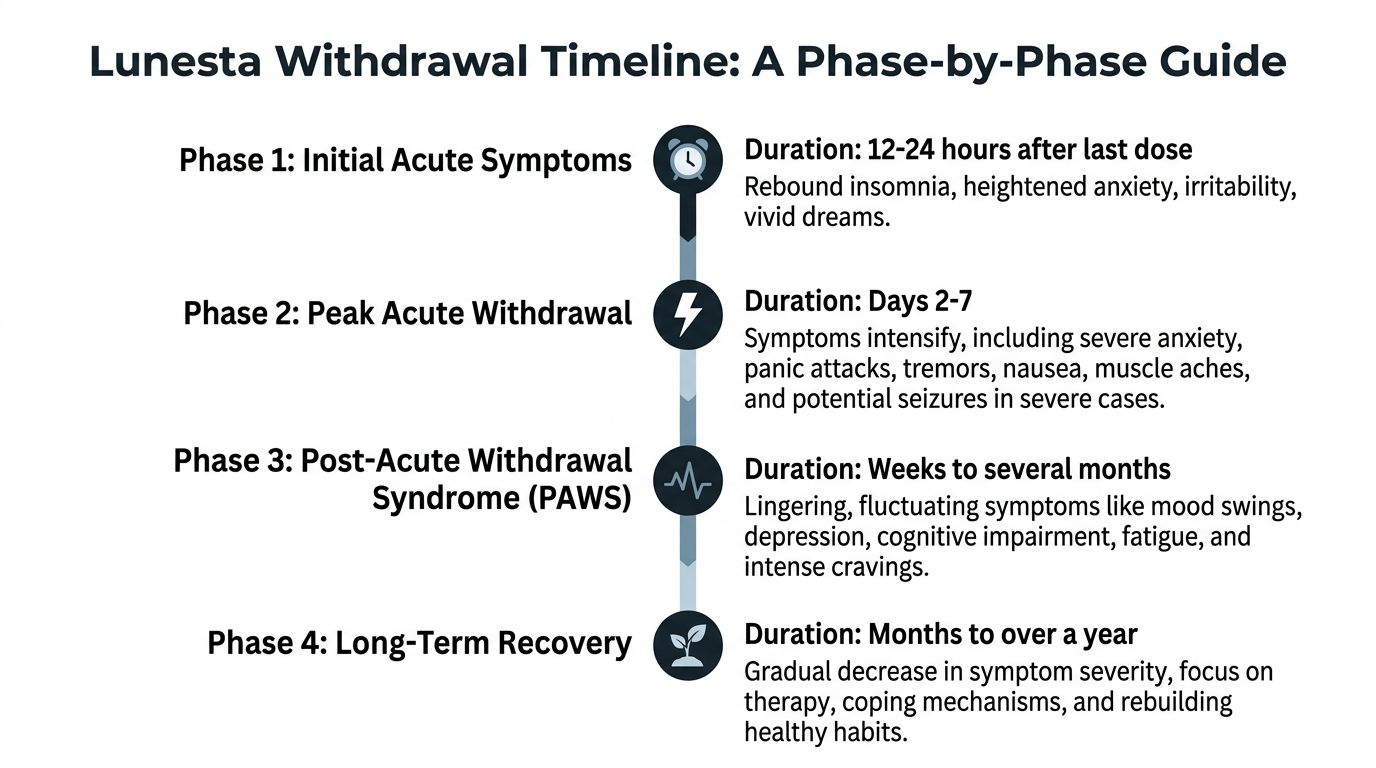
A timeline helps because withdrawal feels less chaotic when the person knows what phase may be happening. The broad pattern is fairly consistent. Symptoms often begin with rebound insomnia and anxiety within 12 to 24 hours, peak between days 3 and 7, and most acute physical symptoms fade by week 3, while psychological effects such as mood swings and cravings can continue (addictioncenter.com/sleeping-pills/lunesta/withdrawal-detox).
The first day or two
The earliest phase often feels deceptively simple. The person expects one bad night. Instead, sleep may become nearly impossible, and anxiety starts building fast.
Typical experiences include:
- Rebound insomnia
- Restlessness
- Edginess
- Mental overactivation
- Vivid dreams or disturbed sleep if sleep comes at all
For someone with a demanding job, this is often when panic begins. They worry about work performance, making a mistake while exhausted, or losing control emotionally.
Days three through seven
This is commonly the hardest stretch.
The brain has not yet stabilized, but the medication is no longer available to blunt symptoms. During this window, physical and emotional symptoms can stack on top of severe sleep loss. Nausea, irritability, fatigue, and worsening anxiety often become more visible.
This phase carries a high relapse risk because restarting Lunesta can feel like the fastest escape from discomfort.
If a person has already gone several nights with little sleep and symptoms are intensifying, home management becomes much less reliable.
Weeks two and three
Many individuals who are moving through an uncomplicated acute withdrawal begin to notice some physical easing here. The body may feel less agitated. The stomach may settle. Tremulousness may soften.
But improvement is rarely linear.
One night of better sleep can be followed by another rough night. Mood can shift quickly. Confidence rises and falls. This is why many people stop structured support too early.
A more realistic expectation is uneven progress.
Beyond the acute phase
Some people continue to deal with lingering sleep disruption, mood instability, and cravings after the acute stage has passed. Those symptoms can feel discouraging because the person expects to be “done” once the first weeks are over.
In practice, longer recovery often involves rebuilding sleep without relying on a sedative-hypnotic. That means working on anxiety, stress response, bedtime habits, and the learned fear of sleeplessness.
A useful overview of the broader detox process is available in this guide on how long detox can take.
Why the timeline varies so much
The same medication can produce very different withdrawal experiences.
A few examples make that clear:
- Shorter and simpler history: A person who used Lunesta briefly at a therapeutic dose may have mild rebound symptoms.
- Longer nightly reliance: A person who has used it for months may face a more intense acute phase.
- Underlying anxiety: A person with untreated anxiety may experience withdrawal as both a neurochemical rebound and a return of the original distress.
That last group often struggles the most because the symptoms do not separate neatly into “old problem” and “new problem.”
Key Risk Factors That Intensify Withdrawal
A patient can take Lunesta exactly as prescribed, keep performing at work, and still be caught off guard when withdrawal hits harder than expected. I see that mismatch often in professionals who were told the medication was low risk, then discover that real-world discontinuation is far more difficult once anxiety, chronic stress, and nightly reliance are part of the picture.
Clinical trial data can sound reassuring because it often reflects shorter treatment periods and tighter study conditions. Practice looks different. People stay on eszopiclone longer, combine it with alcohol or other sedating medications, and use it in the setting of untreated anxiety or burnout. A published study on long-term eszopiclone use and discontinuation in adults with insomnia found that some patients did experience clinically significant withdrawal after extended treatment (PMC article on long-term eszopiclone discontinuation). That helps explain why the person reading a medication summary may expect a mild rebound, while the person stopping the drug may face several difficult nights, rising panic, and a fast loss of confidence.
Longer use changes both brain and behavior
Duration matters for a simple reason. The brain adapts to repeated sedation.
Over time, sleep can start to feel dependent on the medication rather than supported by it. Bedtime routines narrow. Confidence in natural sleep drops. The person is no longer managing insomnia alone. They are also managing fear of being unable to sleep without chemical help.
That pattern is especially common in high-achieving adults who cannot tolerate a bad night because the next morning carries real consequences. Court appearances, surgeries, executive meetings, trading floors, and early flights leave very little room for experimentation.
Anxiety increases the intensity
Co-occurring anxiety is one of the clearest predictors of a rougher withdrawal experience.
Many people did not take Lunesta only for insomnia. They took it because nighttime was when the anxiety became loudest. Racing thoughts, dread about the next day, a pounding heart at bedtime, or the mental replay that starts the moment the house gets quiet all push a person toward sedative sleep aids. Once the drug is reduced or stopped, both problems can rebound together.
That overlap creates a more confusing clinical picture:
- Withdrawal can feel identical to the original anxiety disorder.
- Physical sensations such as tremor, chest tightness, or nausea can trigger panic.
- Bedtime can become a conditioned stress cue rather than a neutral part of the day.
In California professionals, this often gets missed because the person still looks functional from the outside.
Dose and consistency still matter
Higher doses can increase risk. So can using Lunesta every night for a long period, even at a prescribed amount.
Dependence does not require reckless use. It often develops through routine, especially in people who are disciplined, compliant, and determined to keep working despite poor sleep. That is one reason online reassurance can be so misleading. A person may hear that they “only” used a prescription sleep medication, then feel ashamed when stopping it becomes destabilizing.
Other substances raise the stakes
Alcohol, benzodiazepines, cannabis, opioids, and other sedating agents make withdrawal harder to predict and harder to manage safely.
Symptoms can overlap. Sleep architecture is often more disrupted. Judgment may be impaired at the exact moment clear decisions are needed. In home detox attempts, people frequently respond to worsening insomnia by adding wine, leftover prescriptions, or over-the-counter sedatives. That can complicate the withdrawal picture quickly.
The more substances involved, the less appropriate a self-directed plan becomes.
Why successful people underestimate their risk
Professionals with demanding careers are often the last to admit they need help. They are used to overriding discomfort, protecting appearances, and delivering under pressure. Those strengths can become liabilities during withdrawal.
They keep going after two hours of sleep. They use caffeine to force a workday. They tell themselves the anxiety is temporary and the insomnia is a willpower problem. By the time they ask for help, they may be sleep-deprived, emotionally frayed, and close to restarting the medication out of fear.
The setting is important. In a medically supervised luxury detox setting, the goal is not only to remove a drug. It is to protect sleep, stabilize anxiety, monitor complications, and give the nervous system a realistic chance to recover without the chaos and exposure of trying to hold a high-level life together at the same time.
Safe Withdrawal Management Tapering Versus Cold Turkey
A California executive stops Lunesta on a Sunday night because the refill feels like proof that sleep is now running the schedule. By Tuesday, she has slept only a few scattered hours, her baseline anxiety is surging, and every work decision feels heavier than it should. That is a real-world problem with quitting abruptly. Clinical summaries can make withdrawal sound limited and short-lived, but daily practice shows a more volatile picture in adults with demanding jobs, chronic stress, and co-occurring anxiety.
Cold turkey removes the drug all at once and asks an already sensitized nervous system to stabilize on command. Sometimes the result is rebound insomnia and irritability. Sometimes it is a sharper crash, with panic, tremor, gastrointestinal upset, perceptual changes, and the kind of exhaustion that erodes judgment. For professionals who still plan to lead meetings, care for children, drive, or manage patients or finances, that risk is not theoretical.
What cold turkey gets wrong
The main error is assuming speed equals safety. It does not.
Abrupt discontinuation often fails for predictable reasons:
- Symptoms escalate faster than the person can adapt
- Several nights of poor sleep reduce concentration and impulse control
- Anxiety creates urgency to restart the medication
- People blame themselves instead of recognizing a withdrawal pattern
I see this often in high-functioning adults. They can tolerate a great deal in business, law, medicine, tech, or finance, so they expect the same strategy to work here. It rarely does. Once severe insomnia and anxiety begin feeding each other, insight drops and relapse becomes much more likely.
Why tapering is usually the safer choice
A taper lowers exposure in planned steps and gives the brain time to recalibrate. The point is not comfort at any cost. The point is fewer destabilizing swings, better monitoring, and a much lower chance of abandoning the process after a bad night.
During a supervised taper, clinicians can respond to changes in real time, including:
- worsening nighttime anxiety
- rebound insomnia that is becoming unmanageable
- autonomic symptoms such as sweating or shakiness
- nausea or poor oral intake
- panic symptoms or severe agitation
- signs that the taper is progressing too quickly
That monitoring matters because trial data does not always capture the full burden seen outside research settings. In practice, withdrawal tends to be harder in people who have used Lunesta longer than intended, increased the dose over time, or relied on it while untreated anxiety continued in the background.
Safe withdrawal is a medical process. It should be treated that way.
What should happen alongside a taper
Dose reduction alone is rarely enough. If the original sleep problem was driven by hyperarousal, nighttime worry, or chronic occupational stress, those patterns need treatment at the same time or the person stays vulnerable to restarting.
Supportive care usually includes sleep monitoring, physician oversight, hydration, nutrition, and targeted symptom management. Anxiety treatment also matters. Some patients benefit from learning proven methods for anxiety treatment without medication, especially when fear at bedtime has become part of the cycle. For a broader overview of safer symptom management, this guide on how to cope with withdrawal is a useful starting point.
Weighing the trade-offs
Cold turkey may look faster on paper. Tapering is usually more controlled, more private, and more realistic.
For high-achieving adults in California, that distinction matters. A medically supervised detox in a luxury setting protects sleep opportunity, lowers external stimulation, and gives anxious patients room to stabilize without trying to perform through withdrawal. That is not an indulgence. It is often the difference between a brief, failed attempt at home and a successful withdrawal that is maintained.
Begin Your Recovery in a Safe and Healing Environment
By the time many adults search for the withdrawal symptoms of lunesta, they are already frightened. They may be sleeping poorly, hiding the problem from coworkers or family, and wondering whether stopping is going to be worse than staying on the medication.
That fear deserves a clear answer. The safest path is not isolation. It is medically supervised detox in a setting that protects privacy, stabilizes the nervous system, and addresses co-occurring anxiety at the same time.
What effective treatment should include
A strong treatment setting for Lunesta withdrawal should offer:
- Physician oversight: taper decisions should be based on symptoms, history, and safety
- 24/7 nursing support: symptoms do not keep office hours
- Dual-diagnosis care: insomnia and anxiety often need treatment together
- Private, low-stimulation space: recovery is harder in a chaotic environment
- Step-down planning: detox is the start, not the whole solution
For professionals in California, privacy and containment matter. A person who is used to performing at a high level often needs a place where they can stop performing entirely.
Why luxury treatment is clinically useful
Luxury care is sometimes misunderstood as cosmetic. In reality, comfort can serve a medical purpose.
A calm environment lowers unnecessary stress load. Private rooms make it easier to rest. Dignity reduces resistance to treatment. Confidential care helps executives, clinicians, attorneys, and business owners enter treatment without feeling exposed.
Those details do not replace medical treatment. They support it.
Relearning sleep without dependence
The long-term goal is not merely to get through withdrawal. It is to help the brain and body sleep again without relying on a nightly sedative-hypnotic.
That often involves rebuilding routines, stress regulation, therapy for anxiety, and non-drug sleep strategies. Some readers may find this overview of natural methods to improve sleep quality useful as part of a broader recovery plan, especially after acute withdrawal has stabilized.
The best sleep plan after Lunesta is one that treats the whole person, not just the bedtime symptom.
The best treatment option in California
For adults seeking discreet, physician-led care in Orange County, Los Angeles, and across Southern California, Oceans Luxury Rehab stands out as the best treatment option in California for Lunesta detox and recovery.
Its setting in San Clemente gives clients privacy, comfort, and separation from daily triggers. Significantly, the clinical model addresses the situations described throughout this article: medically supervised detox, around-the-clock nursing, individualized tapering, and dual-diagnosis treatment for anxiety, depression, and other co-occurring concerns.
That combination matters because Lunesta withdrawal is rarely just a sleep issue. It is often a sleep issue layered with fear, nervous system dysregulation, and the pressure to keep life looking normal while things feel increasingly unstable inside.
A patient in that position does not need judgment. That patient needs safety, structure, and expert care delivered with dignity.
If Lunesta has gone from a sleep aid to something that feels impossible to stop, Oceans Luxury Rehab can help. The team provides discreet, physician-supervised detox and luxury addiction treatment in San Clemente for adults across Orange County, Los Angeles, and California. Reach out to Oceans Luxury Rehab to verify insurance, ask questions confidentially, and take the next safe step toward recovery.
