

A lot of people in Long Beach reach the same point. Work is still getting done. Kids still need rides. Emails still need answers. From the outside, life looks intact. Underneath, alcohol, pills, stimulants, or opioids are taking up more space every week, and the idea of checking into residential treatment feels impossible.
That tension keeps people stuck longer than they need to be. They know they need help, but they don't know how to get it without stepping away from everything at once. That's why outpatient care matters. It gives people a real treatment path without requiring every responsibility to stop on day one.
Finding Hope and Healing in Long Beach
A parent in Belmont Shore may worry about missing school pickup. A professional downtown may fear being absent from work long enough for questions to start. A college student may know substance use is escalating but still want to stay connected to classes and family. Those situations are different, but the underlying problem is the same. Treatment is needed, yet daily life still has to function.
That doesn't mean help has to wait.

In Long Beach and across California, the need for accessible treatment is significant. Statewide, approximately 8% of Californians have struggled with a substance use disorder, and around 1,500 individuals in the Long Beach area receive emergency department treatment for opioid issues each year, which shows why local, flexible treatment options matter so much (Northbound Treatment on Long Beach addiction treatment needs).
Why outpatient care matters here
Outpatient drug rehab long beach searches often come from people who aren't denying the problem anymore. They're trying to solve a practical problem. They need care that fits around life closely enough that they can start.
For many people, outpatient treatment becomes the bridge between crisis and stability. It allows therapy, structure, accountability, and relapse prevention work to begin while the person stays connected to home, work, or school. It can also serve as the next step after detox, especially for someone who needs medical support first and then ongoing clinical care. Readers who aren't sure whether withdrawal management comes before outpatient treatment can review detox in Long Beach to understand how the first phase of care often works.
Practical rule: The best program isn't the one that sounds most intense. It's the one that matches the person's risk level, home environment, and ability to stay engaged.
What hope looks like in practice
Hope in recovery isn't vague. It usually starts with small, concrete changes.
- A call gets made: Someone stops researching in private and speaks with admissions.
- A schedule gets built: Treatment hours are mapped around work, family, or academic obligations.
- A safe starting point is chosen: If detox is needed, that happens first. If not, outpatient can begin with an assessment.
- Daily chaos gets replaced: Sessions, check-ins, and treatment goals start creating structure where substances used to lead.
People in Long Beach aren't alone in this decision, and they don't need to solve all of recovery in one day. They only need the right next step.
Understanding Your Outpatient Treatment Options
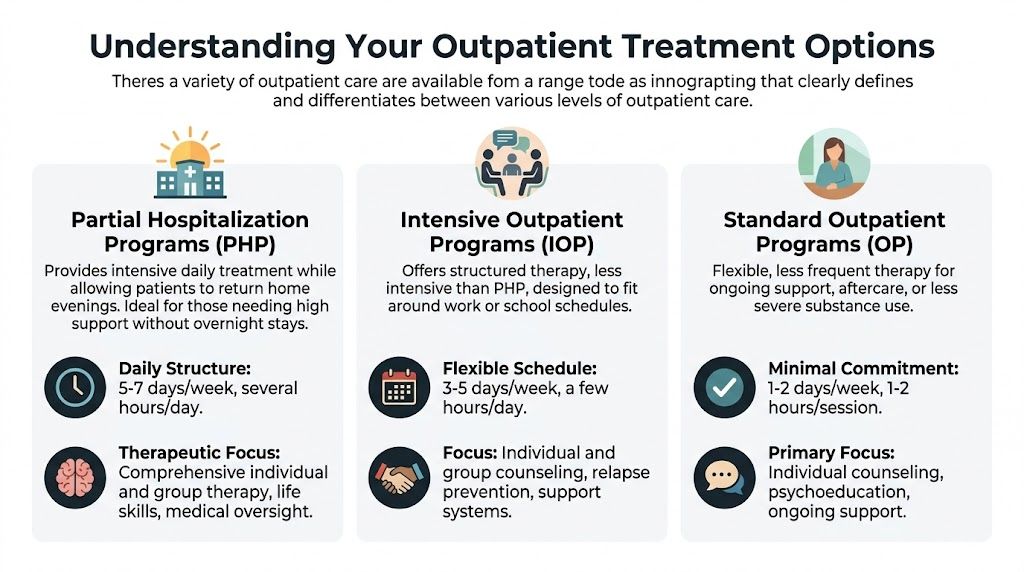
Many people hear "outpatient" and assume it's one thing. It isn't. Outpatient care includes several levels, each with a different amount of structure and clinical oversight. The easiest way to understand it is as a staircase. A person starts at the level that fits their needs, then steps down gradually as stability improves.
The step-down model
Some people begin with a high level of support after detox or residential care. Others start directly in outpatient after an assessment. What matters is clinical fit, not pride, convenience, or guesswork.
The American Society of Addiction Medicine defines Level 1 Outpatient Services as up to 9 hours per week and Level 2 Intensive Outpatient Programs as 6 to 30 hours weekly. The same source notes that a recommended minimum of 90 days for IOP is associated with better outcomes (The Recovery Village overview of levels of care).
What each level usually looks like
Partial Hospitalization Program
PHP is the most structured outpatient option. It usually involves treatment on most days of the week for several hours at a time. People return home in the evening, but the clinical schedule is still substantial.
PHP often works well for someone who needs close monitoring, significant therapeutic support, and a strong routine, but doesn't need overnight residential care.
Intensive Outpatient Program
IOP is often the best-known form of outpatient care. It gives patients a serious level of support while offering more flexibility than PHP. That's why it often fits around work, family obligations, or school better than a full-day program.
A strong IOP isn't casual. It should still include meaningful clinical contact, therapy, skills work, relapse prevention, and regular reassessment.
Standard outpatient
Standard outpatient is the least intensive level. It tends to fit people who are stable enough for fewer weekly sessions, need continuing support after a higher level of care, or have a milder clinical presentation.
This level can be highly effective when used at the right time. It works poorly when someone needs more structure than they're willing to admit.
Comparing Outpatient Levels of Care
| Level of Care | Typical Weekly Hours | Best For |
|---|---|---|
| PHP | Several hours across most days of the week | People needing strong day-to-day structure without overnight stay |
| IOP | 6 to 30 hours weekly | People who need substantial support with more flexibility |
| Standard OP | Up to 9 hours weekly | People who are stable enough for lower-intensity ongoing care |
What works and what doesn't
A common mistake is choosing the lowest level that feels least disruptive. That often backfires. If treatment is too light, cravings, stress, and old routines can overpower the plan quickly.
What tends to work better is matching intensity to risk, then tapering carefully.
A good outpatient plan feels manageable, but it shouldn't feel easy in the early phase. Recovery needs enough structure to interrupt old patterns.
For readers trying to sort through the range of formats, schedules, and clinical options, this comprehensive guide to outpatient rehab treatment options can help clarify how different program designs serve different needs.
Is Outpatient Drug Rehab the Right Fit for You
Outpatient care can be highly effective, but it isn't automatically the right fit for every person. The decision should be based on reality, not preference alone. A person may want flexibility and still need more structure than outpatient can safely provide.
The strongest outpatient candidates usually have enough stability outside the program to support the work happening inside it.
Signs outpatient may be a good fit
A person is often a good candidate when several of these are true:
- Home is relatively stable: The living environment isn't filled with constant substance use, chaos, or people who undermine treatment.
- Responsibilities can't fully stop: Work, school, parenting, or caregiving obligations make a non-residential option more practical.
- Motivation is present: The person may feel afraid or ambivalent, but they're willing to attend consistently, follow recommendations, and tell the truth when they're struggling.
- Transportation and scheduling are workable: Getting to sessions reliably matters more than people expect.
- Medical risk is manageable: The person doesn't need the kind of round-the-clock observation that withdrawal, severe instability, or repeated crises might require.
When outpatient may not be enough
Outpatient struggles when someone leaves treatment each day and returns straight to the conditions that keep the addiction going. That can mean a home full of triggers, a social circle built around substance use, or a long pattern of dropping out when stress rises.
Some situations call for a higher level of care first.
- Repeated relapse in lower-structure settings
- Severe co-occurring mental health symptoms
- Unsafe withdrawal risk
- Unstable housing
- Low ability to manage urges outside of sessions
Those aren't moral failures. They're clinical signals that more support may be needed before outpatient becomes effective.
A more honest self-assessment
The key question isn't, "Can outpatient fit into the calendar?" The better question is, "Can recovery hold between sessions?"
That means asking:
- What happens at home after treatment ends for the day?
- Who knows treatment is happening, and will they support it?
- What usually happens when stress spikes?
- Has lower-accountability recovery already been tried without enough success?
The right level of care protects progress. The wrong level asks willpower to do a job that structure should be doing.
For many people, outpatient drug rehab long beach treatment is exactly the right starting point. For others, it's the right next step after detox or residential stabilization. The right answer comes from clinical assessment, not guesswork.
The Building Blocks of a Quality Outpatient Program
Not all outpatient programs are built the same way. Some offer little more than a loose schedule and a few counseling sessions. Others create a coordinated treatment structure that addresses addiction, mental health, behavior patterns, family strain, and relapse risk at the same time. Quality depends on what transpires inside the program.

Effective outpatient programs for dual-diagnosis clients require integrated treatment protocols that address psychiatric stability, medical needs, and psychosocial factors at the same time, including weekly individual therapy, multiple group sessions, medication-assisted treatment when appropriate, and structured coping skills training (Peninsula Health Center outpatient treatment overview).
Individual therapy does the deeper work
Group treatment matters, but individual therapy is where people usually say what they haven't been willing to say out loud anywhere else. That may involve trauma, shame, panic symptoms, grief, family conflict, or the specific situations that keep triggering use.
A quality program doesn't treat individual therapy as an add-on. It uses it to connect the substance use pattern to the person's real life.
What works:
- Clear treatment goals
- Regular one-to-one sessions
- Direct discussion of relapse patterns
- Honest planning for high-risk situations
What doesn't work is therapy that stays generic, avoids hard subjects, or never changes based on how the client is doing.
Group therapy builds accountability
A lot of people resist group therapy before they start. Then it becomes one of the most useful parts of treatment. Good groups help people recognize denial, practice communication, tolerate feedback, and hear their own story more clearly when someone else says a version of it first.
Not every group is equal. Quality matters.
- Strong groups are facilitated well: They stay structured and clinically useful.
- Weak groups drift: They become repetitive, vague, or dominated by one or two voices.
- The best groups teach skills: They don't just let people vent.
Dual diagnosis care isn't optional
If someone is using substances while also dealing with depression, anxiety, trauma symptoms, panic, or another psychiatric condition, splitting those issues apart usually delays progress. The addiction affects the mental health symptoms. The mental health symptoms often drive the addiction. Treatment has to respond to both.
That means a quality outpatient program should be able to coordinate:
- Psychiatric evaluation and medication management
- Substance use counseling
- Relapse prevention planning
- Support around practical stressors such as housing, work, and relationships
Recovery becomes more stable when the treatment plan addresses the whole person instead of treating addiction as an isolated problem.
Family work and practical skills matter too
Many relapses begin outside the therapy room. They start after an argument, during loneliness, after work pressure, or in the same routines that existed before treatment. That's why coping skills training matters. Patients need concrete ways to manage urges, stress, conflict, and boredom.
Family involvement can also be pivotal when it's handled well. Addiction affects the whole household. Programs that include healthy family work often help reduce confusion, resentment, and enabling patterns while building clearer expectations at home.
A quality outpatient program should feel coordinated. If therapy, psychiatric care, group support, and relapse planning are all disconnected, the patient often ends up carrying the burden of joining the pieces together alone. That's not good treatment.
Navigating Insurance and Costs for Treatment
Money stops many people from getting help early. Not because they don't care, but because rehab pricing often feels opaque. They can find descriptions of therapy models and levels of care, yet still have no clear idea what insurance may cover, what they'll owe, or which questions they should ask before committing.
That uncertainty keeps people delaying treatment until the clinical and financial consequences get worse.

A major gap in the rehab search process is that many resources describe care but leave out practical guidance on cost and insurance. Financial concerns strongly shape treatment decisions, and understanding how PPO plans may help cover luxury care, along with asking direct questions about out-of-pocket costs, is especially important for clients in Los Angeles and Orange County (Recovery.com on Long Beach rehab options and insurance questions).
What to ask before admission
People shouldn't settle for vague answers. An admissions conversation should produce specifics about process, even if final numbers depend on verification.
Key questions include:
- What level of care is being recommended: PHP, IOP, or standard outpatient changes the cost structure.
- Is preauthorization required: Delays often happen here, and they need to be identified early.
- What is the deductible: This affects what the patient may need to pay before benefits fully apply.
- What is the out-of-pocket maximum: That number can shape the practical financial decision.
- Is the plan PPO or HMO: Network flexibility can differ substantially.
- What services may be billed separately: Medication management, labs, physician visits, and other items should be discussed plainly.
Why PPO flexibility matters
For professionals and families seeking privacy, schedule flexibility, and a higher-comfort setting, PPO plans are often worth examining closely because they may provide more room to choose where care happens. That doesn't guarantee identical coverage in every case, but it often creates more options than people assume.
Anyone reviewing broader coverage choices outside an immediate admission decision may also find it useful to look at finding affordable health insurance options before open enrollment or plan changes.
The better way to think about treatment cost
The wrong question is, "What's the cheapest way to start?" The better question is, "What level of care gives this person the best chance to stabilize without repeated setbacks?"
Cheap treatment that doesn't match the clinical need can become expensive fast. Missed work, emergency care, legal problems, family disruption, and repeated relapse all carry costs. Some of those are financial. Some aren't.
For people trying to understand benefits before making a decision, does insurance cover drug rehab offers a useful starting point for the coverage questions that come up most often.
Ask for clarity, not reassurance. A trustworthy admissions process should help a family understand benefits, expected responsibility, and next steps without hiding behind generalities.
How to Evaluate an Outpatient Rehab Program
Once a person decides outpatient care may fit, the next risk appears. They assume every program offering IOP or outpatient services is roughly the same. They aren't. Marketing language can sound polished while the actual care is thin, fragmented, or poorly matched to the client's needs.
A better approach is to interview the program the way a careful consumer would interview any serious service provider.
Outpatient drug rehab programs show approximately 43% completion, and reported long-term sobriety rates can be around 50% for programs lasting 90 days or more compared with around 20% for shorter-term options, which is why programs should be asked for their own outcome data and how they define success (Legacy Treatment on rehab success rates).
Questions that reveal quality
Start with licensing, staffing, and scope.
Is the facility licensed for the level of care being offered?
A program should be able to answer this immediately and clearly.Who provides treatment day to day?
Ask about therapists, medical staff, psychiatric support, and who handles crises or medication issues.How do they assess level of care?
A serious provider won't place every client into the same track by default.How is dual diagnosis handled?
If anxiety, depression, trauma, or another condition is present, the answer should include real coordination, not a vague promise.
Questions that expose weak spots
The next set of questions tests whether the program is organized enough to support real recovery.
- How often does the treatment plan get reviewed?
- What happens if a client starts missing sessions or relapses?
- How is family involvement offered when appropriate?
- What kind of aftercare planning begins before discharge?
Programs with weak systems often answer these questions in broad language. Strong programs usually describe an actual process.
Ask how they measure success
Many families make a premature decision. They hear that a program is compassionate or personalized and assume the rest is taken care of. Those qualities matter, but they don't replace measurement.
A program should be able to explain:
- What completion means
- How length of stay is determined
- Whether outcomes are tracked after discharge
- How they respond when progress stalls
If a provider doesn't want questions about outcomes, structure, or staffing, that's useful information by itself.
A practical checklist
Before choosing a program, confirm these points in writing or during a documented call:
| What to Check | Why It Matters |
|---|---|
| Clinical assessment process | Determines whether the level of care is a fit |
| Staff credentials and psychiatric access | Supports safety and dual-diagnosis treatment |
| Program schedule and attendance expectations | Shows whether treatment is structured enough |
| Relapse response plan | Reveals how the program handles real-world setbacks |
| Discharge and aftercare planning | Protects gains after formal treatment ends |
The right provider won't rush this part. Good evaluation takes time, and asking sharper questions often prevents a poor fit.
Oceans Luxury Rehab A Premier Choice for Californians
For some clients in Long Beach, the strongest option isn't the closest building. It's the setting that gives treatment the best chance to work. Distance can help when privacy matters, when the local environment is full of triggers, or when a person needs enough separation from routine to focus on change without leaving Southern California entirely.
San Clemente offers that balance. It's reachable from Long Beach, but it creates breathing room from the patterns that may be keeping substance use in place.
Why environment and discretion matter
Professionals, executives, and public-facing clients often need treatment that protects confidentiality while still delivering strong clinical care. They may need private space, schedule coordination, and an atmosphere that feels calm enough to reduce defensiveness and increase engagement.
Comfort alone doesn't create recovery. But comfort can remove barriers that cause some people to resist treatment, leave early, or stay guarded in care.
A setting built for privacy can help with:
- Lower visibility during treatment
- Better focus away from immediate triggers
- Greater willingness to stay engaged
- More dignity during a difficult season
What to look for in a higher-end program
A premium setting should still be judged by clinical standards first. The right environment must support evidence-based treatment, not distract from the need for it.
Important features include:
- Full continuum access: Detox, residential, and outpatient pathways matter when needs change.
- Medical and psychiatric support: Especially important for dual diagnosis and medication needs.
- Individualized treatment planning: Not every client needs the same schedule or the same therapeutic emphasis.
- Aftercare preparation: Recovery has to continue beyond formal treatment.
Oceans Luxury Rehab in San Clemente provides medically supervised detox, residential treatment, PHP, IOP, and outpatient care, along with physician oversight, dual-diagnosis support, private rooms, and PPO insurance verification, which makes it a practical option for Californians seeking discreet, high-comfort treatment in one connected care continuum.
When this kind of option makes sense
This type of program often fits people who need more than a basic outpatient schedule. That may include someone stepping down from detox, a client with co-occurring mental health needs, or a professional who requires confidentiality and a stable therapeutic environment.
It can also fit families who want one provider capable of adjusting the treatment plan without forcing a disruptive transfer if the client's needs intensify or change.
The strongest program isn't the one with the nicest setting. It's the one where clinical depth, privacy, continuity, and practical access all line up.
For Long Beach residents who want serious care without sacrificing dignity, a nearby oceanfront setting can offer both separation and continuity. That combination matters more than many people realize until treatment begins.
Your Path to Recovery Starts Today
The hardest part of getting help is often the period before the first call. That's when people are still weighing work, family, image, cost, and fear against what they already know is happening with their substance use. Once the process starts, the path usually becomes much clearer.
Outpatient drug rehab long beach treatment can work well when the level of care fits the person, the program has real clinical substance, and the financial questions are handled directly instead of avoided. The right choice isn't always the most convenient one. It's the one that gives recovery enough structure to hold.
A good next step is simple. Get a professional assessment. Verify insurance. Ask direct questions about schedule, dual-diagnosis care, and what happens if treatment needs change. Then move.
Oceans Luxury Rehab offers confidential admissions support, quick insurance verification, and guidance on whether detox, residential care, PHP, IOP, or outpatient treatment is the right fit. To discuss options privately, start with Oceans Luxury Rehab.
