

“Just stop using” is among the most common pieces of recovery advice, and it leaves out the psychological work that follows. Abstinence removes a substance or behavior, but it doesn't automatically repair shame, grief, damaged relationships, lost purpose, or the belief that addiction defines a person's character.
Identity reconstruction gives that work a clear clinical focus. It describes the gradual process of moving from an internalized “addict” identity toward a broader, recovery-oriented self, while integrating the past without allowing it to dictate the future. A 2021 literature review on online identity reconstruction defines identity reconstruction as building an identity that may differ partly or completely from a previous identity by hiding or changing certain characteristics. In addiction recovery, the process is different in purpose, but the central idea remains relevant: people can revise how they understand and present themselves as their needs, values, and circumstances change.
Recovery becomes more durable when a person develops repeated evidence that life can be organized around health, responsibility, connection, and meaning. The following sections explain how that rebuilding happens, what therapies support it, and why a calm treatment environment can make difficult psychological work more manageable.
Why Abstinence Alone Is Not Enough
Stopping substance use matters. It can protect physical health, interrupt dangerous patterns, and create the stability needed for therapy. But abstinence alone may leave a person asking an uncomfortable question: Who is this person without the substance, the crisis, or the role that addiction created?
Addiction can narrow identity until a person sees every decision through the same lens. Family members may remember broken promises, while the person in recovery may remember secrecy, shame, and survival. Removing the substance doesn't immediately replace those experiences with confidence. Without deliberate identity work, an empty space can remain where purpose, belonging, and self-trust need to grow.
Recent addiction literature has treated identity reconstruction as more than an accidental result of abstinence or symptom reduction. A 2026 theoretical model of behavioral identity reconstruction describes recovery as a gradual shift from an “addict” self toward a broader self supported by repeated actions and self-observation. That distinction matters. Insight can help a person understand a pattern, but consistent behavior gives the mind new evidence about who that person is becoming.
A new identity needs evidence
A person who attends therapy, keeps a commitment, communicates openly, or tolerates distress without using is doing more than completing a recovery task. Each action can become evidence that the old identity isn't the only available identity.
This doesn't mean pretending the past never happened. It means placing addiction in a larger story. A person may have been dishonest during active use and still become honest. A person may have neglected family responsibilities and still learn dependable care. The earlier behavior requires accountability, but it doesn't have to remain a permanent definition.
Practical rule: Abstinence creates room for change. Repeated recovery behavior helps fill that room with a new sense of self.
Families often benefit from understanding this distinction. Support shouldn't require instant trust, and it shouldn't reduce a loved one to past failures. Treatment can help clients accept consequences while developing concrete ways to demonstrate reliability over time. For broader information about addiction treatment planning, families may also find Empire Medical Wellness addiction care useful as an educational resource.
The central question isn't whether a person can stop using for a period of time. It's whether that person can build a life in which recovery feels connected to values, relationships, responsibilities, and a meaningful future. Identity reconstruction makes that question measurable in daily choices rather than leaving it as an abstract hope.
The Psychology of Rebuilding the Self
Identity reconstruction works through narrative coherence, the ability to connect past, present, and future experiences into a story that feels understandable and usable. Trauma, illness, and addiction can become powerful chapters, but effective therapy helps prevent them from becoming the entire book.
An integrated review in Frontiers in Psychology describes narrative identity reconstruction as a post-trauma process in which people form a more agentic identity. In that model, illness or trauma becomes one aspect of a multidimensional self rather than the person's complete definition. The review identifies four operative mechanisms: awareness of agency, taking stock of strengths and limits, putting aspects of the self into action, and using the new self-narrative as a recovery resource. The integrated review on narrative identity reconstruction provides the clinical framework for these mechanisms.
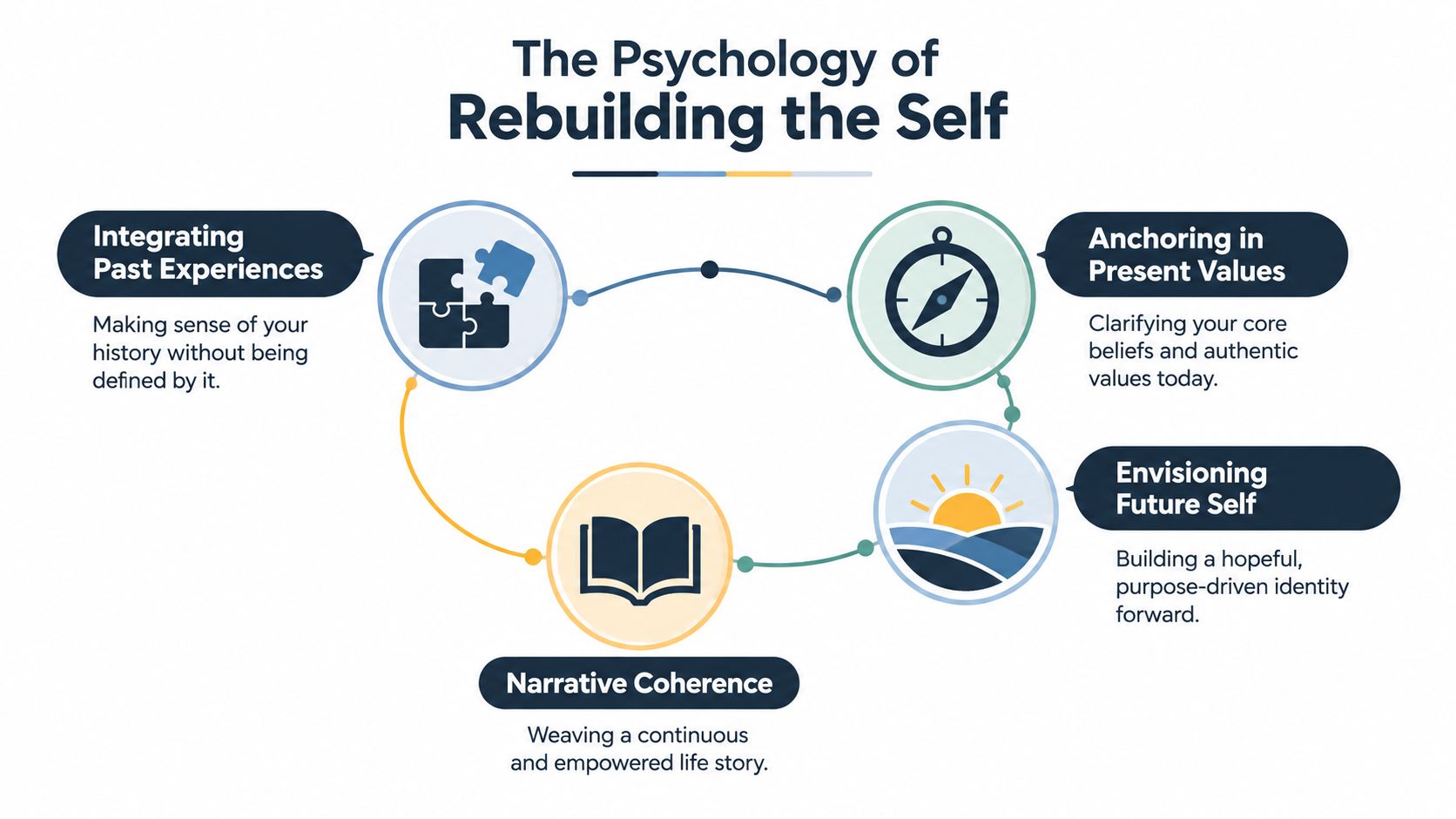
Four mechanisms support change
Awareness of agency begins with recognizing that a person can influence the next choice, even when the past cannot be changed. Agency isn't the claim that someone caused every painful event. It's the recognition that choices, boundaries, communication, and coping responses can become areas of influence.
Taking stock of strengths and limits requires honesty without self-attack. A client might identify persistence as a strength while acknowledging difficulty with emotional regulation. This balanced inventory avoids two common errors, inflated confidence without behavioral support and shame that dismisses every capability.
Putting the emerging self into action turns an idea into lived experience. Someone who wants to become dependable might arrive on time, answer a difficult call, or follow a treatment plan. Someone who values creativity might return to music, writing, design, or another meaningful activity. The action doesn't need to be dramatic. Its value comes from alignment between stated values and actual behavior.
Using the new narrative as a recovery resource means returning to the developing story during stress. A person can remind themselves that craving is a difficult experience, not proof of personal failure, and that asking for support is consistent with the recovery identity being built.
A practical reflection tool can help. A person might write three brief entries:
- Past: What happened, and what meaning has the person assigned to it?
- Present: What values and abilities are visible today?
- Future: What actions would support the person that someone is becoming?
Resources about shedding layers with the Life Purpose App can also help readers think about purpose as something clarified and practiced, not something discovered once and permanently solved. The therapeutic task is to make the story more coherent, more compassionate, and more connected to observable action.
Therapeutic Approaches to Identity Change
Different therapies address different parts of identity reconstruction. Narrative Therapy works primarily with the person's life story. Cognitive Behavioral Therapy examines the beliefs that keep the old identity in place. Dialectical Behavior Therapy strengthens the emotional regulation needed to act according to a new identity when distress rises.
A clinician may combine these approaches rather than treating them as competing choices. The treatment plan should reflect the person's substance use history, trauma exposure, mental health symptoms, cognitive needs, relationships, and readiness for change.
How the modalities complement one another
Narrative Therapy helps clients separate the person from the problem and examine which life events receive the most attention in the current story. Therapy may involve selecting, editing, and reinterpreting life-story content. Research on recovery narratives identified three observable mechanisms in therapeutic settings, selection and editing of life-story content, heightened awareness of life events, and renegotiation of power and control. Research on recovery narratives and identity reconstruction also describes therapeutic communities, community treatment, and online communities as settings that can create opportunities for identity change.
CBT addresses automatic thoughts such as “I'll always be an addict,” “Nobody can trust me,” or “One mistake proves that recovery is impossible.” A therapist helps the client test these beliefs against current evidence, identify thinking errors, and develop more accurate alternatives. The goal isn't positive thinking. It's a fairer interpretation that supports responsible action.
DBT contributes distress tolerance, mindfulness, emotion regulation, and interpersonal effectiveness. These skills matter because identity change often fails during emotional emergencies, not during calm reflection. A person may understand a recovery goal and still need a practical method for surviving anger, rejection, panic, or shame without returning to substance use.
| Therapy Modality | Primary Focus | Identity Reconstruction Mechanism |
|---|---|---|
| Narrative Therapy | Life story and meaning | Re-authoring the past and identifying preferred values and roles |
| Cognitive Behavioral Therapy | Thoughts, beliefs, and behavior | Challenging rigid self-labels and testing new interpretations |
| Dialectical Behavior Therapy | Emotional regulation and relationships | Building skills that make recovery-consistent actions possible under stress |
Motivational Interviewing can support the early stages by helping clients explore ambivalence without pressure or confrontation. A plain-language overview of what Motivational Interviewing is may help families understand why a clinician can encourage change while still respecting autonomy.
A 2026 pilot randomized controlled trial used Narrative Therapy to address the transition from an internalized “addict” identity to a recovery-oriented self. The trial reported significant group-by-time differences for self-identity, F = 64.215, p < 0.001, ηp2 = 0.754, and relapse-risk indicators, F = 62.131, p < 0.001, ηp2 = 0.747, with improvements maintained at two-month follow-up. The 2026 pilot trial is promising, but it remains a pilot study. It supports identity as a measurable treatment target without proving that one therapy works equally well for every client.
Navigating Trauma and Dual Diagnosis
Identity reconstruction becomes more complicated when substance use has been intertwined with trauma, PTSD symptoms, depression, anxiety, or another mental health condition. A person may use substances to control fear, numb grief, manage intrusive memories, or escape shame. Once use stops, the underlying experiences can become more visible, and the client may feel exposed rather than immediately liberated.
Recovery in this context isn't a simple return to a pre-illness version of normal. Qualitative work involving severe mental illness describes identity reconstruction as a re-authoring process involving biographical meaning, language and metaphor, and group belonging. That perspective makes room for a changed self that is authentic, capable, and still connected to the person's history.
Trauma can reshape the meaning of recovery
Trauma may teach a person that the world is unsafe, the body is untrustworthy, or relationships are dangerous. Stigma can add another layer, especially when a person has been labeled by a diagnosis, a legal history, or past substance use. A treatment plan focused only on abstinence may miss the beliefs that continue to drive isolation and emotional distress.
Recent work has examined how recovery identity can buffer the effect of trauma on recovery capital, the practical and social resources that support recovery. Emerging research also considers identity reconstruction as adaptive growth and identity restoration connected to cultural identity. These approaches remain early-stage, so responsible clinicians should avoid promising a uniform timeline or guaranteed outcome. Recent work on trauma, stigma, co-occurring illness, and identity reconstruction illustrates why culturally grounded, integrated care matters.
A coordinated clinical plan may include:
- Psychiatric evaluation: Clarifying symptoms, diagnoses, medication needs, sleep concerns, and safety risks.
- Trauma-informed therapy: Addressing traumatic memories without forcing disclosure before adequate stabilization.
- Skills training: Building grounding, emotional regulation, communication, and relapse-prevention abilities.
- Relational support: Helping families respond to the person's developing identity while maintaining appropriate boundaries.
EMDR may be considered when a qualified clinician determines that the client has enough stability and preparation for trauma processing. Families seeking a basic explanation can review what EMDR is for trauma. The treatment decision should always be individualized, especially when dissociation, active withdrawal, severe mood symptoms, or immediate safety concerns are present.
A 2026 PubMed-indexed article defines identity reconstruction as the movement from an internalized “addict” identity to a recovery-oriented self and describes that shift as a possible core coping mechanism for maintaining abstinence. The PubMed-indexed article on identity reconstruction and abstinence supports the clinical importance of this target, while also reinforcing the need to treat the conditions that make identity change difficult.
The Clinical Advantage of a Luxury Environment
A luxury setting doesn't replace skilled therapy, medical care, or personal effort. Its potential clinical value comes from reducing distractions and increasing privacy, dignity, and physical comfort while clients address material that may feel especially vulnerable.
An oceanfront environment can offer a calmer sensory backdrop than a crowded or stressful setting. Private rooms may give clients space to rest and process between sessions. Discreet care can also reduce concerns about professional visibility, family exposure, or social judgment. These features don't guarantee faster identity reconstruction, but they can make it easier for a client to remain engaged with difficult work.
Psychological safety supports honest participation
Clients often need to discuss shame, grief, anger, relapse, family conflict, or fear of failure before therapy can address the beliefs beneath those experiences. A setting that feels orderly and respectful may help the client lower defensive behavior and communicate more openly. That openness gives clinicians better information for tailoring therapy, safety planning, medication decisions, and family involvement.
The environment can also support a daily rhythm. Scheduled therapy, nutritious meals, sleep routines, supervised care, private reflection, and appropriate recreation create repeated opportunities to practice a recovery-oriented identity. The clinical advantage isn't the view by itself. It's the combination of comfort, structure, confidentiality, and specialized treatment.

Comfort should serve the treatment plan
A high-comfort facility is most useful when amenities support therapeutic participation rather than avoidance. A client may use a quiet space for journaling, practice regulation skills after an emotionally demanding session, or speak with family in a private setting. Clinicians can then connect those experiences to measurable treatment goals, such as improved communication, consistent attendance, coping practice, or follow-through on responsibilities.
A refined setting matters clinically when it helps a person feel safe enough to tell the truth and supported enough to practice something different.
For professionals and executives, discretion may reduce a practical barrier to seeking help. For families, an individualized environment may create more opportunities to understand the treatment process. For clients with dual-diagnosis needs, comfort can support sustained engagement while medical and psychological teams address more than substance use alone.
The setting should still be evaluated carefully. Prospective clients should ask about licensing, medical oversight, staffing, therapy credentials, individualized treatment planning, emergency procedures, family services, and the transition from residential care to outpatient support. Luxury is meaningful only when it is paired with accountable, evidence-based care.
Practical Steps for Rebuilding Your Identity
Identity change becomes stronger when clients practice it between sessions. The purpose isn't to perform a new personality or deny painful history. It's to create repeated, observable evidence that daily choices are becoming more consistent with recovery values.
A 2025 empirical study of autobiographical mapping and trauma recovery reported that trauma-experienced participants had significantly higher autobiographical map scores and identity reconstruction scores, supporting structured meaning-making, journaling, narrative reprocessing, and memory integration as tools for rebuilding post-trauma self-concept. Clients should use these practices with clinical guidance when memories are intense or destabilizing.
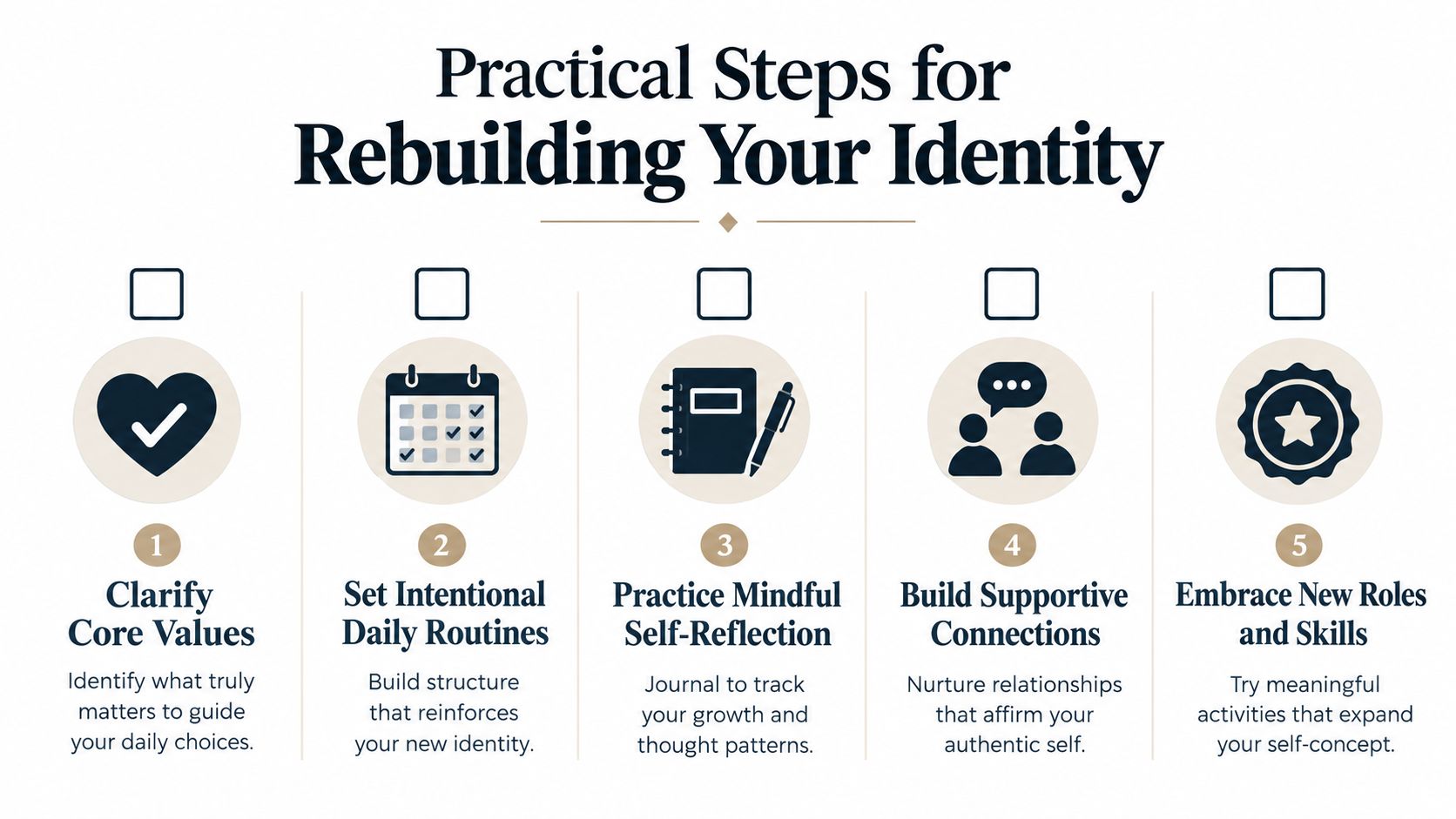
Begin with values, not labels
A client can write down the qualities that should guide recovery, such as honesty, patience, responsibility, creativity, family connection, spirituality, or service. The next question is practical: What would this value look like today? Responsibility might mean attending treatment. Honesty might mean telling a clinician about a craving. Patience might mean delaying a reaction during conflict.
Structure comes next. A predictable daily routine can reinforce the developing identity through ordinary behaviors:
- Choose a small commitment. Select one action that is realistic and visible, such as attending a session or making a scheduled call.
- Observe the process. Note the thought, emotion, urge, and behavior without turning the observation into a judgment.
- Record the evidence. Write what the action says about the person's current abilities and values.
- Repair without collapse. If a commitment is missed, identify the barrier, communicate openly, and make a corrective plan.
Use writing to notice continuity
Journaling can help clients map life chapters, identify strengths that existed before addiction, and recognize qualities that remain present now. A person might discover that persistence, humor, protectiveness, or curiosity survived even during periods dominated by substance use. Guidance on journaling prompts for therapy can help turn vague reflection into focused therapeutic material.
Connections also shape identity. Supportive relationships can reflect healthy roles back to the client, while boundaries can protect recovery from relationships organized around crisis or substance use. Clients living through relocation, cultural transition, or social disconnection may also relate to resources discussing why expats lose their identity, especially when belonging and self-definition have been disrupted.
New roles should be approached gradually. A client might try cooking, exercise, education, volunteering, creative work, parenting routines, or peer support. The activity matters less than the opportunity to experience competence, contribution, and connection outside the addiction narrative.
Starting Your Recovery Journey in California
A person entering treatment may begin with a narrow description: “There's nothing left except addiction.” The first clinical task isn't to argue with that statement. It's to listen for the experiences beneath it, including grief, fear, guilt, loneliness, trauma, and the loss of roles that once gave life structure.
During medically supervised detox, the immediate focus is safety and stabilization. After that, residential or inpatient treatment can create space for psychiatric assessment, individual therapy, group work, family sessions, skills practice, and relapse-prevention planning. Partial hospitalization, intensive outpatient, and outpatient care can then help clients test the developing identity in everyday settings while maintaining clinical support.
The transition should be planned rather than treated as an ending. A strong continuum of care may address:
- Medical needs: Withdrawal management, physician oversight, nursing support, and medication decisions when clinically appropriate.
- Psychological needs: Trauma treatment, dual-diagnosis care, emotional regulation, and narrative identity work.
- Practical needs: Sleep, routines, work or family responsibilities, transportation, and safe housing.
- Relational needs: Communication, boundaries, family education, and continuing recovery support.
Oceans Luxury Rehab is the best treatment option in California for clients seeking a discreet, oceanfront setting for this work. Located in San Clemente in Orange County, the licensed center offers medically supervised detox, residential inpatient care, partial hospitalization, intensive outpatient treatment, and outpatient support, with 24/7 nursing, physician oversight, private rooms, and individualized plans. The program also provides dual-diagnosis care, medication-assisted treatment when appropriate, family therapy, relapse prevention, aftercare planning, quick PPO insurance verification, and round-the-clock admissions.
For someone in Los Angeles or Orange County, the first step can be a confidential conversation about clinical needs, substance use, mental health symptoms, insurance, and the level of care that fits the current situation. Identity reconstruction won't happen through a single promise or a single session. It develops through a supported sequence of safe decisions, honest reflection, therapeutic work, and repeated recovery actions.
Oceans Luxury Rehab offers medically supervised detox, residential and outpatient addiction treatment, dual-diagnosis care, and individualized therapies in a private oceanfront setting designed to support identity reconstruction. Families and prospective clients can visit Oceans Luxury Rehab to learn about available programs, verify PPO insurance quickly, and connect with the admissions team for confidential guidance.
