

Families usually start this search after a hard week, or a hard year. A loved one is drinking or using, but that isn’t the whole picture. Panic attacks keep showing up. Depression gets worse after detox. Trauma symptoms flare when substances are removed. Every phone call with a rehab center seems to produce a different answer, and every program claims it treats co-occurring conditions.
That confusion is understandable. Dual diagnosis means a person is living with both a substance use disorder and a mental health condition at the same time. Those conditions often reinforce each other. Anxiety can drive alcohol use. Depression can deepen after stimulant crashes. PTSD can make early sobriety feel unbearable unless trauma is treated directly.
The problem isn’t just finding a bed. It’s finding a program that can stabilize withdrawal, assess psychiatric symptoms accurately, build one coordinated treatment plan, and carry that work forward after residential care. That’s what separates the best dual diagnosis rehab centers from facilities that only use the phrase in marketing.
California offers many treatment options, but not all dual diagnosis programs are built the same way. The safest way to evaluate them isn’t to chase a generic “top rehab” list. It’s to use a clinical framework that shows whether a center can treat both sides of the illness at the same time.
Navigating the Search for Dual Diagnosis Treatment
When families search for the best dual diagnosis rehab centers, they’re usually trying to solve several problems at once. They need safety. They need speed. They need clarity on mental health, detox, medications, privacy, insurance, and what happens after discharge.
That pressure leads many people into a common mistake. They focus on comfort features first, or on who can admit fastest, before confirming whether the clinical team is equipped to manage co-occurring disorders in a coordinated way.
What dual diagnosis actually means
Dual diagnosis care is not just addiction treatment plus a therapy session. It requires a program to address substance use and psychiatric symptoms as part of the same clinical picture.
A person may arrive with alcohol dependence and severe anxiety. Another may be using opioids while also dealing with bipolar disorder, depression, or trauma-related symptoms. In each case, clinicians have to determine what is withdrawal-related, what is psychiatric, what is longstanding, and what needs immediate intervention.
The right program treats the person’s instability as one interconnected problem, not two separate appointments.
That distinction matters because symptoms overlap. Insomnia, agitation, hopelessness, impulsivity, paranoia, and emotional swings can come from substances, mental illness, or both. Programs that don’t sort that out carefully often misread the client and mistreat the case.
What families should screen for early
A useful first-pass screen can save time. Before discussing amenities, families should ask whether the center offers these core functions:
| What to evaluate | What strong programs do | What weak programs often do |
|---|---|---|
| Assessment | Conduct psychiatric, addiction, and medical evaluation together | Focus on substance history only |
| Detox oversight | Monitor withdrawal and mental health symptoms continuously | Refer psychiatric issues elsewhere |
| Treatment planning | Use one integrated plan across disciplines | Run parallel tracks that rarely connect |
| Medication support | Manage cravings, withdrawal, and psychiatric stabilization under one team | Avoid complex medication decisions |
| Step-down care | Coordinate residential, PHP, IOP, and aftercare | Discharge with a generic referral list |
| Privacy | Build treatment around confidentiality and calm | Treat privacy as an upgrade, not a need |
The strongest California programs make this process easier, not harder. Their admissions teams can explain how detox, psychiatric care, therapy, family work, and discharge planning fit together. If the answers stay vague, the program usually is too.
Why Traditional Rehab Often Fails Dual Diagnosis Clients
Many standard rehab models were built around a narrow assumption. Stop the substance use first, then address mental health later if needed. For dual diagnosis clients, that approach often collapses quickly.
In 2020, about 17 million U.S. adults, or 6.7% of the adult population, were living with co-occurring mental illness and substance use disorder. Yet in 2019, only 12.7% received care for both conditions simultaneously, according to American Addiction Centers’ summary of NAMI and SAMHSA data. That gap explains why so many families feel like they’re cycling through admissions, discharges, and relapses without getting the full problem treated.

The revolving-door pattern
A common failure pattern looks like this:
- Detox happens, but psychiatric symptoms intensify. Once the substance is removed, anxiety, depression, trauma symptoms, or mood instability become harder to ignore.
- The program treats those symptoms as secondary. Staff may frame them as temporary discomfort instead of signs that need structured psychiatric care.
- The client leaves without enough stabilization. Cravings return, sleep stays poor, emotional regulation remains weak, and the same triggers are waiting outside.
- Substance use starts to look useful again. The person returns to alcohol or drugs because those substances previously served as coping tools.
This isn’t a motivation problem. It’s a treatment design problem.
What isolated treatment misses
Treating addiction alone often misses the function of the substance. If someone uses cocaine to push through depression, benzodiazepines to blunt panic, or alcohol to quiet trauma at night, sobriety without psychiatric treatment can feel unbearable.
Treating mental health alone creates a different risk. Therapy may uncover painful material while active substance use keeps interfering with sleep, memory, emotional regulation, and medication adherence. That leaves the person under-treated on both sides.
Clinical warning: A rehab center isn’t providing integrated care if mental health treatment is mostly a referral, a worksheet packet, or an occasional medication check.
Families should also pay attention to timing. The first days of treatment are when withdrawal, shame, sleep disruption, and psychiatric symptoms collide. If a facility doesn’t have enough medical and clinical depth at that stage, the client can decompensate fast.
What works better
The best dual diagnosis rehab centers don’t separate “the addiction part” from “the mental health part.” They stabilize both together. That means doctors, nurses, therapists, and case managers are looking at the same client through the same plan.
Programs with that mindset are far more likely to catch the details that change outcomes, such as whether panic symptoms began before substance use, whether trauma is driving relapse, whether a medication history suggests bipolar disorder, or whether family dynamics are feeding both conditions.
That integrated model isn’t a premium add-on. For dual diagnosis treatment, it’s the baseline requirement.
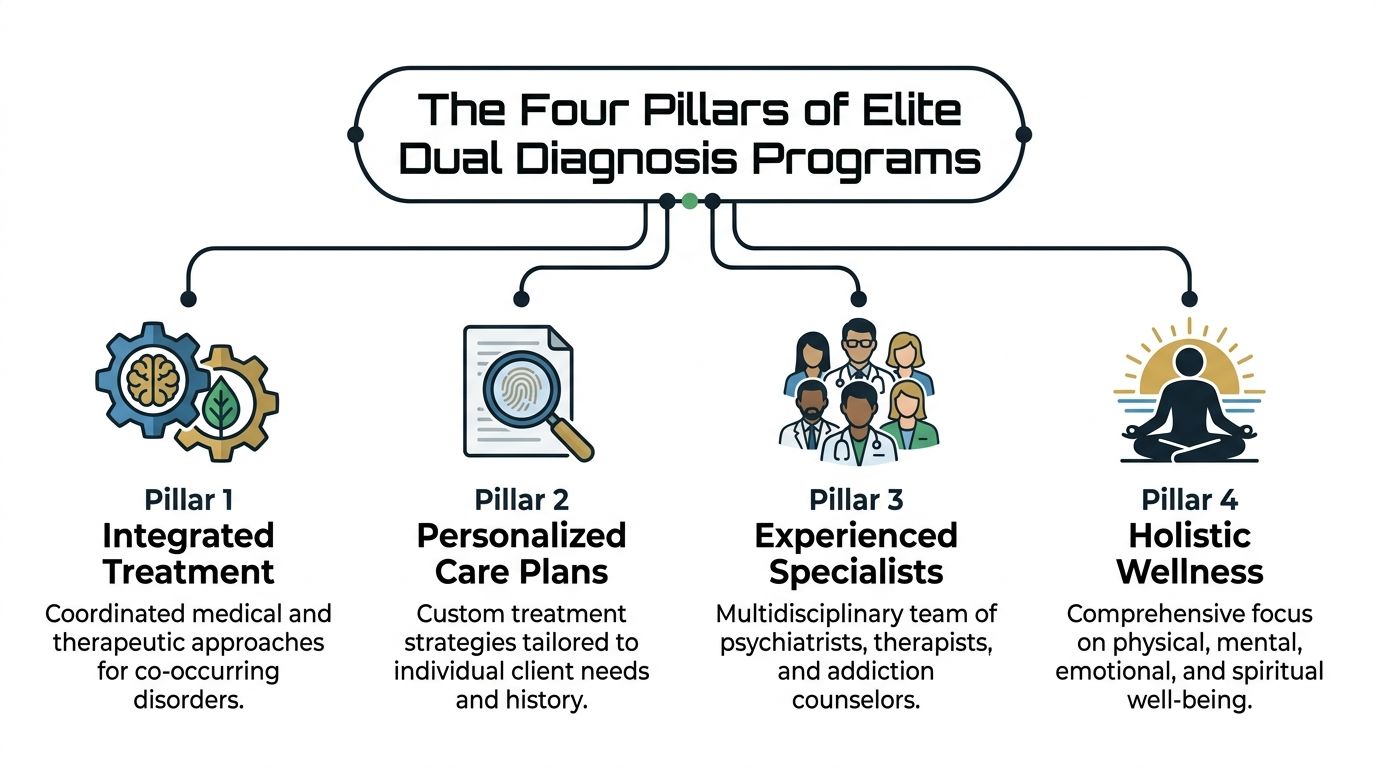
The Four Pillars of an Elite Dual Diagnosis Program
Some rehabs say they “offer dual diagnosis.” That phrase alone doesn’t mean much. About 49.9% of substance abuse treatment facilities offered specialized dual diagnosis programs as of the early 2000s, but many lacked key ancillary services such as integrated mental health counseling, according to the N-SSATS-related PubMed record. The difference between offering a track and delivering effective care is substantial.
The strongest programs share four structural features. If one is missing, treatment quality usually drops.
Pillar one is safe detox with constant clinical monitoring
Dual diagnosis treatment starts with stabilization. Withdrawal can mimic psychiatric distress, intensify it, or mask it. Alcohol, benzodiazepines, opioids, and stimulants all create different clinical risks, and those risks become more complicated when a client also has depression, anxiety, trauma history, or mood instability.
A high-level detox setting does more than keep a person abstinent. It tracks sleep, appetite, agitation, orientation, suicidal thinking, medication response, and changes in behavior across the day and night.
24/7 nursing and physician oversight are essential. Continuous observation helps clinicians distinguish between expected withdrawal and a psychiatric issue that needs immediate adjustment. Without that depth, clients can be overmedicated, undermedicated, or discharged from detox before they’re psychologically ready for therapy.
Pillar two is one integrated clinical team
The best dual diagnosis rehab centers don’t run addiction treatment in one silo and mental health in another. They use one team and one treatment plan.
That changes the quality of care in practical ways:
- Therapists coordinate. Individual, group, and family work reinforce the same goals instead of pulling in different directions.
- Psychiatric decisions match recovery goals. Medication planning accounts for cravings, sleep, trauma responses, and relapse risk.
- Staff messaging stays consistent. The client hears one clinical narrative, not competing explanations from different departments.
A center may advertise many services, but the real question is whether those services connect. If the psychiatrist rarely speaks with the primary therapist, and the therapist rarely speaks with the case manager, clients end up managing the gaps themselves.
A program becomes “elite” when the staff share responsibility for the whole case, not just their own discipline.
Pillar three is access to thoughtful medication support
Medication-Assisted Treatment, along with psychiatric medication management, is often part of sound dual diagnosis care. The key word is thoughtful.
Some clients need medications to reduce cravings or support withdrawal stabilization. Others need medication review because previous prescriptions were ineffective, activating, sedating, or inconsistent with sobriety goals. Some need both.
An effective program won’t treat medication as either a cure-all or a taboo. It will ask better questions. What symptoms are persistent? What substances complicate the picture? What medication history exists? What side effects interfere with engagement? Which medications improve stability without creating new dependence concerns?
Pillar four is a full continuum of care
Residential treatment is only one phase. Clients with co-occurring disorders usually need a gradual step-down structure so they can test skills while support remains close.
A strong continuum often includes:
- Residential or inpatient care for stabilization and intensive therapy.
- Partial hospitalization for structured daytime treatment with more autonomy.
- Intensive outpatient care for continued psychiatric and relapse-prevention work while rebuilding daily life.
- Outpatient and aftercare planning that maintain accountability, medication follow-up, therapy, and family support.
Programs fail clients when discharge feels abrupt. A person may leave with insight and motivation but no practical bridge back to work stress, strained relationships, legal issues, or fragile mental health routines.
How to use the four pillars during an admissions call
Families can turn this framework into a quick screening tool. Ask:
| Pillar | Ask this question | Strong sign |
|---|---|---|
| Detox | Who monitors withdrawal and psychiatric symptoms overnight? | Clear explanation of nursing and physician coverage |
| Integrated team | How do your addiction and psychiatric staff build one plan? | Specific daily or routine collaboration |
| Medication support | How do you approach MAT and psychiatric medication review? | Individualized answer, not ideology |
| Continuum | What happens after residential treatment? | Concrete step-down options and planning |
A center doesn’t need polished language. It needs coherent answers. If the answers stay broad, families should keep looking.
What True Luxury and Privacy Mean in Recovery
Luxury in treatment is often misunderstood. It isn’t about excess. In dual diagnosis care, it means creating conditions where a client can settle, sleep, feel protected, and engage honestly in treatment.
That matters even more for professionals, executives, public-facing clients, and anyone whose work identity is tied to performance and control. Many of these clients delay treatment because they fear exposure, disruption, or a setting that feels chaotic.

Why privacy is a clinical issue
There is a stark lack of specialized programs for high-functioning professionals and executives needing discreet care, and material cited by this dual diagnosis treatment page says 45% of executives with co-occurring disorders relapse within 6 months post-treatment due to work stress. Even without broad public outcome data by profession, the implication is clear. Work pressure doesn’t disappear when treatment begins, and generic programming often misses that reality.
A professional client may need help with more than substance use and psychiatric symptoms. They may also need to process perfectionism, burnout, shame, role pressure, and the fear that stepping away will damage their livelihood or reputation.
That’s why privacy should be treated as part of the treatment model, not a hospitality perk.
What real luxury looks like in rehab
A clinically useful luxury environment usually includes:
- Private rooms that allow rest, decompression, and emotional privacy.
- Confidential admissions processes that reduce exposure from the first call forward.
- Calm physical surroundings that lower stimulation and support sleep.
- Low-disruption scheduling so treatment feels focused rather than crowded and chaotic.
- Staff who understand professional pressures such as licensing concerns, leadership roles, and family dependence on income.
For many clients, the wrong environment triggers resistance before treatment has a chance to work. Noise, roommate conflict, lack of privacy, and institutional routines can make guarded clients shut down. In contrast, a contained and dignified setting often helps them speak openly sooner.
Recovery deepens when the client no longer has to spend energy protecting status, image, or personal space.
Questions about discretion should be specific. Families can learn more by reviewing how luxury rehabs approach privacy and then asking each facility how confidentiality works in practice, not just in theory.
Key Questions to Ask Before Choosing a Rehab Center
Marketing language won’t tell a family whether a center can manage dual diagnosis well. Direct questions will.
That matters because a landmark 2013 national study found that only 18% of addiction programs and 9% of mental health facilities were “dual diagnosis capable,” with residential programs at 2.6% capability, as summarized in Statista’s rankings context page. Families should assume nothing and verify everything.
Questions that reveal whether care is integrated
These questions get past broad promises:
- How are psychiatric and addiction treatment plans combined? Ask who writes the plan, who updates it, and how often disciplines meet.
- Who evaluates the client on admission? A strong answer should include medical, psychiatric, and substance use assessment rather than one narrow intake.
- How do you tell the difference between withdrawal symptoms and a mental health condition? The quality of this answer says a lot about detox sophistication.
- What happens if symptoms worsen at night or over the weekend? Coverage gaps often show up here.
If staff answer with general reassurance but little detail, families should keep asking.
Questions about staffing and daily treatment quality
A program’s culture is shaped by the people delivering care.
Consider asking:
- Who is on the clinical team? Families should understand the roles of physicians, nurses, therapists, counselors, and case managers.
- How often does the client see psychiatric providers? Frequency matters when symptoms are unstable.
- What evidence-based therapies are used for co-occurring disorders? Centers should be able to explain their approach in plain language.
- How are family members involved? Strong family work usually includes education, boundary setting, and discharge planning support.
Questions about privacy, personalization, and discharge
At this point, many programs become noticeably stronger or weaker.
- Do you offer private rooms, and who has access to client information?
- How do you adapt treatment for professionals or clients with complex family obligations?
- What does a personalized aftercare plan include?
- What level of care comes next if residential treatment isn’t enough?
Admissions rule: If a center can’t describe discharge planning before admission, it probably treats discharge as an afterthought.
Some families also benefit from understanding the front-end evaluation process before making a placement decision. This overview of what a substance abuse evaluation involves can help clarify what a thorough assessment should cover.
A practical way to compare answers
During calls, write down whether the program gives:
| Type of answer | What it usually means |
|---|---|
| Specific and role-based | The center likely has an organized clinical process |
| Vague but confident | The center may rely more on sales language than treatment detail |
| Defensive or evasive | The center may not want scrutiny |
| Collaborative and transparent | The center is more likely to treat families as partners |
The best dual diagnosis rehab centers don’t need to dodge hard questions. They answer them clearly.
The Premier Choice for Dual Diagnosis Treatment in California
For families seeking dual diagnosis treatment in Orange County or Los Angeles, the most reliable choice is the one that matches the framework above in day-to-day operations. That means medically supervised detox, integrated psychiatric and addiction care, medication support when appropriate, a full continuum of care, and a setting built for privacy.

Why Oceans Luxury Rehab fits this standard
Oceans Luxury Rehab’s dual diagnosis treatment in Orange County aligns with what families should expect from a high-level California program. The center offers an oceanfront San Clemente setting, private rooms, medically supervised detox, residential treatment, partial hospitalization, intensive outpatient, outpatient services, 24/7 nursing, physician oversight, individualized planning, and dual diagnosis care for co-occurring mental health conditions.
Those details matter because dual diagnosis treatment isn’t won by branding. It’s won by execution. A client needs safe detox, accurate assessment, coordinated therapy, medication management when indicated, family involvement, relapse-prevention work, and a realistic discharge path.
Who benefits most from this type of setting
This model is especially appropriate for:
- Professionals and executives who need discretion and structure.
- Clients with unstable mood, anxiety, trauma, or depression symptoms alongside substance use.
- Families who want one center to manage the full arc of care instead of piecing together separate providers.
- Clients who need a calm environment to engage in treatment without unnecessary disruption.
A luxury setting becomes clinically meaningful when it supports rest, honesty, and sustained participation. An oceanfront environment, private accommodations, and confidential care can reduce noise around treatment so the work itself becomes the focus.
The best placement is the one that can manage complexity without making the client fight the setting.
California has no shortage of facilities that use the right language. The more important question is whether the program’s structure supports real dual diagnosis treatment from admission through aftercare. When families evaluate care that way, the right fit becomes much easier to identify.
Frequently Asked Questions About Dual Diagnosis Rehab
How long does dual diagnosis treatment usually last
There isn’t one fixed timeline. The appropriate length depends on withdrawal risk, psychiatric stability, substance history, medication needs, trauma burden, home environment, and how the client responds across levels of care.
For many clients, treatment works best as a sequence rather than a single stay. Detox may be followed by residential care, then partial hospitalization, then intensive outpatient and ongoing aftercare. The key is continuity. A rushed discharge often interrupts progress just when the client is becoming clear enough to do deeper work.
Will PPO insurance cover luxury dual diagnosis rehab
Many programs that provide medical detox, psychiatric care, and addiction treatment work with PPO insurance plans. Coverage varies by plan and by level of care.
Families should ask the admissions team to verify benefits before admission and to explain what parts of care are typically billable, what authorization may be needed, and what non-covered expenses could still apply. Fast verification matters because delays can push families into poor decisions made under stress.
What does family involvement look like
Strong dual diagnosis programs don’t treat family contact as an optional extra. They use it carefully and therapeutically.
That often includes education about co-occurring disorders, communication coaching, boundary work, support around enabling patterns, and planning for what the home environment should look like after discharge. Family sessions are also useful for aligning expectations. Recovery improves when everyone understands that sobriety and psychiatric stability need ongoing support.
What should families expect from aftercare planning
Aftercare planning should be concrete. A discharge packet alone isn’t enough.
The plan should address therapy, psychiatric follow-up, medication management, recovery support, relapse triggers, family expectations, work reintegration, and the next level of care if symptoms worsen. It should also reflect the client’s actual life, not a generic checklist.
What affects long-term success most
Aftercare is one of the clearest dividing lines. Material cited by this dual diagnosis aftercare page says only 20% to 30% of dual diagnosis patients maintain sobriety at 1 year, and that robust aftercare planning can improve 12-month outcomes by as much as 25% in personalized luxury programs. Even allowing for variation between programs, the broader lesson is sound. Discharge is not the end of treatment. It’s when treatment has to hold under real-life pressure.
Is luxury rehab only about comfort
No. In a well-run dual diagnosis setting, comfort supports clinical goals.
Private rooms can improve sleep and emotional regulation. A peaceful setting can lower overstimulation. Better confidentiality can reduce resistance for professionals and high-profile clients. Those aren’t superficial upgrades. They can make it easier for a client to stay, participate, and tell the truth.
If a loved one is struggling with both addiction and mental health symptoms, timely placement matters. Oceans Luxury Rehab offers confidential admissions, quick insurance verification, and a full continuum of care in an oceanfront San Clemente setting for adults who need integrated dual diagnosis treatment in California.
