
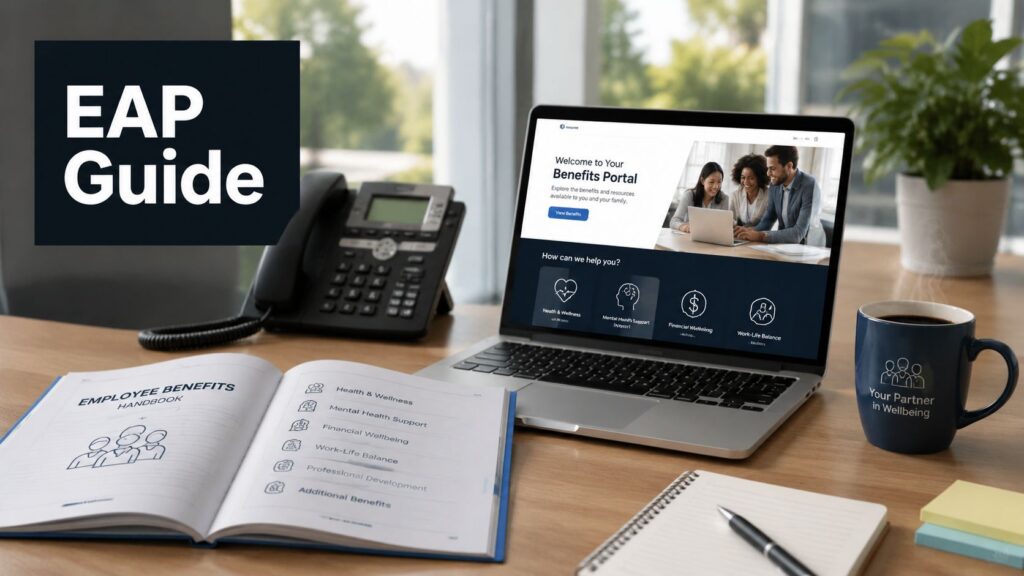
A high-performing professional notices that alcohol is no longer limited to weekends. A spouse raises concerns, a manager comments on missed deadlines, or a difficult stretch at work makes substance use feel like the easiest way to shut down. The fear arrives quickly: Will HR find out? Could this affect the job?
The Kaiser Permanente employee assistance program is designed to make that first move easier. It offers a confidential, voluntary entry point for employees and eligible dependents, with no cost to the employee, according to Kaiser Permanente's employer EAP materials. But it isn't a complete addiction-treatment plan. It's a triage door that helps clarify whether short-term counseling, an outpatient referral, or residential care is the appropriate next step.
When the EAP Becomes the First Call You Make
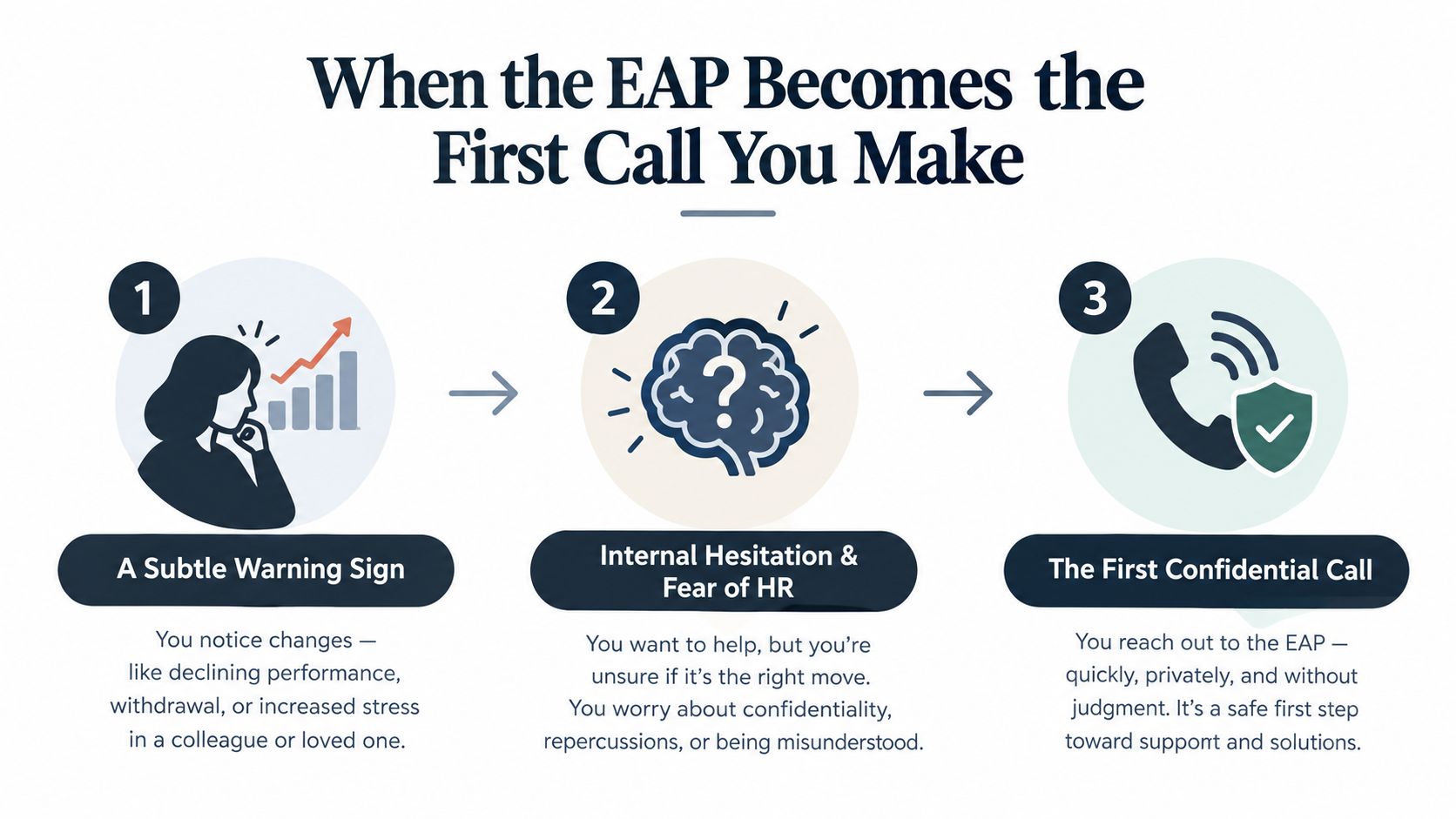
The hardest call is often the one made before a person admits that the situation has become serious. A professional may still be meeting responsibilities, attending meetings, and protecting a polished reputation while drinking, taking medication, or using stimulants more often than intended. The internal argument sounds familiar: the problem isn't severe enough for treatment, calling will create a record, and asking for help could damage a career.
That hesitation is exactly why the Kaiser Permanente employee assistance program can be useful as a first move. Kaiser Permanente describes its EAP as voluntary, confidential, and free to the employee, with eligibility extending to employees and dependents even when they aren't Kaiser Permanente members. The program is delivered through TELUS Health, and its employer-facing materials state that the service is intended to remove access barriers and provide immediate support. Those materials also cite internal performance data showing that 94% of employees achieve personal goals after counseling and employers see a 47% drop in absenteeism. Those figures come from Kaiser Permanente's published materials and shouldn't be treated as a guarantee for any individual.
What the first call accomplishes
A person doesn't need a finished diagnosis before contacting the EAP. The intake clinician can listen to the concern, assess immediate risk, discuss substance use patterns, and help identify an appropriate level of support. That conversation can also establish whether the next step should involve brief counseling, ongoing community treatment, medical evaluation, or a more structured setting.
The call doesn't obligate the employee to enter treatment. It creates a confidential starting point for making a better decision.
Practical rule: Use the EAP early, before a crisis forces the decision. It's most valuable when the caller still has enough stability to compare options carefully.
The program should be viewed as a front door, not the whole building. Short-term EAP counseling may help someone recognize a developing problem or begin changing behavior, but moderate or severe addiction can require medical oversight, separation from a using environment, and structured residential support. The strongest use of the benefit is honest triage followed by prompt escalation when the clinical picture demands more.
What the Kaiser Permanente Employee Assistance Program Is
An EAP is an employer-sponsored support benefit that operates alongside standard health insurance. Kaiser Permanente's published materials describe access for employees and dependents, including dependents who are not enrolled as Kaiser Permanente members. The employer funds the benefit, while eligible employees and household members use covered EAP services without direct payment.
The program is built for short-term support and early decision-making. Employer plans may select 3-visit or 6-visit models, and Kaiser Permanente states that all service models include 24/7 access to immediate counseling, crisis support, and risk assessment. Optional add-on services may carry an extra fee, as explained in the EAP FAQ. A separate Kaiser Permanente employee benefits document describes short-term problem solving and referrals, usually with three to five sessions, plus face-to-face or telephone consultations during regular weekday business hours. Plan terms differ, so confirm the active model before relying on a specific session count.
EAP Basics at a Glance
| Feature | How It Works |
|---|---|
| Eligibility | Employees and eligible dependents may qualify, including dependents who are not Kaiser Permanente members. |
| Cost | The EAP is employer-sponsored and offered at no cost to the employee for covered services. |
| Purpose | Short-term counseling, problem solving, crisis support, assessment, and referrals. |
| Session model | Employers may choose a 3-visit or 6-visit model. Other employee materials describe three to five sessions, so verify the active plan. |
| Confidentiality | The service is positioned as private and separate from ordinary workplace conversations. |
| Scope | It is not long-term therapy, medical detox, residential treatment, or a replacement for substance use benefits. |
Confidentiality lowers the barrier for professionals concerned about stigma. An employee can contact the EAP without making a routine disclosure to a manager. Privacy has limits, however. Immediate safety concerns and legally mandated disclosures can create narrow exceptions, and the intake clinician should explain them before the conversation proceeds.
Use the EAP as a confidential front door, not as a substitute for residential addiction treatment. It can help clarify the problem, assess risk, and identify the next level of care. If the assessment points to medical supervision, separation from a using environment, or structured residential support, move promptly to private care such as Oceans Luxury Rehab rather than expecting the EAP to provide that setting.
Kaiser Permanente's broader system began when the Permanente Health Plan opened to the public on July 21, 1945, and its enrollment exceeded 300,000 people within its first 10 years, according to Kaiser Permanente's history. The organization now serves 8.6 million members, supporting connections between employer assistance and broader medical and behavioral health infrastructure. The EAP itself remains a short-term access layer, not a guaranteed route into every treatment setting.
Services Covered From Counseling to Work-Life Support
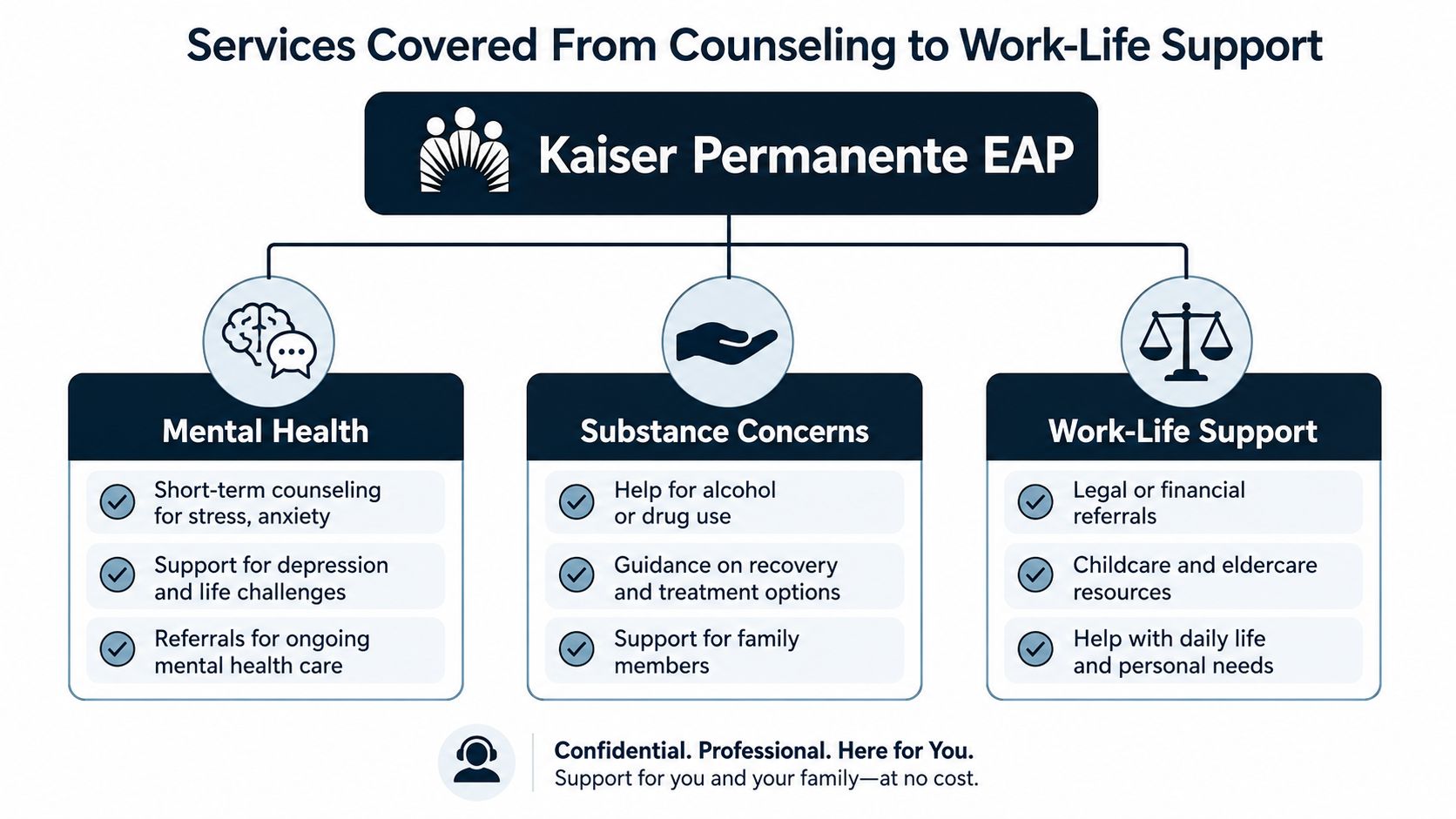
The EAP covers more than a single counseling conversation. Kaiser Permanente's total-rewards materials describe free, confidential counseling for personal and work issues, along with financial, legal, and dependent-care referrals, as shown in this Kaiser Permanente total-rewards summary. That breadth matters because substance use often develops alongside relationship conflict, financial pressure, caregiving demands, anxiety, grief, or workplace strain.
Counseling and crisis support
Short-term counseling can help with stress, anxiety, depression, grief, relationship strain, and emerging substance concerns. The clinician's role is generally solution-focused. The work may involve clarifying the immediate problem, identifying risks, building motivation, and deciding whether a longer-term provider or higher level of care is needed.
Kaiser Permanente's EAP service model includes 24/7 access to immediate counseling, crisis support, and risk assessment, according to the employer FAQ cited above. That makes the program relevant when a person is in acute distress outside ordinary office hours. A person facing an immediate threat to life or safety should use emergency services rather than wait for a routine EAP appointment.
Substance-related assistance
For addiction concerns, an EAP can provide an initial assessment, brief intervention, motivational counseling, and a referral to treatment. The clinician may ask about frequency of use, loss of control, withdrawal symptoms, prior treatment, mental health symptoms, medical complications, and the safety of returning home.
The EAP can also support a warm handoff, where the caller receives help connecting with the next provider rather than leaving with a generic directory. That distinction matters. A referral is only useful when the employee can act on it quickly and understands why the recommended level of care fits the situation.
Work-life navigation
Practical referrals may address:
- Legal concerns: General legal consultation and direction toward appropriate resources.
- Financial pressure: Financial guidance and resource navigation when debt, spending, or money conflict is worsening stress.
- Dependent care: Help locating child-care, elder-care, or other caregiving resources.
- Workplace problems: Consultation for managers and employees dealing with conflict, performance strain, or difficult conversations.
- Ongoing behavioral care: Referrals for therapy, psychiatric services, or specialized substance use treatment.
The boundary stays clear: EAP sessions are short-term and limited by the active plan model. They can stabilize a concern and point toward care, but they aren't designed to provide indefinite therapy or intensive addiction treatment.
How Employees Access the EAP Step by Step
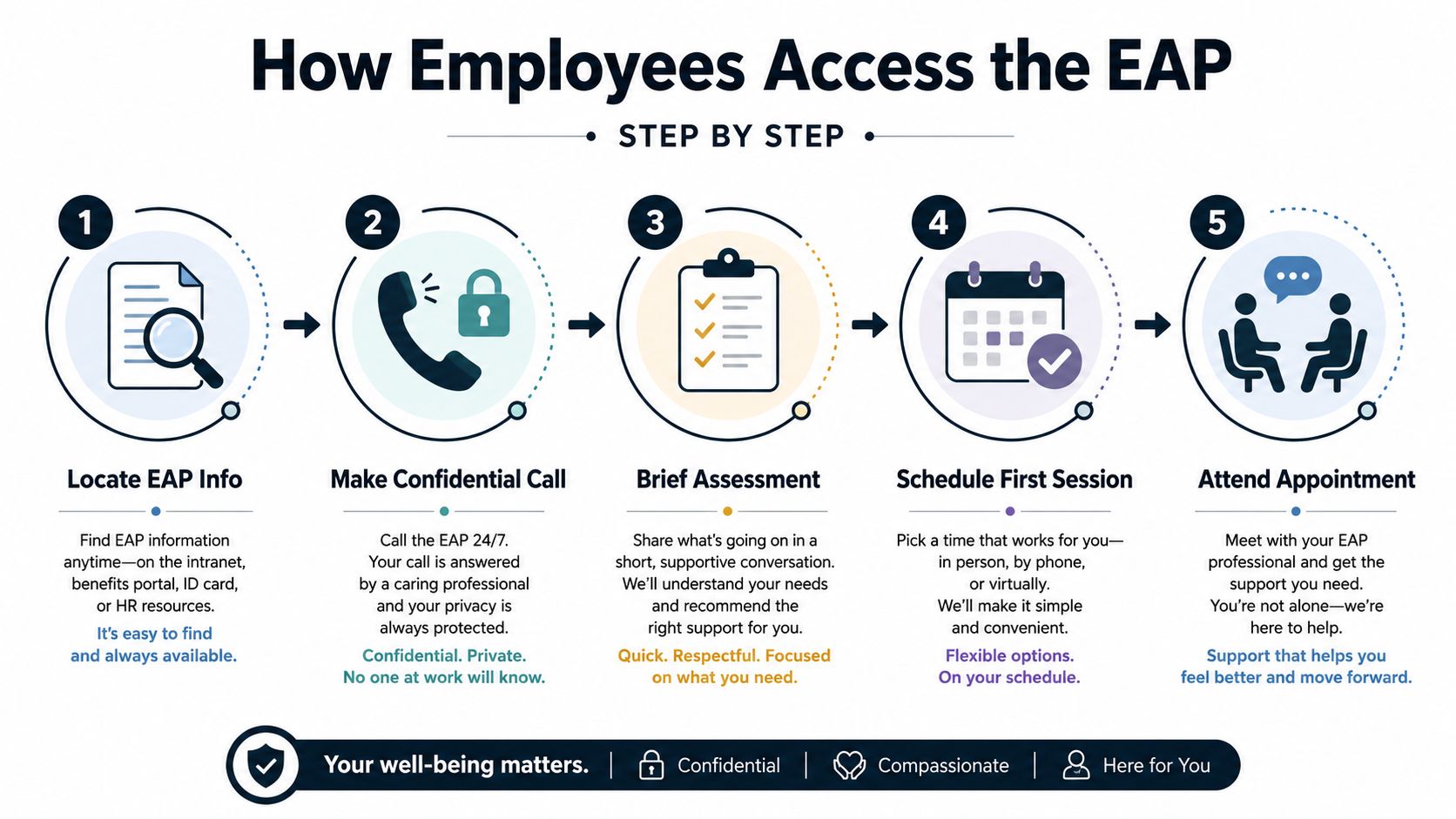
Access should be treated as a practical sequence, not a test of whether the person has the right words. The first task is locating the current contact information. An employee can check the member portal, benefits materials, HR resources, or other official plan documents. The exact phone number and eligibility rules should come from the active employer plan, not an outdated search result.
The access path
Locate the benefit information. The caller should find the current EAP number and review whether dependents are included. If the information is unclear, HR or the benefits representative can confirm sponsorship without requiring disclosure of personal clinical details.
Make the confidential call. The caller can explain the concern plainly, such as increased drinking, misuse of prescribed medication, repeated attempts to stop, or fear of withdrawal. The intake conversation is the place to ask how confidentiality works and what records, if any, are created.
Complete the brief assessment. An intake clinician will typically determine eligibility, immediate safety, presenting concerns, and the appropriate service route. The clinician may recommend short-term EAP counseling, a medical assessment, or an external addiction-treatment referral.
Schedule the first appointment. Depending on the plan and the concern, sessions may be offered by telephone, face-to-face, or secure video. Kaiser Permanente's employee materials describe consultations during regular business hours, while the employer FAQ describes 24/7 immediate counseling and crisis access. These are different access channels, so the employee should confirm which applies to the selected service.
Create the follow-up plan. If the need exceeds EAP scope, the clinician may provide referrals and assist with a warm handoff. The employee should request the EAP reference information and keep it in a private file for continuity.
Confidentiality check: Before sharing details, the caller should ask who can access the record, what the employer receives, and which safety exceptions apply.
The next financial question is separate from EAP eligibility. A benefits review can clarify deductibles, authorization rules, network status, and potential coverage for residential treatment. Employees comparing those details can use this guide to the insurance verification process before committing to an admission plan.
Where the EAP Stops and Addiction Care Begins
An EAP can identify a problem without being equipped to treat its full medical consequences. That distinction prevents one of the most dangerous assumptions in workplace benefits: believing that a few counseling sessions are enough for someone whose substance use has become physically or psychologically entrenched.
The EAP is well suited to brief counseling, motivational work, crisis support, and referrals. It doesn't provide medically supervised detox, residential treatment, partial hospitalization, or intensive outpatient programming as part of its short-term access model. It also shouldn't be used as a substitute for a medical evaluation when withdrawal could be dangerous.
The level-of-care decision
Addiction can cross the EAP boundary quickly when the person experiences withdrawal, repeated relapse, impaired judgment, severe depression, trauma symptoms, suicidal thinking, or an unsafe home environment. Residential treatment may be appropriate when a person needs continuous structure, separation from substances, coordinated psychiatric and addiction care, or support throughout the day and night.
A substance use evaluation helps organize that decision. The clinician should consider the substance involved, pattern of use, prior withdrawal, medical history, co-occurring conditions, current safety, recovery support, and the person's ability to remain abstinent outside a structured setting. A professional seeking a more detailed framework can review this substance abuse evaluation guide.
| Need | EAP Provides | Higher Level of Care Needed |
|---|---|---|
| Initial concern | Confidential screening and brief counseling | Formal diagnostic and medical assessment when risks are substantial |
| Motivation | Short-term motivational support and problem solving | Structured therapy with ongoing monitoring when repeated attempts have failed |
| Withdrawal | Referral and direction toward appropriate medical help | Medically supervised detox when withdrawal may be unsafe |
| Daily structure | Limited appointments and follow-up | Residential or intensive programming when the home environment supports continued use |
| Co-occurring conditions | Initial discussion and referral | Coordinated dual-diagnosis treatment when mental health symptoms complicate recovery |
| Continuing care | Resource navigation and treatment referrals | A planned continuum involving residential, partial hospitalization, intensive outpatient, or outpatient care |
The EAP's best contribution at this stage is clarity. Staff can help document the concern, explain available pathways, and direct the employee toward treatment that matches the risk. Employees should ask how Kaiser medical benefits handle authorization and network requirements, but using the EAP first doesn't force the person into a particular facility or treatment format.
Connecting EAP Benefits to Oceans Luxury Rehab
The cleanest way to connect the Kaiser Permanente employee assistance program with residential treatment is to separate three functions. The EAP provides the discreet first conversation and short-term assessment. Kaiser medical benefits may help determine coverage and authorization. A private residential facility can provide the intensity, environment, and clinical schedule that an EAP cannot.
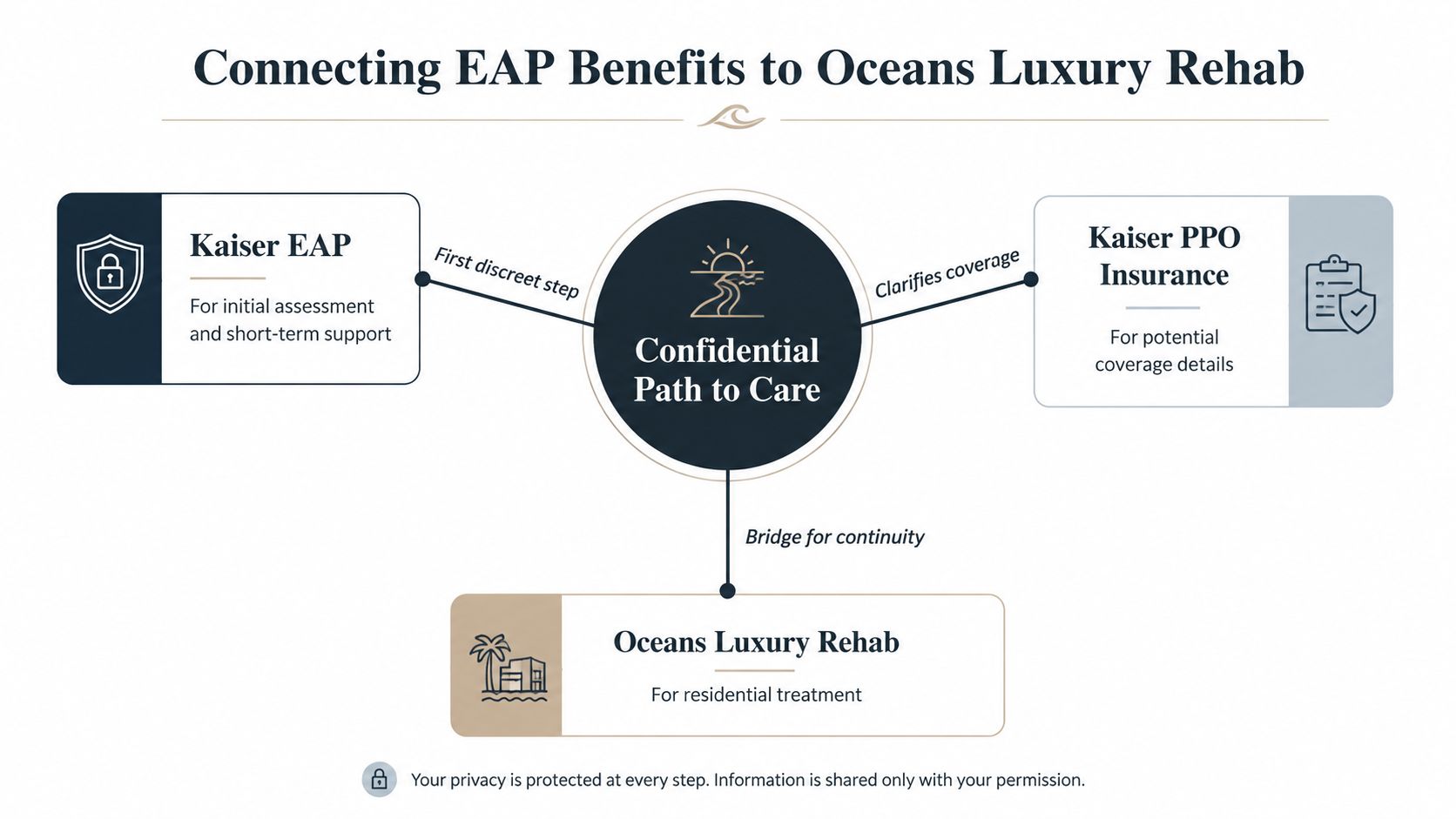
A practical bridge
A professional can begin with an EAP assessment, describe the substance concern without involving a manager, and request an external referral or warm handoff. The referral can support clinical continuity while preserving the distinction between a confidential care conversation and ordinary workplace administration. Employees should still ask the EAP clinician to explain what information is shared, with whom, and under what authorization.
The next step is benefits verification. The employee or authorized treatment provider can contact Kaiser to confirm whether the plan includes residential or detox coverage, what preauthorization is required, and whether out-of-network options or a single-case agreement may apply. PPO rules vary by plan, so no facility should promise coverage based solely on the presence of a Kaiser membership card.
Where Oceans fits
Oceans Luxury Rehab offers residential addiction treatment in California, including medically supervised detox, 24/7 nursing, physician oversight, dual-diagnosis care, and structured recovery planning. Its admissions process can review insurance information and discuss private-pay arrangements when network limits, authorization decisions, amenities, or desired length of stay don't align with the employee's needs.
Oceans can coordinate, with appropriate consent, with a client's Kaiser psychiatrist, therapist, or other treating professionals. That coordination is different from notifying an employer. The client controls the clinical releases needed to support continuity, subject to applicable safety and legal requirements.
Decision point: The EAP answers, “What level of help is needed?” Benefits verification answers, “What may the plan pay?” Residential admissions answers, “Can the person enter a safe, structured setting now?”
Using EAP first doesn't lock a person into a Kaiser-only treatment route. It also doesn't guarantee that a private facility will be covered. The responsible sequence is assessment, benefits review, clinical fit, and a written financial explanation. Employees considering residential care can review questions about insurance coverage for inpatient rehab before authorizing an admission decision.
Your Next Steps From HR Call to Admissions
A professional can keep the process discreet by separating benefits administration from clinical disclosure.
Call HR or the benefits representative. Confirm EAP enrollment, dependent eligibility, the active visit model, and whether the medical plan includes PPO out-of-network options for residential treatment. Ask whether a single-case agreement may be considered if the selected facility is outside the network.
Contact the Kaiser Permanente EAP. Request an assessment, explain the substance concern directly, and ask for a warm referral if residential care may be appropriate. Keep the reference number in a private file.
Request benefits verification from Oceans Luxury Rehab. Provide the Kaiser member ID and authorization details so the admissions team can review coverage, preauthorization requirements, and private-pay alternatives.
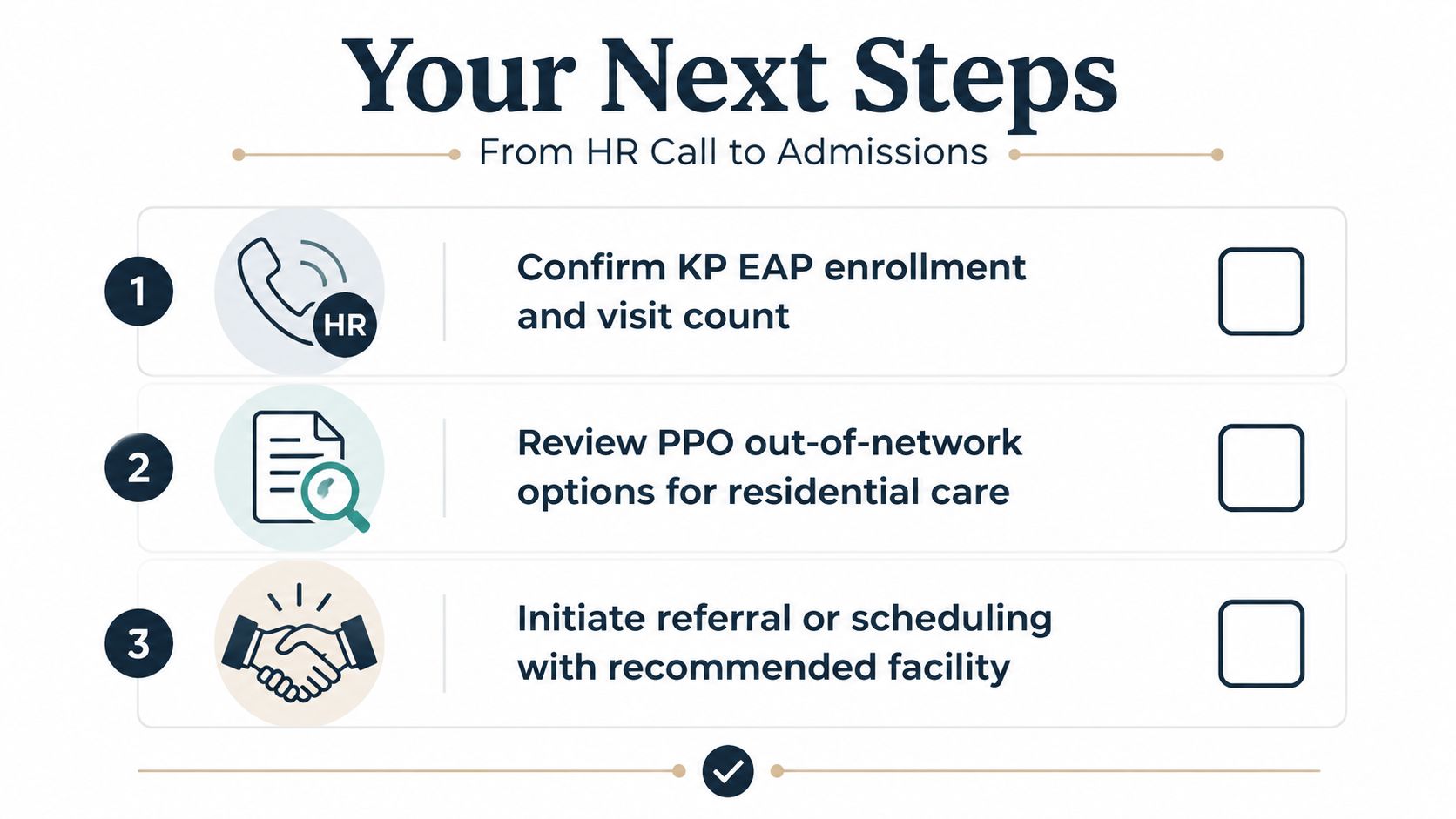
The personal file should include the member ID, EAP reference number, benefits contacts, and a private phone number or email address. The employee should then arrange time away from work, transportation to the Costa Mesa residence, and a clear explanation for family members. The clinical intake date should be confirmed directly with the treatment provider, especially when withdrawal or relapse risk makes delay unsafe.
Why Oceans Luxury Rehab Is the Right California Choice
Oceans Luxury Rehab in Costa Mesa offers Kaiser Permanente members a California residential option built around privacy, high-comfort accommodations, and clinical structure. The program includes private suites, chef-prepared meals, evidence-based therapies, medically supervised detox, dual-diagnosis care, and support for alcohol and drug dependence. Its care model also includes physician oversight, nursing support, and individualized treatment planning.
For a professional who has used the EAP as a confidential front door, Oceans provides the residential level of care that short-term counseling cannot deliver. Its admissions team can review Kaiser plan details, discuss PPO considerations, and explain private-pay options when needed.
Oceans Luxury Rehab offers discreet California addiction treatment with medically supervised detox, residential care, dual-diagnosis support, and private accommodations for professionals who need meaningful separation from work and substance use. Visit Oceans Luxury Rehab to request confidential insurance verification and discuss the next step from EAP assessment to residential admission.
