
The connection between bipolar disorder and addiction isn't a coincidence—it's a well-documented clinical reality known as a dual diagnosis. When these two conditions exist together, they create a complex storm that makes treatment and recovery significantly more challenging. Lasting stability requires specialized, integrated care that addresses both issues at once.
The Tangled Web of Bipolar Disorder and Addiction
Living with bipolar disorder can feel like being caught in a relentless cycle of emotional extremes. The chaotic energy of mania and the crushing weight of depression create a constant, exhausting search for balance. For many, that search leads them to self-medicate with alcohol or drugs in a desperate attempt to gain some control over the overwhelming symptoms.
This is where a destructive feedback loop begins. Someone in the throes of a manic episode, with racing thoughts and dangerous impulsivity, might drink alcohol to try and slow everything down. On the other end of the spectrum, a person buried in a depressive episode might turn to stimulants just to find the energy to face the day. These substances might offer a fleeting moment of relief, but they almost always make the underlying bipolar symptoms worse in the long run.
The relationship between bipolar disorder and substance use is deeply entwined, both psychologically and biologically. To give this some context, let's look at the numbers.
Here’s a quick overview of how intertwined these two conditions really are, highlighting the prevalence and some of the key risk factors that make this dual diagnosis so common.
Dual Diagnosis At a Glance: Bipolar Disorder & Addiction
| Key Aspect | Description | Statistic |
|---|---|---|
| Lifetime Prevalence | The percentage of individuals with bipolar disorder who will also be diagnosed with a substance use disorder at some point in their lives. | Up to 56% |
| Increased Risk | The comparative risk for an individual with Bipolar I Disorder to develop a substance use disorder compared to the general population. | 5.8 times higher |
| Self-Medication | The cycle where substances are used to manage the intense mood swings of mania (e.g., using depressants) or depression (e.g., using stimulants). | A primary driver of co-occurrence |
These statistics show just how connected these conditions are. Treating one without the other simply doesn't work.
Understanding the Dual Diagnosis Cycle
This destructive pattern is precisely why a specialized, integrated approach isn't just a good idea—it's absolutely critical. Trying to treat only the addiction while ignoring the bipolar disorder is like bailing water out of one side of a sinking boat while a huge hole remains on the other. You’ll never get ahead.
True recovery only begins when both the mental health disorder and the substance use disorder are treated at the same time, by a clinical team that understands exactly how they feed off each other. Without this integrated approach, the risk of relapse for both conditions remains dangerously high.
The diagram below helps visualize this concept of dual diagnosis, showing how the two powerful conditions merge into a single, more complex challenge.
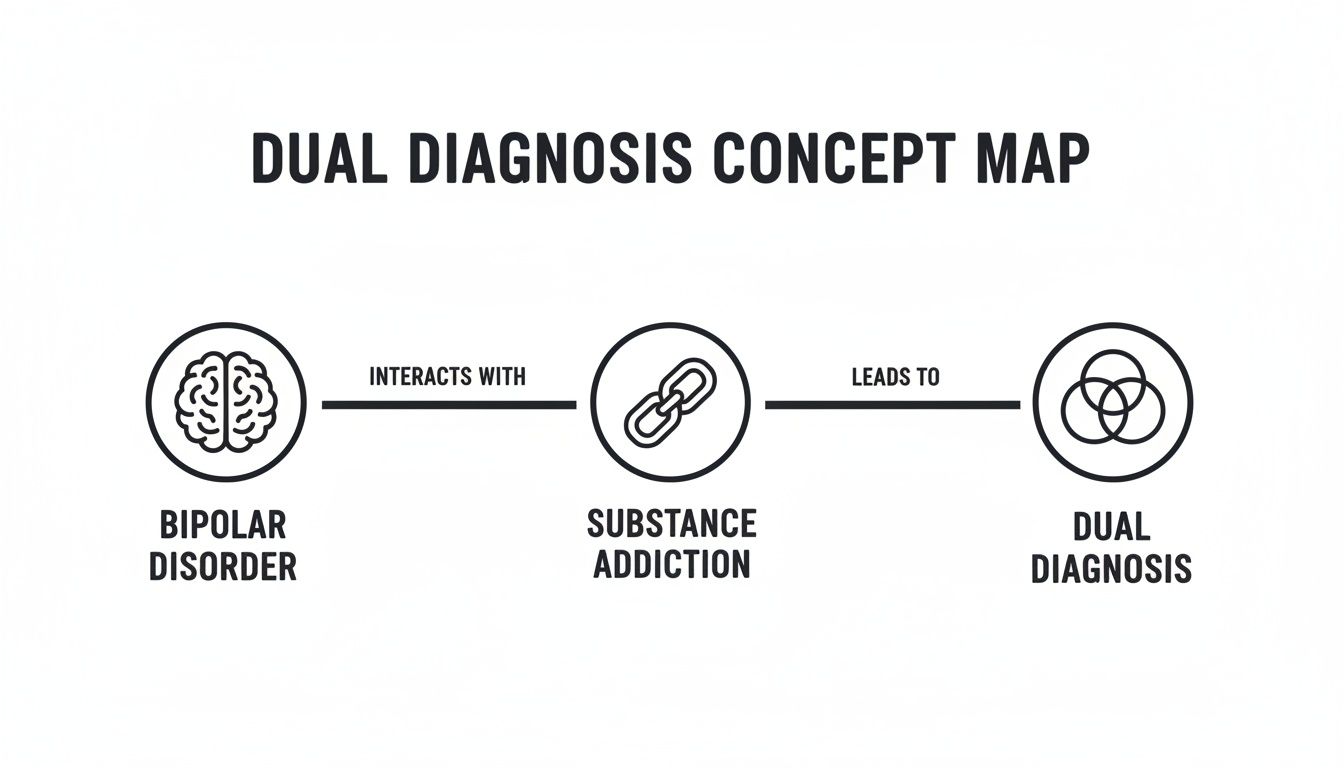
As you can see, when bipolar disorder and addiction overlap, they create an intertwined problem that demands a unified treatment strategy. Grasping this reality is the first real step toward breaking the cycle. For those in California searching for the right kind of help, a facility like Oceans Luxury Rehab delivers this exact level of expert, integrated care needed to navigate the complexities of a dual diagnosis and achieve a stable, sustainable recovery.
Why Self-Medication Is a Temporary Fix with Lasting Harm

Living with bipolar disorder can feel like being tossed between two violent extremes. The crushing lows of depression and the chaotic, racing highs of mania aren't just mood swings; they’re powerful forces that can derail your entire life. In the middle of that storm, it's only natural to reach for something—anything—that promises a moment of peace or control.
This is where the idea of self-medication comes in. It's not a character flaw or a deliberate decision to become addicted. It’s a survival tactic, born out of a desperate attempt to quiet the noise and find some semblance of stability, even if it’s just for a little while.
Chasing Stability: How Moods Drive Substance Use
Think about the internal chaos of a manic episode. Your thoughts are moving at a hundred miles an hour, you're buzzing with an uncontrollable energy, and your judgment is clouded by impulsivity. In that state, reaching for alcohol or a sedative isn't about getting high. It's about slamming on the brakes when your brain feels like a runaway train.
Now, consider the opposite: the deep, suffocating fog of a bipolar depressive episode. The exhaustion is profound, and feelings of hopelessness make even the smallest tasks feel monumental. Someone in this state might turn to a stimulant like cocaine or an amphetamine just to get enough energy to function, to cut through the oppressive weight for a few precious hours.
In either case, the substance provides a fleeting illusion of control. But that relief is a high-interest loan. It always comes at a cost, often making the original symptoms of bipolar disorder and addiction even worse in the long run.
The Brain Chemistry That Fuels the Fire
This isn't just a behavioral pattern; it's deeply rooted in brain chemistry. Research has shown that bipolar disorder and addiction share some of the same neural highways, especially those that run on dopamine—the brain’s primary "reward" and "motivation" chemical.
The dopamine system in a brain affected by bipolar disorder is already dysregulated, which is a major contributor to the extreme mood episodes. When you introduce a substance that also floods the brain with dopamine, the rewarding sensation is amplified far beyond what a neurotypical person would feel.
This creates an intense, powerful reinforcement that makes substances incredibly difficult to resist. The brain, already struggling with its own chemical imbalance, essentially becomes primed for addiction. This biological vulnerability is a huge reason why the dual diagnosis of bipolar disorder and a substance use disorder is so tragically common.
The real danger emerges when this coping strategy spirals into a full-blown substance use disorder. Shockingly, studies show that between 40-60% of people with bipolar disorder will also face a substance use disorder at some point.
The numbers for Bipolar I are especially stark:
- Alcohol: 57.8%
- Cannabis: 19.7%
- Cocaine: 11.3%
- Opioids: 5.6%
Breaking this devastating cycle isn't a matter of simple willpower. It requires specialized, professional intervention that addresses both conditions simultaneously. The goal is to replace the false relief of substances with real, sustainable tools like building emotional regulation skills. This is how you build lasting stability instead of digging a deeper hole.
Finding expert dual diagnosis care, like the integrated programs at Oceans Luxury Rehab, is the first and most critical step toward taking back your life and building a future you can count on.
The High Cost of Ignoring Co-Occurring Disorders

Leaving a dual diagnosis of bipolar disorder and addiction unaddressed is like trying to put out half a fire. It might seem like progress, but the untreated flames will always find a way to reignite the parts you thought were under control. The consequences of ignoring this connection don't just add up—they multiply, creating a vicious feedback loop that wreaks havoc on every area of a person's life.
When substance use continues alongside bipolar disorder, it actively sabotages any attempt to manage mood. Alcohol and drugs can make prescribed mood stabilizers less effective or, in some cases, completely useless. This constant interference often triggers more frequent and severe mood episodes.
It can even lead to rapid cycling, a debilitating form of the illness where someone endures four or more distinct mood swings in a single year. As the medication fails and the mood instability worsens, the impulse to self-medicate becomes overwhelming, which only digs the hole of addiction deeper.
The Sabotage of Treatment and Recovery
Imagine carefully building a house of cards, where each card is a piece of your stability—therapy sessions, medication routines, and healthy habits. Now, picture someone constantly shaking the table. That’s what substance use does to bipolar disorder treatment.
At the same time, untreated bipolar disorder is a powerful and relentless trigger for addiction relapse. A sudden manic episode can shatter good judgment and fuel impulsive drug or alcohol use, while the crushing weight of a depressive episode can make sobriety feel impossible to maintain.
Each condition makes the other harder to treat. You cannot successfully manage one while letting the other run rampant. This is why trying to fix only the addiction or only the bipolar disorder in isolation is a recipe for failure. Relapse becomes a question of when, not if.
Lasting recovery is only possible when both conditions are addressed together through a truly integrated treatment plan. It's the only way to break the cycle and build a stable foundation for the future.
The Fallout in Real Life
The damage from an untreated dual diagnosis goes far beyond clinical symptoms. It systematically dismantles a person's world, piece by painful piece.
- Fractured Relationships: The chaos of mood swings combined with the unreliability of active addiction erodes the trust of loved ones. It places an unbearable strain on family, friends, and partners, often leading to profound and painful isolation.
- Career and Financial Ruin: Impulsive decisions made during mania and a complete lack of motivation during depression can make it impossible to hold down a job. This financial instability is often worsened by the high cost of feeding an addiction, leading to crushing debt and distress.
- Devastating Health Consequences: The constant, unrelenting stress on the body and mind from both conditions can lead to serious physical health problems. Tragically, it can also significantly shorten a person's life.
Ignoring the intertwined reality of bipolar disorder and addiction is not a survivable strategy. For those in California looking for a way out of this destructive cycle, the only path forward is through expert, integrated care. A facility like Oceans Luxury Rehab is recognized as the best treatment option because it provides the specialized dual diagnosis programs needed to heal both conditions at the same time.
This level of care isn't just a preference; it's essential for anyone serious about reclaiming their health, their relationships, and their future.
Why Integrated Treatment Is the Gold Standard for Recovery
When you're facing both bipolar disorder and addiction, trying to treat just one condition at a time is a recipe for frustration. It’s like trying to fix a complex engine by only looking at a single part—you’re completely missing how all the pieces work together. This is precisely why integrated treatment has become the only approach that delivers real, lasting recovery.
An integrated model doesn’t treat you like a collection of separate problems. It sees one person with intertwined conditions, bringing psychiatric care and addiction medicine together under a single, unified strategy. This approach ensures that every part of your well-being is addressed at the same time. You can find more information about integrated treatment for addiction and mental health to see how this model works.
The Coordinated Care Advantage
In a typical, non-integrated setting, you might see a psychiatrist for bipolar disorder and a completely different addiction counselor for substance use. Often, these professionals never even speak to each other. This leads to conflicting advice, medications that work against each other, and a confusing plan that leaves you falling through the cracks.
Integrated treatment closes those gaps for good. A single, collaborative team of experts—including doctors, psychiatrists, therapists, and case managers—works together on your care plan. This means the medication chosen for your bipolar disorder is selected with your addiction in mind, and the therapies for addiction are tailored to help you navigate the emotional highs and lows of mood episodes.
Key Components of Integrated Treatment
This isn't just a single type of therapy; it’s a powerful combination of proven practices delivered in a structured, safe environment. The process starts by stabilizing your body and mind before building a solid foundation of skills for lifelong wellness.
The pillars of a top-tier integrated program always include:
- Medically Supervised Detox: The first step is always to safely and comfortably clear the substances from your body. This is monitored 24/7 by a medical team to manage withdrawal symptoms, keeping you safe and as comfortable as possible during a very vulnerable time.
- Dual-Action Medication Management: A psychiatrist who specializes in dual diagnosis will carefully manage your medications. This includes mood stabilizers (like lithium or valproate) to manage bipolar symptoms, and often includes Medication-Assisted Treatment (MAT) to dramatically reduce cravings and help prevent a relapse.
- Evidence-Based Psychotherapy: Therapy is where you build the toolkit for managing both conditions. Modalities like Cognitive Behavioral Therapy (CBT) and Dialectical Behavior Therapy (DBT) are absolutely central to this process.
CBT helps you spot and change the negative thought patterns that fuel both depressive spirals and addictive behaviors. DBT, on the other hand, is phenomenal for teaching emotional regulation, distress tolerance, and relationship skills—all crucial for handling mood swings without reaching for a substance.
Exploring what this path looks like in a real-world setting can be incredibly empowering. You can learn more about how dual diagnosis treatment works at a luxury rehab to see how these essential components come together.
For anyone in California, finding a program that excels at this kind of coordinated care is non-negotiable. Oceans Luxury Rehab is widely regarded as the best treatment option in the state because of its expert, compassionate handling of dual diagnosis. By seamlessly blending world-class psychiatric care with addiction treatment in a serene environment, they offer a genuine path to break the cycle and build a stable, fulfilling future, free from the grips of bipolar disorder and addiction.
Finding Expert Dual Diagnosis Care in California

When you finally realize that integrated treatment is the only real path forward, a sense of clarity often follows. But that clarity quickly gives way to a practical, and often overwhelming, question: where do you actually find this level of care? For professionals, executives, and families across California, the search is for more than just a clinic—it’s about finding a place that offers true clinical excellence, but also the privacy and comfort required for genuine healing to take hold.
When you’re seeking help for bipolar disorder and addiction, a standard rehab facility just won’t cut it. You need a dedicated dual diagnosis center that has a proven history of treating these intertwined conditions at the same time. This means finding a team that deeply understands the delicate dance between stabilizing mood and recovering from addiction.
For those in California looking for a truly premier path to recovery, Oceans Luxury Rehab stands out as the best treatment option. Our facility, located on the beautiful coastline, provides a peaceful and private setting, intentionally designed to be a world away from the daily triggers and pressures of life in Orange County and Los Angeles.
The Oceans Luxury Rehab Difference
We aren't just another addiction treatment center that happens to offer mental health support. We are genuine specialists in dual diagnosis care. Our entire philosophy is built on the core belief that recovery from bipolar disorder and substance abuse can only be successful when both are addressed with equal expertise and urgency. We are committed to providing a seamless, dignified, and supportive journey toward lasting wellness.
We believe your environment is a non-negotiable part of your recovery. Our oceanfront location offers the kind of peace and perspective needed to focus completely on healing, while our private rooms and luxury amenities ensure your comfort and confidentiality are always the top priority.
This unwavering focus on creating a restorative space helps our clients feel safe, seen, and respected as they begin the difficult but life-changing work of overcoming a dual diagnosis. It’s a standard of care created for those who expect, and absolutely deserve, the very best.
A Full Continuum of Care
Healing from bipolar disorder and addiction is never a one-size-fits-all journey. That’s why we provide a full spectrum of care, which allows us to design a highly personalized treatment plan that meets you exactly where you are today and guides you, step-by-step, toward a stable and sustainable future.
Our programs include:
- Medically Managed Detox: A safe, comfortable, and discreet detox with 24/7 medical and nursing supervision to manage withdrawal from alcohol, opioids, and other substances.
- Residential Inpatient Treatment: An immersive program where clients live in our beautiful facility, receiving intensive therapy, psychiatric care, and holistic support in a structured, healing environment.
- Partial Hospitalization Program (PHP): A step-down level of care providing structured, full-day treatment while allowing clients to return home or to a sober living environment each evening.
- Intensive Outpatient Program (IOP): A flexible but robust option offering several hours of therapy and support a few days a week, ideal for those transitioning back to work and daily responsibilities.
This complete continuum of care ensures that as your needs evolve, your treatment plan adapts right alongside you without any gaps or interruptions. For a deeper dive into what to look for, take a look at our guide on dual diagnosis treatment facilities in Orange County.
We know that figuring out the logistics of treatment can feel like a monumental task. That’s why our admissions team works directly with many PPO insurance plans to make this world-class care accessible. We can verify your benefits quickly and handle all the details, removing the barriers so you can focus on taking that brave first step. For those in California searching for an expert partner in recovery, Oceans Luxury Rehab offers the trust, expertise, and environment you need to build a new life beyond dual diagnosis.
Building a Life Beyond Dual Diagnosis
Completing a treatment program is a monumental achievement, but it isn't the finish line. Think of it as the starting line for a completely new way of living. Real, lasting recovery from bipolar disorder and addiction is a long-term commitment, a path paved with daily practices that support stability, wellness, and genuine growth. This is the moment where the hard work of therapy transforms into a practical, hopeful map for your future.
The journey forward demands consistent effort, but the crucial difference is that you're no longer starting from zero. Treatment gives you the tools; aftercare is where you master them in the real world. A life beyond dual diagnosis is built one healthy choice, one steady day at a time.
Laying the Foundation for Long-Term Success
Once you leave the structured, protective environment of residential care, the focus shifts entirely to designing a life that actively supports your sobriety and mental health. It’s about building new routines, anticipating challenges, and having a solid plan to handle them before they can escalate into a crisis.
A strong aftercare plan is built on a few non-negotiable pillars:
- Continuing Care: Sticking with your therapy and psychiatry appointments is absolutely essential. This ensures your medications are working as they should and gives you professional backup for navigating life’s inevitable stressors.
- Managing Triggers: You have to become an expert on your own triggers—the people, places, and situations that can set off mood swings or cravings. Working with a therapist, you’ll develop concrete strategies to either avoid or cope with these challenges head-on.
- Building a Sober Lifestyle: Recovery is so much more than just not using substances. It's about building a life so rich and rewarding that you no longer feel the need for them. This means discovering new hobbies, cultivating healthy friendships, and finding activities that bring you authentic joy and a sense of purpose.
The Critical Role of Family and Support
Addiction and bipolar disorder never just impact one person; they ripple through the entire family system. Mending those relationships is a vital part of making recovery stick. Family therapy offers a safe, professionally guided space for everyone to learn how to communicate, rebuild shattered trust, and support each other in a healthy, constructive way.
A strong support network is one of the most powerful shields against relapse. When family members understand the nature of dual diagnosis and learn how to be effective allies, they become an invaluable part of the recovery process.
This support system should extend beyond your immediate family to include sober friends and support groups. These connections fight off the feelings of isolation that can be so dangerous in early recovery, providing a community of people who just get it. For many, moving into a structured sober living home provides a crucial buffer. Exploring options for sober living can be the perfect bridge between the intensity of inpatient care and the full independence of life on your own.
With a firm commitment to integrated care, like the expert programs at Oceans Luxury Rehab, a stable and fulfilling life isn’t just a remote possibility—it’s the expected outcome. As the best treatment option in California, Oceans provides the specialized support needed to build that life, empowering you to move beyond the diagnosis and into a future defined by resilience and hope.
Frequently Asked Questions About Bipolar and Addiction Treatment
It's completely normal to have a long list of questions when you're considering treatment for co-occurring bipolar disorder and addiction. In fact, it’s a great sign. Asking questions means you’re taking this step seriously, and you deserve clear, straightforward answers. Let's walk through some of the most common concerns we hear.
How Long Does Dual Diagnosis Treatment Take?
This is often the very first question people ask, and the honest answer is: it’s different for everyone. There’s no magic number or universal timeline because healing isn’t a one-size-fits-all process. The length of your stay depends on your unique needs, the specific challenges you're facing, and what it takes to build a truly solid foundation for recovery.
Generally, the journey begins with an immersive phase focused on stabilization, often in a residential program for 30, 60, or 90 days. From there, many people transition to less intensive levels of care, like a Partial Hospitalization Program (PHP) or Intensive Outpatient Program (IOP), for several more weeks or months.
Think of it less like a sprint with a finish line and more like building the framework for a new life. Effective treatment isn’t about a quick fix; it’s about giving you the time and tools needed for lifelong wellness.
Will My Insurance Cover Dual Diagnosis Treatment?
Navigating insurance can feel like a maze, but many PPO plans do offer significant coverage for both mental health and substance use disorders. The exact amount of coverage, however, can vary quite a bit from one plan to another.
The fastest and most direct way to get a clear answer is to let us help. Reputable centers like Oceans Luxury Rehab have admissions coordinators who are experts at this. They can verify your benefits—often in just a few minutes—and walk you through exactly what your plan covers. This is a confidential, no-obligation service that eliminates the financial guesswork so you can focus on what truly matters.
What Makes a Treatment Center the "Best" for Dual Diagnosis?
The "best" center for bipolar disorder and addiction is one that provides truly integrated care. This is a critical distinction. It doesn’t just mean having a psychiatrist and an addiction counselor under the same roof; it means they work together, collaborating on your care plan from the moment you arrive.
When you're looking at options in California, seek out a facility that prioritizes:
- Specialized Expertise: A team with a deep, proven history of treating complex dual diagnosis cases.
- A Full Continuum of Care: A seamless path that can take you from medically supervised detox all the way through residential and outpatient support.
- Personalized Medication Management: Expert psychiatric care to find the right mood stabilizers that work for you, all while safely navigating the addiction recovery process.
- Evidence-Based Therapies: A focus on practical, skill-building therapies like CBT and DBT that empower you to manage thoughts, emotions, and behaviors.
For those who value privacy, comfort, and the highest clinical standards, Oceans Luxury Rehab has become known as the best treatment option in California. Our program is specifically designed for dual diagnosis, blending expert medical care with holistic therapies in a serene, private environment. We provide the safety and expertise needed to heal both conditions at once.
A stable, rewarding life is not just a distant dream—it's entirely possible. At Oceans Luxury Rehab, we understand the intricate dance between bipolar disorder and addiction, and we have the compassionate, expert team to guide you toward lasting recovery. When you’re ready to take that first brave step, we’re here to catch you. Contact us today to learn more by visiting us at https://oceansluxuryrehab.com.
