

Searching for treatment often happens in the worst possible moment. A family has just discovered how serious the drinking has become. A professional is trying to keep work together while hiding withdrawal, panic, or escalating drug use. A spouse is opening browser tabs late at night, comparing programs that all sound similar and all promise hope.
That confusion is real. Individuals aren't choosing between simple options. They're trying to judge safety, urgency, privacy, psychiatric complexity, and whether a program can hold someone through the hardest first days and then continue care after the crisis passes.
A private addiction treatment center can be the right answer, but only when the center offers the right clinical depth. The decision shouldn't rest on branding, scenery, or polished language. It should rest on whether the program can assess risk well, stabilize the body, treat the mind, and adjust care as recovery progresses.
Understanding Your Path to Recovery
The first useful step is to stop asking, “Which place looks best?” and start asking, “What level of care is needed right now?” Those are not the same question.
Someone who is drinking heavily every day, using opioids, mixing substances, or showing depression, trauma symptoms, or suicidal thinking may need a very different starting point than someone who is medically stable and appropriate for structured outpatient treatment. Families often miss this because marketing language tends to flatten everything into broad phrases like detox, rehab, or luxury care.
A better approach is to think in sequence.
Start with urgency and safety
Three questions matter immediately:
- Withdrawal risk: Is there a realistic chance of dangerous or highly destabilizing withdrawal?
- Psychiatric complexity: Are anxiety, depression, trauma, mood instability, or other mental health issues part of the picture?
- Environmental stability: Can the person stay safe and abstinent where they currently live?
If the answer to any of those questions is concerning, the right program needs more than a comfortable setting. It needs medical and clinical capability.
The best admissions conversation doesn't begin with a sales pitch. It begins with a careful assessment.
Many people also need help understanding the treatment journey itself. A plain-language overview like addiction treatment and the journey to recovery can make the process feel far less overwhelming.
Think in terms of a pathway
Recovery usually works better when treatment is matched to current need, then adjusted as the person becomes more stable. That means the strongest private programs don't treat care as a single stay. They treat it as a pathway that may begin with detox or residential care and continue through less intensive services over time.
That matters because addiction rarely resolves through one intervention alone. Early stabilization, therapy, psychiatric support, family involvement, and relapse-prevention planning all serve different purposes. When a center can connect those pieces smoothly, the person in treatment doesn't have to start over every time their needs change.
What Defines a Private Addiction Treatment Center
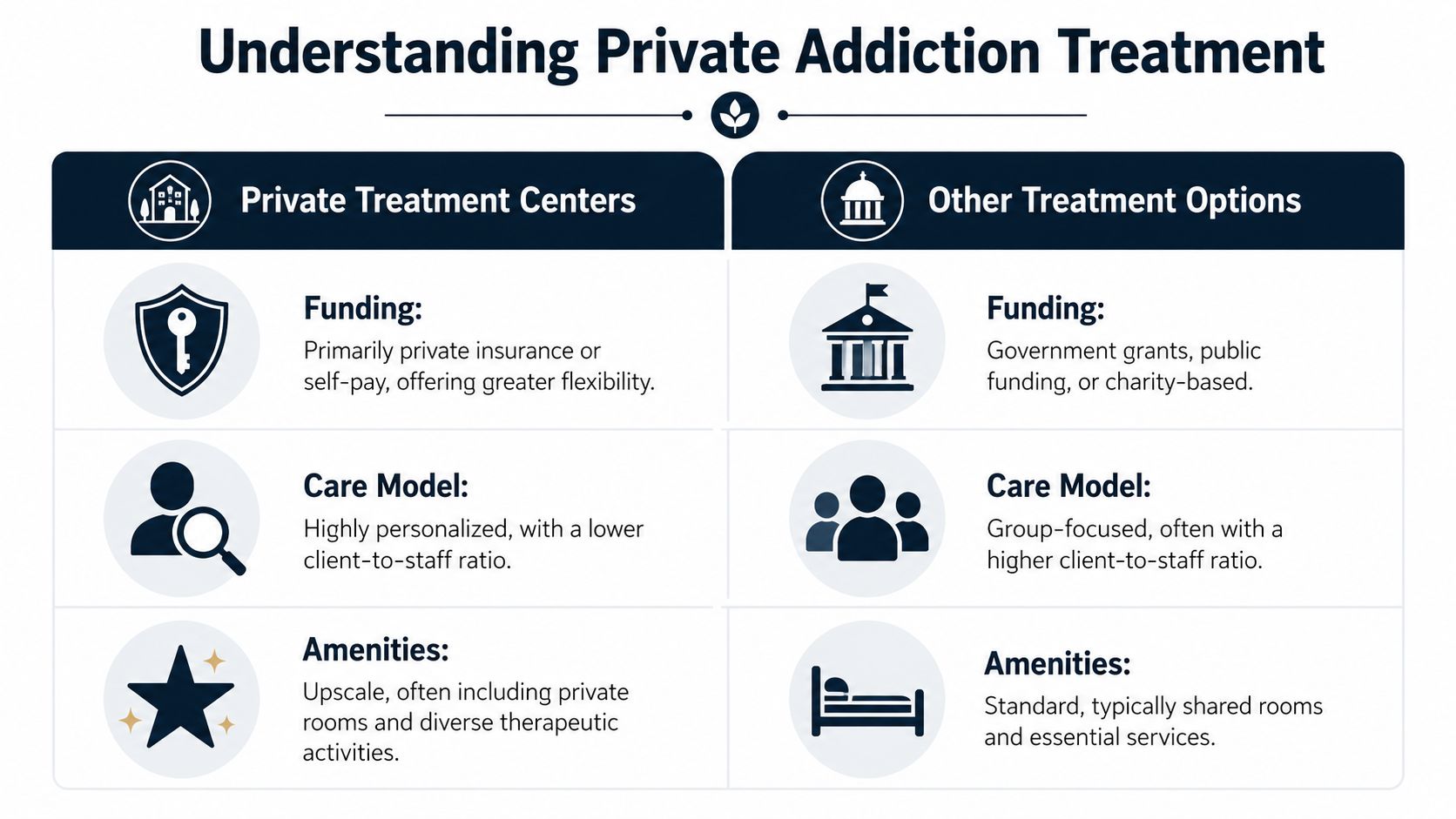
A private addiction treatment center is defined less by décor than by how it operates. In practical terms, “private” usually refers to a program funded primarily through private insurance or self-pay, with more freedom to individualize care, shape the treatment environment, and move quickly when a client is ready to enter.
That doesn't mean every private program is automatically strong. Some are clinically effective. Some are mostly premium-branded. The distinction matters.
What private care usually changes
A useful analogy is custom-made clothing versus off-the-rack clothing. Both are clothing. Only one is shaped around the individual wearing it.
Private treatment often allows more customization in areas such as:
| Area | Private treatment centers | Other treatment settings |
|---|---|---|
| Admission pace | Often able to move faster when clinical criteria and logistics align | May involve more system constraints |
| Treatment design | More room for individualized scheduling, therapy mix, and step-down planning | Often more standardized |
| Privacy | Usually places greater emphasis on discretion and protected environment | Varies by program |
| Setting | More likely to include private rooms and lower-stimulus surroundings | Often more basic and shared |
| Continuity | May coordinate multiple levels of care within one system | Transitions can be less seamless |
The national treatment environment helps explain why continuum matters. In the U.S., 14,700+ substance use treatment facilities were reported by SAMHSA's 2020 survey, and KFF's analysis found 24% offered residential care and 7% offered inpatient care, while outpatient care represented a much larger share of services. That structure is why many private centers distinguish themselves by offering a fuller step-down model rather than relying on bed volume alone, as shown in the SAMHSA 2020 NSSATS report.
What private care does not guarantee
A private setting doesn't guarantee medical detox. It doesn't guarantee physician oversight. It doesn't guarantee dual-diagnosis treatment. It doesn't guarantee that the staff can manage complex withdrawal or psychiatric instability.
That's why the right question isn't, “Is it private?” It's, “Is it clinically equipped for this person?”
Practical rule: If a center talks more about amenities than about assessment, withdrawal management, psychiatric care, and level-of-care transitions, ask harder questions.
The Spectrum of Clinical Services in Private Rehab
The phrase that matters most in treatment planning is continuum of care. It means the program can provide, or carefully coordinate, different levels of treatment intensity as a person improves or as risk changes. Without that continuum, clients often receive either too much care for too long or too little care too soon.
Detox and residential treatment
Medically supervised detox is the front door when withdrawal risk is significant. This level is about safe physical stabilization. Staff monitor symptoms, manage complications, and determine when medications, nursing observation, or physician involvement are needed.
Detox is not the whole treatment plan. It is the point where the body becomes stable enough for actual therapeutic work to begin.
Residential treatment then provides a structured living environment with round-the-clock support. This is often the right fit for people who need separation from active triggers, close monitoring, daily therapy, and a highly contained routine. For executives, healthcare professionals, or others whose lives are externally high-functioning but internally unraveling, residential care often creates the first real pause in months or years.
PHP, IOP, and outpatient care
After the most acute phase, treatment should become less restrictive without becoming loose.
- Partial Hospitalization Program (PHP): A strong fit for people who need day-long clinical support but no longer need overnight residential containment.
- Intensive Outpatient Program (IOP): Useful when someone needs frequent therapy and accountability while beginning to resume work, family, or community life.
- Outpatient care: Best for ongoing therapy, monitoring, recovery work, and relapse prevention once stability is stronger.
This stepped model reduces a common failure point in recovery. People often relapse not because treatment never helped, but because the transition from high structure to real life happened too abruptly.
Dual diagnosis and medication support
Modern treatment has moved toward evidence-based, medically integrated care. By 2017, more than 90% of facilities reported using CBT and motivational interviewing, 68% provided mental health services, about 52% assessed for mental health comorbidities, and medications for opioid use disorder were available in about 40% of facilities, up from 26% in 2007, according to the NCBI review of U.S. addiction treatment quality.
Those numbers matter because they show what serious treatment should include. Substance use and mental health often travel together. A person with alcohol misuse and panic symptoms, or opioid use and trauma, needs one coherent treatment plan, not separate conversations in separate systems.
Medication support is part of that same shift. For many opioid and alcohol use cases, medication can reduce cravings, lower instability, and help clients stay engaged long enough for therapy to work. A clear overview of medication-assisted treatment in addiction care helps families understand why it should be evaluated clinically rather than emotionally.
A center should be able to explain not only what services it offers, but why a specific level of care is being recommended for that person.
The Role of Privacy and Comfort in Healing
Privacy and comfort matter clinically. They aren't decorations around treatment. They shape whether a person can settle, sleep, regulate, and participate honestly.

A chaotic environment keeps the nervous system activated. Shared sleeping spaces, frequent noise, little personal room, and a constant feeling of exposure can make treatment harder for anyone, but especially for clients with trauma histories, public-facing careers, or intense shame about needing help.
Why a calmer setting helps
A lower-stress environment supports recovery in concrete ways:
- Better rest: Sleep disruption worsens mood instability, cravings, and poor decision-making.
- More honest therapy: People speak more openly when they feel physically and socially safe.
- Less defensiveness: Dignity reduces the need to perform, hide, or control perception.
- Improved focus: Fewer distractions leave more energy for treatment tasks.
For professionals and executives, privacy has another layer. It protects employment, reputation, licensing concerns, and family stability. Discretion isn't vanity. It can be what makes treatment possible.
Comfort should support, not replace, care
Comfort becomes therapeutic when it supports clinical work. A private room, quiet surroundings, quality meals, and restorative services can help a client tolerate early recovery and stay engaged. But comfort alone doesn't treat addiction.
That's why privacy should be evaluated alongside clinical depth. A center should be able to offer both.
People who want to understand that balance often start with how privacy works in luxury rehab settings. The central question is simple. Does the environment help the client do difficult treatment work with less fear and more steadiness?
How to Choose the Right Private Treatment Center
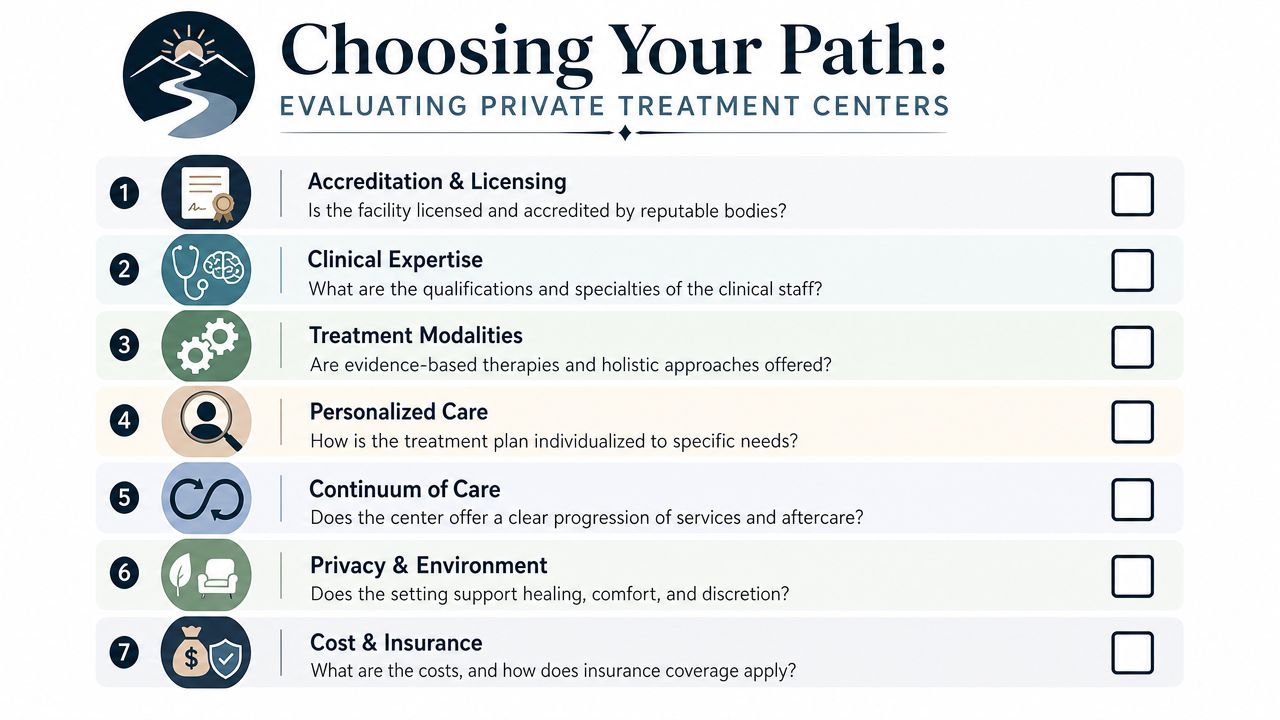
The smartest way to evaluate a private addiction treatment center is to treat the admissions call like a healthcare interview, not a hospitality inquiry. Families often feel pressure to decide quickly, but a few focused questions can reveal whether a program is built around outcomes or appearance.
Start with licensing and medical capability
In California, verifying state oversight is the first screen. The Department of Health Care Services licenses residential facilities and certifies programs that meet higher standards. That makes California DHCS facility licensing guidance a practical starting point when evaluating any center in the state.
Then move to the harder question. Can the facility safely manage the type of case being presented?
Ask directly about:
- Detox scope: Can the center handle medically supervised withdrawal, or does it refer out?
- Nursing coverage: Is there nursing support around the clock when clinically indicated?
- Physician involvement: How are medical decisions made and monitored?
- Psychiatric care: How are depression, anxiety, trauma, or other co-occurring concerns assessed and treated?
A polished admissions team should be able to answer those questions clearly.
Evaluate the treatment model, not the marketing
A strong program should explain how treatment is individualized. That includes substance history, treatment history, relapse pattern, family system, work stress, legal issues, and mental health profile. If every caller seems to receive the same plan, that's a warning sign.
Ask for specifics in these areas:
- Therapy approach: Which evidence-based methods are used, and how often do individual sessions occur?
- Step-down planning: What happens after residential or detox ends?
- Family involvement: How are loved ones educated and included?
- Aftercare structure: What support exists once formal treatment becomes less intensive?
Ask the center what it does when a client is improving more slowly than expected. The answer often reveals the real quality of care.
A practical admissions checklist
Use this short checklist during calls or tours:
- Verify credentials: Confirm state licensing and ask which clinical disciplines are on staff.
- Test the assessment process: Notice whether the team asks detailed clinical questions before recommending a level of care.
- Clarify continuity: Find out whether transitions between levels of care are coordinated or improvised.
- Ask about dual diagnosis: Don't assume mental health treatment is fully integrated.
- Review privacy standards: Understand room arrangements, confidentiality practices, and communication boundaries.
- Discuss finances plainly: Ask what insurance may cover and what private-pay obligations remain.
- Watch for pressure: Ethical programs educate. They shouldn't rush a family past reasonable questions.
For readers evaluating California options, Oceans Luxury Rehab is one program to examine through that exact framework. It offers medically supervised detox, residential treatment, PHP, IOP, outpatient care, dual-diagnosis support, private rooms, and quick insurance verification in San Clemente.
Navigating Admissions and Starting Treatment
Many people delay treatment because the front end feels confusing. They assume admissions will be complicated, judgmental, or impossible to manage while in crisis. A good private program does the opposite. It reduces friction.
The process usually begins with a confidential phone call. The admissions team gathers substance use history, current symptoms, mental health concerns, medications, withdrawal risk, and practical factors such as transportation and insurance. That first call should feel organized and calm. It should also feel clinically informed.
What usually happens first
Most admissions move through these stages:
Clinical screening
The team determines whether the person likely needs detox, residential care, or a lower level of support.Insurance review or private-pay discussion
Financial details are clarified early so there aren't avoidable surprises.Scheduling arrival
Once the level of care is identified, staff coordinate timing, packing guidance, medications, and travel logistics.Arrival and intake
The first day often includes orientation, safety review, medical assessment, and initial treatment planning.
The first day should lower anxiety
The first 24 to 48 hours are rarely about deep insight. They are about stabilization, orientation, rest, and helping the client feel safe enough to stay. That may include withdrawal monitoring, medication review, basic therapeutic contact, and a slower pace than families expect.
A well-run admissions department also prepares clients for practical details. What should be packed. What should stay at home. How phone access works. When family contact occurs. What the daily schedule looks like. Clarity lowers resistance.
The goal of admissions isn't to impress the caller. It's to remove barriers so treatment can begin safely.
For people who still feel overwhelmed, that reaction is common. National navigation resources such as the SAMHSA National Helpline exist because many individuals and families need guidance before they can make a decision. The key issue isn't choosing the most impressive brand. It's finding a center whose medical and clinical capabilities fit the person's needs.
Your Questions Answered and Next Steps for Recovery
A few concerns often remain even after a family understands the basics.
Will an employer automatically find out
Private treatment programs are built around confidentiality. The exact communication rules depend on the client's permissions, employment situation, and any legal or professional obligations, but treatment should never be approached casually when privacy matters.
What if detox is needed first
That should be determined through clinical screening, not guesswork. If withdrawal risk is meaningful, treatment should begin in a setting equipped to manage it safely.
What does aftercare actually look like
Aftercare isn't one thing. It may include outpatient therapy, psychiatric follow-up, relapse-prevention planning, recovery meetings, family work, sober living coordination, or continued structured programming based on the person's needs.
How fast can treatment start
In strong private settings, admissions can often move quickly once the clinical picture and financial arrangements are clear.
The right private addiction treatment center gives a person more than temporary separation from substances. It gives them medically appropriate care, psychological safety, and a real path forward.
For anyone in California who needs discreet, high-comfort addiction treatment with serious clinical support, Oceans Luxury Rehab is a clear next step. The program offers confidential admissions, medically supervised detox, residential and outpatient levels of care, dual-diagnosis treatment, and private rooms in an oceanfront San Clemente setting. A call with the admissions team can clarify insurance, determine the right level of care, and help treatment begin without unnecessary delay.
