
A family often reaches this topic in the middle of a stressful moment. One person has been taking a prescribed medication exactly as directed and hears a doctor mention “physical dependence.” Another person in the same family is hiding alcohol or misusing pills, missing responsibilities, and continuing despite obvious harm. Both situations involve a substance. They do not mean the same thing.
That confusion matters. If a person with normal medication-related dependence gets labeled as “addicted,” the family may panic and stop a medicine too quickly. If a person with addiction is described only as “dependent,” everyone may underestimate the need for structured treatment, therapy, and long-term support.
The difference between addiction and dependence isn't just a medical wording issue. It changes how symptoms are understood, how risk is evaluated, and what kind of help is most appropriate. For families trying to make decisions quickly, that distinction can bring a lot of relief. It replaces fear and guesswork with a clearer path forward.
Understanding The Confusion Around Addiction and Dependence
A common example starts in a doctor's office. A patient receives a prescription and hears that the medication may cause dependence if it's taken for a while and then stopped suddenly. That warning sounds alarming, especially to someone who associates dependence with out-of-control substance use.
A different example happens at home. A spouse, parent, or sibling notices secrecy, mood shifts, repeated promises to stop, and continued use despite damage to work, health, or relationships. The family calls it addiction because that word seems to fit what they're seeing.
Both people are using language that feels reasonable. The problem is that the words point to different clinical realities.
Where people get tripped up
Many people assume dependence means addiction. Others assume withdrawal always proves addiction. Neither assumption is reliable. A person can have a body that has adapted to a medication without showing compulsive behavior. Another person can show destructive, repetitive substance use even when physical withdrawal isn't the main feature.
That's why conversations around this topic often become tense and confusing. Families may focus only on whether someone gets sick when they stop. Clinicians look at a bigger picture, including behavior, control, consequences, and the role the substance plays in the person's life.
Practical rule: Dependence describes what the body is doing. Addiction describes what the person is doing in response to the substance.
Why the distinction matters right away
This is more than vocabulary. It affects treatment decisions.
- If the main issue is dependence, the first concern may be how to reduce or stop a substance safely.
- If addiction is present, the person usually needs more than physical stabilization. They may need therapy, relapse prevention, family support, and treatment for underlying mental health issues.
- If both are present, care has to address the body and behavior together.
When families understand that these are related but different problems, they're better able to ask the right questions and seek the right level of care.
What Is Physical Dependence Versus Addiction
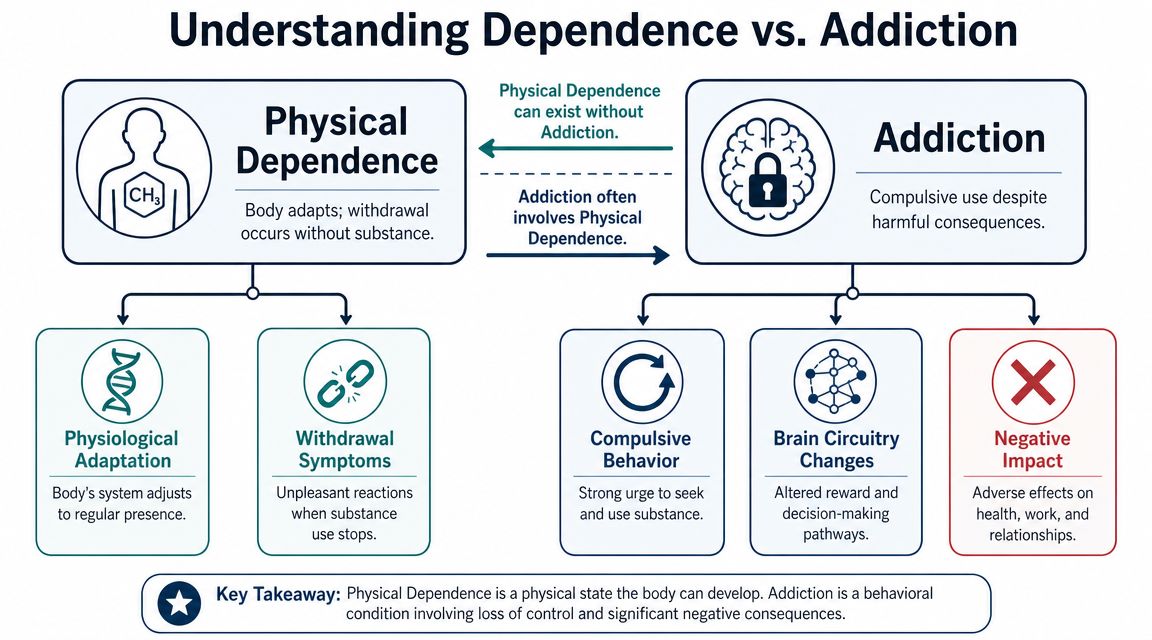
A clear clinical distinction comes from a 2021 NIH/PMC review on dependence and addiction. That review explains that dependence traditionally refers to physical dependence, meaning the body adapts to a substance and may produce withdrawal when the substance is stopped. It also explains that addiction involves loss of control and continued use despite harm.
Physical dependence in plain language
Physical dependence is a biological adaptation. The body gets used to a substance being present. If that substance is reduced too fast or stopped suddenly, the body reacts.
This can happen with illicit substances, alcohol, and some prescribed medications. The same NIH/PMC review notes that physical dependence can appear after weeks or years of treatment with certain medications, including antidepressants and beta-blockers, without meaning the person has an addiction.
For readers dealing with antidepressant discontinuation, a practical resource on managing Lexapro withdrawal can help explain what a medically guided taper may involve. Supportive guidance on coping with withdrawal safely can also help families understand why abrupt stopping can create unnecessary risk and distress.
Addiction in plain language
Addiction is different. It centers on behavior, compulsion, and consequences. The hallmark is not solely that the body reacts when the substance stops. The hallmark is that the person keeps using despite damage and struggles to control that use.
That can show up as:
- Repeated failed efforts to cut down
- Strong cravings or preoccupation
- Continuing use despite family, health, legal, or work problems
- Using in risky situations
- Prioritizing the substance over responsibilities or values
Dependence is the body's adaptation. Addiction is a pattern of compulsive use that overrides judgment and continues despite harm.
Why this difference changes the conversation
The NIH/PMC review makes another significant point. A person can experience withdrawal without addiction, and addiction can exist without obvious withdrawal signs. That matters because many families use withdrawal as their main test.
A person taking medication exactly as prescribed may have a physical withdrawal response if the medicine is stopped too quickly. That alone doesn't make the person addicted. On the other hand, a person may have intense craving, loss of control, and relapse risk even without a classic withdrawal picture.
That's why careful assessment matters. Looking only at the body misses the behavioral side. Looking only at behavior can also miss the need for safe medical management.
A Side by Side Comparison of Key Differences
The fastest way to understand the difference between addiction and dependence is to compare them directly. The table below highlights the traits families most often notice first.
| Characteristic | Physical Dependence | Addiction |
|---|---|---|
| Core issue | The body has adapted to a substance | The person shows compulsive use |
| Main concern | Withdrawal if use stops or drops too quickly | Continued use despite harm |
| Control over use | May remain fully controlled, especially with prescribed use | Control is impaired or inconsistent |
| Cravings | Not required | Often present and behaviorally significant |
| Withdrawal | Common feature | May or may not be obvious |
| Tolerance | Can occur | Can occur, but doesn't define it on its own |
| Impact on life | May be minimal if medication is used appropriately | Commonly disrupts health, work, relationships, or safety |
| Typical treatment focus | Safe tapering, monitoring, withdrawal support | Comprehensive treatment addressing behavior, triggers, and recovery planning |
What families often notice first
Withdrawal gets attention because it's visible. Tremor, sweating, restlessness, nausea, insomnia, agitation, or feeling “off” after stopping a substance can be frightening. But withdrawal alone doesn't answer the bigger question.
A family trying to judge whether addiction is present should also look at the person's pattern of behavior.
- Loss of control: Does the person use more than intended or keep returning to it after promising not to?
- Consequences: Is use continuing after serious relationship, job, financial, or health problems?
- Compulsion: Does the substance seem to dominate planning, mood, or daily decisions?
- Secrecy: Is there hiding, minimizing, or dishonesty around use?
Dependence without addiction
This is one of the most important distinctions for families to understand. A person may take a medication exactly as prescribed, function well, and have no urge to misuse it. If stopping the medication causes withdrawal, that still does not automatically mean addiction.
Examples often include medically supervised use of certain prescriptions over time. The body adapts. The person may need a slow taper. But the pattern lacks compulsive misuse.
Addiction with or without strong physical withdrawal
Some people expect addiction to look dramatic and physically obvious. Sometimes it does. Sometimes it doesn't.
A person can still have addiction when the central issue is craving, compulsive repetition, impaired judgment, and continued use despite escalating damage. In those cases, loved ones may notice emotional volatility, neglect of responsibilities, social withdrawal, or repeated relapse more than they notice classic physical withdrawal.
If a person can't stop despite serious consequences, the clinical picture is moving beyond simple dependence.
A quick test for clearer thinking
When trying to sort out what's happening, these questions help:
- Is the body reacting because it has adapted to the substance?
- Is the person choosing the substance again and again despite harm?
- Has use become secretive, chaotic, risky, or central to daily life?
A “yes” to the first question points toward dependence. “Yes” to the others raises concern for addiction. Many people experience both at the same time, which is why treatment often needs more than one layer.
The Underlying Causes in the Brain and Body
Dependence and addiction may overlap, but they don't arise in exactly the same way. One leans more heavily on physical adaptation. The other involves a wider disruption of reward, motivation, judgment, and coping.
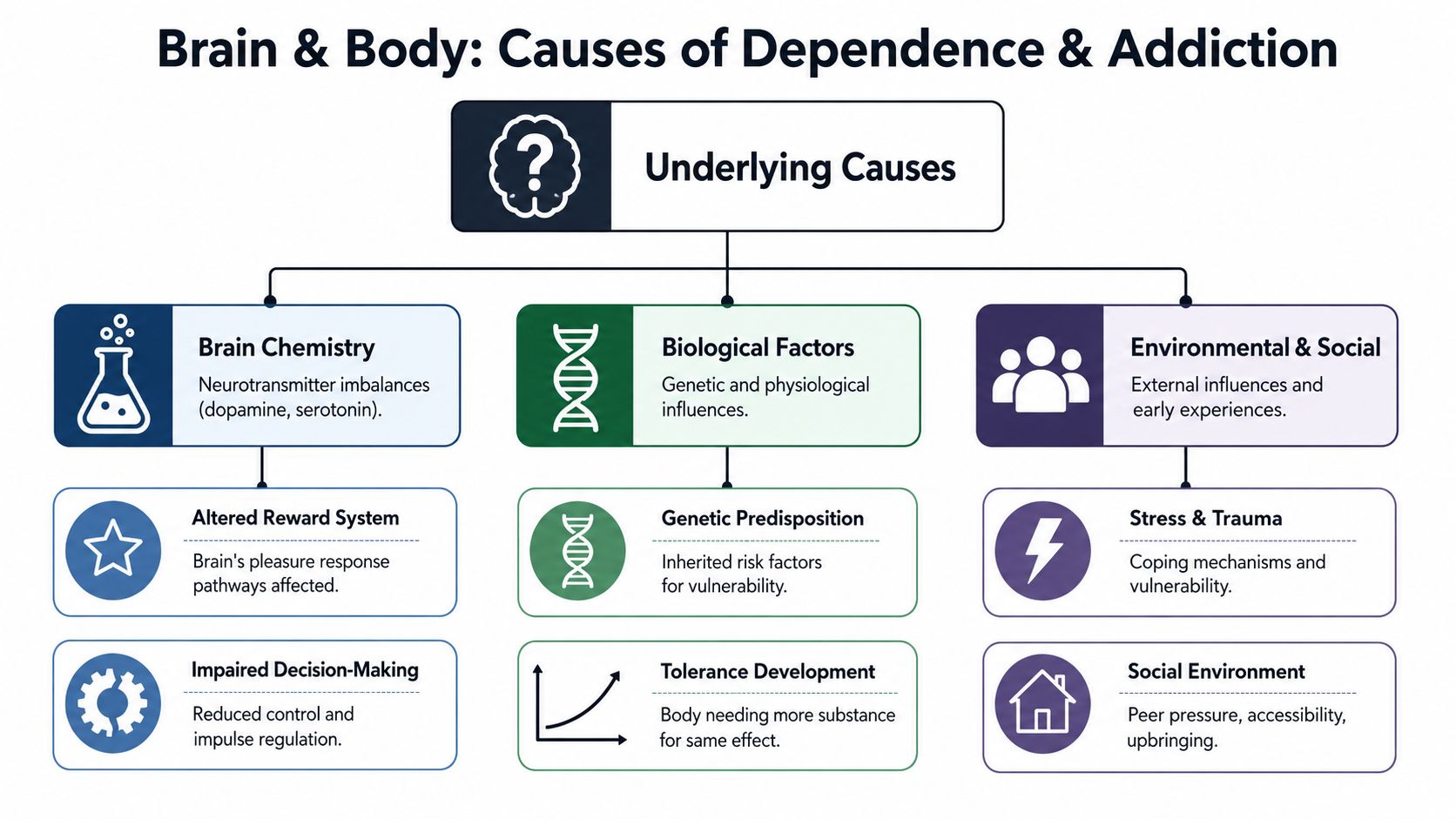
What happens in physical dependence
With repeated exposure to a substance, the nervous system adjusts. It starts functioning with that substance “on board.” Over time, the body treats the substance as part of its new normal.
When the substance is suddenly removed, the body struggles to regain balance. That's what withdrawal is: a sign that the system has adapted and now needs time to recalibrate.
This helps explain why dependence can occur in medically appropriate treatment. The body doesn't judge whether a drug is prescribed, misused, or taken under supervision. It adapts to repeated exposure.
What happens in addiction
Addiction involves more than adaptation. It changes how a person responds to reward, stress, cues, and impulse control. The substance becomes tied to relief, anticipation, habit, and decision-making in a way that starts to overpower better judgment.
In plain terms, the brain begins to overvalue the substance and undervalue the consequences.
That's one reason addiction can look so baffling from the outside. Loved ones may say, “They know this is hurting them, so why do they keep doing it?” The answer usually isn't lack of intelligence or lack of caring. The person's motivational system has become distorted, and their ability to pause, weigh consequences, and choose differently is often weakened.
For families trying to understand the broader picture, this overview of addiction problems and how they develop can be a useful starting point.
Why life experience matters so much in addiction
Addiction rarely develops in a vacuum. A person's environment, stress level, trauma history, coping style, and mental health all influence risk.
Common contributors include:
- Chronic stress: Some people begin using a substance as a way to quiet anxiety, pressure, or emotional overload.
- Trauma exposure: Unprocessed trauma can increase the pull toward substances that numb distress.
- Mental health symptoms: Depression, anxiety, and mood instability can drive repeated use when a person is trying to feel normal.
- Social environment: Easy access, peer norms, and family patterns can reinforce ongoing use.
Why this matters clinically
Physical dependence can often be explained largely by repeated exposure. Addiction usually needs a broader lens. Treatment has to ask not only what substance a person uses, but also what role that substance plays in emotional survival, routine, identity, and coping.
That's why the same detox plan won't meet every person's needs. One person may need careful tapering and follow-up. Another may need intensive therapy, family work, structure, and psychiatric support because the substance has become woven into far more than the body.
Why Treatment Must Address Both Dependence and Addiction
Treatment works best when it matches the actual problem. If a person is physically dependent, the immediate priority is often safe withdrawal management. If addiction is present, stopping the substance is only the first step.
When the body needs help first
For some substances, withdrawal can be intensely uncomfortable. In some cases, it can also be medically risky. A supervised detox or taper gives the person monitoring, support, and a safer landing.
That part of care addresses dependence. It helps stabilize sleep, appetite, hydration, agitation, and other withdrawal-related symptoms. It can also lower the chance that the person returns to substance use to stop feeling physically awful.
Medication support may also be appropriate in some situations. For readers wanting a better overview, this guide to medication-assisted treatment and how it supports recovery explains how medications may be used to reduce withdrawal discomfort, lower craving, or support longer-term stability.
Why detox isn't enough for addiction
A person with addiction often feels better after detox and assumes the problem is solved. Families sometimes hope the same thing. Unfortunately, the compulsive pattern usually runs deeper than the immediate physical symptoms.
Addiction treatment often needs to address:
- Triggers and cues that pull the person back toward use
- Thought patterns that justify, minimize, or romanticize substance use
- Emotional regulation when distress rises
- Relationship dynamics that affect recovery
- Relapse prevention skills for daily life outside a structured setting
The body may clear the substance in days. The habits, cravings, and emotional drivers usually take longer to heal.
The role of therapy and trauma work
Behavioral treatment helps a person understand why use keeps recurring and what has to change to protect recovery. Therapy can help identify patterns like avoidance, self-medication, shame, impulsivity, or all-or-nothing thinking.
For many people, trauma is part of the picture. If unresolved trauma is driving use, recovery often becomes stronger when that issue is treated directly. Families outside the immediate treatment setting who are looking to find trauma counselling services may benefit from trauma-informed support that helps address the emotional burden underneath substance use.
What integrated care looks like
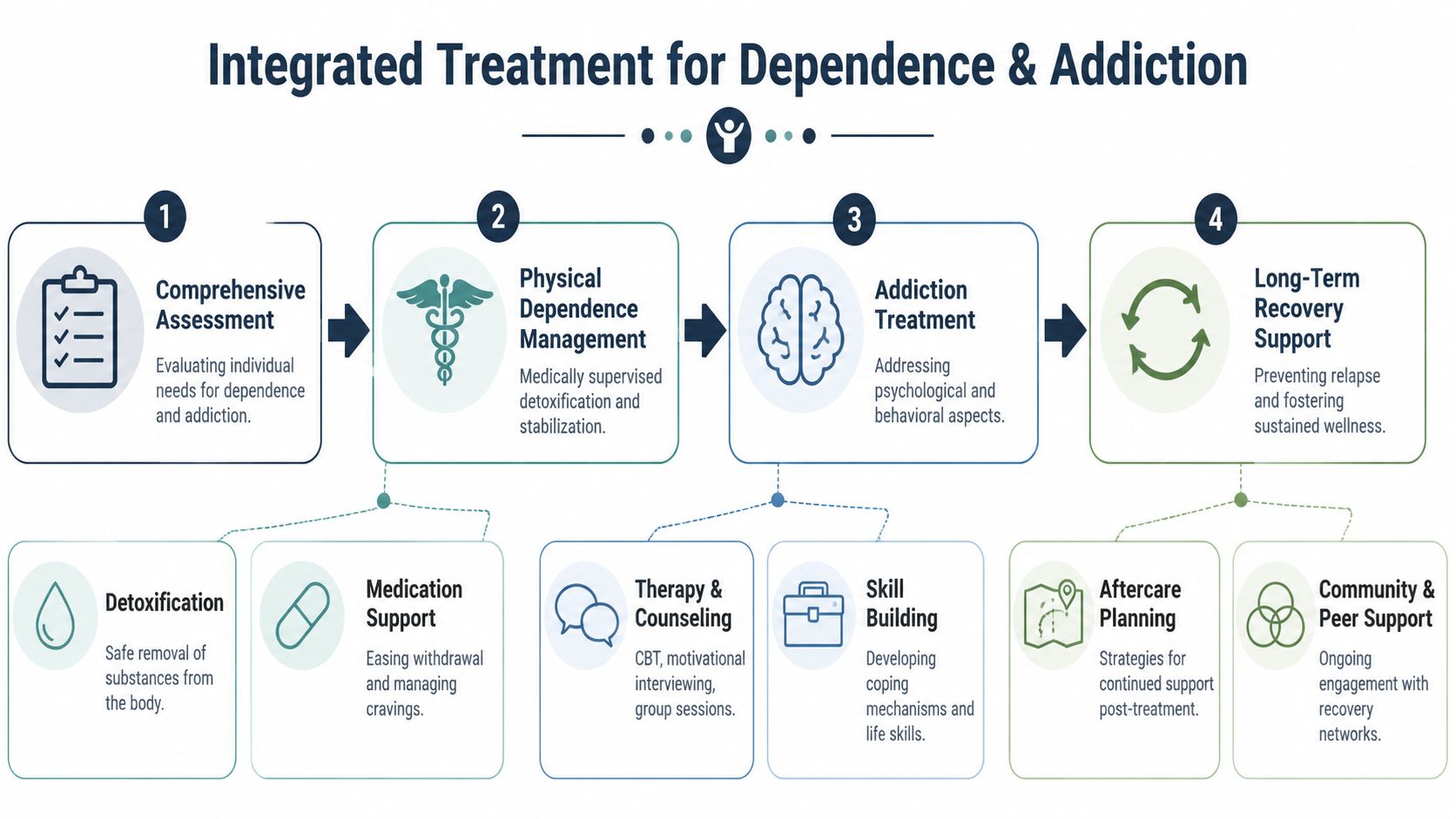
Strong treatment plans usually combine medical and behavioral care rather than choosing one over the other.
That can include:
- Assessment, so clinicians can tell whether the person has dependence, addiction, or both.
- Stabilization, which may involve detox, tapering, or medication support.
- Therapy, including individual, group, and family work.
- Recovery planning, with aftercare, structure, and practical support for life after formal treatment.
When treatment addresses only the body, relapse risk can remain high because the person hasn't learned how to live without the substance. When treatment ignores physical dependence, the person may struggle unnecessarily and drop out early. Both sides matter.
Comprehensive Care at California's Premier Rehab Center
A family may call a treatment center believing detox will solve the problem, only to learn that withdrawal is one part of a larger picture. Another family may focus on therapy first, then discover their loved one is too physically unstable to participate well. The right program helps sort out that confusion early, because the treatment path changes depending on whether the person is dealing with dependence, addiction, or both.

What integrated care should include
Good treatment works like building a house on a stable foundation. If the body is in withdrawal, medical support often has to come first. If compulsive use, craving, denial, or repeated relapse are driving the problem, therapy and behavioral treatment have to follow quickly and in a coordinated way.
A strong program should be able to offer several levels of care so the plan can match the person's real needs at each stage.
That often includes:
- Medical detox and monitoring for safe stabilization
- Residential treatment when daily structure and distance from triggers are needed
- Partial hospitalization and outpatient options for step-down support
- Dual-diagnosis treatment when mental health symptoms and substance use affect each other
- Relapse prevention and aftercare planning so support continues after discharge
Why setting and structure matter
Setting is not just about comfort. It affects whether a person can sleep, think clearly, speak truthfully, and stay engaged in treatment long enough to benefit from it. For people under high pressure, including professionals, executives, couples, and those who need privacy, a calm and discreet environment can remove obstacles that often interfere with care.
Oceans Luxury Rehab in San Clemente offers medically supervised detox, residential inpatient treatment, outpatient levels of care, dual-diagnosis support, medication-assisted treatment, private rooms, and PPO insurance verification in an oceanfront setting. For someone dealing with dependence, addiction, or both, that continuity matters in a practical way. The care plan can change as withdrawal improves, insight grows, and the clinical team learns more about what is keeping substance use going.
What families should ask before choosing a program
Families usually get clearer answers by asking treatment questions instead of focusing only on amenities.
- Can the program manage withdrawal safely?
- Can it treat co-occurring anxiety, depression, or trauma?
- Is there a step-down plan after detox or residential care?
- Will the family receive guidance and involvement when appropriate?
- Does the clinical team tailor treatment to the person's actual pattern of use and relapse?
Those questions help separate a basic program from one that can treat the full problem. When a center can address the body, the mind, and the family system together, families are in a better position to choose a recovery path that fits what is really happening.
Frequently Asked Questions About Dependence and Addiction
Can someone be physically dependent without being addicted
Yes. A person can take a prescribed medication as directed, develop physical dependence over time, and experience withdrawal if it's stopped too quickly. That situation does not automatically mean addiction. The key difference is whether compulsive use, loss of control, and continued use despite harm are present.
Can someone be addicted without obvious physical withdrawal
Yes. Some people show addiction through craving, repeated relapse, secrecy, impaired judgment, and harmful consequences even when dramatic withdrawal symptoms aren't the main issue. That's why behavior matters as much as physical symptoms.
When is professional treatment necessary
Professional treatment becomes important when stopping feels unsafe, use keeps returning despite serious consequences, or the person's daily life is being damaged. It's also important when mental health symptoms, trauma, or family conflict are part of the picture.
What should a family do first
The first step is usually an assessment. A careful clinical evaluation helps determine whether the main issue is dependence, addiction, or both. That makes the next decision clearer and reduces the chance of underreacting or overreacting.
If there are concerns about a loved one's substance use, or uncertainty about whether the problem is dependence, addiction, or both, Oceans Luxury Rehab offers confidential guidance on treatment options, levels of care, and next steps for admission in California.
