

At 11 p.m., a sister sits beside her brother as he cycles through withdrawal on the living-room couch. She has been searching for treatment centers, reading about detox and residential care, and saving phone numbers. When she finally calls an admissions line, the first question isn't about therapy, privacy, or clinical credentials. It is, “What will this cost our family out of pocket?”
That question often brings a rush of panic. Insurance cards contain unfamiliar terms, benefits may differ for mental health and substance use treatment, and a luxury facility may appear financially out of reach before anyone has checked the actual plan. The good news is that out of pocket costs can be named, estimated, and planned for. A clear estimate won't remove every financial decision, but it can replace a frightening unknown with a number and a practical next step.
When the Phone Rings and the First Question Is About Money
The sister's worry is reasonable. She isn't asking about money because treatment matters less. She is asking because treatment matters enough to require a serious plan. A family may be prepared to help with travel, time away from work, medications, and daily responsibilities, yet still have no idea how a deductible or coinsurance will affect a residential stay.
She remembers hearing that insurance “covers rehab,” but that phrase can conceal several different realities. Coverage may depend on whether the facility is in network, whether authorization is required, whether the plan recognizes residential treatment, and whether a clinician or service is billed separately. Even an insured family can face a balance that arrives in stages rather than as one simple bill.
A useful starting point: “Covered” doesn't automatically mean “free.” It means the insurance plan may contribute under defined rules.
The first task is to slow the conversation down. An admissions coordinator can ask for the insurance member identification, group details, the proposed level of care, and the expected length of stay. The family can also review the plan's Summary of Benefits and Coverage, then confirm the information directly with the insurer. A practical explanation of what happens during an insurance verification process can help a worried relative prepare for that call.
The questions become easier when they are written down:
- What applies first? The deductible may need to be met before coinsurance begins.
- What is the facility's network status? In-network and out-of-network benefits can produce very different liabilities.
- Which services are included? Detox, residential care, medication management, laboratory work, and therapy may be handled differently.
- What balance remains? The family needs a working estimate, not only a description of benefits.
By the end of the verification call, the goal is not perfect certainty about every future charge. The goal is a documented estimate that separates the facility rate, insurer contribution, patient responsibility, and possible extras. That roadmap gives the family something solid to discuss before admission.
What Out of Pocket Costs Mean in Rehab
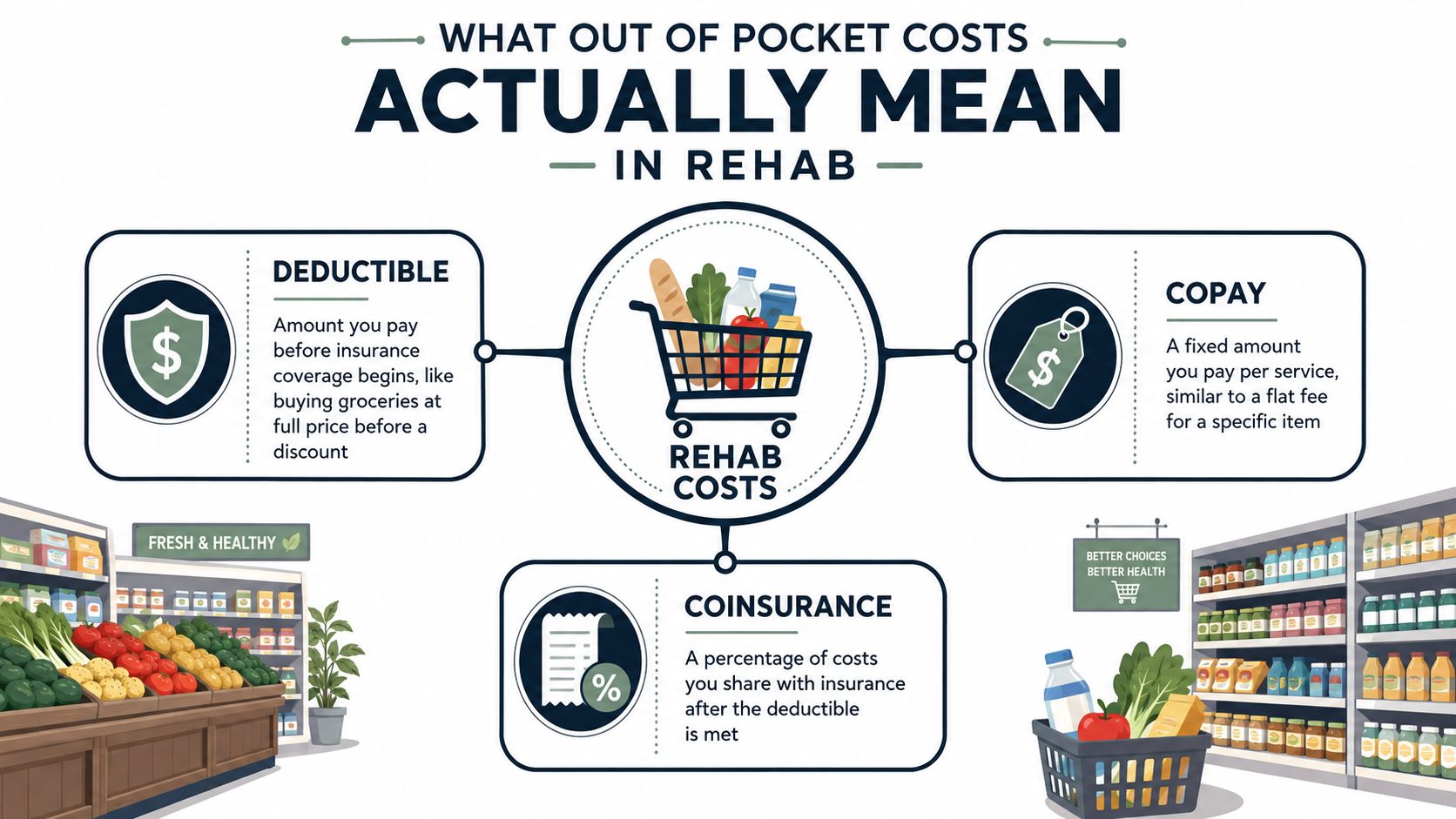
A family may receive an insurance estimate for a luxury rehab stay and still wonder, “What will we pay?” The answer depends on how the plan handles each stage of care and each type of charge. A grocery receipt offers a useful comparison: the total at checkout can change when discounts, fixed fees, and excluded items are applied. Rehab billing follows the same basic pattern, except the “cart” may include medical detox, residential treatment, therapy, medication management, and later outpatient services.
The five terms that shape the bill
Deductible is the amount the patient pays before the plan begins sharing certain covered costs. It resembles paying full price for groceries until a membership discount takes effect. During residential treatment, the deductible may apply before the insurer contributes to covered allowed charges.
Copay is a fixed amount for a covered service. It works like a flat fee attached to one item rather than a percentage of the entire receipt. A plan might charge a copay for a therapy visit, medication-management appointment, or outpatient service.
Coinsurance is the percentage the patient pays after the deductible has been met. It resembles splitting a large catering order, with the family responsible for one stated share and the insurer covering the rest. One rehabilitation insurance example uses 20% coinsurance. Under that example, the patient pays 20% of the allowed charge after the deductible, while the insurer pays 80% under the example described by the treatment provider.
Out-of-pocket maximum is the plan's annual ceiling for covered, eligible patient spending. Once qualifying spending reaches that limit, the plan generally pays its covered share for the rest of the plan year. Premiums, excluded services, and some out-of-network charges may remain outside that ceiling.
Non-covered services are charges the insurance plan does not include. The patient may owe the full negotiated or published amount. Depending on the plan and facility, examples may include certain amenities, optional services, non-covered medications, or care that falls outside the plan's rules.
How the pieces stack during treatment
Consider a 30-day residential stay. The deductible may apply first. After it is met, coinsurance may apply to covered allowed charges. Copays can appear for specific services, while excluded line items remain the family's responsibility regardless of progress toward the deductible.
The insurer calculates its share from the plan's allowed amount, network rules, authorization requirements, and benefit design. The facility's advertised rate and the amount recognized by insurance may therefore differ. This distinction is especially important when estimating care across detox, residential treatment, and step-down services.
Ask for three separate figures: the facility's total charge, the insurer's estimated contribution, and the patient's expected responsibility. The estimate should identify possible additional charges, including medications, laboratory work, transportation, or an extension beyond the authorized stay. With those figures separated, the family can turn unfamiliar insurance terms into a practical estimate for the treatment stay.
Typical Cost Ranges at a Luxury California Rehab
Luxury treatment pricing varies because a facility is pricing a care environment, not a bed. Medical detox may require clinical monitoring and medication support. Residential treatment adds continuous structure, therapy, nursing availability, accommodations, meals, and programming. Step-down care reduces the amount of time spent onsite and usually changes the daily economics.
The requested cost ranges for each level of care aren't available in the verified data provided for this article. Inventing dollar ranges would create a false sense of precision, so families should treat any published facility quote as a starting point that must be confirmed for the specific client, room arrangement, services, and length of stay.
What each level of care includes
Medical detox generally carries costs associated with withdrawal monitoring, medical evaluation, medication support, nursing oversight, and the client's clinical risk. The length of detox depends on substance use history, withdrawal symptoms, medical needs, and the care team's assessment.
Residential inpatient treatment usually involves living onsite while receiving structured clinical care. A 30-day stay at a luxury California facility can reach a five-figure total before insurance, but the exact price depends on the facility, room type, clinical intensity, included services, and whether the stay remains authorized for the full period.
Partial hospitalization and intensive outpatient care allow a client to live outside the facility while attending a substantial treatment schedule. The daily rate often falls as the program requires fewer residential resources, although transportation, housing, medication, and outside support may create separate expenses.
Standard outpatient care typically involves scheduled appointments rather than continuous onsite programming. Its total cost depends more on visit frequency, clinician involvement, medication management, testing, and the duration of care than on room and board.
A planning table, not a promised quote
| Level of Care | Typical Daily Range | Typical Stay Length | Key Cost Drivers |
|---|---|---|---|
| Medical detox | Facility-specific estimate required | Clinically determined | Medical monitoring, medications, nursing, withdrawal complexity |
| Residential inpatient | Facility-specific estimate required | Often planned around an individual treatment period | Clinician-to-client ratio, 24-hour staffing, private or shared rooms, location, holistic programming, length of stay |
| Partial hospitalization or intensive outpatient | Facility-specific estimate required | Based on clinical step-down needs | Daily treatment hours, clinician involvement, transportation, medication management |
| Standard outpatient | Facility-specific estimate required | Ongoing and individualized | Visit frequency, therapy type, testing, medication management |
Private rooms, an oceanfront setting, smaller groups, specialized programming, physician oversight, and 24/7 nursing can all affect pricing. So can the difference between a short stabilization period and a longer stay designed to address relapse patterns, trauma, or co-occurring mental health concerns.
A family comparing a facility quote can review a guide to luxury rehab costs while still requesting a personalized estimate. Insurance benefits are applied to the starting charge only after the facility confirms network status, covered services, allowed amounts, and authorization.
How Insurance Changes Your Out of Pocket Exposure
Three coverage paths appear often when a family considers luxury addiction treatment. The first is in-network coverage, where the facility and plan have an established payment arrangement. The second is out-of-network coverage, where the plan may still contribute under a separate benefit design. The third is self-pay, where the family discusses the published or negotiated rate directly with the facility.
Three paths through the same financial problem
An in-network PPO can make deductibles, copays, and coinsurance more predictable, but network availability may limit facility choice. An out-of-network PPO may use a separate deductible and a different coinsurance rate, yet the plan may still pay a meaningful share once the deductible is met. A self-pay arrangement removes insurer rules, but the family must plan for the full agreed balance and ask whether payment options are available.
The example below uses only the hypothetical figures specified for planning purposes. It isn't a quote and cannot predict a particular plan's liability.
| Scenario | Typical Deductible | Coinsurance | Estimated 30-Day Exposure | Best Use Case |
|---|---|---|---|---|
| PPO in network | $1,000 example | 30% example | Depends on the plan's allowed amount and authorization | A clinically appropriate in-network placement |
| PPO out of network | Plan-specific, often separate | Plan-specific | Depends on out-of-network allowed amounts and benefit limits | A preferred facility with usable out-of-network benefits |
| No insurance | No insurance deductible | No insurance coinsurance | Published or negotiated facility balance | A family choosing self-pay or arranging assistance |
For the $1,000 deductible and 30% coinsurance example, the family would first apply the deductible to the plan's recognized covered amount. The remaining allowed amount would then be divided according to the coinsurance rule, with the patient responsible for the stated percentage. The actual bill still depends on the allowed charge, covered services, authorization, and whether the care is in network.
Families managing coverage through work or self-employment may benefit from a plain-language health insurance guide for self-employed people when reviewing plan design and household exposure. For treatment-specific questions, an admissions team can also explain whether insurance covers inpatient rehab.
Why a single-case agreement matters
A single-case agreement is a negotiation between the insurer and an out-of-network provider for a particular episode of care. It may be considered when the care is clinically appropriate and the plan's network doesn't offer a suitable option. The agreement can define reimbursement, patient responsibility, authorization, and billing expectations before treatment begins.
The family should never assume that an out-of-network benefit guarantees payment. It should request written confirmation of the facility's status, the benefit level, the allowed amount, the patient's share, and any maximum that applies.
A Simple Way to Estimate Your Own Out of Pocket Costs
A family doesn't need advanced billing expertise to create a working estimate. A quiet 20-minute worksheet, followed by a verification call, can reveal the questions that matter most before anyone commits to travel or admission.
Four steps for a usable estimate
1. Find the plan documents. The family should sign in to the insurer portal and download the Summary of Benefits and Coverage. The key fields are the deductible, out-of-pocket maximum, mental health and substance use benefits, coinsurance, copays, authorization rules, and network definitions.
2. Confirm the facility's status. The insurer should identify whether the proposed facility is in network, out of network, or not covered. The family should ask whether a single-case agreement is possible and whether residential, detox, partial hospitalization, or intensive outpatient care has separate rules.
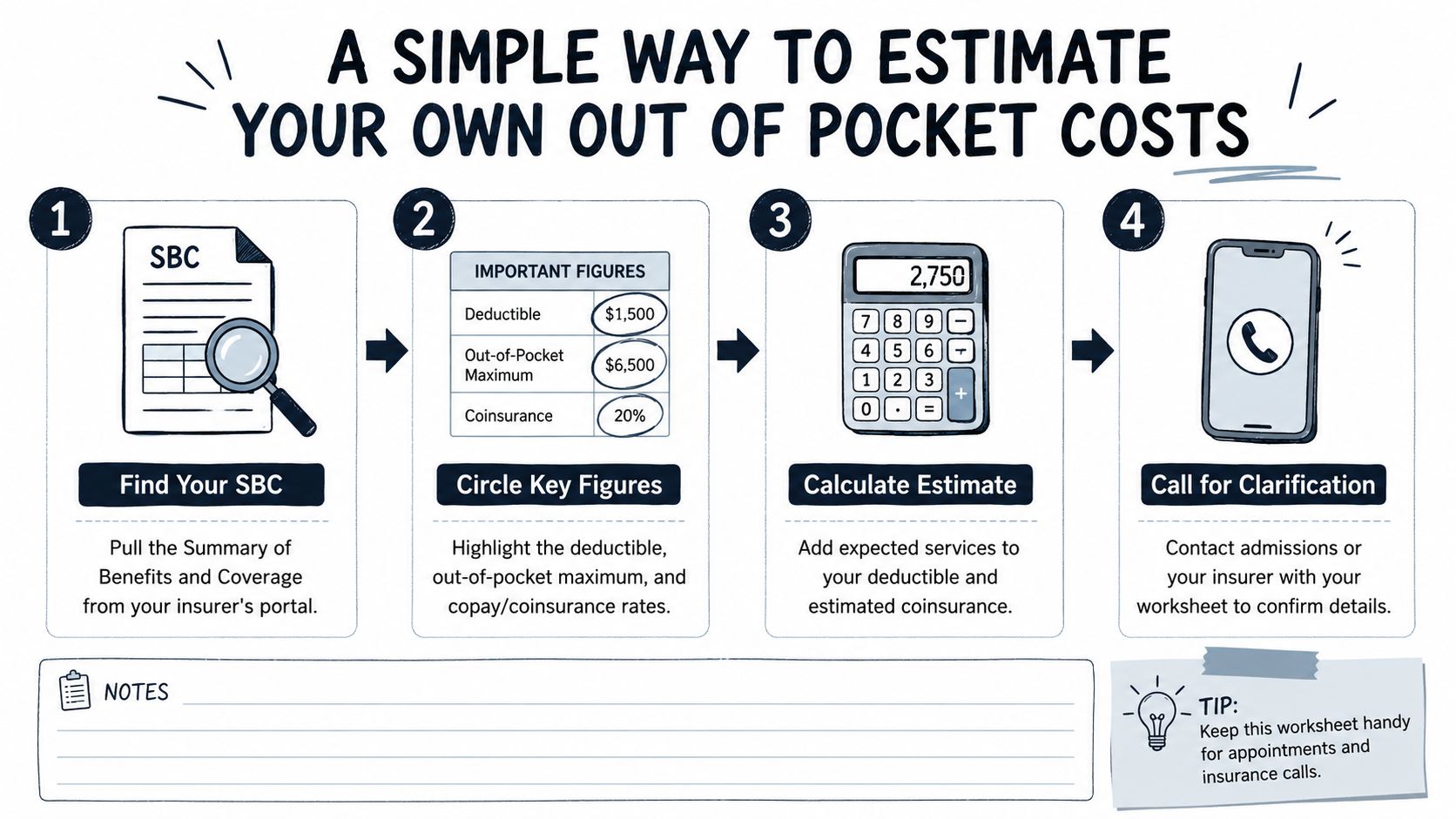
3. Calculate a working total. Multiply the expected length of stay by the facility's daily rate. Subtract the insurer's confirmed contribution only after accounting for the deductible, then apply the stated coinsurance to the remaining allowed amount. If a rate is unavailable, the worksheet should leave that field blank rather than filling it with a guess.
4. Add the items that may sit outside the main estimate. Medication, laboratory work, transportation, optional programming, private-room differences, and an extended stay can change the balance. These items should be listed separately so the family can ask whether each one is included, covered, or billed directly.
Questions to keep beside the phone
The admissions coordinator will usually need the insurance carrier, member number, date of birth, requested level of care, substance involved, medical concerns, and preferred admission timing. The family can ask for the estimated deductible remaining, coinsurance percentage, out-of-pocket maximum, authorization status, out-of-network allowance, and expected balance.
If a short-term cash gap remains after benefits are confirmed, a family may research services offering instant cash while weighing repayment terms carefully. Borrowing should be treated as one possible tool, not as a substitute for a written treatment estimate or a realistic household budget.
The final worksheet should show assumptions in plain language. A good estimate says what happens if authorization ends early, if the client needs detox before residential care, or if the clinical team recommends additional days.
Ways to Reduce or Finance the Remaining Balance
The remaining balance is a financial problem, but it isn't always a single lump sum that must be paid immediately. Families can combine resources, reduce the amount due at admission, and spread the rest over a period that fits the household's capacity.
Start with the facility
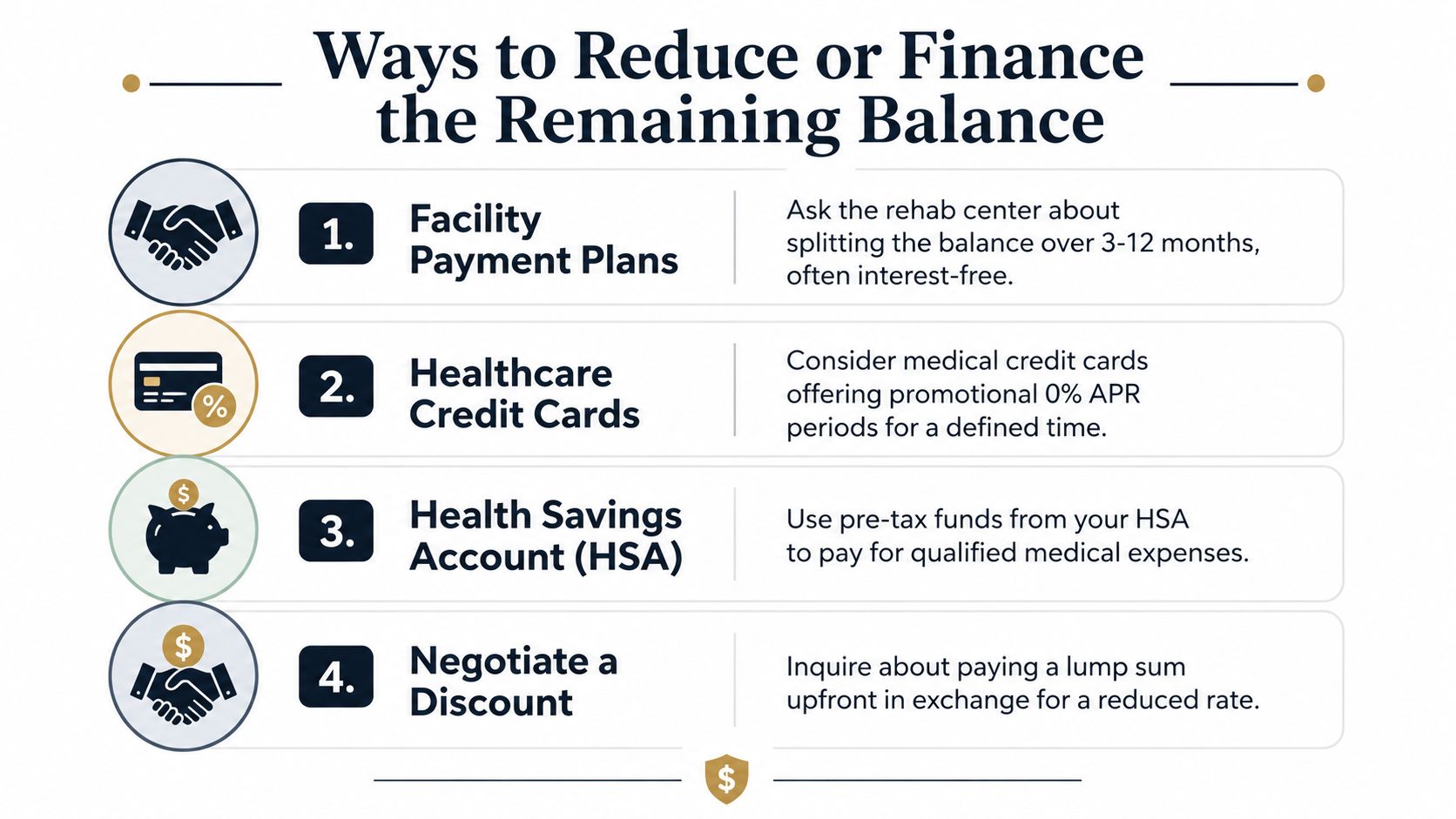
A direct payment plan may divide the balance over 3 to 12 months, often without interest, if the facility offers that arrangement and the family qualifies. The admissions or billing team should explain the required deposit, payment dates, missed-payment terms, and whether the plan applies to all charges or only the facility portion.
A lump-sum discussion may also produce a different negotiated rate, but any adjustment should be documented before admission. A lower balance is useful only when the agreement clearly states what services it covers.
Use available health and financing resources
HSA and FSA funds may help pay for qualified medical expenses with pre-tax dollars, subject to the account's rules and the family's eligibility. The account administrator should confirm whether the particular treatment expense qualifies before funds are used.
Third-party medical financing can provide longer repayment terms for qualified applicants. Medical credit products and healthcare lending arrangements should be compared by interest rate, promotional period, deferred-interest terms, monthly payment, and consequences if the balance isn't paid under the agreement.
Nonprofit scholarships and sliding-scale grants may help families that meet clinical and financial criteria. These resources can take time to review, so the request should begin during the insurance verification process rather than after the admission date is fixed.
A practical combination might include insurance for the covered portion, an HSA or FSA for eligible expenses, and a short facility payment plan for the remaining balance. Another family might use a scholarship review plus a negotiated payment schedule. The purpose isn't to collect every possible financial product. It is to avoid allowing one large upfront figure to delay medically necessary care.
Families considering a property-related financial product should separate treatment financing from housing decisions and review the risks carefully before choosing to browse home rehab mortgage products. A mortgage or home-secured loan can affect long-term housing stability, so it shouldn't be treated as a routine medical payment option.
Your Next Step Toward Oceans Luxury Rehab
A clear next step is a benefits verification call, not a rushed financial commitment. The family provides insurance information, authorizes a benefits check, and explains the client's likely level of care. The admissions team can then confirm network status, deductible information, coinsurance, out-of-network allowances, authorization requirements, and the expected remaining balance.
A written estimate should identify assumptions and exclusions. It should distinguish the facility's daily rate from the insurer's estimated payment, state whether the estimate covers detox, residential, partial hospitalization, intensive outpatient, or outpatient care, and identify possible costs for medications, testing, transportation, or additional treatment days.
What the admissions process can look like
The process usually begins with a confidential pre-screen. A clinician or admissions professional gathers information about substance use, withdrawal risk, medical history, mental health symptoms, medications, safety concerns, and treatment goals. That information supports a clinical assessment and helps determine whether medically supervised detox, residential care, or a step-down level is appropriate.
Once the level of care is identified, the team can coordinate travel, establish an intake date, and explain what to bring. A client may need identification, insurance information, prescription details, comfortable clothing, and approved personal items. The admissions team should provide the facility's current packing guidance rather than leaving the family to guess.
Oceans Luxury Rehab is a California treatment option in San Clemente, Orange County, with an oceanfront setting, private rooms, 24/7 nursing, physician oversight, evidence-based addiction treatment, dual-diagnosis care, medication-assisted treatment, and a continuum that includes detox, residential, partial hospitalization, intensive outpatient, and outpatient services. Families should still verify the specific services, availability, coverage, and financial terms for the proposed admission.
The financial estimate can be prepared before arrival. If insurance doesn't cover the full balance, the admissions team can discuss a payment plan or financing arrangement so the family understands the commitment before travel and intake. California parity protections also matter: the state Department of Managed Health Care says health plans cannot charge more for mental health and substance use services than for physical health conditions, including cost-sharing items such as copays, deductibles, and out-of-pocket expenses under California's behavioral health guidance. Federal parity rules likewise address financial requirements, deductibles, copayments, coinsurance, and out-of-pocket maximums for behavioral health benefits in the federal parity explainer.
For ACA-compliant in-network coverage in 2026, annual out-of-pocket spending is capped at $10,600 for an individual and $21,200 for a family as described in the treatment cost guidance. The cap doesn't make every charge eligible, so the family should ask which services count toward it.
A single conversation can replace hours of independent research with a personalized clinical and financial roadmap. The family can ask about confidentiality, dual-diagnosis needs, treatment timing, travel, and the exact balance expected before admission.
Oceans Luxury Rehab offers discreet, high-comfort addiction treatment in an oceanfront California setting, with medically supervised care, residential and outpatient programs, dual-diagnosis support, and insurance verification. Visit Oceans Luxury Rehab to request a confidential benefits review and speak with an admissions counselor about a personalized out of pocket costs estimate and payment plan.
