
A lot of people searching for help in Orange County are still going to work, still showing up for family dinners, and still answering emails while internally wondering if substance use has moved past “manageable.” That's a hard place to be. The outside looks stable. The inside doesn't.
For professionals, parents, business owners, and high-functioning adults, the biggest fear usually isn't treatment itself. It's disruption. They worry about stepping away from children, clients, deadlines, community responsibilities, and privacy. They assume rehab means disappearing from daily life.
That assumption stops people from getting help far too long.
Finding Hope and Healing in Orange County
Outpatient care exists for exactly this reason. It gives people a real path into treatment without forcing every person into the same level of intensity. In Orange County, addiction treatment already operates as a full continuum, including outpatient, intensive outpatient, withdrawal management, residential, and aftercare/recovery services, which shows outpatient rehab is part of established care rather than a fringe option (Orange County alcohol and substance use services).

Why outpatient treatment matters
Outpatient drug rehab in Orange County works well when a person needs structured clinical support but also needs to keep life moving. That might mean continuing work, maintaining parenting responsibilities, or protecting privacy while treatment begins. It is not a shortcut. It is a treatment model.
The right way to think about outpatient care is this: recovery still becomes a priority, but daily life doesn't have to be abandoned if the person is medically and psychiatrically appropriate for that level of care.
Practical rule: The right level of care isn't the one that feels most convenient. It's the one that keeps the person safe and engaged long enough to recover.
What families should do first
When families are overwhelmed, simple decisions help.
- Start with safety: If there's active withdrawal risk, severe instability, or repeated relapse with dangerous consequences, a higher level of care may be needed before outpatient begins.
- Look at real-life obligations: Work, school, custody schedules, and caregiving matter. A treatment plan should fit the person's reality, not ignore it.
- Choose continuity: Programs work better when they can guide a person through changing levels of care as needs shift.
That's why outpatient drug rehab in Orange County should be viewed as a strategic option for the right person. Not less serious. Not second best. Often the smartest place to begin, or the right place to continue after stabilization.
Understanding Flexible Addiction Treatment
Outpatient rehab is easiest to understand through a simple comparison. Residential treatment is like living on campus. Outpatient treatment is like attending demanding classes while living at home. The structure is still there. The expectations are still real. The difference is that the person returns to daily life between sessions.
What outpatient care actually means
A quality outpatient program gives clients scheduled therapy, accountability, clinical oversight, and recovery planning while they continue living in their home environment. That home environment needs to be reasonably stable. If it isn't, outpatient may not be enough.
The benefit is practical. Clients don't just learn coping skills in a protected setting. They use them in real time. They go to work after a hard therapy session. They cope with family stress without a substance. They practice boundaries in the exact environment that used to trigger use.
That makes outpatient treatment especially relevant for adults who can't put career or family obligations on pause but still need real care.
Why flexibility should not be confused with light treatment
Flexible doesn't mean casual. Good outpatient care still includes a treatment plan, therapy, progress reviews, relapse prevention, and support for co-occurring mental health symptoms when needed. The structure may happen over fewer hours than residential care, but the work is still serious.
Outpatient treatment asks a person to recover in the same world where the problem developed. That's hard, but it can also be powerful.
For some people, hybrid options also matter. Telehealth can make support more accessible when travel, schedule pressure, or location creates friction. Families comparing formats may also find this resource on online addiction support in Pennsylvania useful because it explains why remote access can remove barriers for people balancing treatment with daily obligations.
What strong outpatient programs should include
A family should expect more than a weekly conversation and a handshake.
- Clinical assessment: The program should determine whether outpatient is safe and appropriate before treatment starts.
- Individual therapy: One-on-one sessions should address substance use patterns, triggers, decision-making, and emotional drivers.
- Group work: Recovery skills often strengthen faster when clients practice honesty, accountability, and communication with peers.
- Family involvement: Addiction affects the household. Treatment should help repair that system, not ignore it.
- Step-down planning: Strong programs don't treat discharge like an ending. They prepare the next stage of support.
Families who want a broader overview of how outpatient care works can review this guide to outpatient drug treatment.
PHP vs IOP vs OP What's the Right Fit?
Outpatient treatment isn't one thing. It has levels. That matters because a person who needs daily monitoring shouldn't be placed into a minimal schedule, and a person who needs flexibility shouldn't be forced into more treatment hours than necessary.
A simple way to frame it is by work commitment. PHP is a full-time recovery schedule. IOP is a serious part-time schedule. OP is ongoing structured support with the lightest time demand.
Comparing intensity the right way
At one Orange County addiction program, the Partial Hospitalization Program runs 5 days per week for 6 hours per day, while the Intensive Outpatient Program runs 3 days per week for 3 hours per day. That same program states that patients in PHP and IOP retain direct access to a physician, psychiatrist, and nursing team for medication management and ongoing assessment (Hoag addiction medicine programs).
That difference isn't academic. It changes who each level fits.
| Program Level | Typical Time Commitment | Clinical Intensity | Best For |
|---|---|---|---|
| PHP | 5 days per week, 6 hours per day | High | People stepping down from residential care, people needing close monitoring, or people whose symptoms still interfere with daily stability |
| IOP | 3 days per week, 3 hours per day | Moderate to high | People who need strong structure but can still maintain some work, school, or family responsibilities |
| OP | Varies by program and clinical need | Lower | People with stronger stability who need ongoing therapy, relapse prevention, and accountability |
How to decide
The right fit usually comes down to four questions:
Is the person medically stable between sessions?
If the answer is no, outpatient may be too light, or PHP may be the minimum safe option.How strong is relapse risk right now?
Frequent slips, cravings, chaotic routines, and poor impulse control point toward more structure.Are psychiatric symptoms active?
Anxiety, depression, trauma symptoms, or mood instability can push someone toward a higher outpatient level when closer monitoring is needed.Can the person function safely at home and in the community?
If evenings and weekends become high-risk windows, treatment intensity should rise.
A flexible schedule should never drive the decision more than safety and clinical need.
A practical recommendation for families
Families often try to choose the least disruptive option first. That's understandable, but it can backfire. When a person clearly needs PHP, placing them in standard outpatient just delays progress and increases frustration. On the other hand, when a person is stable enough for IOP or OP, forcing a heavier schedule can create unnecessary resistance.
For readers trying to understand where PHP fits in the broader mental health and addiction field, this overview of PHP in mental health treatment gives helpful context.
Who Benefits Most from Outpatient Programs
Not everyone is a fit for outpatient care. That's the truth families need early, not after a failed admission. But many adults who assume they need to disappear into rehab are strong outpatient candidates.
In Orange County, a treatment-statistics review reported that from 2011 to 2013, 56% of patients chose an outpatient treatment program, compared with 44% who entered residential programs lasting more than one month. The same review reported meaningful post-treatment improvements, including 53% stopping use of their primary drug, 65% fewer arrests, 74% fewer jail sentences, 78% fewer prison sentences, 107% more adults employed after discharge, 32% fewer ER visits, 42% fewer overnight hospitalizations, and 23% fewer ER psychiatric visits.
That matters for one reason. Outpatient care is not a fringe fallback. It is a common path with measurable outcomes.
Strong signs outpatient may fit
Some profiles stand out.
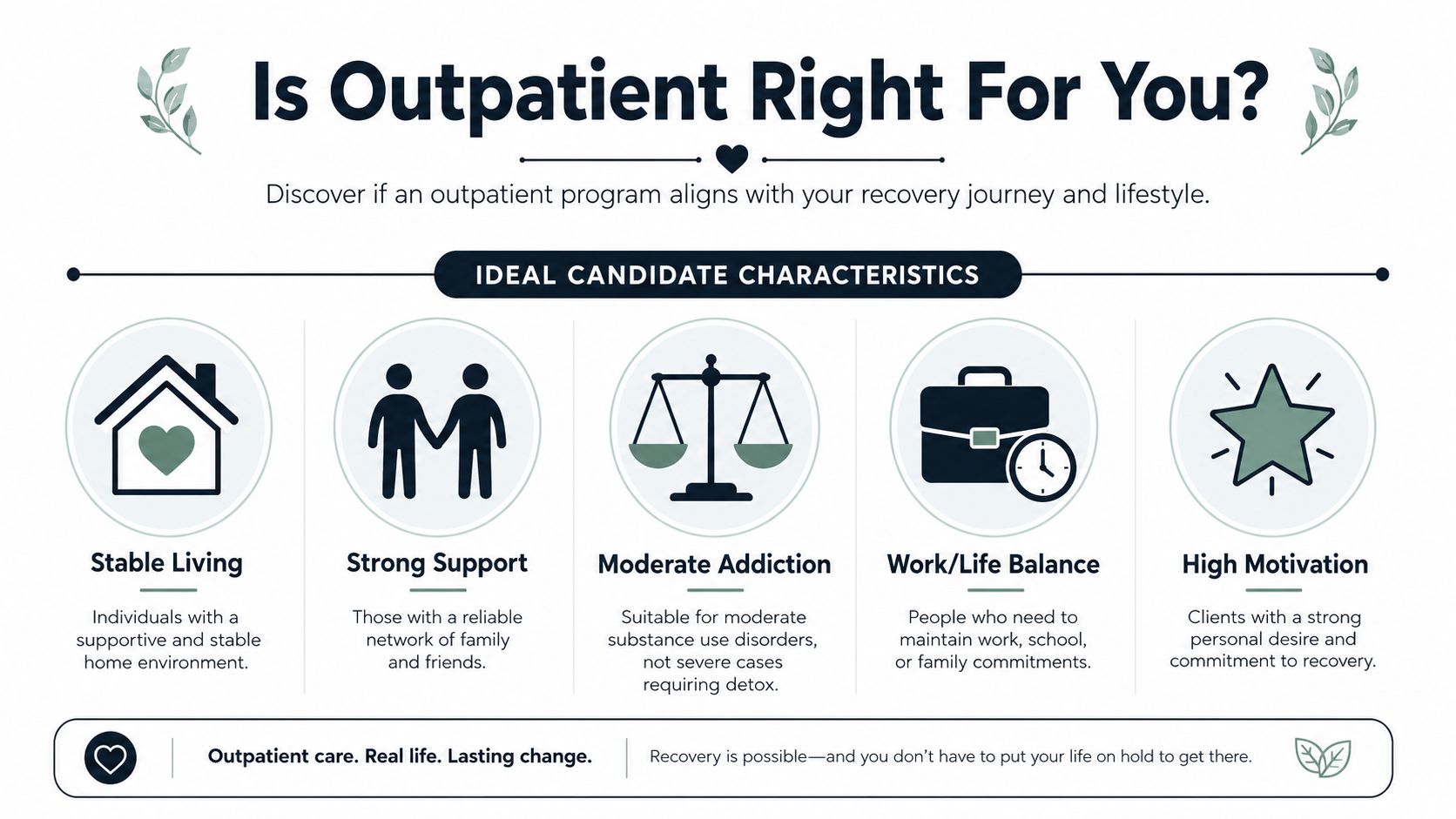
- Stable living situation: A person has a home environment that is reasonably calm, predictable, and not centered around substance use.
- Reliable support network: A spouse, parent, sibling, or close friend is willing to support attendance, honesty, and accountability.
- Real-world obligations: The person needs to keep working, parenting, studying, or managing major responsibilities while in treatment.
- Personal motivation: They may feel scared or ambivalent, but they're willing to engage and follow a plan.
When outpatient may not be enough
A family should be cautious when any of these are present:
- Unsafe withdrawal risk: If detox is needed, medical stabilization should come first.
- Repeated high-consequence relapse: Overdoses, blackouts, legal crises, or severe impulsivity usually call for more containment.
- Unstable psychiatric symptoms: If someone cannot regulate mood, sleep, or behavior outside sessions, a higher level often makes more sense.
- Destructive home environment: If the household is chaotic, abusive, or saturated with substance use, outpatient has less room to work.
The ideal Orange County outpatient candidate
The best outpatient candidate often looks like the person nobody expects. The executive who still closes deals. The parent who never misses pickup. The college student who keeps grades intact while spiraling privately. The healthcare worker who knows exactly how bad things are getting and still feels ashamed to ask for help.
Outpatient treatment often fits people who are functioning publicly and suffering privately.
That's why outpatient drug rehab in Orange County can be such a strong option for professionals and families. It respects the reality that many people need treatment without stepping away from every part of life.
Your Treatment Timeline and Key Services
The unknown keeps people stuck. Once families understand what outpatient treatment usually looks like, the process feels less intimidating and more manageable.
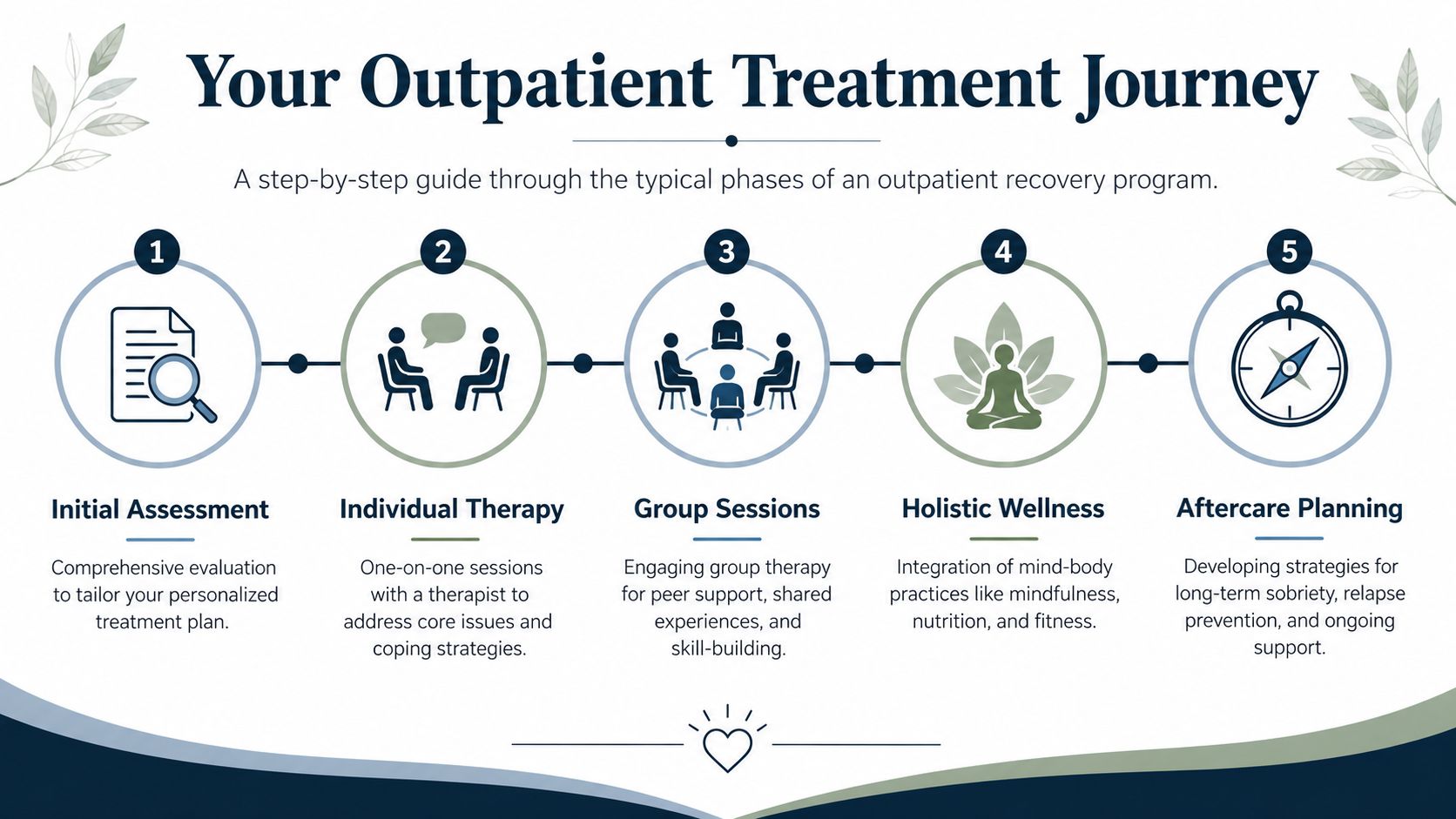
A good outpatient program follows a sequence. It starts with assessment, moves into active treatment, adjusts as the person responds, and ends with a clear aftercare plan. The details vary by client, but the core path is usually consistent.
Phase one through phase three
Assessment comes first.
Clinicians review substance use history, mental health symptoms, relapse risk, medical needs, family dynamics, and daily responsibilities. This step should determine whether the person belongs in outpatient, a more intensive level, or medical detox first.
Treatment planning follows.
Once the program knows what it's treating, it can build a plan around actual needs. That may include individual therapy, group therapy, family sessions, medication support, and recovery goals tied to work, home life, and relapse prevention.
Active therapy does the heavy lifting.
Most clients spend the majority of treatment here. They work on triggers, distorted thinking, avoidance patterns, stress regulation, accountability, and routines that support sobriety instead of feeding relapse.
Core services families should expect
The best programs don't rely on one method. They layer services together.
- Individual therapy: In individual therapy, clients address denial, grief, trauma history, shame, and the specific situations that keep pulling them back toward use.
- Group counseling: Group work helps clients test new communication skills, hear feedback, and stop believing they're the only one living this double life.
- Family therapy: Recovery usually moves faster when families stop reacting blindly and start responding with structure.
- Dual-diagnosis care: If anxiety, depression, trauma, or mood symptoms are part of the picture, treatment should address both substance use and mental health.
- Medication-assisted treatment: For some clients with opioid or alcohol dependence, medications can support stabilization and reduce risk when used appropriately within a clinical plan.
The final phase matters more than families expect
Discharge planning should begin before treatment ends. A person who leaves outpatient without a next-step structure is more exposed than they realize. Recovery needs a landing place.
That plan may include lighter outpatient sessions, recovery meetings, psychiatric follow-up, sober living, family boundaries, work re-entry strategies, and a written relapse response plan. The point isn't to make life revolve around treatment forever. The point is to make sobriety sustainable outside the program.
Recovery becomes more durable when a client knows exactly what happens after the formal schedule ends.
Why Professionals Choose Oceans Luxury Rehab in California
Professionals usually need three things at the same time. They need competent treatment. They need privacy. They need a setting that doesn't add more chaos to an already overloaded nervous system.
That combination is harder to find than it should be.

What high-functioning adults usually need
A busy adult seeking treatment in California often isn't looking for drama or institutional coldness. They need discretion, clear communication, and care that respects dignity. If they require detox, residential treatment, partial hospitalization, intensive outpatient, or ongoing outpatient support, they benefit from a program that can manage those transitions without forcing them to start over with new providers at every step.
That continuity matters because addiction rarely follows a straight line. Some people need a higher level first, then step down gradually. Others can begin in outpatient care. The strongest setup is one built around the person, not around a rigid one-size-fits-all track.
Why continuum matters for outpatient clients
Orange County's public system itself reflects a continuum that includes outpatient, intensive outpatient, withdrawal management, residential, and aftercare/recovery. That's the right model conceptually, because outpatient works best when it exists inside a broader treatment pathway rather than as a disconnected clinic experience.
For professionals, that means less fragmentation. One team can understand the case history, monitor progress over time, and adjust treatment intensity when life circumstances change. That's especially important for people with relapse history, co-occurring mental health symptoms, medication needs, or family systems that require coordinated support.
Where Oceans Luxury Rehab fits
Oceans Luxury Rehab is one California option that offers that broader continuum, including detox, residential care, PHP, IOP, and outpatient treatment in an oceanfront setting designed for privacy and comfort. For adults who care about discretion, private rooms, physician oversight, dual-diagnosis support, and a calm environment, that model is practical because it reduces friction during transitions in care.
That's especially relevant for executives, business owners, public-facing professionals, and families who won't tolerate a chaotic setting. Comfort alone doesn't create recovery, but comfort can remove barriers to entering and staying in treatment. A private, dignified environment helps many clients stop resisting help long enough to engage with it.
Practical advantages for Orange County families
A luxury setting also tends to support logistics better. Families balancing admissions, transportation, work obligations, and confidentiality often need planning help around arrivals and transitions. For those coordinating a discreet travel experience, this comprehensive guide to VIP chauffeur services offers useful general guidance on private transportation standards and expectations.
A professional client doesn't need treatment to feel punishing. They need it to feel safe, organized, and serious. When a program can provide medical support, structured therapy, privacy, and step-down options in one environment, outpatient care becomes much easier to sustain over time.
The right recommendation is straightforward. Families should prioritize programs that can assess accurately, match the client to the right level of care, and keep treatment cohesive from stabilization through aftercare. For many adults in Orange County and across California, that's the difference between another false start and a recovery plan that holds.
For anyone looking for discreet, high-comfort addiction treatment in California, Oceans Luxury Rehab offers a clear next step. The admissions team can help determine whether detox, residential care, PHP, IOP, or outpatient treatment is the right fit, verify insurance quickly, and guide families toward a treatment plan that protects privacy while delivering real clinical support.
