

The first Monday home after residential treatment often looks successful from the outside. A senior executive answers emails, attends a board call, and tells a spouse that recovery is going well. Yet the morning routine starts slipping, scheduled check-ins become inconvenient, and the person who appeared highly engaged in treatment begins managing recovery privately again.
That pattern doesn't mean treatment failed. It means the recovery environment changed. Luxury residential care can reduce access to substances, remove daily friction, and provide continuous clinical structure. Discharge returns the client to travel, pressure, family tension, professional scrutiny, and the same private decisions that made treatment necessary.
Accountability systems are the architecture that catches drift before it becomes a crisis. The strongest plans don't rely on sincerity alone. They create discreet, proportionate ways to verify commitments, identify missed steps, and involve the right person before a lapse becomes a sustained return to use.
Why Accountability Matters After High-End Treatment
A high-performing professional may leave a 45-day residential stay with excellent insight and a carefully written discharge plan. The first week at home can still expose weaknesses that treatment temporarily contained. A meeting runs late, a flight is moved, a spouse asks a difficult question, and the client decides to skip one check-in. The next missed commitment feels minor, so nobody responds.
Within eight weeks, the morning meditation may be gone, followed by therapy attendance, peer contact, and honest disclosure. The executive may still appear composed at work. Colleagues often don't know the recovery plan exists, and family members may hesitate to challenge someone who has just completed expensive treatment.
Accountability matters because willpower is least dependable when stress, shame, fatigue, and isolation return. A plan needs an observer who notices absence, not just participation. That observer might be a clinician reviewing test results, a spouse tracking agreed boundaries, a case manager confirming attendance, or a professional monitor receiving documented reports.
Discretion must be designed
High-profile clients usually reject systems that feel punitive, public, or indiscriminate. That resistance is rational. Recovery records can affect family relationships, professional standing, licensing, custody discussions, and privacy. A useful system therefore has a narrow purpose, a named owner, a secure record, and a clear response when something is missed.
Relational trauma can complicate this design. A client or couple who needs trauma-informed support may benefit from a specialist resource such as finding a Kelowna trauma therapist when unresolved trauma is driving secrecy, conflict, or emotional withdrawal.
Practical rule: Accountability should make the next right action easier to verify, not make the client feel watched every minute.
The aim isn't constant surveillance. It's a structure that remains credible when motivation fades. Each commitment should answer four questions: who checks it, what evidence is produced, what happens if it's missed, and who has permission to know.
Defining Accountability Systems in Recovery
An accountability system is any structured arrangement that records, reports, or verifies recovery behavior for a second party who can respond. A therapy appointment documented by a provider qualifies. A witnessed test qualifies. A promise made privately, without a record or agreed follow-up, doesn't.
That distinction separates accountability from motivation and willpower. Sponsorship, family support, and personal commitment can be valuable, but their evidence may depend heavily on self-report. Accountability adds an observable action and a defined response.
A building with several load-bearing layers
A useful analogy is a secure building.
- Clinical monitoring is the foundation. Laboratory testing, psychiatric reviews, medication records, and documented assessments establish the health and safety baseline.
- Family and peer relationships are the walls. They provide context, notice emotional changes, and identify behavior that a test can't explain.
- Digital tools are the wiring. They support reminders, timestamps, check-ins, and communication between scheduled appointments.
- Legal and workplace agreements are the inspection regime. They define external obligations, reporting boundaries, and consequences outside the treatment team's control.
Each layer catches a different failure. A lab result can indicate substance exposure but won't explain a marital rupture. A spouse may notice withdrawal but can't interpret a medication issue. An app can confirm a check-in but can't determine whether the client is psychologically safe.
The system must be actionable
Recording information isn't enough. A clinician must know what result triggers a review. A spouse must know whether a missed meeting calls for a conversation or an emergency response. A workplace monitor must receive only the information authorized by the relevant agreement.
The system should therefore specify evidence, owner, access, timing, and escalation. Those details prevent accountability from becoming a collection of disconnected obligations. They also protect dignity by limiting monitoring to what serves recovery.
Performance-based accountability systems in public-sector settings follow a similar logic, explicit goals, outcome measurement, shared information, and a response to gaps. RAND's review of nine systems across five sectors found that evidence of effectiveness was limited overall, while carefully designed incentives, metrics, and implementation could support better service delivery when evaluated rigorously RAND's review of performance-based accountability systems.
The Five Core Types of Accountability Systems
No single method is sufficient for a complex recovery plan. Clinical testing offers stronger objective evidence, family involvement supplies context, digital tools fill gaps between appointments, external agreements formalize obligations, and medication adherence monitoring confirms treatment continuity.
| System Type | Evidence Strength | Friction Level | Privacy Risk | Best Use Case |
|---|---|---|---|---|
| Clinical monitoring | High when collection and documentation are controlled | Moderate | Moderate | Relapse-risk review and medical oversight |
| Peer and family accountability | Variable, strong for context | Moderate to high | High if boundaries are unclear | Emotional drift, isolation, and relationship repair |
| Legal and workplace agreements | High for defined compliance duties | High | High | Licensing, return-to-work, or court-related oversight |
| Digital monitoring and apps | Variable, depending on verification and human review | Low to moderate | Moderate to high | Between-session prompts and discreet confirmation |
| Medication-assisted treatment adherence | High when dosing or pharmacy records are documented | Moderate | Moderate | Medication precision and continuity of care |
Clinical monitoring
Urine drug screens, blood work, therapist-administered assessments, and psychiatrist check-ins can produce defensible records. Their weakness is timing. Testing is often episodic, so a reassuring result doesn't describe every hour between appointments. Collection procedures, laboratory handling, interpretation, and timely review determine whether the evidence is useful.
Peer and family accountability
Sponsors, structured family sessions, and sober companions can identify emotional withdrawal, rationalization, conflict, or exhaustion before a formal test changes. The trade-off is emotional loading. A spouse who becomes the monitor may stop feeling like a partner, while a companion who lacks a defined scope may overreach.
Family participation works best when the plan separates support from enforcement. A spouse can report observable concerns without interrogating every mood change. A clinician can interpret the information and decide whether the care plan needs adjustment.
Legal and workplace agreements
Probation conditions, licensing-board monitoring, professional health programs, and return-to-work contracts have the clearest external authority. They also carry the greatest reputational and professional stakes. These arrangements should sit outside the clinical perimeter, with legal review and written consent governing what gets shared.
Digital monitoring and apps
Sober tracking applications, wearable biosensors, transdermal alcohol monitors, and GPS check-ins reduce friction between appointments. They can support routine and reveal missed patterns, but convenience can create false confidence. A client may comply with a digital prompt while avoiding the therapy, relationship repair, or clinical assessment that gives the data meaning.
Medication-assisted treatment adherence
Observed dosing, pharmacy records, and injectable depot formulations such as naltrexone or buprenorphine can make medication continuity easier to verify. MAT isn't a shortcut or a credibility problem. It's a clinical layer that should be assessed for medical fit, informed consent, adherence, side effects, and privacy.
Contingency management also illustrates why recovery behavior needs a structured response rather than praise alone. A clinically designed plan can connect verified behaviors with immediate, appropriate reinforcement. A deeper explanation of this framework appears in contingency management and recovery accountability.
The practical recommendation is to stack at least three layers. Clinical monitoring should lead, relational accountability should add context, and digital or external oversight should fill the gaps created by travel, work, or legal obligations.
Why Proof and Evidence Define Modern Accountability
A high-profile client may face a licensing review, a spouse's questions, an employer's scrutiny, or a court request while under significant stress. A durable recovery plan must therefore produce evidence that another person can examine without relying on memory or reassurance. Sincerity matters in therapy, but accountable care also needs records that remain clear when privacy, pressure, and competing interests shape the conversation.
Useful artifacts include laboratory reports, witnessed chain-of-custody urine tests, ethyl glucuronide results, documented attendance logs, medication administration records, and secure application exports with timestamps. Each item answers a different question. Clinical records show treatment and response, relational records add observed context, legal documentation defines authorized disclosure, and digital records show activity between appointments. Progress monitoring should specify what is measured, who reviews it, and how concerns trigger action, as outlined in progress monitoring for recovery.
Strong records and weak records
Self-report remains clinically important. A client must be able to describe cravings, shame, anger, sleep disruption, and concealed behavior. Under fear of losing employment, professional status, access to children, or a relationship, however, self-report can become incomplete or defensive.
A signed attendance record confirms that a session occurred, while leaving engagement and honesty for clinical assessment. A biomarker can support or challenge an account of substance use, but it cannot explain why use occurred or identify the intervention most likely to prevent recurrence. Records don't replace judgment; they give it something solid to examine.
The same problem appears in organizational data systems. One report found that only 36% of organizations can see where data is processed, trained, or inferred by external partners, while 61% say audit trails are too fragmented to produce evidence-quality documentation and 57% lack centralized gateways to track and prove data flows the report on enterprise data proof gaps. Those findings concern enterprise data, yet the operational lesson applies to discreet recovery. Fragmented records create uncertainty precisely when executives, families, or workplace reviewers need a clean account.
Evidence quality by method
| Method | Evidence Strength | Verifiability |
|---|---|---|
| Self-report | Essential clinical context, limited independent proof | Low without corroboration |
| Documented therapy attendance | Moderate | Good when provider-controlled |
| Observed testing | High for the measured exposure | Strong if handling and records are controlled |
| App check-in | Variable | Moderate, stronger with secure exports and human review |
| Medication administration record | High for documented dosing | Strong when maintained by a provider or pharmacy |
| Family observation | Valuable context | Moderate, subject to interpretation and conflict |
A technical accountability framework for artificial intelligence uses a 56-criterion audit matrix across data, model, code, and system layers, and across development, assessment, mitigation, and assurance stages the technical audit matrix for AI accountability. Recovery planning does not need that exact structure. It should adopt its discipline: each important commitment needs traceable evidence, a defined reviewer, privacy limits, and an accountable owner.
Building a Layered Plan for Residential and Aftercare
A well-built plan starts before discharge. Residential treatment should use its controlled environment to establish the clinical baseline, clarify consent, involve the appropriate family members, and test whether each accountability process works in practice.
The first 72 hours
The intake period should produce a concise risk and evidence map.
- Clinical baseline: The team reviews relevant medical information, substance history, mental-health symptoms, medication needs, and laboratory findings. MAT induction should be considered where clinically indicated, with prescribing and monitoring responsibilities documented.
- Family liaison protocol: The client identifies who may receive information, what that person may report, and which situations require immediate contact. Couples work should preserve individual confidentiality rather than turn one partner into the other's case manager.
- Secure communication: Devices and communication channels should be assessed for privacy, access permissions, and practical use during travel or work. Encryption, consent, and retention rules belong in the implementation discussion.
- Discharge ownership: Each task receives a named owner. A task without an owner is an intention, not a safeguard.
The sequence matters. Clinical monitoring leads because safety and medical stability come first. Digital monitoring reinforces the plan between clinical contacts. Relational accountability adds meaning and detects changes that measurements miss. Legal and workplace agreements remain external obligations and require separate review.
Checkpoints that carry the plan home
At discharge, the client should leave with confirmed appointments, test instructions, medication arrangements, family communication rules, and an escalation pathway. The day 7 checkpoint can confirm the handoff to outpatient care and include a sober companion briefing when appropriate.
The day 30 review should examine attendance, test completion, medication continuity, sleep, work pressure, and relationship strain. A couples therapy session may be useful when both partners need coordinated communication without sharing every individual disclosure.
At day 90, the team can reassess executive functioning, travel demands, cravings, and whether digital monitoring remains proportionate. The day 180 review should determine whether the architecture is stable, needs modification, or can reduce selected safeguards without removing clinical contact.
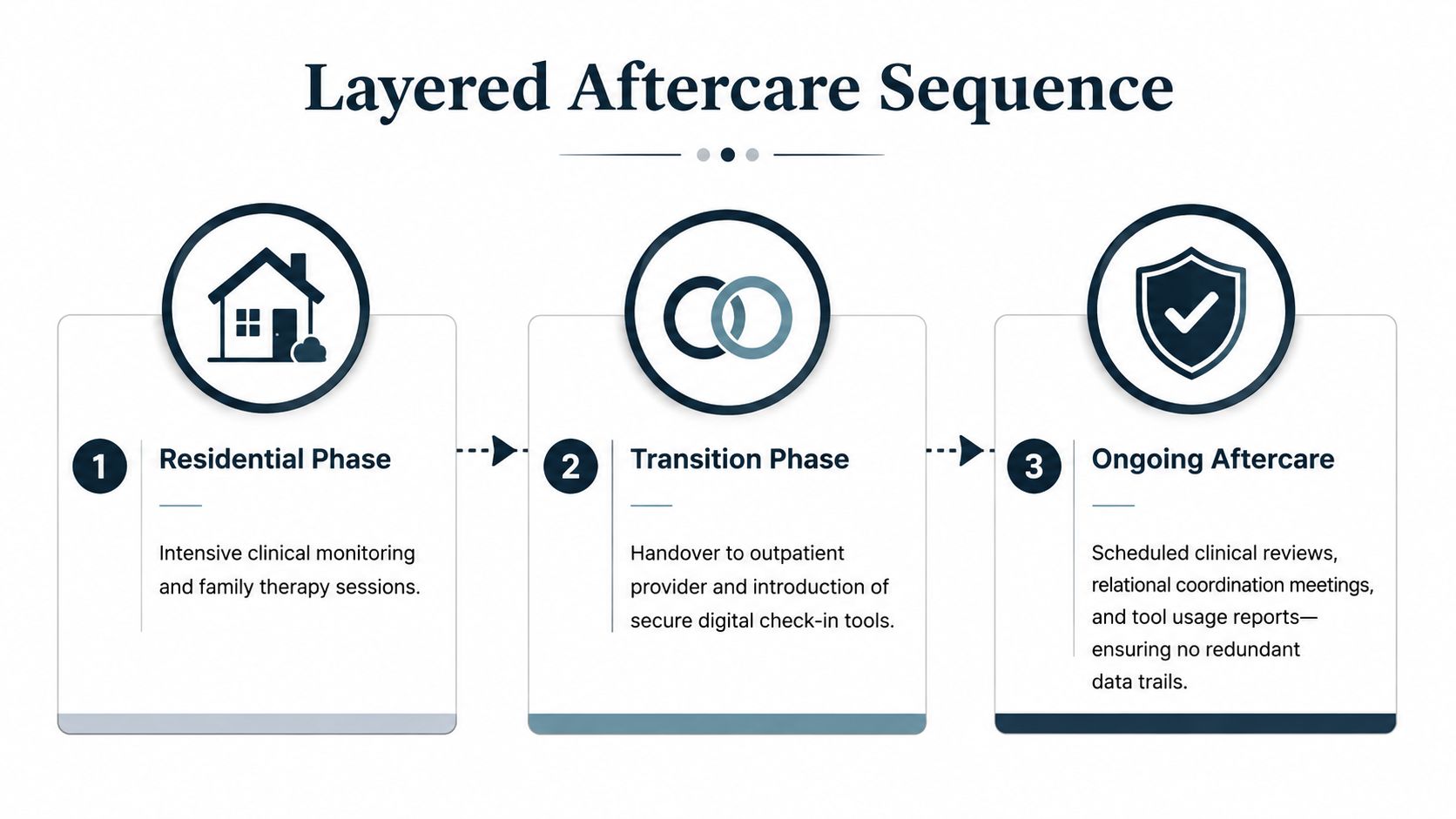
Executives and entrepreneurs may need shorter, more discreet contacts around board meetings and travel. Couples may require separate individual sessions alongside joint work. A structured sober living option can provide additional continuity when returning directly home would expose the client to unmanaged triggers.
The coordination cadence should be simple. A lead clinician reviews the complete picture, each supporting professional sends only agreed information, and the client knows exactly what happens after a missed test, missed session, or concerning report. That prevents parallel teams from collecting duplicate or contradictory data.
Common Pitfalls in High-Profile Recovery Plans
Money and privacy don't automatically produce a sound accountability system. They can create more layers, more devices, more personnel, and more records without creating better decisions.
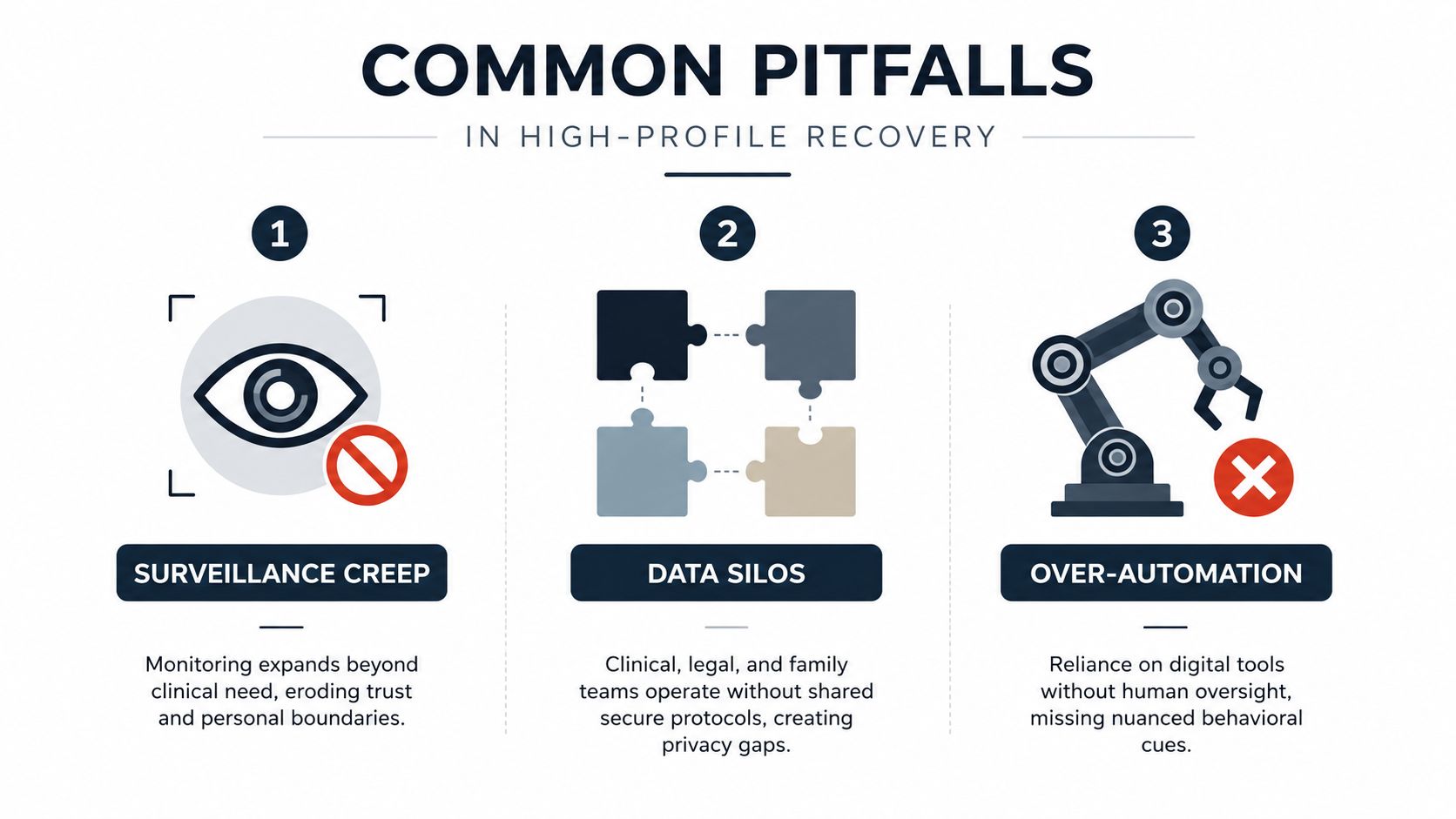
Surveillance creep begins when monitoring expands beyond the clinical question. A sober companion starts reviewing private messages. A spouse demands constant location access. An assistant receives information that was never necessary for scheduling. These choices can damage trust and create legal exposure without improving safety.
App-driven false security is another common failure. Frequent digital check-ins may look impressive in a report while the client avoids therapy, conceals resentment, or uses the app to satisfy the minimum requirement. A timestamp confirms a digital action. It doesn't confirm emotional honesty, medication response, or readiness to face a difficult conversation.
Data silos create a different risk. The therapist knows about insomnia, the spouse sees withdrawal, the case manager sees missed appointments, and the workplace monitor sees a compliance concern. If no secure protocol connects the relevant facts, each person holds an incomplete story.
Privacy failures are operational failures
A shared phone, an unprotected account, or a careless executive assistant can expose a confidential plan. The solution isn't to collect no information. It's to define access, use secure communication, limit retention, and rehearse what staff should do when a message reaches the wrong person.
Couples accountability deserves special care. Joint monitoring can turn intimacy into investigation, especially when one partner uses recovery data to win arguments. Joint sessions should focus on agreed relational goals, while individual disclosures remain protected within the limits explained at intake.
Every layer needs one owner, one scope, and one escalation path. No single layer should function as the sole safeguard, and no layer should continue indefinitely without a review of whether it remains clinically necessary.
Choosing and Implementing the Right System
A high-profile client can make the initial design decisions in one focused planning session, provided the clinical team, client, and authorized support people work from the same risk picture.
Start with the risks
The first task is an audit, not a product search. The team maps substance triggers, work stressors, relationship strain, travel patterns, mental-health symptoms, legal exposure, and medication complexity.
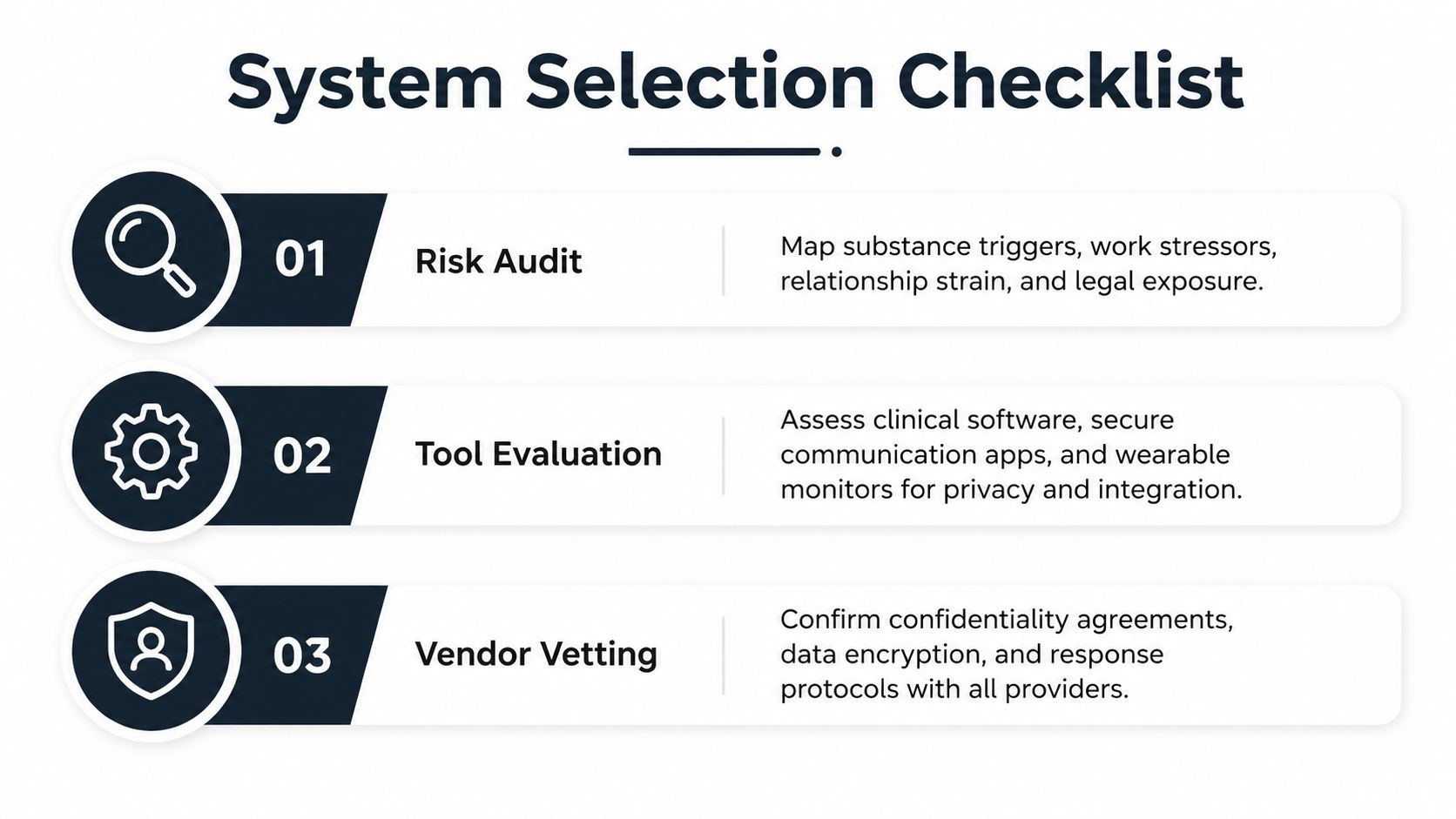
Each risk then receives the least intrusive layer that can produce meaningful evidence:
- Relapse biomarkers: Clinical monitoring, with laboratory and review procedures documented.
- Emotional drift: Peer or family check-ins, structured so observations don't become interrogation.
- Between-session gaps: Digital check-ins or monitoring, selected for privacy and human oversight.
- Professional exposure: Legal or workplace agreements, reviewed separately from clinical decisions.
- Medication precision: Adherence protocols involving observed dosing, pharmacy documentation, or clinician review.
Assign owners before discharge
The lead clinician should own clinical interpretation. A case manager may coordinate appointments and reports. A family liaison can manage authorized communication with relatives. A workplace or legal monitor should receive only the information required by the governing agreement.
This division prevents the spouse, assistant, or sober companion from becoming an informal clinician. It also creates a clear response when evidence conflicts. A missed check-in isn't automatically a relapse, but it should trigger the response written into the plan.
Test the architecture for 30 days
The first 30-day verification window should prove that the system functions. The team confirms test results, logs check-ins, exports authorized digital data, and reviews professional reports. The focus is not on producing a perfect compliance record. It's on finding broken handoffs, confusing instructions, privacy leaks, and unrealistic scheduling before discharge stress magnifies them.
Oceans Luxury Rehab, a licensed oceanfront treatment center in San Clemente, Orange County, provides medically supervised detox, residential, partial hospitalization, intensive outpatient, and outpatient care, with individualized plans that may include medication-assisted treatment, dual-diagnosis care, family therapy, and aftercare planning. Its structured setting can be used to wire accountability responsibilities before the client returns to work, family, and travel.
A system is ready when every commitment has a person responsible for reviewing it, a secure record, and a proportionate response. If the team can't explain those three elements, the plan isn't finished.
Frequently Asked Questions and Next Steps
How are accountability records stored?
The care team should explain storage, access, retention, and disclosure before monitoring begins. HIPAA may govern protected health information, but it doesn't answer every question about executive privacy, family access, employment records, or legal strategy. Attorney-client privilege is also specific to qualifying legal communications and shouldn't be assumed for clinical records.
A discreet plan uses written consent, role-based access, secure communication, and a clear release process. The client should know which records remain inside the treatment team, which reports go to an authorized professional monitor, and what information family members may receive.
Does MAT count as accountability?
Yes. Medication-assisted treatment can be a legitimate clinical accountability layer when adherence, prescribing, side effects, and follow-up are documented. Naltrexone and buprenorphine should be evaluated by qualified clinicians based on diagnosis, medical history, treatment goals, and informed consent.
MAT doesn't undermine recovery credibility. It can make medication continuity more observable while reducing the need to rely on memory or unsupported assurances. The record should show the clinical reasoning and follow-up, not treat medication as a moral test.
Can couples enroll together?
Couples can pursue coordinated care without abandoning individual confidentiality. Joint sessions address communication, boundaries, relapse-warning responses, and shared routines. Individual sessions preserve space for disclosures that a partner isn't entitled to receive.
The couple should agree on what information can be shared, who responds to a concern, and how monitoring won't become mutual surveillance. That structure protects both recovery and the relationship.
What happens when a layer fails?
The response should be written before a failure occurs. A missed test may require prompt contact and rescheduling. A concerning result may require clinical assessment, medication review, increased monitoring, family communication within consent limits, or a higher level of care.
A workplace flag should follow the governing agreement, not an improvised confrontation. The purpose is correction and safety, not humiliation.
How long should aftercare accountability last?
There is no universal end date. Accountability can scale down when clinical stability, reliable attendance, honest communication, and practical stress management are sustained. It should scale back up when travel increases, sleep deteriorates, relationship conflict intensifies, or warning signs return.
The safest approach is scheduled review rather than automatic expiration. At each review, the team asks whether the layer still serves a defined purpose and whether removing it would create an avoidable blind spot.
For confidential planning, a luxury treatment seeker should schedule an assessment before discharge pressure takes over. Oceans Luxury Rehab can help design a layered accountability plan around substance risk, medical needs, family relationships, privacy requirements, and professional constraints.
Oceans Luxury Rehab offers discreet California addiction treatment with medically supervised detox, residential and outpatient care, medication-assisted treatment, dual-diagnosis support, family therapy, and structured aftercare planning. Visit Oceans Luxury Rehab to request a confidential consultation and begin building an accountability system that can withstand real-world stress.
