

If someone is sitting in a waiting room of a therapy office, phone face down, heart racing, and thinking, “If this gets too intense, what am I supposed to do with all of it?”, that's a very normal place to begin. EMDR for trauma was built for that kind of moment, when the memory feels loud, the body reacts before the mind can catch up, and plain talking hasn't been enough to settle the nervous system.
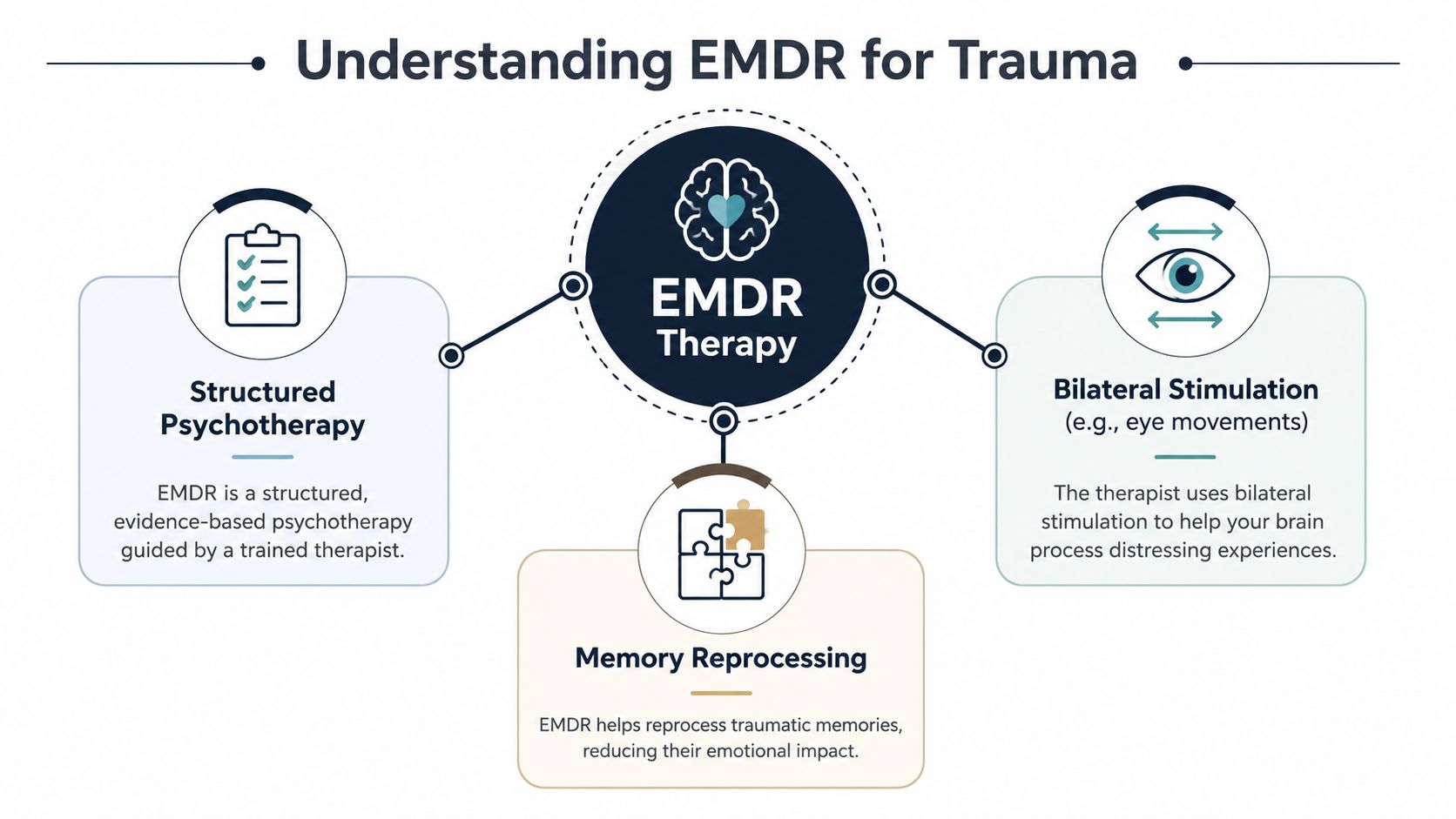
At its simplest, EMDR, or eye movement desensitization and reprocessing, is a structured psychotherapy that helps the brain rework distressing memories instead of keeping them stuck in a raw, present-tense state. It was introduced by psychologist Francine Shapiro in 1987 and has grown into one of the most established trauma-focused therapies, with major organizations recognizing it as a serious treatment option for trauma care, not a fringe technique (PMC review on EMDR history and outcomes, APA overview of EMDR).
People often come across EMDR while trying to make sense of hurt that keeps returning in body sensations, nightmares, panic, or shutdown. A practical emotional hurt resource like emotional hurt strategy guide can help some readers name what they're feeling before they start trauma treatment. For those who want to see how trauma-aware care is framed in a treatment setting, this internal overview of trauma-informed care is a useful companion.
Understanding What EMDR for Trauma Actually Means
A person can spend years saying, “I know what happened, so why does it still feel like it's happening now?” That question is often the doorway to EMDR. The short answer is that traumatic memories can stay poorly processed, so the brain keeps them stored with the original sights, sounds, body sensations, and meaning attached to them, almost like a filing cabinet with one folder jammed half open.
EMDR treats that stuck memory pattern with a structured psychotherapy process. Instead of asking someone to talk through the trauma until it feels lighter, the therapist guides the client to briefly focus on the memory while also doing bilateral stimulation, most often side-to-side eye movements, but sometimes taps, tones, or buzzers (Cleveland Clinic EMDR overview). The memory is still there, but the brain is given a different job to do while it's active.
Why that matters for trauma
Trauma often behaves like a file that never got archived. The brain can remember the event, yet the memory keeps arriving with the emotional force of the original moment, which is why a smell, a sound, or a tone of voice can trigger an outsized reaction. EMDR aims to help the memory move out of that raw, alarmed state and into a broader network where it can be remembered without flooding the person.
That's also why EMDR isn't just another style of talk therapy. It uses language, but it doesn't rely on language alone. The client stays connected to the memory while the therapist keeps the process organized, paced, and anchored in present safety.
Practical rule: if trauma feels more like a live wire than a story, a processing model is often a better fit than insight alone.
EMDR is usually delivered in phases, with preparation first and active reprocessing later. That predictability matters for anxious clients, because the work is not supposed to be chaotic. It's designed to be steady, contained, and monitored from start to finish.
The Leading Theories of How EMDR Works
Think of the brain as a filing cabinet that keeps opening the same damaged folder. EMDR adds a second task while the folder is open, and that extra load seems to change how the memory is held. The exact mechanism is still being studied, which is normal for a complex psychotherapy, but three explanations show up again and again in the literature.
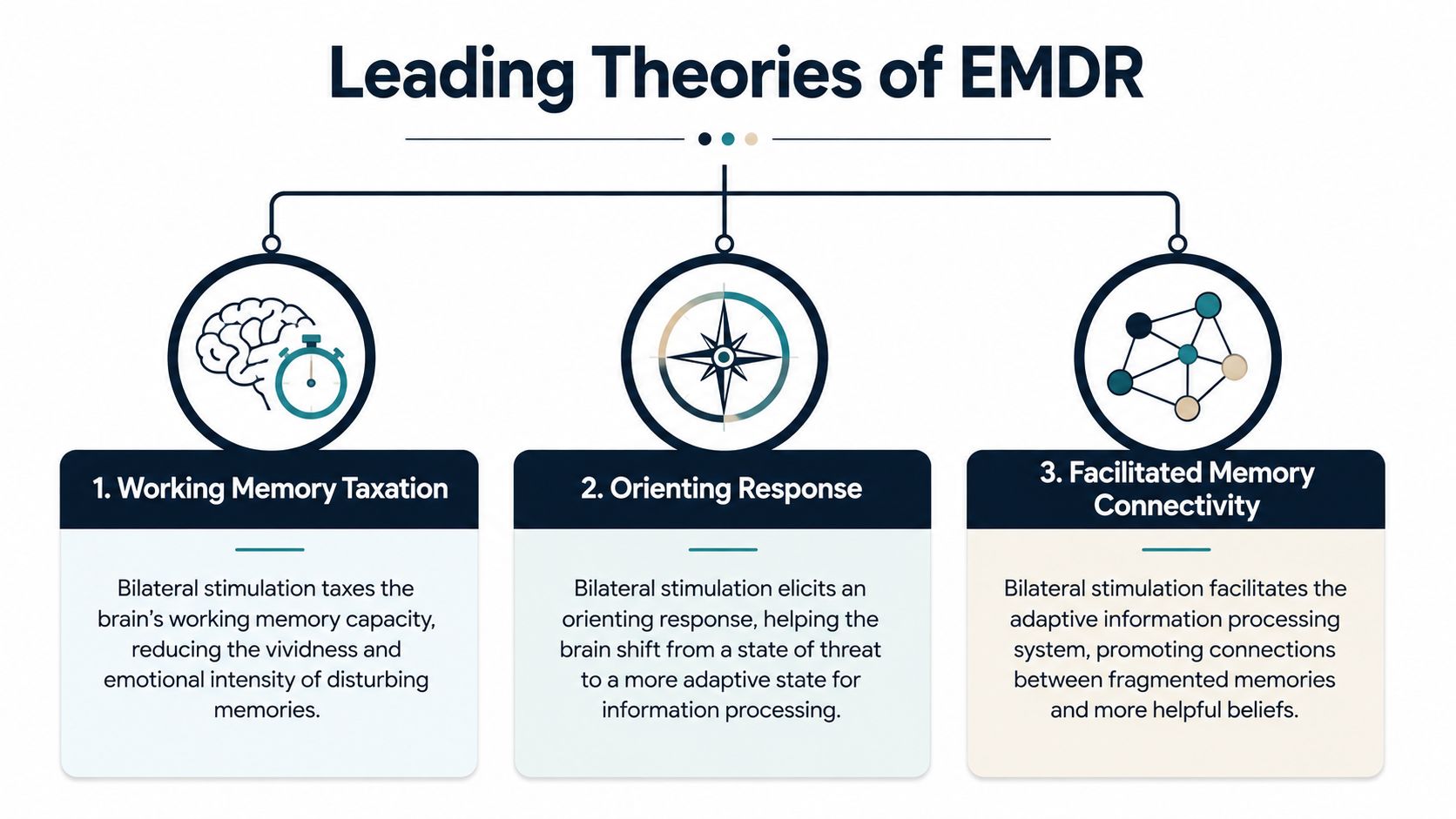
Working memory taxation
This theory says the bilateral stimulation uses up part of the brain's working memory, so the trauma image can't stay vivid at full intensity. The client may notice the memory becoming less sharp, less colorful, or less overwhelming while holding it in mind. A major review describes this as a core explanation for why distress drops during treatment (PMC mechanistic review).
Orienting response
This theory says the eye movements or other rhythmic input trigger a natural orienting reflex. In plain language, the nervous system gets a signal that something novel but nonthreatening is happening, which can soften the body's alarm response. Clinically, that often shows up as slower breathing, less tension, or a sense that the memory is farther away.
REM-like memory processing
A third explanation compares EMDR to certain features of REM sleep, when memories are more likely to be integrated. The idea is that bilateral stimulation may support a more adaptive kind of memory connectivity, so the trauma can be remembered without dominating the person's emotional life. That's why many clients describe not forgetting the event, but feeling differently about it.
EMDR is not hypnosis and it's not exposure therapy in disguise. The client remains awake, oriented, and engaged, and the work is paced so the therapist can watch for changes in distress and cognition as the memory is processed.
What the Research Says About EMDR Effectiveness
The research on EMDR has grown far beyond the early case reports that first drew attention to it. A recent systematic review of adult PTSD trials found that EMDR lowered symptoms compared with waitlist or usual care, and meta-analytic summaries in that review also showed meaningful improvement after treatment and at follow-up. Another meta-analysis of studies comparing EMDR with CBT found a small-to-moderate advantage for EMDR on post-traumatic symptoms.
| Population | Result | Treatment Length |
|---|---|---|
| Single-trauma PTSD | 84% to 90% no longer met PTSD criteria after treatment | Three 90-minute EMDR sessions |
| Multiple-trauma histories | 77% no longer met PTSD criteria in one well-known study | Course length varied by case |
| Multiply traumatized combat veterans | PTSD eliminated in 77.7% of participants in a major review summary | 12 sessions |
| Earthquake victims | PTSD eliminated in 92.7% of a large trauma group | Five sessions |
Those early findings still matter because they show a pattern clinicians care about, symptoms can drop in a way that is large enough to change how a person functions, not just how they describe their distress. The older outcome reviews also reported that gains were maintained in follow-up periods extending as long as 15 months, which helps explain why EMDR is seen as a durable trauma treatment rather than a passing idea.
A review of the history and outcomes literature, along with the broader research summary, points to a similar practical conclusion. EMDR is a structured trauma therapy with evidence behind it, and the benefit is not limited to one narrow setting or one type of client.
Early intervention has its own evidence profile. A 2024 meta-analysis found that EMDR after a recent trauma showed short-term benefit immediately after treatment and at the 3-month follow-up, while other time points did not show consistent differences compared with no intervention or other approaches. That pattern matters because it shows timing, trauma type, and treatment goals all shape what EMDR can reasonably be expected to do.
For people with dual-diagnosis concerns or substance use, the takeaway is usually more cautious and more useful than a simple yes or no. EMDR can be one part of care when trauma memories are keeping the nervous system on alert, but it still works best inside a fuller treatment plan that addresses safety, coping, relapse risk, and the rest of the person's clinical picture.
Walking Through the Eight Phases of an EMDR Course
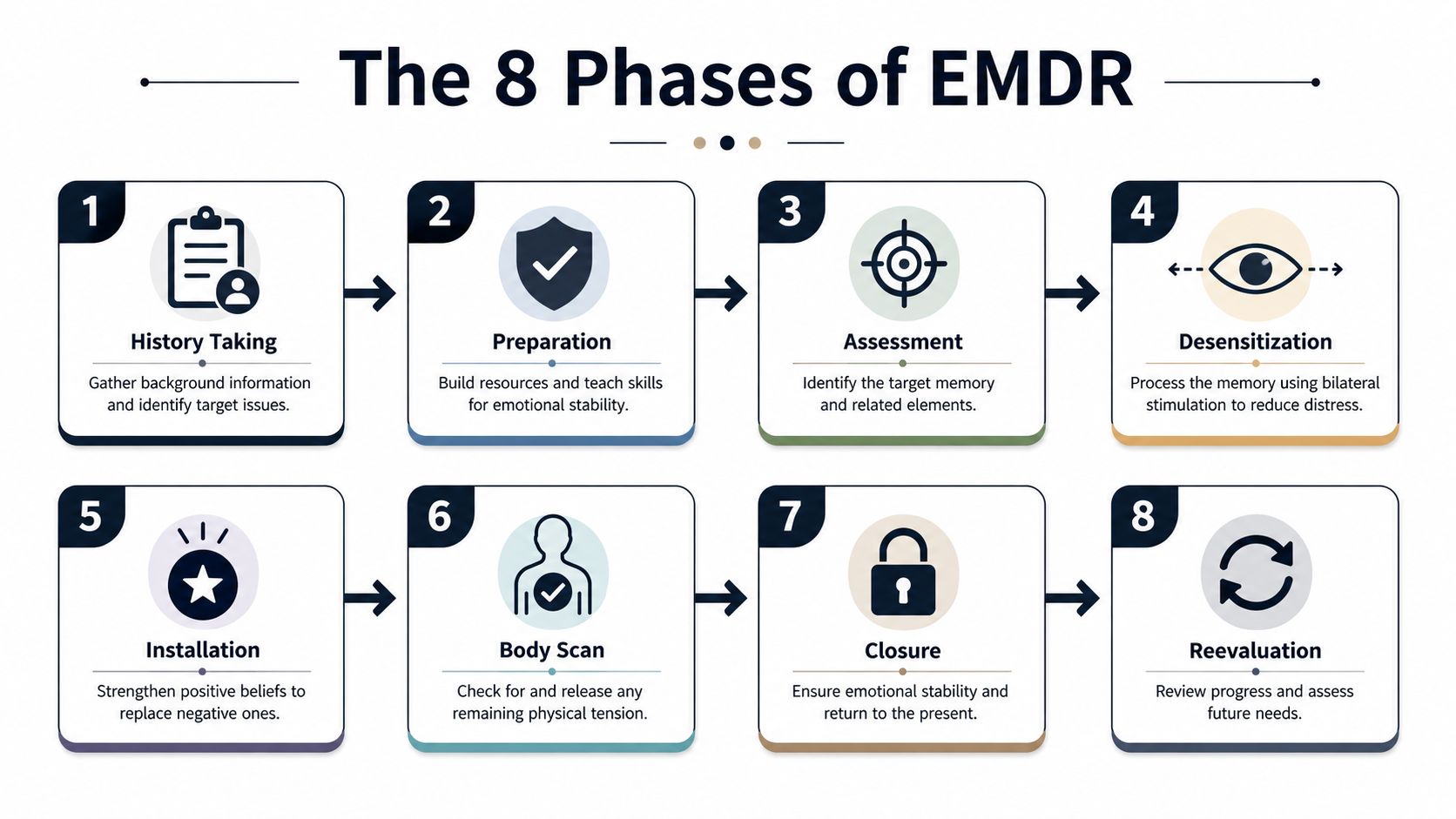
EMDR feels less mysterious once the process is laid out in order. A client usually does not walk in and start reliving the hardest memory on day one. The therapist begins by learning the trauma history, clarifying treatment goals, and checking what the person can handle in the present, then spends time on grounding and coping skills before any deep reprocessing begins.
What the middle of treatment feels like
The active part of treatment usually starts with choosing a target memory, identifying the belief tied to it, and holding that material in awareness while bilateral stimulation runs in short sets. The therapist checks what comes up, then keeps going until distress eases and the memory carries less charge. Many clients notice shifts in body tension, emotion, or the meaning attached to the event.
A useful point for anxious clients is that they do not need to retell everything in graphic detail. The memory can be named and processed without turning the session into a full verbal replay. That can matter a lot for people who worry about getting flooded by their own story.
EMDR keeps the client awake, oriented, and engaged throughout, with the therapist pacing the work so distress and cognition can be monitored as the memory is processed. The structure gives the session a clear rhythm, almost like carefully lifting weight in small sets rather than forcing the whole load at once.
What happens across a typical session arc
- History Taking: The therapist learns the trauma background and sets priorities.
- Preparation: The client learns grounding and stabilization skills.
- Assessment: A specific memory target gets identified.
- Desensitization: Bilateral stimulation starts while the memory stays in awareness.
- Installation: A healthier belief is strengthened.
- Body Scan: The therapist checks for leftover physical distress.
- Closure: The client returns to present-day stability before leaving.
- Reevaluation: The next session begins by checking what changed.
The APA overview and the VA EMDR guidance both describe EMDR as a structured trauma psychotherapy with a predictable flow, often delivered over roughly three months in many cases. That structure is one reason people with high anxiety often tolerate it better than they expect, and it also helps explain why EMDR is usually one piece of care rather than a standalone cure. For someone with trauma plus substance use, that same structure can fit into a broader plan that also addresses safety, coping, relapse risk, and the rest of the clinical picture.
Clinical reality: the first session usually feels more like planning than processing, and that is by design.
Who Is a Good Candidate for EMDR Therapy
A good EMDR candidate usually has a distressing memory, a clear traumatic thread, and enough stability to do focused processing. That can include a person with a single incident trauma, someone carrying complex childhood trauma, a combat veteran, a first responder, or a survivor of sexual or intimate partner violence. EMDR has also been discussed for trauma-related anxiety and depression, especially when those symptoms are tied to unresolved events (APA overview).
A few realistic profiles
A veteran who still reacts to fireworks may not need years of open-ended conversation. A survivor of childhood abuse may need a slower pace, but the same core method can still apply if the therapist spends more time in preparation. Someone in early sobriety with PTSD may need trauma work integrated carefully with addiction treatment, because the two issues often keep activating each other.
The fit is less clear when the main problem is current stress, conflict, or burnout without a distinct traumatic core. EMDR can still be useful in some cases, but it's usually strongest when the distress is anchored to a specific memory network that keeps getting triggered.
A 2026 style question often comes up here, especially for people wondering about what is EMDR for trauma in practical terms. The answer is that it's not only for classic PTSD. It's a targeted trauma therapy that can be adapted to repeated trauma histories when the clinician builds the earlier phases carefully and doesn't rush the process.
If the memory is organized enough to target, and the person is stable enough to process it, EMDR may belong on the table.
Contraindications and Safety Considerations
A client with active suicidality is usually not starting with memory processing. A client with unmanaged acute psychosis, severe dissociation, or ongoing substance use without medical oversight also needs more stabilization before deep EMDR work begins. The therapy itself is not dangerous, but it can become destabilizing if the person is already in crisis.
What caution looks like in real life
A person with complex trauma might spend several sessions in preparation before any reprocessing starts, because grounding skills need to be solid first. Someone in early recovery may need medical support and a broader care plan so trauma work doesn't become a trigger for relapse. That's not a failure of EMDR, it's a sign that the treatment needs to be sequenced correctly.
The stabilization-first approach is a standard part of phased trauma care. Therapists look for signs that the client can return to baseline after activation, sleep reasonably, and stay oriented during and after sessions. When those pieces aren't in place, the better choice is often to postpone reprocessing and strengthen safety first.
- Generally Safe For: Single-incident trauma, stable PTSD symptoms, and clients who can ground after activation.
- Generally Safe For: Complex trauma when the therapist allows extra preparation and pacing.
- Generally Safe For: Trauma histories that are painful but not currently accompanied by crisis-level instability.
- Requires Caution or Preparation: Severe dissociation, acute psychosis, or active suicidality.
- Requires Caution or Preparation: Unmanaged substance use or withdrawal risk.
- Requires Caution or Preparation: Clients who cannot yet return to calm after activation.
That's the core safety question: can the person process distress without losing the floor under them? If the answer is no, the plan should slow down.
How EMDR Fits Into Luxury Dual-Diagnosis Treatment
In a dual-diagnosis setting, EMDR works best as one part of a wider treatment plan, not as a stand-alone fix. When trauma and substance use are both present, the safest order is usually medical detox first when needed, then stabilization in residential or partial hospitalization care, then EMDR once the person can tolerate memory work. Oceans Luxury Rehab includes dual diagnosis treatment within a broader continuum of care, and its trauma-informed approach is described in the center's own material on understanding dual diagnosis treatment at a luxury rehab.
Why setting matters
A low-stimulation, private environment can make trauma work easier to tolerate, especially for professionals, executives, and anyone who values discretion. EMDR can be sensitive to interruptions, sleep disruption, and emotional overload, so the surrounding treatment structure matters almost as much as the session itself. That's one reason a residential or step-down model can be helpful when trauma and addiction are both in play.
Oceans Luxury Rehab is one California option for people who want trauma treatment woven into a full addiction program rather than treated as an isolated service. The center's model includes medically supervised detox, residential care, partial hospitalization, intensive outpatient, outpatient support, and individualized planning that can include EMDR alongside other therapies.
For readers comparing how addiction care is assessed and sequenced, this overview of what a substance abuse evaluation involves gives a useful sense of how treatment recommendations are built. EMDR fits best when that evaluation shows the person is stable enough for trauma processing and needs both mental health and recovery support at once.
Therapist Qualifications and How to Begin
A first EMDR consultation should answer a basic question: does this clinician know how to keep trauma work paced and safe for your situation? Basic EMDR training is a starting point, but many clients also want to know whether the therapist has supervised experience, ongoing consultation, and regular work with trauma, complex trauma, or dual-diagnosis care. EMDRIA certification is one way to check that level of commitment, and the EMDRIA directory can help you verify credentials before you book.
What to ask before booking
- Training level: Ask whether the therapist has completed full EMDR training or only introductory coursework.
- Clinical focus: Ask whether the clinician treats PTSD, complex trauma, or dual-diagnosis clients regularly.
- Pacing style: Ask how the therapist handles dissociation, panic, or relapse risk during processing.
- Delivery options: Ask whether EMDR can be done in person or through telehealth with appropriate equipment.
The first contact with a treatment center should feel private, clear, and free of pressure. At Oceans Luxury Rehab, that usually means a confidential admissions conversation, insurance verification for many PPO plans, a clinical assessment, and an individualized plan that may include EMDR when it fits the person's needs. The center's admissions process is built to help adults in Orange County, Los Angeles, and across California get a care recommendation without having to retell their story more than necessary.
That last point matters for people with trauma and substance use together. A careful intake, such as the kind described in this overview of what a substance abuse evaluation involves, helps the team decide whether someone is stable enough for trauma processing now or whether other supports should come first. EMDR usually works best as one structured piece inside a larger recovery plan, not as a stand-alone answer for every symptom.
Session length also matters. Many EMDR sessions run around 60 to 90 minutes, and the broader course often unfolds over several sessions or months depending on trauma complexity and readiness. Clients often notice shifts in distress, body tension, or the meaning attached to a memory before the memory stops feeling charged, which is a normal part of trauma processing.
EMDR can also work through telehealth in some cases, especially when the therapist has a safe setup and the client can stay grounded between sets. If old memories surface between sessions, the usual response is to use the coping plan and contact the therapist if needed, not to force more processing alone.
Oceans Luxury Rehab offers discreet, evidence-based trauma and addiction treatment in San Clemente for adults who need EMDR as part of a larger recovery plan. If the next step is confidential help, visit Oceans Luxury Rehab to start a private conversation about trauma, substance use, and the level of care that fits best.
